
This post concerns a minor section of a larger Ministry of the Environment consultation. While there are 87 set questions in the infrastructure and development discussion document, just a small group (see bottom of this Substack) concern loosening rules on telecommunications infrastructure in the NES-TF Regulations 2016 (administered by MBIE).
Consultation closes tomorrow 27 July 2025.
The Impact Statement states that concerns for health and safety will not be considered - even though the Regulations operate under the RMA Act 1991 which requires that government officials operating under the RMA Act must provide for the ‘health and safety of people and communities’.
The Impact Statement fails to highlight that access to much safer fibre optic broadband is common. I.e. we have broadband for household and business use. The rollout of 5G mobile broadband everywhere is important for whom?
Many European countries have far safer standards than NZ, even as NZ is weakening them. (Discussed page 30-31 of PSGRNZ’s submission)
The Ministry of Health rely on an anonymous Interagency Committee to do the ‘science’ on radiofrequency electromagnetic (RF-EMF) radiation. Their Reports frequently follow the reports of a dubious self-referencing organisation.
The self-referencing organisation continues to sideline a weight of evidence, from mechanistic data showing impacts at the cellular level, to animal and case studies that show that non-thermal effects are risky. The MoH Interagency Committee then copy the self-referencing organisation to say the same thing.
MoH Reports do not follow transparent or trustworthy independent process but consistently verify the authority of 26-year-old standards NZS 2772.1:1999 standards (NES-TF Regs 2016.s.55(6)).
So much obscurity - info is hard to find. The standards are secret and the Ministry of Health is cagey on emission strengths from different equipment - from antennae, to small cell towers, to the little black boxes to large towers.
The current Consultation only talks about heights and sizes - not about emissions strengths. Yet safety is ‘out of scope.’
Telcomm corporations pay contractors to monitor sites for safety - not the government. European standards look at cumulative exposures, but NZ??? - our government isn’t triangulating corporate-supplied data on safety.
There is absolutely no knowledge concerning the lowest threshold for safety for pregnant women, babies, children, adolescents and RF-EMF sensitive populations. This is because the government ignores non-thermal effects.
I wrote an article for the Daily Telegraph NZ that went in geeky on this.

Since I wrote the Daily Telegraph article I was advised that an Official Information Act request had identified the members of the Interagency Committee (at the date the request was made, this has since changed). The acting secretary, Martin Gledhill additionally contracts to the telecommunications industry.
There is no clarity on the expertise of those members, and while a couple of (excellent) scientists were in attendance, the discussion wanders through some selected scientific papers. There was no outline of the methods followed to identify literature, and no clarity on who selected the literature, so at best, the information was selected for the purposes of the meeting. Cherry picked? Who knows. No methods.
These days 5G enabled cell towers can be erected in one day. Local communities do not get a chance to voice their concerns. The tower is simply erected. There is no knowledge on the output power, the frequency can probably operate in the 600MHz-4GHz range - and the max permitted public exposure is up to 61 V/m (compared to a maximum that is increasing common in Europe of 4-6V/m.
This small-cell tower was erected across the street from the Oma Rapeti daycare, 371 Main Road, Kumeu. It is 20 metres from the from the entrance to the carpark, and 47 metres roughly from reception. It’s perfectly legal, of course.
Now the government wants to loosen restrictions around where these small cells and antennae that can sit on top of a roof, on a power pole etc, can go.
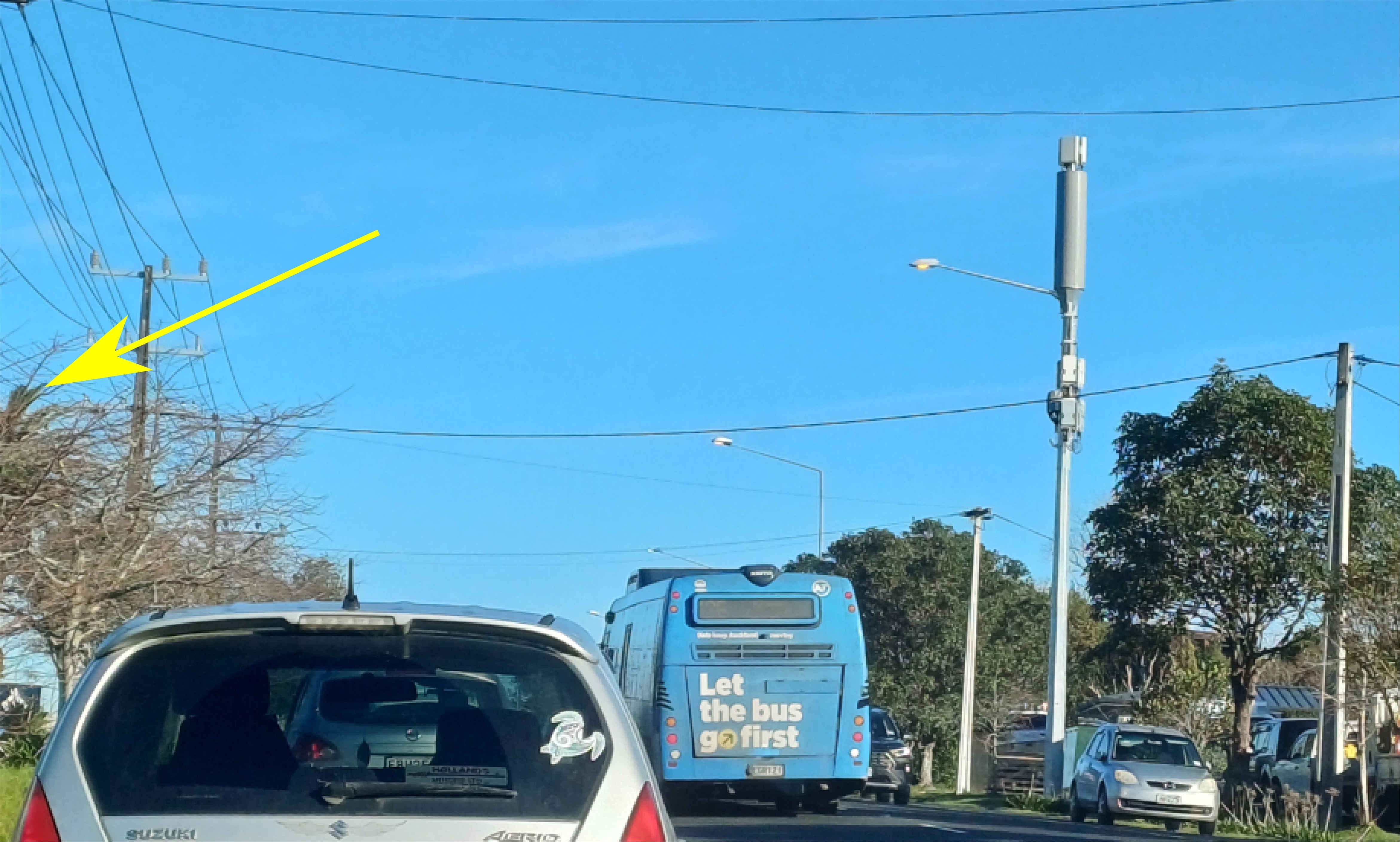
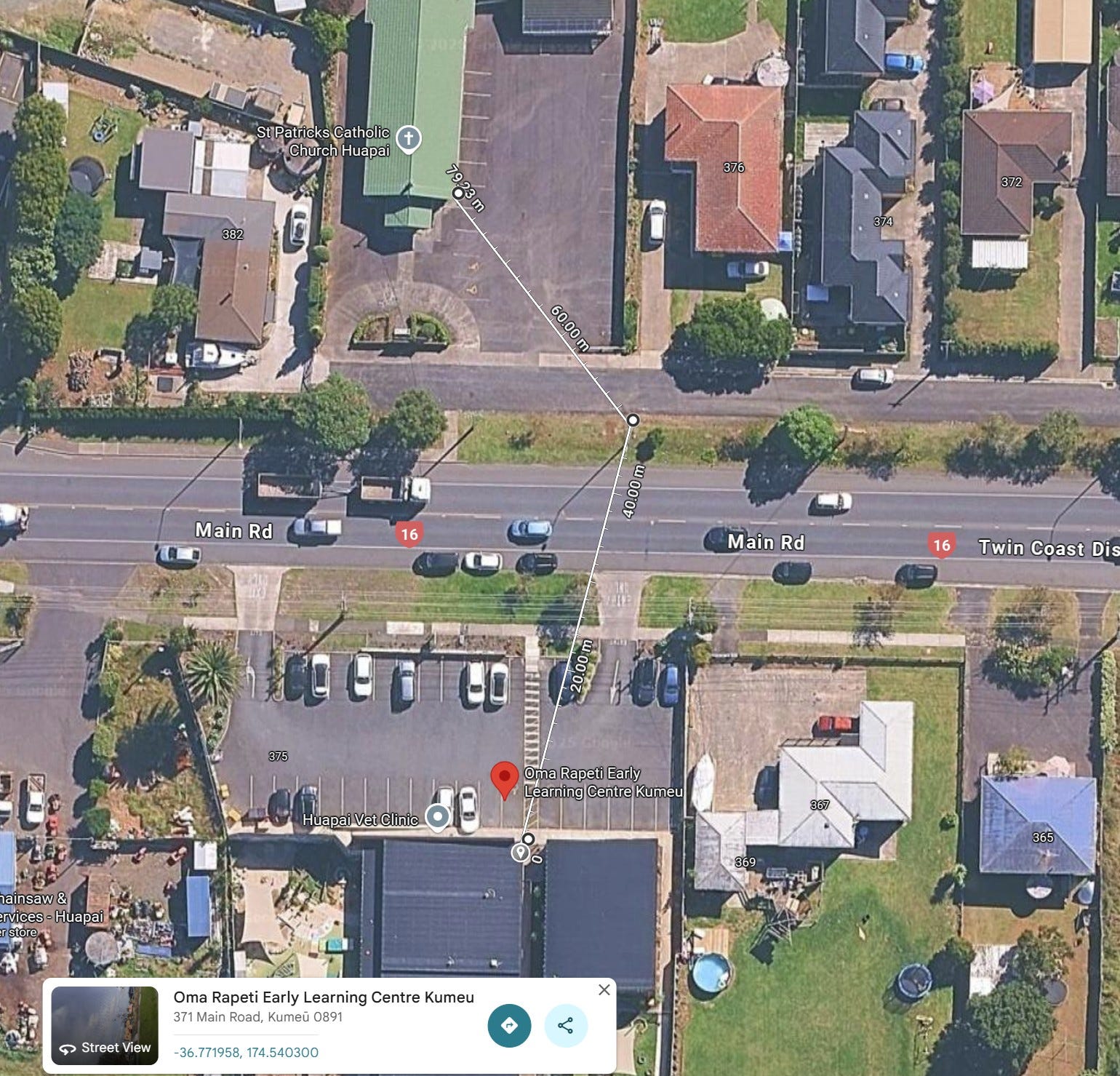
If phones of staff, and equipment in the Day Care centre are not on airplane mode, they will be pinging to and from that tower. They could be on airplane mode and be connected to internal Wi-Fi - a much shorter and safer distance.
The cars driving past do not need to stream 5G and the inhabitants of those cars are at greater risk going between 5G towers.
As I note in the Daily Telegraph NZ article:
Phones effectively ramp up their transmission power output to maintain connectivity – to maintain a stable connection, especially when moving between cell towers. For children, teenagers, and adults travelling on a bus or in other mobile environments, frequent signal handovers and surges in device output increase exposure burden. Thousands of scientific papers show a pattern – exposures correlate with oxidative stress and inflammation (studies persistently cite hundreds of references). In bodies that are still developing — or in those lacking time for adequate biological recovery — the cumulative effects of chronic oxidative stress can increase risk for a range of disease conditions.
These interactions generate a cumulative burden of rapidly pulsed and modulated RF-EMFs. This cumulative burden (which occurs over time) is not typically reflected in regulatory assessments.
Increasing 5G towers everywhere - wellbeing for whom?
Consultation questions DEADLINE TOMORROW - telecommunications component.
Do the proposed provisions sufficiently enable the roll-out of upgrade of telecommunications to meet the connectivity needs of New Zealanders?
Which option for proposed amendments to permitted activity standards for telecommunications facilities do you support:
Do you support the proposed amendments to the activity standards:
Do the proposed provisions appropriately manage any adverse effects (such as environmental, visual or cultural effects)?
Do the proposed provisions place adequate limits on the size of telecommunications facilities in different zones?
Should a more permissive approach be taken to enabling telecommunications facilities to be inside rather than outside the road reserve?
No posts
Comments
Nothing yet. Say the first thing.
Sign in to join the conversation.