
Happy Gemini season to all you lookalikes and dynamic duos! This morning I woke early to amble around a bluff with a bunch of other folks, looking at and listening to the songbirds migrating through the Willamette Valley, some stopping to nest here, others just passing through. We stopped to listen to the sweet sweet sweet I’m so sweet of the Yellow Warblers and the song of a Wilson’s Warbler, which someone described as an old car trying to start. Farther along, we saw crows mobbing a red-tailed hawk, and though I know I’m projecting, I swear that raptor looked scared, perched on a pine limb, ducking as one crow after another dived toward its head, trying to drive it away from their young.
It was powerful to see such fear on a predator’s face, powerful to watch so many beings migrate relatively unimpeded to the places where they’ll raise their families. As we tip toward the long days of summer here in the northern hemisphere, may you witness the sweetness of such power shimmering around you, may you stop to listen to the power you hold within.
xo
JP
In the “Assembling a Poetry Manuscript” class that I occasionally teach, one of the experiments I offer to participants is to look through the table of contents of poetry books they haven’t read yet, to see what kind of signposts the section titles offer for the journey the book is going to take them on. Those titles, those signposts, are there to entice a reader, to beckon them to travel down a trail they otherwise might not, and to offer a lens through which they will view everything they encounter on that road. No matter how difficult or charming the terrain actually is, no matter what the destination at the end of the path turns out to be, the experience of it will be different if the sign says “Paradise Hills” or “Misery Ridge” or “Devil’s Rest.” We’ll be on the lookout for different vistas, creatures, emotions.
Almost exactly four years ago, right around the time I started this newsletter, I finished a draft of the manuscript that would become Beautiful Outlaw. At the time, the first section in the book was simply called, “Beautiful Outlaw,” which seems now like a temporary waymark, a blaze painted on a tree until a more permanent marker could be erected. At some point on the way to the book’s final draft, the one that will come out next month, I returned to my old habit of pulling section titles from words or phrases in my poems, and now Beautiful Outlaw begins with a section called “Homeland,” a word that shows up twice—in the last poem in the book’s first section, and in the first poem in the book’s last section.
“Homeland” feels apt for the book’s genesis. That first draft was written in roughly a year or so when I was isolating during the height of the pandemic, when I was forming a new relationship to both home and land by being in one place all hours of the day, attentive to the small patch of earth I found myself on and to the birds and plants and other beings who lived there. At the time, I was also forming a new relationship to the sense of nationhood and origins and “security” that the word homeland conjures, sitting with the histories of violence and racism and xenophobia that I’d experienced and witnessed, as those histories were brought to my surface by new waves of public reckoning. My home, this land, was my entire world, and it felt like that world was falling apart, like I was falling apart.
When I finished that first draft, I didn’t know that there were whole sections of the book that didn’t yet exist, that couldn’t yet exist because I hadn’t lived through them, let alone written about them. The two sections at the dead center of the book, “Spell to Leave Behind a Life” and “Such Good Dreams” contain exactly zero poems that were present in the first draft. Those sections focus on the end of a relationship and the grief I swam in afterwards, and only living through the time they document allowed me to recognize that experience as the heart of the book, to see domestic relationship—and its dissolution—as of course another core understanding of homeland.
After the book was contracted for publication, I wrote and revised a few poems to adjust the ending of the book, to gesture toward hope, toward a future I’d only begun to imagine after years of traveling on a trail that, despite its frequently breathtaking panoramas, was certainly still dubbed Misery Ridge. That final section, entitled “Ever After,” isn’t a fairy tale, isn’t quite joyous enough to merit the modifier happily, but it does recognize that there is, at least, an after, that we can survive, can change, can emerge from a homeland—whether it’s our interior state or our nation state—that can feel like an underworld. And in emerging, we can look back across the abyss and help others make that crossing to the other side—to the ever after—too.
Both my therapist and my editor described Beautiful Outlaw as a companion, and it’s true. The book, the writing of it, was a companion through my loneliness and grief, and soon it will exist as a companion for other folks, to be with them when their travels might otherwise seem desolate. As with anything I’ve devoted so many years of my life to, there’s some mourning in releasing it, but it’s been a good friend, one who gave me the signposts I needed to make this journey to my ever after, whatever it may bring.
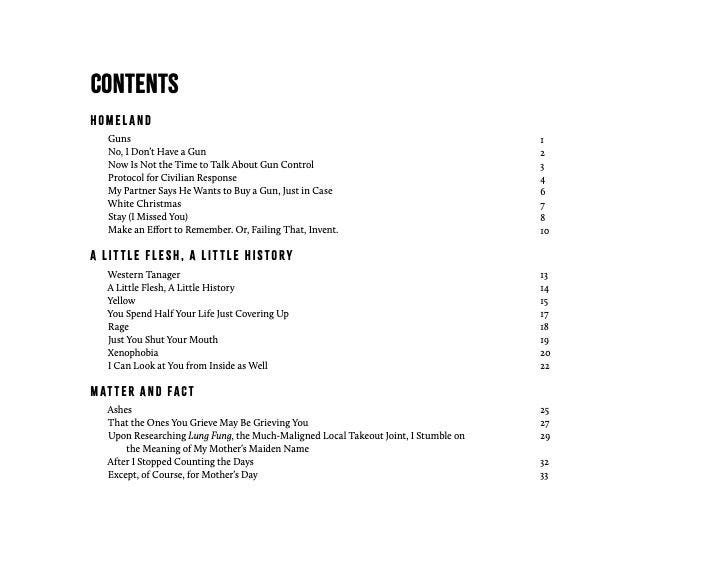
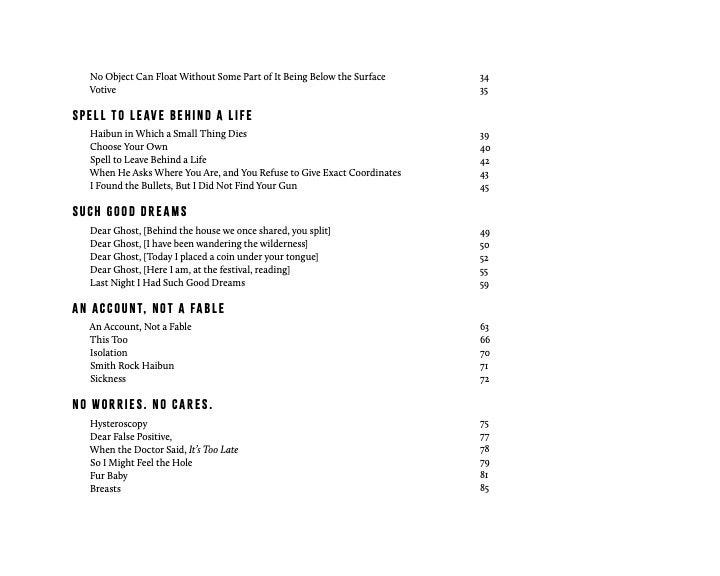
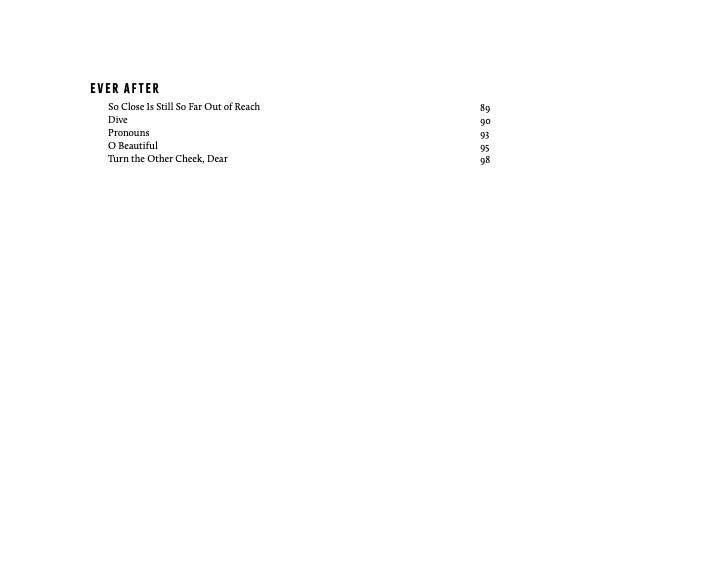
You’ve heard of a cover reveal? So passé.
Here’s my table of contents reveal! Très chic.
You may have gathered from previous newsletters that even my “pauses” are fairly active, that although I savor slowness, I tend to live a hummingbird life, wings flitting at 80 beats per second, constantly moving from one sip of nectar to the next and the next. I rarely give myself space to celebrate my efforts, my creations, before darting to the next flower, the next sweet spot. So, I’m practicing letting myself enjoy this new book, this thing many years and many wingbeats in the making, by saying, Thank you.
In the book’s final acknowledgments pages, I offer gratitude to all of you, some by name, some as the collective of folks who read this newsletter. It truly takes a village to create a book, and it feels fitting that Beautiful Outlaw ends by giving credit to all the kith and kin who made the book possible: the editors who published poems and gave me confidence to keep going, the colleagues who introduced me to poetic forms that I ran with, the fellow writers and writing communities who made me feel welcome and loved, the healers who kept my body and mind from falling apart and helped me explore both trauma and recovery, my friends and partners, my ancestors and animals.
Alongside these specific individuals, I also thank eight arts organizations, each of whom awarded me a grant or residency that allowed me to devote time to writing, sometimes by quite literally keeping a roof over my head during periods of precarity, and other times by allowing me to have more choice over how many hours I needed to expend on paid labor. There is a world, in another ever after, where artists don’t have to chase after grants, where we’re all adequately cared for, where we’re housed and fed no matter what value the market assigns to our creations. Until then, though, many of us are still dependent on grant funding to get us through, to give us the freedom to turn our dreams into matter and fact.
I know I’m preaching to the choir here, but as we watch the National Endowment for the Arts being dismantled here in the U.S., we’re also watching access to grants disappear. If you live in the U.S. and haven’t yet written or called your elected officials, or reached out to all your art-loving friends to spur them into making some calls or sending some messages, now’s the time.
And if you’re in Oregon, you can counteract some of the harm done by the loss of federal funding by pushing the Oregon legislature to pass HB 3189: Improve Access to State Funding for Arts/Culture Providers. The bill would increase the grants budget of the Oregon Arts Commission from its current $4 million to $10 million, which would be distributed to Oregon's arts sector. It would also provide one-time funding of $5.5 million for six large arts organizations, unlocking much needed state resources for our arts community in this dire time of need. If you’re an Oregon artist or culture worker and would like to add your name to this letter in support of the bill, fill out the form by May 30, 5pm PT.
Luckily, we’re a crafty bunch, and I know many of us will find ingenious ways to keep making the art we all need so much. But most of us could also use this financial support that gives us the ability to slow down, to stop flapping our wings long enough to craft that beautiful, necessary flower that will go on to nourish someone else.
This month, I was part of the latest installment of the Oregon ArtsWatch portrait series in which photographer K.B. Dixon profiles creative folks from this state. I am forever uneasy in front of a camera, but Dixon was warm and reassuring as he set up his camera in my home for this shoot. If you’d like to see a photo of me that makes me think, “Wow, I’m really starting to look like my dad,” and that features the patio chair in which I’m writing this very newsletter, go check it out!
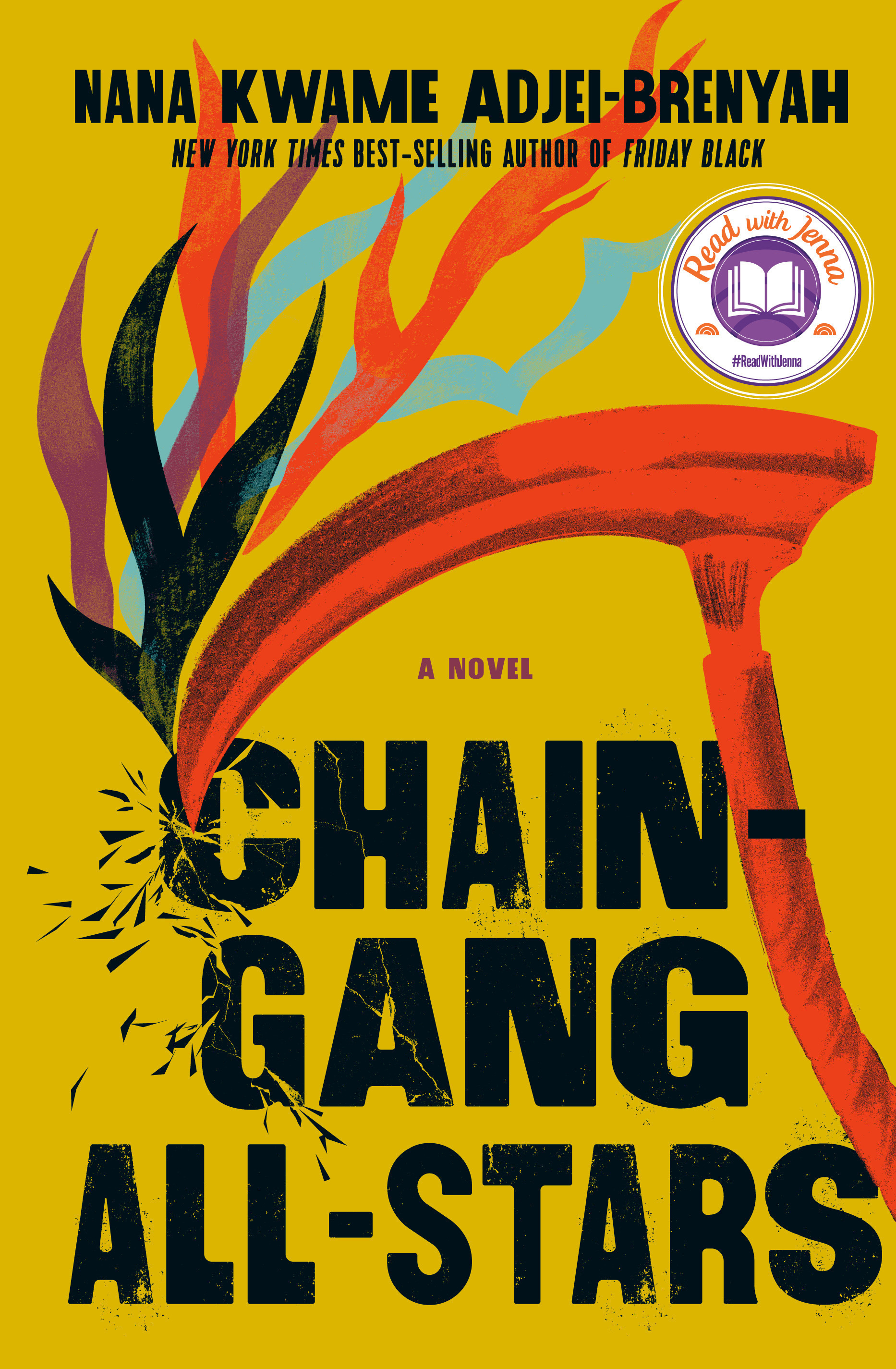
Sometimes when I read a book, I cynically conjure up the voice of an agent picking it up in manuscript form and using the old “X meets Y” formula to pitch it to presses. When I recently read Nana Kwame Adjei-Brenyah’s Chain Gang All-Stars, that voice kept announcing, “It’s The Hunger Games meets The New Jim Crow!,” which might tell you something about both my warped inner monologue and about how utterly devastating this novel is. The novel, which is often described as dystopian speculative fiction but which feels only a step or two removed from current reality, centers on a program in which the U.S. private prison system offers incarcerated folks the chance to compete, gladiator-style, for their freedom, and for the entertainment of viewers in arenas and in homes across the country. Adjei-Brenyah—whose short story collection, Friday Black, I’d also highly recommend—writes from the perspective of a number of characters, including those on the titular Chain Gang All-Stars team, offering insight into the people pitted against each other in these brutal games and what they’ve experienced both in the program and in their lives beforehand. These chapters reveal the cruelty they endured as “mere” prisoners before signing up for the competition—cruelty that only slightly exaggerates current prison conditions—and explore the possibility of how much love and humanity one can cultivate in a system designed for violence and death. Other chapters follow people outside of the carceral system, including fans of “hard action sports” and protestors attempting to take down “entertainment lynching,” and these, too, reflect our current reality’s championing of and resistance to the intersections of capitalism and systemic racism. The book is, of course, speculative, but as Margaret Atwood has said of The Handmaid’s Tale, “everything in the novel is inspired by something that has actually happened,” and Adjei-Brenyah’s use of footnotes that often allude to studies and statistics about our real-world U.S. prison system assures us that we don’t forget that.
After a few delays, I finally have a publication date for my book: June 15! It’s a Gemini baby, which I’ve been told is auspicious for writing projects, and the duality of the twin sign feels apt for poems that are simultaneously playful and serious, that attend to both absences and presences, and that often invite folks to read the same poems in multiple different directions.
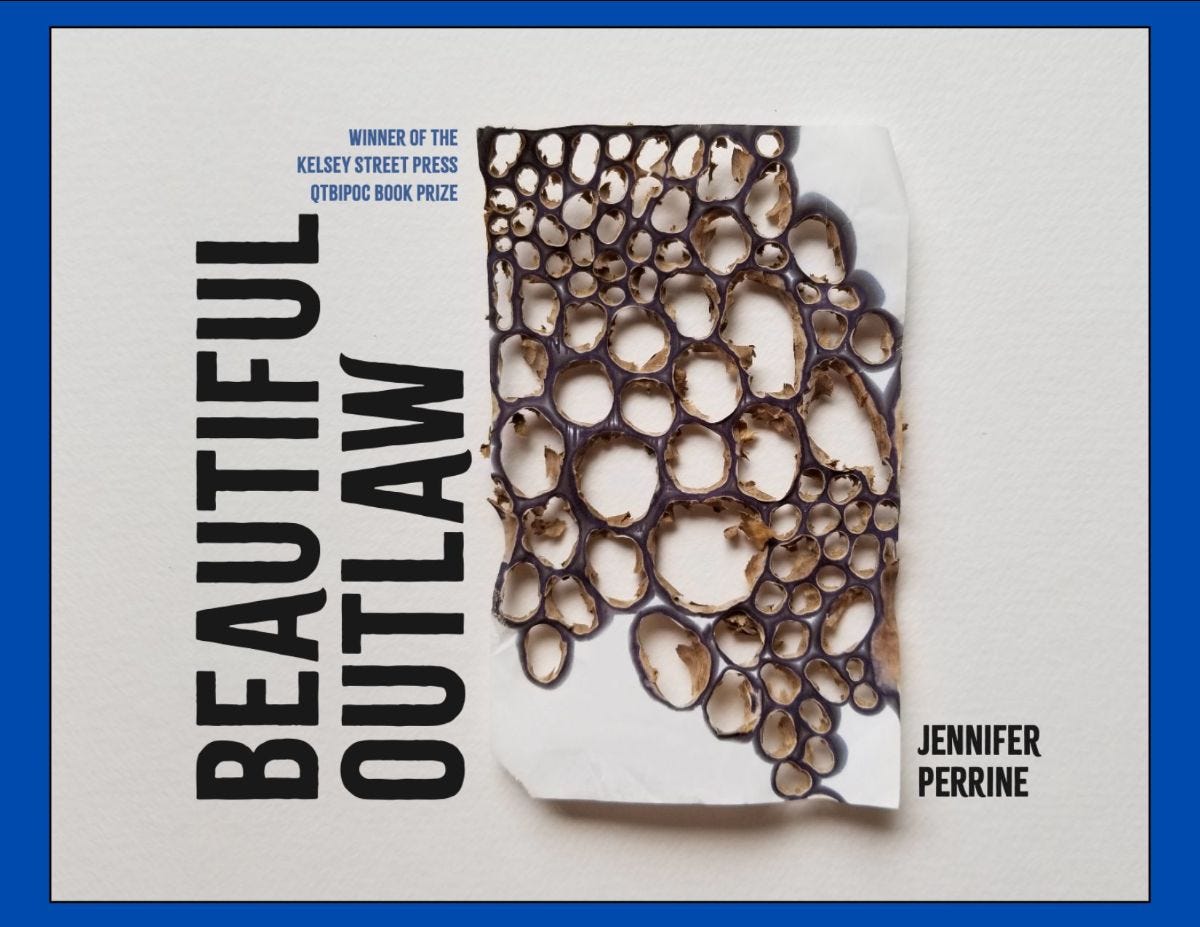
Wish it a happy birthday with me, won’t you?
Pre-order the book from my publisher, Kelsey Street Press
Write a review of Beautiful Outlaw. Request a free review copy at info@kelseystreetpress.org
If you’re a teacher who'd like to use Beautiful Outlaw in your classes, request a free desk copy at info@kelseystreetpress.org
Ask your local public library to carry a copy. Most libraries have links on their websites where you can suggest books to add to their collections.
Ask your favorite local bookstore to stock Beautiful Outlaw. Don’t have a favorite indie bookstore? Now’s a good time to find one.
Invite me to read with you or at a series you host, to teach a guest workshop for your class, to do an interview on your podcast, or to otherwise collaborate on something nerdy and fun.
Come out and celebrate with me after the book’s released! I’ll be organizing some launch events for this summer, so stay tuned to future newsletters for more details on those.
In the meantime, I’ll be celebrating the publication of someone else’s book. On Friday, June 20, 3:00pm PT, at Portland Chinatown Museum, I’ll be in conversation with Ingrid Hu Dahl about her new memoir, Sun Shining on Morning Snow. Admission is free, and the event will be followed by a book signing.
I’m about to enter frolicking in the sunshine mode, so the one and only class I’ll be teaching this summer will be online, Sunday, June 22, 9:30-11:30am PT, through the Hudson Valley Writers Center. In “Poetry Under Pressure: Finding the Freedom in Constraints,” we’ll write using several playful and poetic constraints—such as lipograms, acrostics, and bout rimés—to discover what happens when we write our way through tricky restrictions. Find more details and registration info here.
On Wednesday, July 9, 7pm PT, I’ll be forsaking my usual co-hosting duties to be one of the featured readers at Incite: Queer Writers Read, alongside Grey Traynor and Eliot Feenstra. The last time I read at Incite was when it was online back in 2020, when the theme was “Together/Apart,” so I’m excited to be firmly in camp “together” for this one, where the theme will be “Play.” Join us and my co-host Vinnie Kinsella at Literary Arts, 716 SE Grand Ave, Portland. As always, the reading will be followed by a community discussion.
On Thursday, August 14, 7:00pm PT, at Hidden Creek Community Center, Hillsboro, OR, my comedy and poetry worlds will converge as I team up with improvisors from Kickstand Comedy, as they create a night of comedy inspired by my writing. Tickets are available here.
If you’re looking way out to this fall, on Tuesday, September 9, 5:30pm PT, I’ll be the guest speaker at the Central Oregon Writers Guild online meeting, which is free and open to the public. I’ll be talking about “Finding the Freedom in Form” (aka, what I’m always talking about), and there will be a couple of opportunities during the talk for everyone to experiment with some unusual formal constraints.
I’ll be following that talk with an in-person workshop, “Contents Under Pressure: Using Constraints to Stretch Your creativity,” on Saturday, September 13, 1pm PT at the Downtown Bend Library in Oregon. We’ll play with what I think of as “extreme” constraints inspired by everything from music to math, from dictionaries to daily walks, and invent some of our own constraints to try out after the workshop ends. Tickets for the workshop are available here.
Finally, on Saturday, October 18, 9:30am-1:30pm PT, I’ll be teaching an online class, “Assembling Your Poetry Manuscript” (the same one I mentioned at the beginning of this newsletter—see how I brought that all full circle?). The class includes exercises to help you identify themes, experiment with sequence and structure, and recognize opportunities for further development. Find more details and registration info here.
Other opportunities I recommend:
For Writers with Chapbook-Length Works:
Zines + Things is accepting submissions of fiction, nonfiction, poetry, and comics to be published as part of their 2025-2026 series. Authors are paid $200 on the date of the zine’s production, as well as additional payments as copies are printed. Artists receive a featured interview on their website, the option to take over their social media, and a virtual or in-person release party. Submissions are open through May 31.
For Queer Nature Writers and Artists:
Seedlings is seeking prose, poetry, and art for its next issue, Queer as Nature. Possible themes include gardens as queer spaces, queer ecologies, queer art using natural materials, stories of queer naturalists, and queer perspectives on the natural world. Submit up to five poems, prose up to 1000 words, or up to 5 pieces of art by May 31.
For Folks in the Portland Metro Area Committed to Racial and Environmental Equity:
At my day job for Metro Parks and Nature, I’m recruiting for a new cohort of our Equity Advisory Committee, which brings a community-led racial equity perspective to our department’s planning processes, policy formation, and projects. We’re looking for folks who have long-term connections to local communities of color; who have expertise in elevating the needs and aspirations of communities of color; who bring a commitment to restorative justice and to environmental, economic, cultural and health equity; and who have an interest in connecting their communities to the outdoors. Committee members serve two-year terms and attend monthly meetings, generally held virtually on the first Monday of the month from 4:00-6:00pm. Committee members receive $200 per attended monthly meeting. Learn more here, and complete the application by June 2.
For Trans Writers:
Sundress Publications is open for microgrant applications from trans writers with a chapbook or full-length book in progress in any genre. The microgrant will award $500, the potential for publication, and a one-week residency at the Sundress Academy for the Arts in Knoxville, TN. To apply, send a sample of the work in progress (up to 15 pages) along with a brief artist or personal statement (no more than 500 words) about what this grant would mean to the completion of said work. There is no fee to apply. The application closes July 15.
For Rural Oregon Writers:
The Incite: Queer Writers Read series can now offer $750 stipends to writers from rural Oregon to cover the cost of their travel expenses to Portland to read in the series. For these purposes, “rural” is defined as locations that have fewer than 15,000 residents and that are at least 10 miles away from population centers of 40,000 or more people. If you’re an LGBTQIA2S+ writer who’d like to visit Portland to read in the series between September 2025 and May 2026, please respond to this newsletter with information about or samples of your writing.
If you’ve got an opportunity you’d like me to include in a future newsletter, please let me know.
No posts
Comments
Nothing yet. Say the first thing.
Sign in to join the conversation.