
Happy Taurus season to all you cosmic oxen and bucolic babes! I’m writing to you on a chilly evening, cozied under a blanket with a pile of dogs atop it, after a sunstruck day where I walked around a local wetland, listening to a pied-billed grebe do its best impersonation of a chuckling owl, to a red-breasted sapsucker drumming out a tattoo on a cottonwood snag, to a crabapple offering up a full-throated song via a throng of bees attracted to its bounty of blossoms, to someone mishearing the grebe’s name as “high bill grief,” which added human laughter to the set this spring day’s DJ was mixing.
Which is to say, there was beauty and wonder and delight even in the midst of a time that’s felt stressful and worrisome and exhausting on so many levels. However this month finds you, I hope today you have your fill of bee hum and bird guffaws, of comforting companions and happy misapprehensions.
xo
JP
I am in love. All the signs are there. Throughout the day, a thought will cross my mind, and I’ll feel a flutter of excitement sweep up my sternum. Even with a schedule packed full of one too many to-do’s, I’m making the dubious choice to go out night after night, because I just can’t get enough of my new love. And I’m staying up into the wee hours just so I can devote more attention to the object of my affection. Who’s the lucky beloved? If you read last month’s newsletter, you already might have guessed that stand-up comedy is my new paramour, the one I can’t stop thinking about, the one who is getting so much of my devotion.
Since last month, I’ve been writing a new five-minute set every week, have performed at maybe half a dozen open mics around Portland, and have attended another half dozen or so shows to laugh and to learn from pros. Although I set myself a goal to create a new piece and perform it each week, I haven’t had to chase the muse or force myself to carve out time to write. The seeds of jokes show up everywhere—as I’m walking through the neighborhood, or driving to work, or drifting off to sleep—and all I have to do is make sure to note them down so that I can sharpen them up later. After a year of barely writing poetry or stories or essays, where I worried I had nothing left to say, it turns out that I just had to turn to a new genre for the ideas to come flooding in. It’s been refreshing to turn back to the same subjects I’ve been writing about for years—race, gender, sexuality, family, religion, embodiment—and see them through this new vantage point, where the goal is to be funny rather than meaningful, where I feel I can be playful not only with the form of my writing, but also with the content of it.
I’ve heard many established comedians talk about their first time performing, and how they immediately knew they needed to devote their life to stand up. I’m not sure that’s what happened after my first set, but I have felt so deeply satisfied after all the mics I’ve performed at, even when I’ve forgotten where I was going with a joke, or when I’ve gotten up in front of painfully silent crowds, or when I realized afterwards that there was a different way I could have said something to make it even funnier. Even when I’m fumbling through being a newbie, I think I’ve been enjoying it so much because laughter feels liberatory, especially at mics where the crowds and other comedians are mostly queer, trans, women, gender-expansive, POC or some combination thereof. It feels empowering and necessary to be in a space where we’re all fueling each other up, creating a pocket of joy in an environment that is distressing and dangerous.
I recently read this advice from comedian Gary Gulman: “Had a bad set? Go home and write. Had a great set? Go home and write. Bumped by Bob Saget? Go home and write. Few things can offset the feelings of helplessness in show business than engaging in one of the few things over which you have total control.” Though he was talking about comedy’s professional challenges, his counsel feels like wisdom for attending to the helplessness that has surfaced in me so often over the last few months. And it’s not only control over my writing that’s been meaningful, but also control over the distribution of what I create.
I haven’t mentioned it before in this newsletter because I don’t want to seem ungrateful, but preparing for the upcoming publication of my new book has felt stressful and at times disappointing, as I’ve had to let go of my agency over the book’s design, the production timeline, and how it will be marketed. There’s been quite a bit of uncertainty about these decisions—I’m still uncertain about the book’s release date, for instance—and that’s been difficult to accept in a time when I’ve experienced many other uncertainties—health concerns, layoffs and budget reductions at work, and of course the political, economic, and legal uncertainties of the current administration.
So, being able to have so much control in stand-up has felt like a lifeline. I can write something one afternoon and deliver it directly to an audience that night. I get to choose the gestures and tone of voice and volume with which the jokes make their way to the audience, and I immediately find out whether or not that piece of writing was successful. I suppose this is all true for poetry open mics, too, but it feels like there’s less of a barrier for access in comedy, both for performer and audience, because most people don’t think they need to have any esoteric knowledge to get a joke. When I tell a stranger I write poetry, it’s usually a conversation-killer because they immediately feel like they’re not learned enough to talk about it. When I tell people I do stand-up, pretty much everyone just asks me to tell them a joke. (Seriously. Even my therapist responded this way.)
Still, there are plenty of overlaps between poetry and stand-up, some of which I mentioned last month, like concision and repetition. Over the last few weeks, I’ve been experimenting with using ambiguity and incongruity as the basis for punchlines, leading an audience in one direction in the premise of a joke and then making them laugh by veering them sharply in another direction for the punchline. This doesn’t feel altogether different from the way I use line breaks and enjambment to create unexpected surprises and double meanings in poems. And as I’ve been studying some of the great comics, I’ve found more and more instances of the sonic elements of poetry in their work. George Carlin’s “seven words you can never say on television” bit, which I won’t include here for fear of ending up in everyone’s spam folder, but which is easy enough to look up online—though I do recommend headphones if you’re in public—is such a clear example of assonance, rhyme, and the importance of word order that I don’t know why I never used it to teach those concepts in a poetry class. (Okay, maybe it was not wanting to get fired or deal with outraged parents, but the point still stands.)
As I fall in love with stand-up, I do wonder if this will be a brief fling, a dalliance that will lose its spark after a few months, a sweet flirtation that I’ll look back on fondly in years to come. Or, maybe, like poetry, it will grow into an enduring relationship, a companion who is there through the best and worst of times, who deserves my care and commitment. Only time will tell. For now, I will revel in the early, bubbly, exuberant delight of new love and give thanks for it while it’s here.
This is the section where I usually share some adventures from my dilettantish approach to hobbies, but if you want to hear about how I learned to make paper out of blackberry canes or how I’ve made so many rings in metalsmithing classes that my hands are starting to look like Liberace’s, you’ll have to wait for another newsletter. For the moment, I’m going to focus on some of the many actions you can take to help keep the arts alive for folks who have moved beyond the dilettante stage.
Earlier this month, DOGE rescinded and ended many grants offered by the National Endowment for the Humanities (NEH). As a result, state humanities councils, including Oregon Humanities, with which I’ve worked on several projects over the last few years, have lost the funding that they rely on to support them now and in years to come. Oregon Humanities and councils in other states bring people together across differences to build relationships, attempt to understand each other’s experiences, and experiment with different responses to some of the most entrenched social and cultural problems. Often, art, storytelling, and imagination are core components of the programs these councils create and fund.
If you want to help your state humanities council survive and thrive, you can:
Call or message your U.S. senators and representatives and urge them to protect the NEH.
Use this federal action alert to email your officials. You can tailor it to your state humanities council.
Spread the word about this threat and ways to respond to it. This may not get as much news coverage as many of the other threats to democracy we’re experiencing right now, so talking about it to your friends, family, and coworkers can raise awareness and give them a tangible action they can take.
If these actions aren’t up your alley, the Oregon Humanities website offers lots of other responses, including directly donating to your state humanities council, participating in their programming, and using other forums to express your support for the NEH. If you have a few minutes to spare (and if you’ve read this far in the newsletter, past my love affair with comedy, I’m guessing you might), I hope you’ll give a couple of those minutes to whatever action feels best for you, to give us all one more avenue for keeping imagination and understanding alive.
Earlier this month, I had the chance to chat over email with David Bates for an interview in Oregon ArtsWatch, in which we talked about poetic form, finding inspiration in grief, and using writing as a healing practice. As is always the case when working with a good editor, I was astonished that he’d been able to carve out a series of coherent, thoughtful paragraphs from my ramblings. I offered so many lengthy responses, that—in what I believe was a first for David—he created a “director’s cut,” available on his Substack, which includes the outtakes where I discuss religion and building relationships with the more-than-human world.
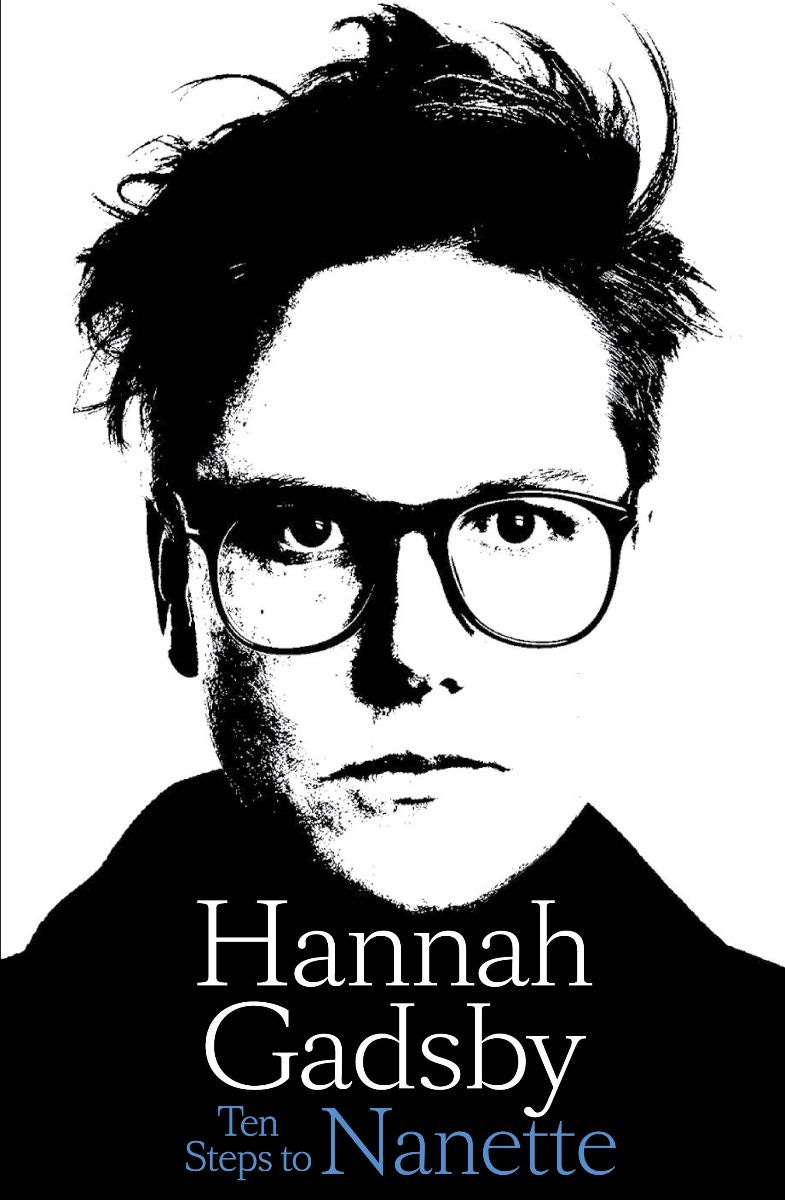
Unsurprisingly, this month I’ve been nerding out on books by and about comedians, and the first one I finished was Hannah Gadsby’s Ten Steps to Nanette. The book certainly has humorous moments, but as its subtitle notes, it’s less of a comedic book than “a memoir situation.” The book recounts both Gadsby’s experience growing up queer in Tasmania and their path of developing as a comedian, writing and performing shows for over a decade before they created Nanette. (Which, if you haven’t seen, go watch it now! But maybe be prepared to do a little self-care after, okay?) The memoir had slightly more detail about Gadsby’s childhood than I needed, but including stories about that era of their life did feel important, since it provides Gadsby an entry point to talking about the political and historical context that Nanette grew out of. Over the first half of the book, I learned much more about anti-LGBTQ rhetoric and policy in Australia than I expected to, and I’m better off for it, both as a nudge out of my America-centric bubble and to better appreciate exactly how powerful Gadsby’s choices as a comedian have been.
The final chapters of the book, where Gadbsy most directly describes creating Nanette, were so helpful for thinking about the ethics of sharing trauma with an audience. Gadsby describes their process of reorienting, biochemically and situationally, to be able to perform a show about trauma without re-traumatizing or triggering themselves. They also detail the path they took to craft a show designed to help other assault survivors feel witnessed and safe while making folks who haven’t experienced assault feel as distressed as they ought to be by its pervasiveness. They had their share of missteps—meltdowns on stage, early performances where they’d just begun to craft the work and didn’t know how to create safety for people who needed it—but the depth of thought and care is so detailed that it lays out one pathway for the rest of us who wrestle with these questions, in this genre or others. Perhaps what I loved most about the book was discovering that Gadsby is a great writer for the page, as well as for the stage, and that they could keep me as riveted through a memoir as through a show. I highly recommend listening to the audiobook version, which Gadsby narrates, for the full effect.
Hey, my new book is coming out soon!
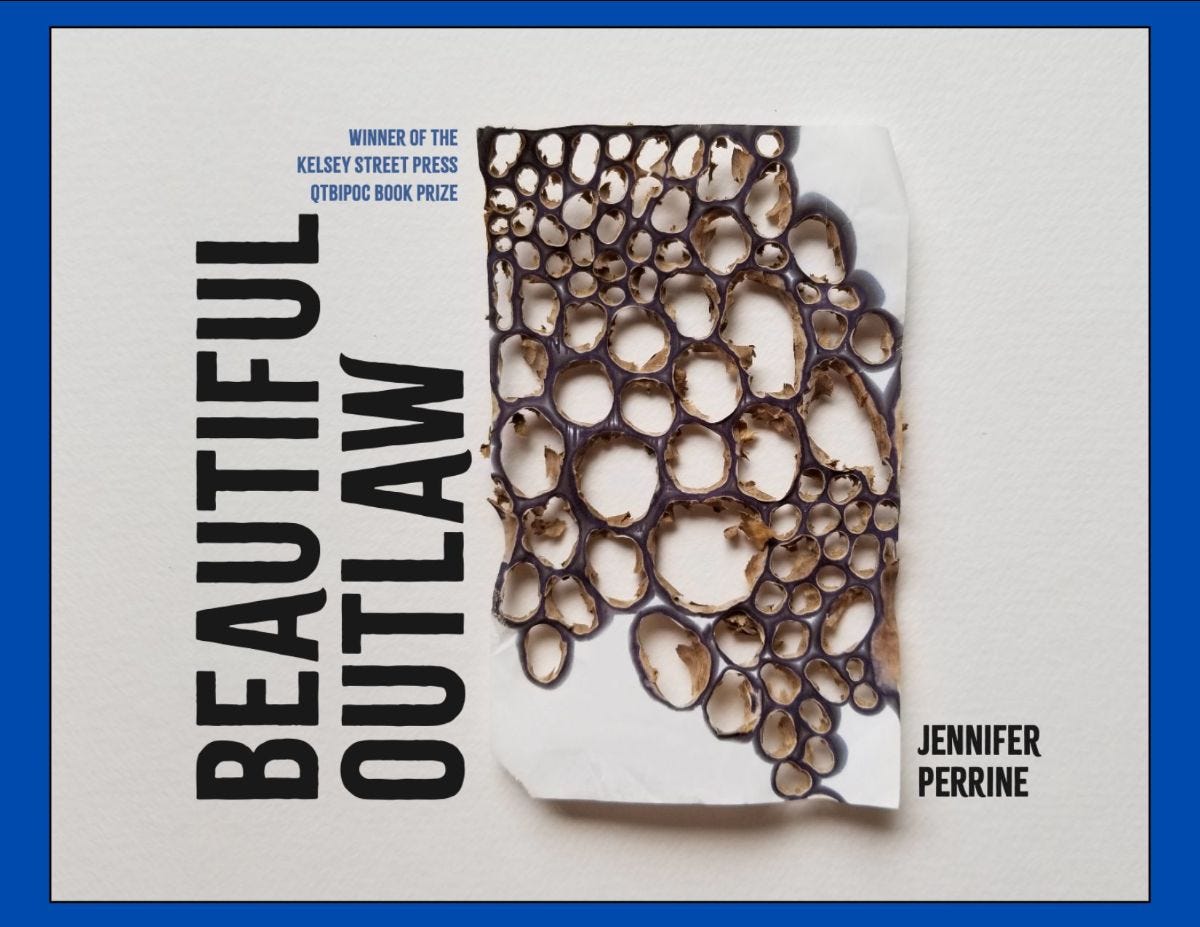
The exact release date hasn’t been pinned down yet, but it will be out later this spring. If you’d like to be part of helping Beautiful Outlaw land in the hands of readers, here are a few good deeds you might do:
Pre-order the book from my publisher, Kelsey Street Press
Write a review of Beautiful Outlaw. Request a free review copy at info@kelseystreetpress.org
If you’re a teacher who'd like to use Beautiful Outlaw in your classes, request a free desk copy at info@kelseystreetpress.org
Ask your local public library to carry a copy. Most libraries have links on their websites where you can suggest books to add to their collections.
Ask your favorite local bookstore to stock Beautiful Outlaw. Don’t have a favorite indie bookstore? Now’s a good time to find one.
Invite me to read with you or at a series you host, to teach a guest workshop for your class, to do an interview on your podcast, or to otherwise collaborate on something nerdy and fun.
Come out and celebrate with me after the book’s released! I’ll be organizing some launch events for this summer, so stay tuned to future newsletters for more details on those.
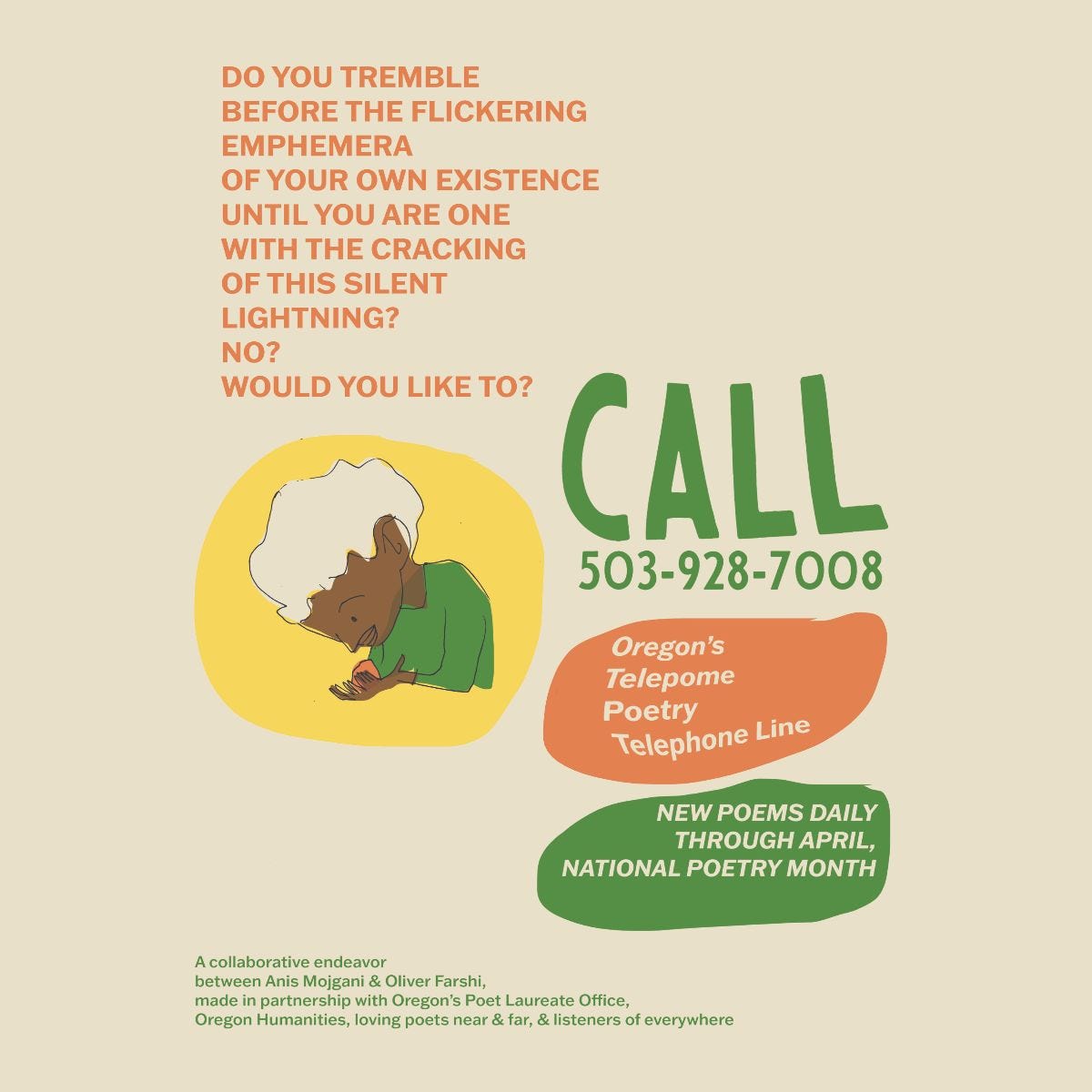
In the meantime, you can get a little taste of the book by calling the Oregon Poetry Phone Line, which features a new poem each day throughout April, in celebration of National Poetry Month. On Friday, April 25, you can dial (503) 928-7008 to hear my contribution. While you’re there, kick back and listen to other poems from this month or from previous years’ hotlines.
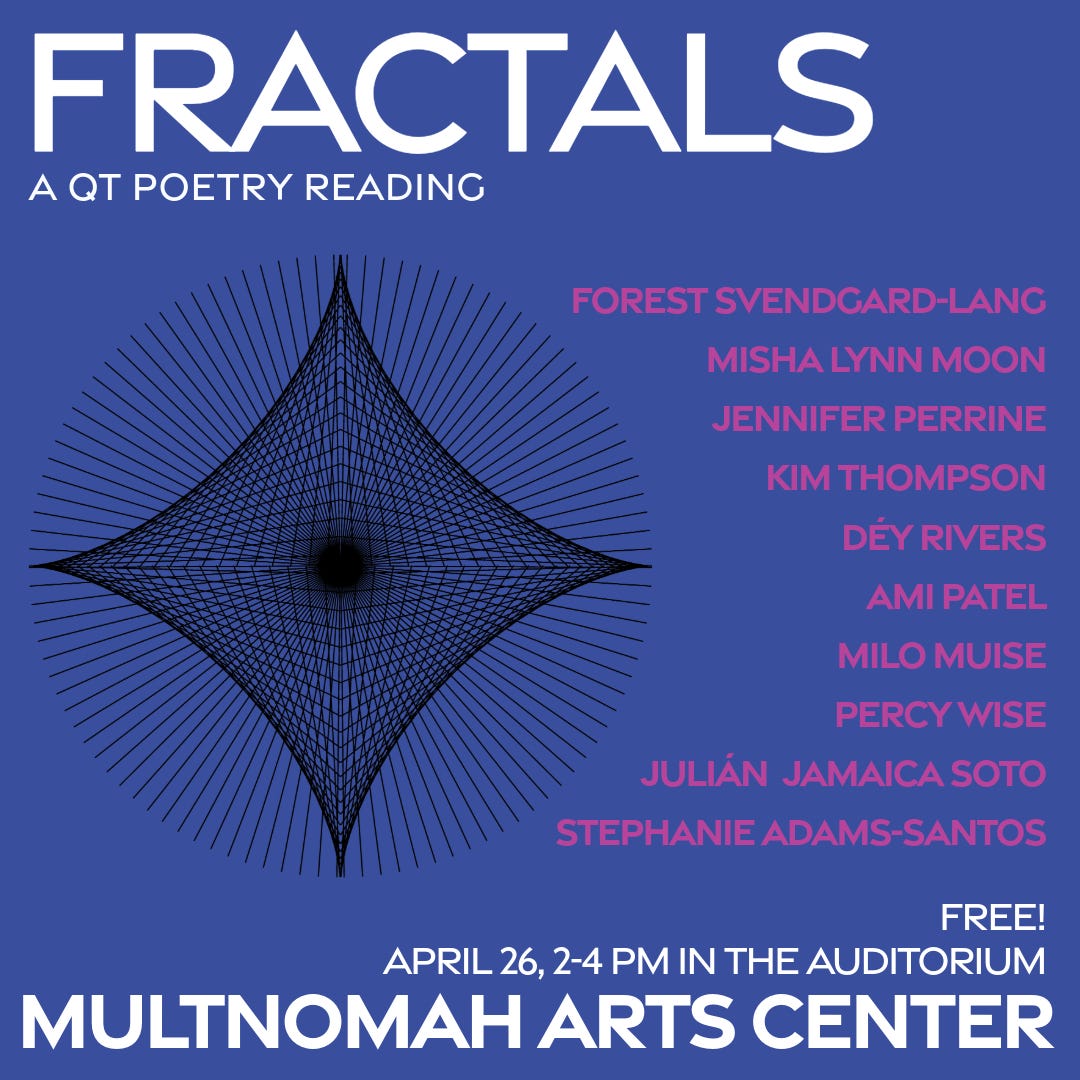
On Saturday, April 26, 2pm PT, I’ll be joining other queer and trans writers for “Fractals,” a free reading celebrating two shows by regional LGBTQIA2S+ artists at the Multnomah Arts Center Auditorium, 7688 SW Capitol Hwy, Portland. The shows, “Shift Work: Queer Artists in Tectonic Times” and “Holding Our Own: Works by Queer Ceramic Artists,” are co-curated by Pablo V. Cazares, Lux Harris, and Megan Hatch, and I’ll be reading alongside Forest Svendgard-Lang, Misha Lynn Moon, Kim Thompson, Déy Rivers, Ami Patel, Milo Muise, Percy Wise, Julián Jamaica Soto, and Stephanie Adams-Santos.
Just after that, I’m heading up to UW Tacoma for their poetry festival on Monday, April 28. The festival is an all-day event with programming open to the community, including a literary fair and open mic. I’ll be one of the featured authors at the event, with a reading and Q&A at 6pm PT.
If you’re curious what all this stand-up hubbub is about, you can come see me perform alongside a dozen other new comedians on Sunday, May 4, 6:30pm PT at Curious Comedy, 5225 NE Martin Luther King Jr Blvd, Portland. Doors open at 6pm, and admission is $5.
And then it’s back to poetry time! I’ll be reading on Saturday, May 10, 3pm PT, with Rivka Clifton and David Seung at UpUp Books, 1211 SE Stark St, Portland.
Incite: Queer Writers Read is also back in May for a reading on Wednesday, May 21, 7pm PT with T. Thorn Coyle, Miranda Schmidt, and Juan Antonio Trujillo. The theme for May’s reading is “Ritual.” As usual, I’ll be co-hosting with Vinnie Kinsella at Literary Arts, 716 SE Grand Ave, Portland, and the reading will be followed by a community discussion.
If you’re looking way out to this fall, on Tuesday, September 9, 5:30pm PT, I’ll be the guest speaker at the Central Oregon Writers Guild online meeting, which is free and open to the public. I’ll be talking about “Finding the Freedom in Form” (aka, what I’m always talking about), and there will be a couple of opportunities during the talk for everyone to experiment with some unusual formal constraints.
I’ll be following that talk with an in-person workshop, “Contents Under Pressure: Using Constraints to Stretch Your creativity,” on Saturday, September 13, 1pm PT at the Downtown Bend Library in Oregon. We’ll play with what I think of as “extreme” constraints inspired by everything from music to math, from dictionaries to daily walks, and invent some of our own constraints to try out after the workshop ends. Tickets for the workshop are available here.
Other opportunities I recommend:
For Asian American & Pacific Islander Writers and Artists:
Slant’d is now accepting submissions for Issue 7 of their annual literary magazine. The theme is LORE, which speaks to the bodies of knowledge, traditions, and stories passed down across generations. They welcome stories, poems, essays, and art that considers origin points, hauntings of superstitions or beliefs, recounting of traditional medicine or the healing arts, and/or the inheritance of lessons and learnings or of wishes and warnings. They especially want to co-create with AAPI writers and artists who identify as disabled, neurodivergent, trans and LGBTQIA+, over the age of 30, without an MFA, unagented, or without professional/career training in the arts. You can learn more about their editorial vision here and send your work by April 30.
For Trans and Nonbinary Writers:
The Sundress Academy for the Arts (SAFTA) will be hosting their 2025 Trans/Nonbinary Writers Retreat from July 12–13, 2025 via Zoom. The event is open to trans and nonbinary writers of all backgrounds and experience levels and provides an opportunity to work with talented authors from around the country, including workshop leaders Joy Ladin and SG Huerta, and keynote speaker Dani Putney. To apply for a fellowship, send a packet of 5-12 pages of writing (poetry, fiction, nonfiction, or hybrid) along with a brief statement on why you would like to attend this retreat no later than May 1.
For Oregon Writers and Media Creators:
Beyond the Margins is seeking nonfiction stories related to the theme “Real.” They welcome submissions that explore any aspect of the theme, such as: What does it mean to be a real person, and what does it mean to be artificial? How do we balance multifaceted identities and different modes of engaging with the world? How do we determine a bona fide resident of a nation or member of a group? What constitutes a real home? Pieces usually range from 1,000 to 2,500 words, and can also include audio, video, and multimedia projects. Contributors are paid $300 per piece. Send a draft or detailed proposal to editors@oregonhumanities.org by May 1.
For Rural Oregon Writers:
The Incite: Queer Writers Read series can now offer $750 stipends to writers from rural Oregon to cover the cost of their travel expenses to Portland to read in the series. For these purposes, “rural” is defined as locations that have fewer than 15,000 residents and that are at least 10 miles away from population centers of 40,000 or more people. If you’re an LGBTQIA2S+ writer who’d like to visit Portland to read in the series between July 2025 and May 2026, please respond to this newsletter with information about or samples of your writing.
If you’ve got an opportunity you’d like me to include in a future newsletter, please let me know.
No posts
Comments
Nothing yet. Say the first thing.
Sign in to join the conversation.