
Happy Gemini season to all you double troubles and dead ringers! I’m writing to you from my backyard, where I’m bundled in a sweatshirt, ducking to avoid the drizzle, and listening to the bees thrum in the poppies, which have to be the reddest things for miles. Despite the chilly weather, spring has unfurled her flamenco skirts, awakening every bloom in the neighborhood from the delicate white salal bells to the brash extravaganza of the rhododendrons. All the nearby yards packed to their edges with columbine and camas, bleeding hearts and bellflowers, seem like acts of generosity, less driven by a desire to keep up with the Joneses and more by an opportunity to share space with pollinators and passersby who might need a little more beauty in their lives.
As we inch toward the leisurely delights of summer here in the northern hemisphere, may you also throw open your most opulent blooms, letting whatever’s been budding within you spill out some splendor.
xo
JP
Over the last few weeks, I’ve begun practicing writing without any intent of publication. It’s a strange process, made stranger here by my attempt to write about said process without making it public, which I fear is a paradox. By describing what I’m creating, or even what I’m pondering as I create it, it feels like I’m revealing too much, defeating the purpose of trying to write only for myself, to see how that might differ from the habits I’ve formed as I’ve written for an audience over many years. What to do with this newsletter, then, if I can’t (or won’t) let myself devolve into my usual meandering musings, if I’ll speak only obliquely about what I’m writing?
For now, I’ll offer instead some observations that have come up over this last month. One thing I’ve noticed is that I continue to be tempted by publishing opportunities. Friends and collaborators and readers like you have sent me calls for proposals and applications and pitches, on everything from essays on queer ecology to short stories on climate action. Instead of offering the obvious, reasoned response of Oh well, I don’t have a single draft that fits this bill, maybe next time, the eager puppy that lives within me wants to run pell-mell into the maw of these requests, barking, How cool! I should do this! I must drop everything and create! The puppy starts yapping out dozens of ideas for what to research, for new forms I could experiment with, for titles and endings and everything in between. The puppy is incessant. The puppy is making a mess of my no-publishing experiment. The puppy needs to be housetrained.
As I work with my puppy’s impulse control, I’m giving him room to run around and frolic by letting myself follow some of his wild ideas. As I start to research and write pieces prompted by these calls, but in an extraordinarily unhurried way—since I have no intention of sending anything in before the looming deadlines—I’ve noticed that what I’m making feels different. For years, I wrote proposal after proposal for this grant or that residency, trying to make a convincing case that I deserve opportunities to make something new. While I’ve appreciated every one of those opportunities that panned out, that process often meant that I had to identify the value of an essay or story or set of poems before it had even been created. I had to write statements of merit that professed some grand meaning or importance for things that were, at the time, nothing more than ideas, nothing more than my puppy’s woofs and arfs and bow-wow-wows.
But what I embraced when I started writing as a youngish person, and what I reckon I’m returning to now, is the process of making first, without knowing where I’m going, and without even understanding my own intentions as I string words together. I have no elaborate interpretation for what these new drafts mean, why they deserve to be read, or what they’ll contribute to public discourse, since I’m really trying to approach these as if I might never share them with an audience. After my self-imposed moratorium ends, if I decide to send these bits and baubles out for publication, I’ll leave it to someone else to decide what it all represents or how it works or why it matters. For now, though, I’m back to discovering what I’m doing as I stumble along, figuring out how to plod around with these oversized paws. The puppy might be learning how to sit, how to stay, but he is most certainly still running the show.
For the last few months, I’ve been participating in The Belonging Project, an online space for bicultural and multicultural folks to explore our relationship to anti-racism. I’d taken workshops before with one of the facilitators, Karine Bell, and knew that her work was grounded in the same somatic abolitionist practices popularized by Resmaa Menakem’s body of work, especially My Grandmother’s Hands. My life has been profoundly changed by these practices, which help us recognize and address how racism has taken root in our bodies, and whenever I’ve engaged with groups to practice these skills, I’ve been in spaces designated for what Menakem calls bodies of culture, or human bodies that are not considered white. And of course, this is true—I don’t know if anyone’s ever considered me white, and the way racism shows up in my body is undoubtedly shaped by that perception.
But I am multiracial—or in Menakem’s terms, my ancestors had both bodies of culture and white bodies—and that, too, has undoubtedly shaped how racism has and continues to show up in my body and in my actions. So, when I came across The Belonging Project, I was curious what it might be like to explore this complexity with other people who’ve had similar experiences.
Sometimes, you don’t recognize how much you’ve felt alienated by the systems and structures of the world until you’re in a space where you are suddenly not the exception, but the norm. So it was every time I sat before my Zoom screen, looking into the faces of 150 other people, all multiracial, all of us connected by our experience of not easily and clearly belonging in either BIPOC community spaces nor in white-dominant ones. Many of us also shared experiences of not comfortably belonging among our families of origin, and there were common threads that ran through our stories as multicultural people: immigration, displacement, colonization, diaspora—estrangement from our ancestors by one means or another—running alongside expectations to assimilate, to “choose a side,” to for goodness’ sake make ourselves legible so that our ambiguity doesn’t confuse or disrupt a system built on the myth of racial purity. And for many of us, these stories also mingled with reckonings of how our lineages hold both colonizers and colonized, oppressors and oppressed, how we’ve inherited that tension, and how we might make that conflict that lives in our bodies a productive one.
I’m approaching the last month of The Belonging Project, and I can’t say that I’ve reached any conclusions, found any straightforward answers. There’s no magical, effortless way to be anti-racist, no matter what body you move through the world in. But I have found a greater desire to embrace the power that can come from not belonging, from not being legible, from being unable to fall neatly into the confines of a cruel system. It’s a power that has intuitively made sense to me in other realms—gender and sexuality especially—but one that I’ve found difficult to fully embrace in anti-racist spaces, which often, wittingly or not, recreate racism’s binary categories of white and not-white.
Perhaps after this experience ends, I’ll seek out or create other spaces where multicultural bodies can gather, where we can keep feeling our way through these questions. Perhaps we’ll find more ways to come together in our shared non-belonging, to learn what it means to create community around the wisdom of not fitting in.
Recently, I was grateful to discover that Pádraig Ó Tuama, host of the podcast Poetry Unbound, released a series of seven episodes entitled “Poems as Teachers.” Like every Poetry Unbound episode, these are brief events that begin and end with a reading of a single poem. In between, Ó Tuama offers an unhurried, curiosity-driven exploration of the poem, its craft and connections to history and social consciousness. In this recent series, Ó Tuama selected seven poems that spoke in some way to conflict and studied how we might turn to these poems for guidance as we engage in and respond to conflict. As Ó Tuama says in the first episode, these poems don’t propose a solution to war, but they do slow us down, help us understand our own part in conflict and its causes. Many of the episodes illuminated poems that I think of as old friends—Szymborska’s “A Word on Statistics,” Cavafy’s “Waiting for the Barbarians,” Amichai’s “The Place Where We Are Right.” Others introduced me to poets I was previously unfamiliar with, like Mosab Abu Toha. No matter what the poem, each episode helped me to ward off despair and to examine more critically and honestly how my beliefs, choices, and actions foster or resolve conflict. If you listen to these poems and to Ó Tuama’s careful, generous considerations of them, you might find yourself, as I did, listening to the questions that the poems ask and to your own inner responses. In Ó Tuama’s words, “listen to yourself as you’re listening to the poem and as the poem is talking to you, experience the resistance, the critique, the thoughts you have back, or the story that’s opened in you as part of it.”
This month, I recorded a short reading of poems from my forthcoming book for Talking Earth, Dan Raphael’s poetry show on KBOO radio. The episode, which also features Laura Winter and Flavia Rocha, will air Monday, May 20, 10pm-11pm PT, and will also be available on the KBOO website after the show airs.
This weekend, on Saturday, May 25, 6pm PT, I’ll be reading alongside Krystle May Statler, Stephanie Victoire, and Kevin Thomas at Up Up Books in Portland. The theme of the reading is “Bearing Witness,” and it will be followed by a conversation/Q&A.
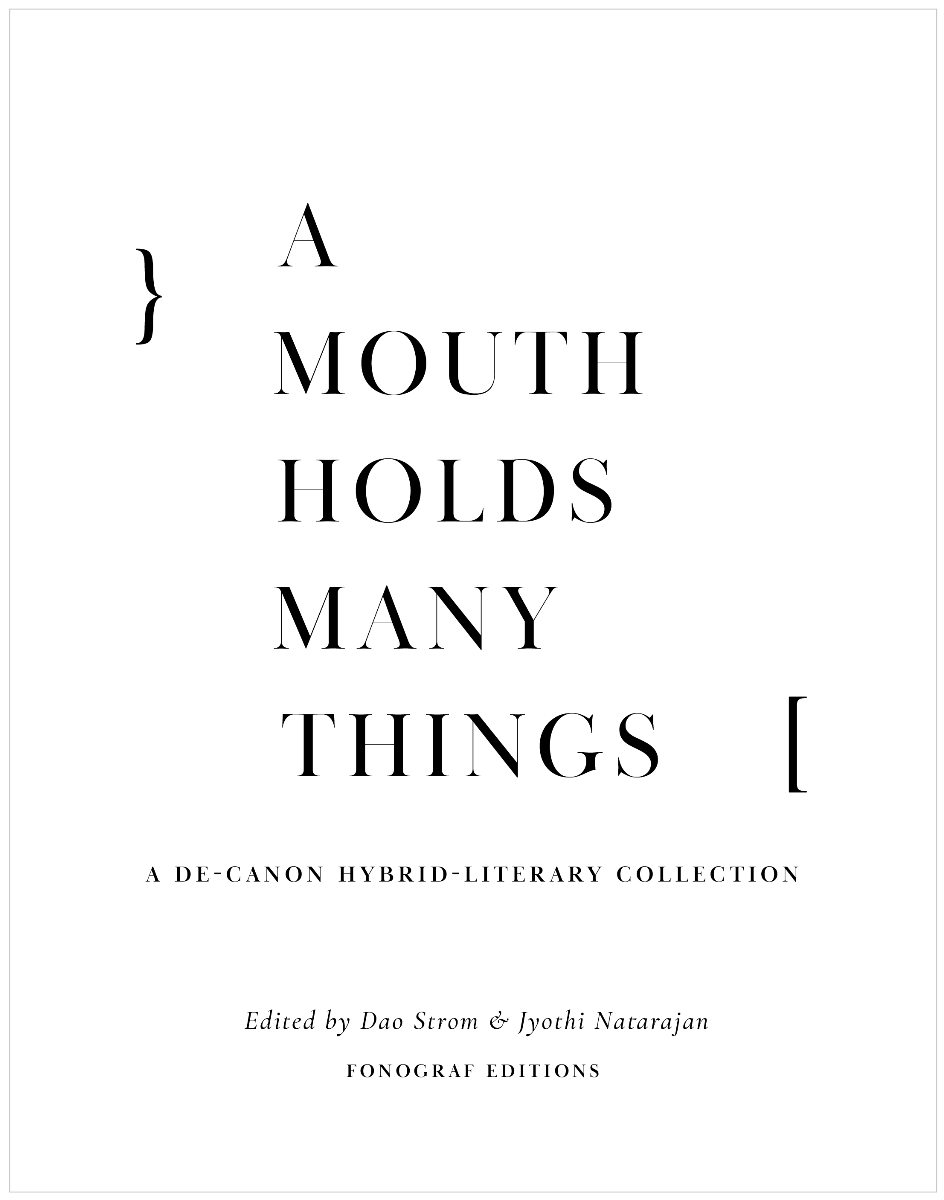
In the last newsletter, I shared that I’ve got a hybrid-literary piece included in A Mouth Holds Many Things, a new anthology edited by Dao Strom and Jyothi Natarajan. The anthology, which features hybrid work from 36 women and nonbinary BIPOC writers, was scheduled to be published by Fonograf Editions in May, but with the sudden shutdown of Small Press Distribution, the publication date has been pushed back to June 25. All that’s to say, if you’re interested in pre-ordering a copy, there’s still time! If you’re curious about the anthology, check out this recent feature in Poets & Writers.
In celebration of Pride, I’ll be co-hosting a collaboration between Incite: Queer Writers Read and Oregon Humanities on Wednesday, June 26, 7pm PT, at Bishop & Wilde in Portland. The event will feature performances by Bobby Jo Valentine, Emily Moon, Zoë Gamell Brown, Rowan Bay, Heather Wiedenhoft, and Aakash Kishore.
I’ve got a couple of new poems coming out in the next issue of Clockhouse, due out in August 2024. If I stick to my “stop sending writing out” experiment, these will be the last poems published until my new book comes out in 2025.
But before 2025 arrives, there’s one more opportunity to catch me doing writerly things, at Northwest Writers’ Weekend in Port Orchard, Washington. This will be my fourth year teaching at the camp, which this year will be held Thursday, November 7-Sunday, November 10. As ever, it will include classes on songwriting, poetry, creative nonfiction, cross-genre writing, and art. I’ll be teaching two classes: “Writing with Our More-Than-Human Kin,” and “Poetry Is a Party, and You Are Invited.” Registration covers classes, housing in a cabin in the woods by a lake, and scrumptious meals. Scholarship funding is available by contacting the camp’s incredible organizers, Karee and Janet, at nwwritersweekend@gmail.com.
Other opportunities I recommend:
For BIPOC Birders in the Portland Area:
In celebration of Black Birders Week (May 25-June 1), Through the Trees Collective is hosting a series of free events for BIPOC folks centered around community, birds, and being outdoors. From nature walks to outdoor yoga to paddling to film discussions, there’s an abundance of opportunities to be outside in the company of birds. Learn more and reserve your spot here.
For Artists and Justice Workers in the Portland Area:
On June 22, 12:30pm-3:30pm PT, at Historic Alberta House in Portland, brilliant artists Bobby Bermea and Rene Denfeld will be facilitating a workshop, “As Often as the Bold: Fear, Community, Movement, and Change.” The workshop will draw from liberatory frameworks including restorative justice, Michael Rohd and Sojourn Theatre, and Augusto Boal's Theatre of the Oppressed, to help participants experiment with movement-based techniques to navigate the fears that hinder us. Participants will leave feeling more empowered to use fear as a stepping stone for making greater changes in their own lives and beyond. Learn more about and register for this free, all-ages workshop here.
For Writers and Nature-Lovers in Eastern Oregon/Western Idaho:
On July 20, 12:30-3:30pm PT, at Four Rivers Cultural Center in Ontario, OR, friend and fellow poet Amelia Díaz Ettinger will be hosting “Touching Inspiration: Embracing Creativity through the Senses.” In this workshop that blends poetry and visual art, participants will explore the literal and symbolic meanings of our hands as they relate to creative acts, collaboration, and renewal. They’ll also engage in activities that encourage them to witness the human and more-than-human world through touch, smell, and sound. Learn more about and register for this free, all-ages event here.
If you’ve got an opportunity you’d like me to include in a future newsletter, please let me know.
No posts
Comments
Nothing yet. Say the first thing.
Sign in to join the conversation.