
Last week I was able to share a message at our new church, part of their ongoing “Healing Deep” series where members are invited to tell a story of how the Lord is working in their lives. I presented the following — which is why this post is much longer than my usual! If you’d prefer to watch/listen, you can access the recording here, though the audio quality isn’t ideal.
I decided to start with a story from the gospel of John that I’ve returned to over and over in the last four years or so. It’s a story that’s continuing to do a lot of healing in me, and I hope can be encouraging for others too. It’s the story of the apostle that we, I think unfairly, call “Doubting Thomas.” Recently I’ve been more and more able to identify with him.
You’re probably familiar with his story — he’s one of the 12 disciples, and after the Resurrection when Jesus appears to his friends again, for whatever reason, Thomas isn’t there. He missed seeing Jesus that first time. And when he finally rejoins them, (in John 20) they’re so excited: “Jesus is alive!”
But Thomas says, “No, I can’t go along with that. I will not believe unless I see Jesus for myself,” and that’s where he gets his nickname. Over the years, he’s been held up as a bad example: Doubting Thomas, don’t be like him, he had no faith.
I’ve developed another perspective on him recently that I think helps us see him better. But for me, most of all, it’s helped me to see the goodness and kindness of Jesus in a way that’s given me hope when I needed it most, and has moved me towards healing.
To get there, I have to start with our story, starting 13 years ago.
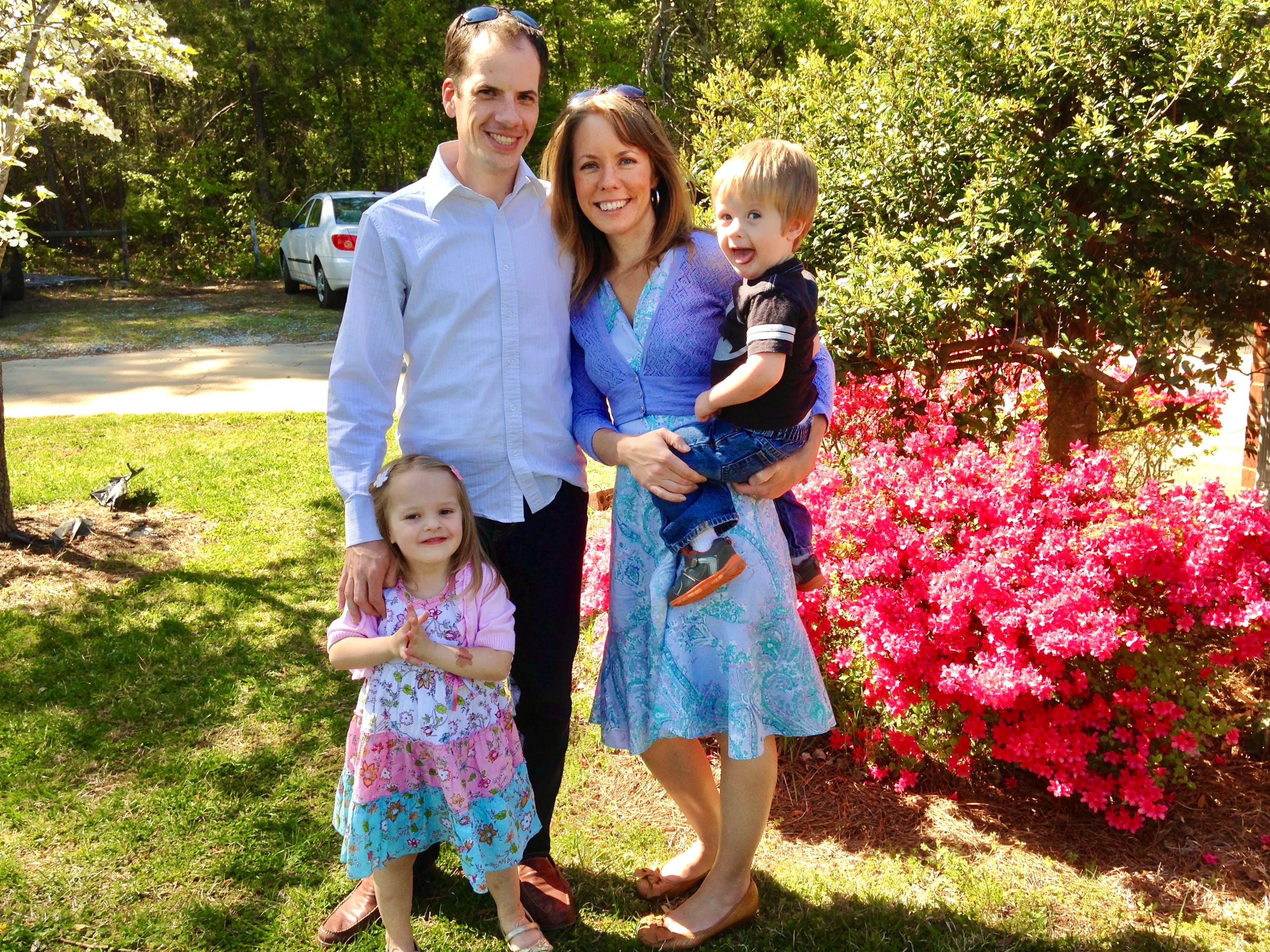
There were just four of us then, and we had just moved to North Carolina, outside Charlotte. We got there in March, and found a church right away. We were really excited to find this. It was a new church plant, it had a lot of young families, and it was an Acts 29 church — to us, at the time, that was a great thing.
We were thrilled, because we had no family in the area, to find a community right away that we felt connected to. It was such a gift. And it was interesting — I looked back at the calendar, and Easter fell on March 31 that year, just a few weeks after we arrived in the state. One of the families we’d met on our first Sunday invited us to join them for Easter dinner. And it was just a beautiful experience for us: Wow, we’re being welcomed into this church family.
And from there, the next few years were more of the same. Just this incredible community that we got connected to. Our church was very big on community. We had community groups; everybody was encouraged to be part of one. And of course we joined, and it was a blessing to us. Every Tuesday, we came and saw our friends, our kids saw their friends — it was an anchor in our weeks. Truly, a church family.
“The church is the body of Christ.”
“The local church is the hands and feet of Jesus.”
If you’ve been around evangelical churches for a while, you’ve probably heard these phrases. We heard these, and we believed this was what we were experiencing. These phrases reflect the idea that even though Jesus is not physically present now, we’re able to see his goodness and grace in the ways we love and serve one another. And we saw that in some really beautiful ways. There were families who came over in the middle of the night when I needed emergency surgery. At 2 a.m., they showed up, stayed with our kids and took care of them all the next day. It was a beautiful community.
And we saw our church serving. We were part of a group that went to the local prison once a month. We would bring a home-cooked meal and do a Bible study, and there was a woman there we were able to help, when she got out, to transition back to normal life. She wanted to start over, and she ended up briefly living with a few of our families as she got back on her feet, got a job, and went through recovery. Eventually she and her husband got a place in our town. They were living there, working there, and attending our church.
All the things that these phrases above were supposed to reflect, we believed we were seeing. There was tangible evidence of God’s grace in and through this community. We were so grateful to be part of it. And we got pretty deeply involved. We started leading and hosting a community group. Konrad, my husband, ended up hosting a men’s cigar and theology night in our garage, and every Friday night there were guys out there talking.
I eventually started teaching at the prison ministry, discovered I loved doing that, and started writing and teaching women’s Bible studies. And then — at that time the church was still pretty young and didn’t have a formal women’s ministry — the pastors came to me and said, would you run this?
I’m sharing all this just so you get a sense of how deeply invested and committed we were. We really did think, This is the body of Christ. This is a beautiful place where we’re seeing the love of Jesus, and we get to be part of it.
And when I think of Thomas now, I see that kind of commitment. So I want to share a couple of quotes from John, because as I’ve looked at Thomas, I see a different picture than a “doubter.”
This is from John 11, from the story where Jesus raises Lazarus from the dead. In the prior chapter, Jesus has had an attempt on his life. He and his disciples have left Jerusalem, getting away from the mob that was trying to kill him. Then they get news from Mary and Martha: “Please come back, Lazarus is about to die.”
The disciples say, “Rabbi, just now the Jews tried to stone you, and you’re going there again?” (v. 8) They don’t want to head back into danger. What’s interesting to me is that Thomas is the one who speaks up at that moment, and he says, “Let’s go too, so that we may die with him.” (v. 16) He’s not a doubter here. He is truly committed, devoted. He’s ready to follow Jesus to death.
Now let’s skip ahead to John 14. This is the Last Supper. Jesus has celebrated passover with his disciples, washed their feet. At this point, Judas has already left to betray him, and Jesus is giving his final encouragement to the disciples. And he says:
“Do not let your hearts be troubled. You believe in God; believe also in me. My Father’s house has many rooms; if that were not so, would I have told you that I am going there to prepare a place for you? And if I go and prepare a place for you, I will come back and take you to be with me that you also may be where I am. You know the way to the place where I am going.” (John 14:1-4)
So often in the gospels, we see Jesus say something and the disciples are like, “We have no idea what you’re talking about.” Or they’ll pretend, and say “Oh yes, we understand everything.” Just a few verses prior, Peter declared, “I will lay down my life for you.” (13:37) He’s pumped up and certain — so sure of himself and of his faith. He’s such a contrast to what we see of Thomas, who says, “Lord, we don’t know where you are going, so how can we know the way?” (14:5)
That question has stayed with me. I see it as an expression of so much love and loyalty and humility. Thomas is not pretending to know, not pretending he has some sort of ability to do what it takes, the way Peter was just claiming. He’s just saying, “Jesus, I want to be with you, and I need you to tell me how.”
I think of it almost as a childlike faith. So I don’t see Thomas as a doubter. I see him as someone who’s ready to follow Jesus wherever he leads.
When I look back at myself from 10 years ago, our church at the time had a phrase — “being missionaries in our zip code” — and we loved that. We were very invested in that idea. My husband and I were so grateful for what we had found in that community, for the tangible ways we had seen the grace of Jesus, and we wanted to share it with others. We loved inviting people in, having them in our home.
At one point, he was given a job opportunity to move to another part of the state. And it was more money, a bigger position. We considered it, talked to some people, prayed through it a lot, and eventually turned it down because we thought — you know what, loving and committing to a place and a people is ultimately what we want to do, more than just chasing the next opportunity. And we could imagine — we thought we would be spending the rest of our lives there.
Obviously we didn’t. That’s why we’re here today.
This is a picture from February 2022, from a regular Wednesday morning. It has come to signify a lot for me — to represent the final hour of innocence, before things started coming apart.

That morning I had to go to Target to grab a few things. I needed to get my youngest some new winter shoes. She tried on those little boots, and as soon as she put them on she was in love. She refused to take them off and went stomping through the store trying to say the word “boots.” It was so cute.
While I was there that morning I got a text from the lead pastor: “when you get a chance, give me a call.” I didn’t think anything about it, because we stayed in communication regularly. We had a regular monthly meeting to talk about what was going on in the women’s ministry, which was coming up the next day. So I figured, ok, we’re going to review something ahead of time.
So I got my girls home, got them down for their nap, and I gave him a call.
And — it’s so funny, every time I tell this story, I can still feel in my body the adrenaline, as things started to kind of wash over me, what was happening. Because what he said to me on that call was: “Hey Joy, we’re going to have a meeting tomorrow, but it’s not going to be our regular women’s ministry meeting. I want you to know that charges have been brought against you, and I’m going to sit down with you and a couple of the elders tomorrow and present those to you.”
There had been no warning. I had no idea this was coming. I didn’t know how to process it. So I tried to ask some questions: what do you mean “charges”? He said, “I won’t tell you right now.”
“Well … can I know who’s bringing these charges?” And he said, “No.”
“What about tomorrow, are they going to be at this meeting?” “No, they won’t be.”
I remember trying to get my footing. I said, “I’m not sure how that’s fair. That doesn’t seem like the right way to handle something like this.” And all he said was, “Well, I understand you feel that way.”
My husband was able to come with me to that meeting. And they still did not answer the majority of our questions. I never found out… I still don’t know, four years later, who accused me, even though we spent months and months and months trying to work through this process with the pastors.
But they informed me that I was being removed from my position; I could not teach the women’s Bible study that I’d spent months preparing and was just about to begin. I could no longer come to staff meetings, and there was going to be an “investigation.”
We walked out of that meeting shaken and confused. At the time, I thought, Ok, this is awful, but surely we can work through this. We love each other so much. This is the body of Christ. Every one of them — there were six pastors at the time — we were good friends with all of them. Every one of them had been in our home, some many times, some of them we’d known for years. And I — naively, I can see now — had this belief that the years we’d spent and the commitment we had to Jesus was going to give us the ability to sort through this.
I thought, Ok, this is a mess, this is a conflict, but they’re going to realize this is a mistake, and we’ll get through it. But that’s not how it went. That was just the beginning. The next six months are what I can only describe as hell. Not being able to get answers, not being able to get responses.
At the time, I didn’t understand. I’ve done a lot of reading and a lot of research since then, and I can put it into perspective now. I now know that was a very dysfunctional church family, and I had been made a scapegoat. I also ended up becoming kind of a whistleblower in this system that had some really deep flaws that we were blind to at the time. I understand that now, but at the time I didn’t.
All we knew was that these people that we loved, and that we thought loved us, were now hurting us. And didn’t seem to care. I’ll never forget the lead pastor, in the first meeting we finally were able to have, telling everyone in the room that I should be “run out of town.”
There was so much pain. It was hard enough dealing with that from the pastors, but there were other broken relationships with friends who kind of walked away from us gradually over time. Many of them were upset about this injustice initially. But if any of you have been in a situation where there are a lot of unhealthy behaviors from leaders, you know there’s a lot of pressure not to speak up. A lot of pressure to stay quiet and not rock the boat.
We heard from a lot of people who over time would say, “This is just too hard on us emotionally, we don’t want to talk about it anymore. We’re ready to move on.”
Or: “The pastors, we know they’re good and godly men with good intentions, and we just need to trust them. C’mon Joy, let this go. You just need to forgive. You need to forgive them and move on.”
We kept going through this process they wanted to do. We were committed: We’re going to see this through; maybe someone will see the light. But after several months of this, we were just broken — physically, emotionally, spiritually — and we could not take it anymore. This community was disintegrating in front of our eyes, and we couldn’t see how it was ever going to come back together in a healthy way.
At the time, my husband had a job where he was working remotely and working part time in Delaware. And we came to the conclusion that for the sake of our health, we needed to leave. So we sold our house, and that summer packed everything up and moved to Delaware.
This is the question I started asking at that point. Is the body of Christ real? We believed, as much as we ever could, that we’d found what the body of Christ was supposed to be. The goodness of Jesus, embodied in a community of people loving and caring for each other. And when that fell apart, I just started to doubt. I can understand why Thomas asked that question, why he said he didn’t want to believe anymore, couldn’t believe.
My faith was really shaken.
This is a quote from Aaron Hann, who’s been studying the gospel of John on his Substack. He’s helped me think through the story of Thomas:
“If we follow John’s narrative and the repeated descriptions of fear, violence, and oppression, it becomes clear that Thomas wasn’t a doubting skeptic asking for evidence. He was traumatized. Lazarus had a death warrant (John 12:10-11), and Jesus predicted the same for the disciples (John 16:2).
So Thomas had every reason to think he was next. Maybe he regretted saying “Let’s go too so that we may die with him.” (“The Hermeneutic in the Scars”)
I can understand that Thomas: the grief, the loss in the wake of something being taken away. Thomas was traumatized. He was grieving. And what he said — “If I don’t see, I will never believe” — I think because he’s been given the nickname “Doubting Thomas,” we read a certain tone into that. He’s detached, maybe prideful, he just doesn’t care. But I’ve come to see him differently now.
I don’t think he was doubting. I think he wanted to believe, but he couldn’t let himself anymore.
I’ve wondered: was he holding back tears when he said that? Was his heart aching? Was he maybe angry: I was such a fool to believe in what Jesus promised. I was so stupid. I’m not going to let myself fall for that again.
So I think Thomas wasn’t so much doubting, as wanting to believe and not being able to. He wanted to see the body of Christ, he wanted to know it was real, but he just couldn’t bring that up on his own. I can understand that.
When we moved to Delaware, it was really hard to walk through the doors of a church again. I still wanted to believe that the grace of Jesus could be found in a church community, but I wasn’t really sure anymore.
We did find a good church there, and it was a good experience in a lot of ways, but every Sunday those doubts came in with me: Are the hands and feet of Jesus something I can trust? Is the body of Christ even a real thing? Can we expect to see goodness through a community of imperfect people? Is the church ever going to be a safe place of unconditional love?
I have to confess, I’m still doubting. I’m still not sure. I still want to see it, to feel it for myself.
And this is where Thomas’s story again has provided me with hope. Something I’ve noticed is even though he said “Unless I see, I will never believe,” he doesn’t walk away. When he rejoins the disciples, even though he no longer believes, he stays with them. For a whole week.
I can imagine the difficulty for Thomas, sitting in that room — they’re all rejoicing, full of hope, and he’s unable to participate. He’s not believing, but he’s waiting. He doesn’t have hope, but he’s staying around people who do.
And I think I can do that.
Then the beautiful part is after that week of waiting, Jesus does, finally, show up again.
A week later his disciples were in the house again, and Thomas was with them. Though the doors were locked, Jesus came and stood among them and said, “Peace be with you!” Then he said to Thomas, “Put your finger here; see my hands. Reach out your hand and put it into my side. Stop doubting and believe.”
Thomas said to him, “My Lord and my God!”
Then Jesus told him, “Because you have seen me, you have believed; blessed are those who have not seen and yet have believed.” (John 20:26-29)
I find this scene so beautiful, and the more that I’ve re-read it and reflected on it, the more I see Jesus’s goodness here.
There’s three things I want to point out:
Jesus takes the initiative to address Thomas’s doubts. He comes into the room and he’s not like “Dude, what’s wrong with you? I told you I was going to come back to life.” He doesn’t lead with shame or condemnation. He just knows Thomas is hurting, he knows that he’s struggling, and he goes right to him. He seeks him out.
Jesus gives Thomas the exact proof that he asked for. Jesus wasn’t there when Thomas listed his expectations for proof of life: “I want to see him, I want to touch the nail marks, I want to touch the wound in his side.” Jesus didn’t have to do all of that, but he did. He knew the specific things Thomas wanted to see, and he didn’t make him ask again. He just said, “Come here and feel — I’m real.”
Jesus accepts Thomas’s faith. It’s weak and imperfect, but Jesus accepts it. And again, we face this question of, what tone do we read into these stories? I’ve always been under the impression that Jesus is rebuking Thomas for his lack of faith. He’s a little bit disappointed — “Your faith isn’t good enough. You had to see.”
But — side note: every other one of the disciples did not believe until they saw, either. The women came to them with reports of the resurrection, and they wouldn’t take their word for it. They had to wait until Jesus showed up, too.
Jesus does say to Thomas, “You have believed.” In verse 28, when Thomas says “My Lord and my God,” he recognizes Jesus for who he is. He confesses it, and Jesus calls that “faith,” even though it might have been weak, and it came after a long struggle. I think this helps us to read the rest of what Jesus says not as disappointment or frustration, but as a kind and gentle affirmation: “It was hard, Thomas, I know — but you did believe. And there will be others who will struggle in the same way.”

So when Thomas couldn’t believe in Jesus, Jesus came to him. This is something that continues to give me hope, continues to help me towards healing.
I don’t know if anybody else here can see themselves reflected in Thomas, if anybody else has known the experience of finding the body of Christ to be an unsafe place, or the hands and feet of Jesus have done you harm in some way. Maybe you’re wondering — I’m still sometimes wondering — is the body of Christ anything more than a metaphor? I hope not.
But I see this story in John 20 as something more than Thomas and his doubt. I would like to call him something else. Maybe we call him “Traumatized Thomas” or “Grieving Thomas.”
What I love is the way this story shows me Jesus, even when I might be struggling to see him in the church.
That’s what continues to give me hope. Because it’s been four years, and it’s still not easy to come to church. It still hurts to want community, to open up and make the effort to build relationships. I’m still wondering — Is the body of Christ real? Are the hands and feet of Jesus something I can trust?
I hope it’s something more than just a pretty phrase, just a spiritual concept. I think it’s supposed to be. I don’t know if I’m going to experience the body of Christ again, to be able to feel it in the way I once did.
But like Thomas, I want to believe, and I’ll keep waiting in the place I think Jesus is most likely to show up. Because I see in this story how Jesus kept his scars for the people like Thomas, who are struggling to believe.
I see how Jesus seeks out those who are grieving the loss of their faith, who maybe want to believe but can’t. And what I continue to find a comfort and hope in is this:
When Thomas couldn’t believe in Jesus, Jesus came to him.
Thanks for reading! This post is public, so feel free to share it.
No posts
Comments
Nothing yet. Say the first thing.
Sign in to join the conversation.