
If someone says you’ve hurt them, but you don’t think you did anything wrong, how might you respond?
What if an impartial outside observer says you’re at fault? What if a judge writes a 58-page ruling explaining what you did was unlawful?
Well, if you’re Naperville Presbyterian Church and pastor/author Dane Ortlund, you simply deny it.
A judge for the Illinois Human Rights Commission recently ruled that Ortlund unlawfully fired his employee Emily Hyland, retaliating against her after she complained of gender discrimination.
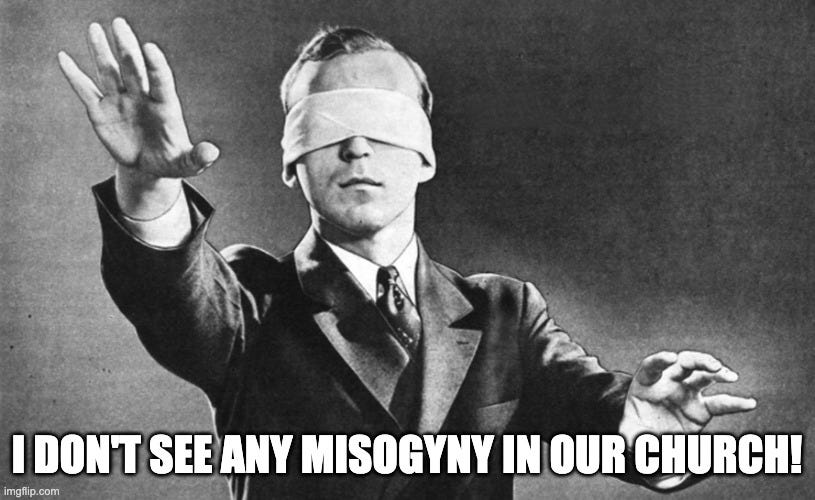
This case is a perfect illustration of how complementarian theology creates spaces where misogyny can flourish, while at the same time blinding men (and women) to how real and destructive it truly is.
Throughout this case, there has been plenty of evidence of contempt for and mistreatment of women at NPC.1 Misogyny has been a factor here. Unfortunately, not even a court ruling could prompt Ortlund and his church staff to consider whether they’re in the wrong.
What could cause Christians — even pastors and elders — to become so entrenched in sin that they refuse to listen to anyone trying to call them out? The problem is complementarian theology. This belief system creates an alternate reality, training believers to ignore or dismiss conflicting evidence.
It all comes from the Danvers Statement, the document that created the complementarian movement in 1988. The statement redefines common words and denies historical realities. For instance:
Men having authority over women is called “equality.”2
Women can never teach or preach to men, yet this is said to be evidence of “equally high value and dignity.”
Domestic abuse is not the fault of male authority or a history of patriarchal practices in our culture. Instead, it’s the result of feminist egalitarianism.
Complementarian doctrines declare that God has given men power over women and called it “good.” This fundamental assumption creates church cultures where, by definition, misogyny cannot exist… which is exactly why it does.
I’ve identified three basic beliefs of complementarianism that work together to enable and conceal misogyny at the same time:
Men have the privilege of defining reality
Women are seen as potential enemies
Men aren’t held accountable; women are blamed instead
All three of these are obvious factors in Hyland’s case, so let’s take a look:
Complementarian theology allows men like Ortlund to harm women and call it “respect.”
According to the legal ruling, Hyland was mistreated — Ortlund unlawfully retaliated against her. Judge Azeema Akram directed the church to pay Hyland at least $90,000 for lost wages, legal fees, and emotional distress. But Ortlund and NPC deny that they did anything wrong, and are even claiming the case was decided in their favor because Akram did not rule against them on two other charges.
According to NPC, Judge Akram is simply wrong. “The church disagrees that its actions were retaliatory,” it wrote in a public statement following the ruling.
The statement goes on to assert that the elders stand with Ortlund, whose behavior has — in their view — been exemplary: “He has treated Ms. Hyland with dignity and respect.”
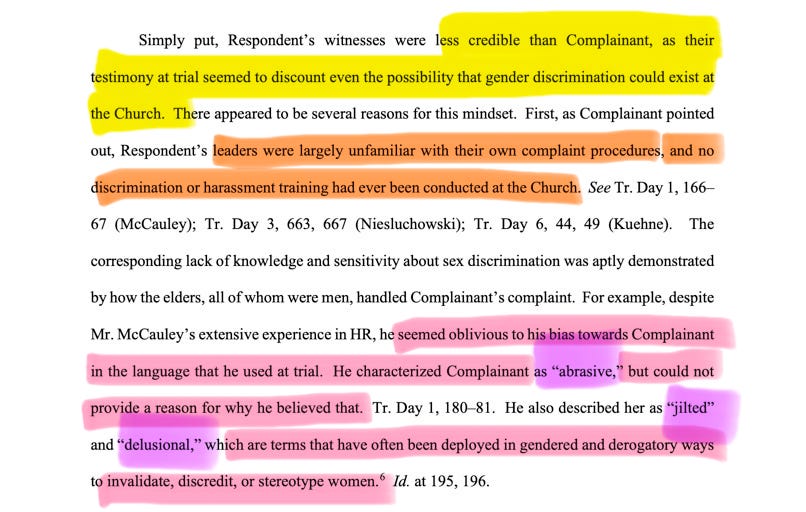
Unfortunately, anyone who reads the entire ruling is likely to come to the opposite conclusion. Judge Akram certainly did. While the specifics of the case did not meet the legal burden of proof for two of the charges, her written comments make it clear that she saw Ortlund and the culture of NPC as lacking “dignity and respect” for women.3
Notice how complementarian thought has distorted reality for the pastors and elders. A judge — whose job it is to decide exactly these types of cases — has called the church’s behavior retaliation. But the men at NPC claim they’re only guilty of “respect.”
Unfortunately, this is the natural outcome of the complementarian practice of male headship: men get to define reality. As leaders, they have the privilege to decide what “respect” is — whether their wives are giving enough to them, or whether their behavior towards women counts as such.
It’s not surprising, then, that the male elders of NPC feel confident to reject the words of a governing authority.
I can’t help but wonder if they’d reply the same way to a male judge.

All we have to do is take a look at Ortlund’s own words to see misogyny at work.
Within a month of being hired, Ortlund was already complaining about Hyland to associate pastor Davy Chu, over email: “I’m going to start keeping track of a bit of a paper trail of things with our sister…,” he wrote.
Notice that phrase: “Our sister.”
There’s nothing warm or loving in that statement — quite the opposite. Remember: Ortlund has just gotten settled into his new office, and he’s already decided to keep a record of wrongs for a woman he barely knows. Rather than have a direct, face-to-face conversation to deal with whatever was bothering him, he chooses to gossip about one employee with another.
There’s no “dignity and respect” here. Instead, there’s suspicion and contempt, covered in Christianese “love.”
From that point on, Ortlund avoids having real discussions with Hyland, even as he appears increasingly frustrated. Again and again, he forwards her emails to Chu instead, adding complaints and commentary. Here’s one example: “I just got coffee and ran into [Emily] in the hallway. She started her usual ‘talking at me’ mode saying stuff about why she hadn’t responded.”
This would’ve been a great moment for Ortlund to talk to Hyland and address his concerns. But does he? No: “I just said thank you and went back to my office.”
… and then, he emailed someone else to complain about it.
Ortlund’s weak and ineffective leadership is on display here, but so is his contempt for Hyland. A more mature man might have invited her to his office for a longer conversation, but he dismisses her words, assumes he knows better than her, and treats her as though she doesn’t know how to do her job (she’s just “talking at me”). His frustration festers.
In their months working together, Ortlund almost never spoke to Hyland, while he invited a “parade of men” for meetings in his office. This left her confused and discouraged, but even when she shared these concerns with him, he didn’t change his behavior.
Unfortunately, this sort of attitude towards women is exactly what complementarianism encourages. God has desired male headship from the very beginning of creation, according to the Danvers Statement. But ever since sin entered the world, women have tended to “resist” male authority, tending towards “usurpation” of men’s power. The implicit message to men is this: God wants you to have leadership in the church and the home, but watch out — women will refuse to submit or even try to take your authority.
Complementarian thinking creates hostility between the sexes, and this is on display in Ortlund’s words and behavior towards Hyland. He does not assume the best of his “sister,” does not approach her with patience or hope. He keeps a suspicious, cynical distance.
Love keeps no record of wrongs, but complementarian thinking does not encourage love towards women. This is why Ortlund started gathering evidence to convict Hyland before he even knew her.
This point is the natural result of the first two. If God wants men to have authority over women — a reality that men get to define — and if women are likely to sin by refusing to submit to that power, then women will be held responsible for relational conflict.4
Men in authority are inherently good in a way women can never be, because the Danvers Statement claims God created male headship before the fall: it “was not a result of sin.”
Men in this system simply cannot imagine they might be treating women poorly. Their authority is God-given, after all, and while the Danvers Statement encourages men to avoid “harsh or selfish leadership,” it claims that most of the world’s problems can be solved by a return to proper gender roles.
Yes, that’s right: what the world needs more than anything, according to complementarian thought, is men and women returning to their “God-given roles.”
Failure to conform to these roles threatens to compromise the church’s “biblically faithful witness,” “the authority of Scripture,” and even the spread of the gospel. Complementarian practices are represented as the hope of salvation for all the world. These can “promote the spread of the gospel among all peoples by fostering a Biblical wholeness in relationships that will attract a fractured world.”
When the hope of the world hangs on men and women being in their proper roles — and when that requires men to have authority over women — it’s essentially impossible to hold a man responsible for abusing his power. (John Piper, one of the authors of the Danvers Statement, famously advised that a woman should “endure verbal abuse for a season, and she endures being smacked perhaps one night, and then she seeks help from the church.”)
Yes, the Danvers Statement and many complementarians emphasize the need for “humble” leadership, but in practice, there’s almost nothing a man can do to lose the right to spiritual authority. Just look at the Southern Baptist Convention, where male leaders claimed they could do nothing about male pastors convicted of sexual abuse, but where churches with female pastors were hunted down and quickly “disfellowshipped.”
In complementarian systems, a woman threatening a man’s power is far more dangerous than a man using his power to harm others.
And that’s what led the male pastors and elders at NPC to discriminate against a female staff member — they saw Hyland as a threat to their authority, and at the same time were incapable of imagining that Ortlund might have abused his authority.
Even though Hyland told the men she believed Ortlund treated her differently because of her gender, they ignored and dismissed her concerns. She was just “venting,” according to one elder. Judge Akram summarized it:
“…because [the male elder] did not believe that gender discrimination had or could occur at the Church, [Hyland’s] claims of gender discrimination did not need to be taken literally … after multiple elders were confronted with an accusation of sex discrimination, they were simply unable to accept the notion that such behavior could even occur at the Church and thus undertook no efforts to investigate or dispel the allegation.”
Notice that phrase: the male elders “were simply unable to accept” that there could be gender discrimination or misogyny within their own church.
To put it another way: when you believe men’s power over women is unequivocally good, and you’ve been taught that women are threats to male authority, any problem will be the woman’s fault.
… which is precisely how Ortlund himself saw the situation — and continues to see it, despite the ruling.
When he learned that Hyland had shared her worries with other elders, he was furious. Not once did he pause to consider that he might have wronged her in some way — that she might have good reason to feel hurt. According to complementarian thinking, Hyland was simply following the dangerous inclination all women have — to resist male leadership. Since this “sin” is a threat to the creation order and the spread of the gospel, Ortlund immediately labeled her actions “insubordination” and moved to fire her.
This, Judge Akram made clear, is the very definition of retaliation.5
Unfortunately, complementarianism leaves no way for women to appropriately call out men’s misbehavior. Hyland said a man in authority was wrong, and this automatically made her wrong.
The closed system created by complementarian thinking will not permit another view of the situation. And so, Ortlund and the NPC elders continue to believe that contempt is “dignity” and retaliation is “respect.”
A disbelief in misogyny has no bearing on its existence. This is true. Unfortunately, complementarian theology trains men (and, sadly, many women) to close their eyes, hearts, and minds to the reality of misogyny, even as they wield and are wounded by its destructive weapons.
If this sounds like “separate but equal,” that’s because it’s simply another version of the same principle.
If you haven’t read the full ruling, I highly recommend it.
This is very similar to how abusers blame victims: “Look what you made me do.”
pg. 48 of the ruling: “[Ortlund] further admitted that although complaining to the elders was permitted under the handbook, he considered [Hyland’s] March 10, 2021, conversations with Mr. McCauley and Mr. Kuehne to be a form of ‘insubordination.’ Where the asserted ‘insubordination’ is the complaint of discrimination, such a label is akin to an admission of retaliatory animus.”
No posts
Comments
Nothing yet. Say the first thing.
Sign in to join the conversation.