
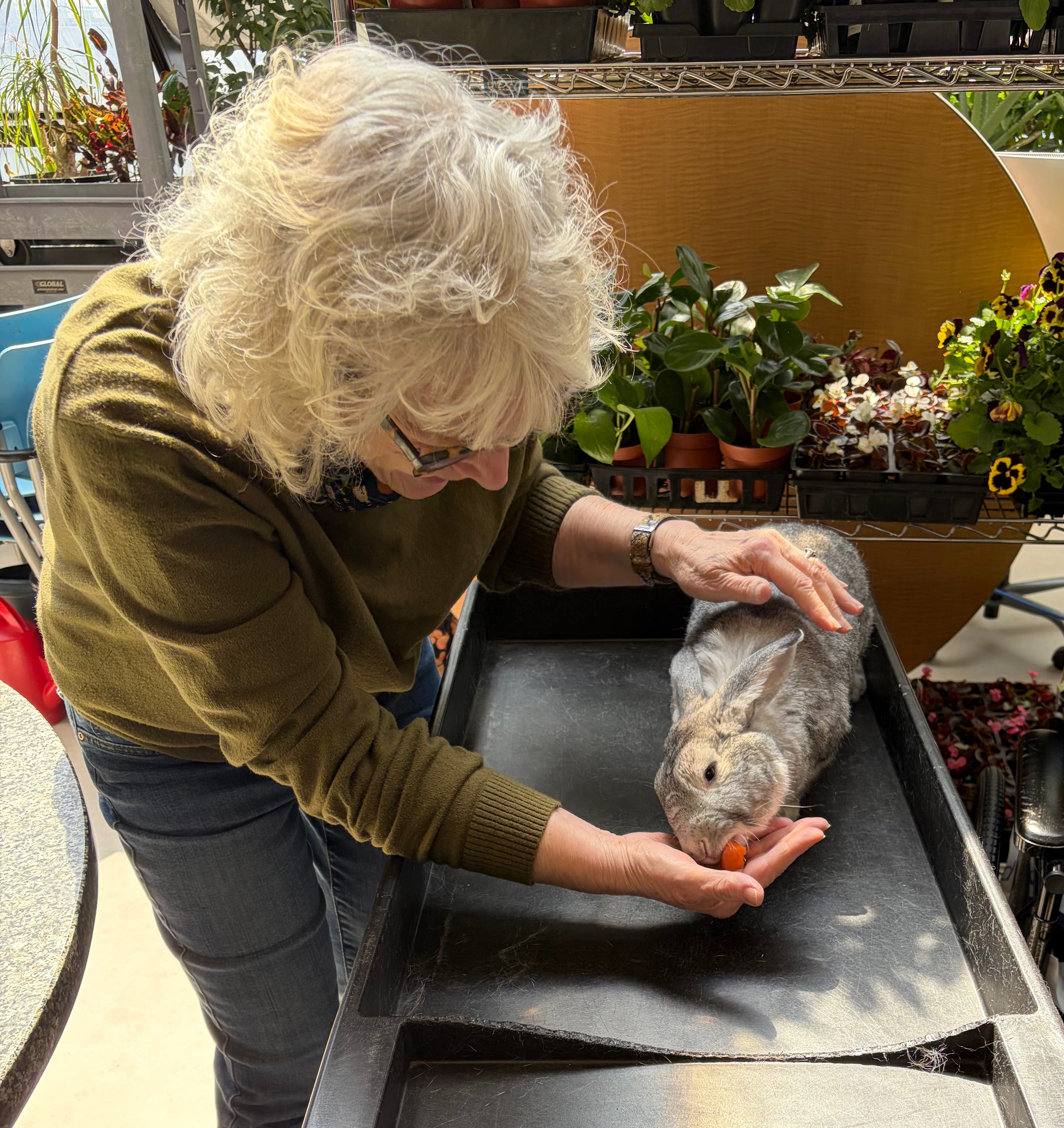
Okay, it’s supposed to be the patient’s therapy rabbit. But the only way the patient would have seen him was in a mustard sauce.
Things have been grim here in Greenwich Village, with me diagnosed with a sinus cancer that’s gotten a foothold in my brain and my friend Herb, who is 85 and has Parkinsons, breaking his hip and having hip replacement therapy.
But I knew things were looking up when I spoke to the admission woman, at Rusk. It is, as far as I know, the best rehab joint in Manhattan, an acute care center which is part of the NYU Langone Orthopedic Hospital. I had been coaching Herb, during his hip-replacement recuperation in Lenox Hill Hospital, about what to tell the social worker, like the mother of a three-year-old at a pre-school interview.
“Rusk, that’s the one you have to push for,” I said. “Like the name of that politician in the ‘60s…uh..”
“Dean Rusk,” says Herb, who does the nouns. “Secretary of State under Kennedy. Hawk on Vietnam.”
A few days later, I get the call from an admissions lady at Rusk that Herb is in.
“We have three hours of therapy a day, an hour each of physical, occupational and speech and swallow therapy,” she says. “We also offer a lot of alternative therapies, music therapy, recreational, horticultural. Does your friend have a religious affiliation?”
I have a memory of Herb during a Bat Mitzvah, showing me a section in a prayer book that appeared to be pro-cannibalism.
“He’s a devout atheist,” I say. “If you need somebody to sit in the back of the room during a service and make jokes, he’s your man.”
“We also have emotional support animals,” the woman says. “Dogs, rabbits…”
Fifty years of feature writing alert lights start flashing: Animal story. Animal Story. Animal story.
“Hold on,” I say. “You have support rabbits? That people get to play with?”
“They live here,” the woman says proudly. “You can go in and play with them any time you want.”
This is clearly a step up. The last time my friend Herb was in rehab, he had a blood cancer that left him so weak he couldn’t stand up. I provided the home – and Medicare – with a letter from his oncologist at Memorial Sloan-Kettering, where he had just begun treatment, saying discharging him would be dangerous to his health. That didn’t impress the home, which discharged Herb after declining us the loan of a wheelchair, in a Dickensian rainstorm.
“I don’t get why you’re doing this,” I told the social worker, in our required exit meeting. “He just started chemotherapy; he’ll be getting stronger.”
“He has Parkinson’s,” the social worker said, as if Herb, who was sitting across from her, were a potted plant. “He’ll never get stronger.”
Now, Herb, who was able to walk two flights up to the Highline after finishing chemo, so Fuck you, social worker, is going to a rehab joint where he will not only have three hours of physical therapy a day, he will have cute, fluffy animals, no doubt bred for empathy.
“They have rabbits!” I text Herb. “You can play with them anytime you want! I’ll flip you for the story.”
“I don’t care about rabbits,” Herb writes back.
“You were a newspaper feature writer and you don’t care about rabbits in a rehab home?” I reply. “They’re not even visitors. They live there full time.”
“You take the rabbits,” Herb says.
I go to Herb’s apartment, after he’s transferred, to pack some workout clothes and his computer, which is more or less his oxygen tank, then go to Rusk.
“I hear you have rabbits,” I say to the receptionist. “What floor are they on? Can I go see them anytime? I also need the floor for Herb Pseudonymberger.”
Okay, so I ask about the rabbits before I ask about Herb. But I bring Herb his stuff first, which means that by the time I get to the rabbit floor, the rabbit handler is literally closing the door and all I get is the sign.
“Can’t I just see them?” I ask, which is pathetic, especially when the sign reads “Therapy bunnies” and identifies them as Parsley and Pepper, which is a little barfy.
What can I say? The specter of brain surgery has given me the emotions of a pregnant woman. I tear up for no apparent reason. Everything moves me disproportionately. It’s the old The Sky is Never Bluer Than After a Cancer Diagnosis Reaction, which I know all about from breast cancer (1991) and ovarian (1995). Negotiations with a God you don’t believe in are a major part.
Get me through this, and I will appreciate every moment. (I didn’t.) I will never be bored by the banquet of life spread before me. (Ha!) I will be a kinder, nicer person. (Thirty years after ovarian cancer, I still tell anyone watching “An American in Paris” with me that Leslie Caron has a mouth like a duck, dances jazz with a ridiculous turnout, and is a vomitous presence who should never have been cast. Of course, the role requires simpering at an obnoxious guy who is too old for her, so maybe Leslie Caron is brilliant. It does have Gershwin. I would never start in on Gershwin.)
My distress over my up-coming surgery is so obvious that my youngest brother, Lochinvar (not his real name), the second funniest man in America after Herb, comes down from New England to stay with me for a few days. When I open the door and see him in the hall, I start to cry. I get the reason for this one right away: I didn’t realize I needed him so much until he was here.
Lochinvar comes with me and my friend Anita, the retired oncology nurse, to an appointment at Memorial Sloan Kettering with the radiologist. I am, for some reason, particularly tense, so rigid I can barely speak to Anita and Loch, though I do give them the wisdom of years of visits.
“People are always on their best behavior in a cancer hospital,” I say. “Normally, in New York, you’re in an elevator and when someone hollers, ‘Hold it!’ you make believe you don’t hear them. In a cancer hospital, patients let other people get in the elevator first. Like God is going to notice and say, ‘She’s so polite. I think I’ll let her live.’”
The news, from the radiologist, is an enthusiastic, “I can cure this”, shouted as she enters the room. You would think that would stop me from tearing up for at least 24 hours, but it does not, though Loch and I have a nice time watching “Airplane” for the 112th time that evening, screaming with laughter when the passenger who’s been trapped listening to the lovelorn hero threatens to immolate himself.
Next day, Loch and I go over to Rusk, to visit Herb. Before we leave, I pack a few carrots in a baggie.
“For the rabbits?” Loch says, cracking up. “Oh, my God. I thought you were making a snack for us.”
We track Herb down in a gym, where a therapist is helping him back into a wheelchair. I know, as a mature adult, not to try to push my interests down someone else’s throat, so I only ask the therapist once about whether we can stop on the way back to Herb’s room to see the rabbits.
“They’re very popular,” she says, taking out her phone. “We’d have to make an appointment. But we can do that.”
“No rabbits,” Herb says, from his wheelchair.
“He doesn’t mean that,” I say.
“Hate the rabbits,” Herb says.
He holds on to this position throughout his lunch, a salad and a miniature meat pie.
“How is that?” I ask.
“Not bad,” Herb says. “I think it’s rabbit.”
Loch tells Herb how much he’s loving his Stack, they talk politics and joke, we discuss Herb’s progress. I only mention a rabbit visit about five more times. Nobody calls about getting Herb a rabbit therapy session, but one does not get to be the legend I was as a newspaper feature writer by waiting for an invitation.
“Screw an appointment,” I tell my brother, after we leave Herb. “We’re going in.”
Often, creatures fall short of their reputed cuteness. (Newborns, for instance.) (Not yours.) (Yours was so adorable, I still remember it.) (My God, that kid was cute.)
Staff therapists Parsley and Pepper (I confess I do not recall which was which) exceed their cuteness reputation. One, who has short grey hair, is taking a break from patients and relaxing in its cage. The other, who is fluffier than it looks in the photo, is stretched out on a metal table. Despite being in the middle of a session with a young woman in a wheelchair, it graciously agrees to meet with me for a few minutes, accepting a piece of carrot and letting me pet it.
“How you doing with the brain surgery bit?” the rabbit asks.
“I break into tears for no reason,” I say. “I’m eating a huge amount of sugar. I get up in the middle of the night and write out the instructions for my memorial service. Which I’m afraid is bad luck and will make it happen.”
“Magical thinking,” the rabbit says. “None of us are that powerful. And I hear the head of the department at MSK is your neurosurgeon.”
“Yeah,” I say. “I’ll have three surgeons in the room. I’m trying to think of it as just another surgery, like taking out an appendix.”
“That’s excellent – that’s a very good mindset,” the rabbit says. “Sorry, I have to cut his short, I’ve got a patient. Would you like to pet me some more between the ears before we stop?”
All in all, I would say it was an excellent therapy session.
Comments
Nothing yet. Say the first thing.
Sign in to join the conversation.