
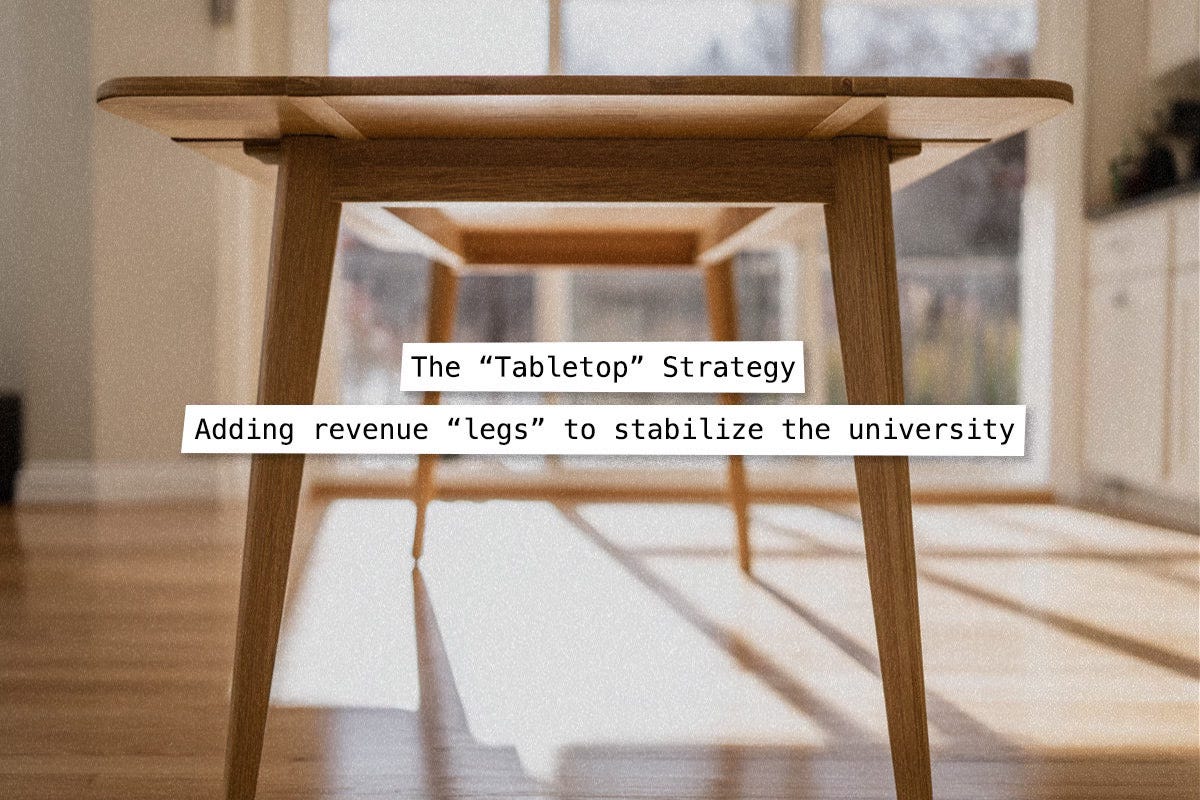
The university president smacked the boardroom table with his open palm. “This is my business model for the university,” he said, pointing directly to the table at which we were seated. “I run what I call the tabletop model of higher education. My job is to establish as many revenue-generating legs as possible to support the institution… the more legs I have, the sturdier the top. And each leg is a separate income source.”
This strategy of adding revenue-producing enrollment “legs” to create a balanced “tabletop” has gained significant traction in higher education since I spoke with this pioneering president while writing Capitalizing on College. From small private schools with a few hundred students to large state universities, institutions across the country have embraced this approach.
Elon University added a leg with its recent merger with Queens University. Southern Virginia University pursued this strategy this semester when it launched the first sport performance major in the US (with American and Boise State now looking to do the same). And last week, Arizona State University announced it expanded abroad to London, offering students a three-year UK bachelor’s with a one-year accelerated master’s.
As higher education finds itself in dire straits, an increasing number of institutions are looking to add more legs to their wobbly tabletops. Yet as today’s higher education leaders embrace this strategy, they should carefully study the lessons learned by those who pioneered it.
The tabletop strategy maximizes the number and type of revenue-producing enrollment “legs,” using their surplus revenues, or margins, to support the “tabletop.” The presidents of these pioneering schools referred to the residential campus as the tabletop – what one administrator characterized as “the fabric of the university.” The tabletop legitimized the whole model, providing the enrollment legs with the seeming permanence and quality of a “real” college education.
The early adopters of this strategy remained continually on the lookout for new enrollment legs to support the weight of the costly residential campus. Legs came in the form of dozens of peripheral programs – adult learning, international branch campuses, online, transfer partnerships, graduate professional and medical programs, military education, dual enrollment, vocational programs, and more. To hold the tabletop up, their strategies required what one president described as, “going after income sources, running the place like a business, rather than a traditional college.”

Running a college like a business in constant pursuit of income sources might have been novel to these innovative leaders, but it is standard today. As a recent BDO Higher Education Snapshot survey of campus leaders highlighted, universities continue to struggle to balance budgets, with nearly half of respondents reporting that “budget constraints are the number one issue facing their institutions.” Consequently, forward-thinking institutions continue to establish new legs to support their respective tabletops, like those covered in previous issues: online and nontraditional learning, apprenticeships for adult learners, and open source learning platforms.
This strategy, as the president sitting at the boardroom table with me stressed, is never-ending: “You are always looking for new markets. Taking that tabletop strategy [means you] keep building new revenue sources.”
When properly balanced, the tabletop model can offset declines in one student enrollment market with gains in others. As one president explained, “we started with undergraduate, graduate, adult, online… I keep adding different sources, so when certain numbers are down, other numbers tend to be up.” Like diversifying a portfolio of investment stocks, this balance provides a financial buffer against market fluctuations and allows institutions to “shim” different legs in response to prevailing conditions.
We see this playing out today with aforementioned schools like Southern Virginia and Arizona State adding atypical programs that can protect the core university finances as traditional higher education continues to experience disruption and, in some areas, decline. A business professor explained how this “revenue diversification strategy” benefited their institution:
You may take a hit in any given year in one program, but it is not going to be the death of what you are doing, because you have got a lot of other things that are going on… you have got to have multiple legs!
As more diverse legs continue to be added, we even see the development of “multiversities,” characterized by a plethora of complex revenue legs working in concert to balance the institutional tabletop. Online education has proven particularly attractive, providing additional legs for an increasing number of universities.

In 2017, Purdue University acquired Kaplan University, with its “15 campuses and learning centers, 32,000 students, 3,000 employees, and decades of experience in distance education.” In 2020, the University of Arizona made a similar move, acquiring Ashford University and its 35,000 students to, as then-president Dr. Robert C. Robbins put it, “enhance our Arizona Online platform… further diversify our educational enterprise and…provide much-needed short- and long-term revenue.” Following their lead, the University of Massachusetts added a leg to its table in 2021 by purchasing Chapman University subsidiary Brandman University to create “UMass Global… that will deliver expanded online education to adult learners across the nation and around the globe.”
Even smaller schools are adding revenue legs to balance their portfolio of enrollment options, like Jessup University, which recently acquired Multnomah University, and the University of Redlands, which merged with Woodbury University. The wide embrace of the tabletop strategy demonstrates the forward thinking of the leaders in Capitalizing on College while also revealing how universities across the US are being forced into tuition-driven innovation (a topic I have covered previously here).
The hidden irony in the tabletop approach is that each new revenue leg also increases the model’s administrative complexity and instability. Often governed in a “central command” manner from the main campus, each leg demands dedicated administrative oversight, leading to coordination challenges, internal enrollment competition, and diverted resources.
For some of the schools I visited, satellite campuses ended up siphoning off financial support intended for the residential core. One administrator recalled the competition between a new leg and programs on the main campus: “We have a [branch] campus and adult accelerated programs versus main campus adult and graduate programs – those are same dollars competing for the same market… we are recruiting the same student market!”
Another vice president tasked with launching a new branch campus in another state described how it “is pulling on the time and the availability of existing staff resources that are here to support the main campus enrollment and growth and success.” A senior colleague reiterated how internal competition had begun to affect many other legs as well: “The problem is, all the things…that should have been used to constantly work here on the main campus were being sent all these other places.”

In many cases, the internal competition and lack of coordination among the many new enrollment legs ultimately reversed the flow of revenues and resources away from the main campus. The result was wobbly legs whose lack of support not only failed to prop up the legitimizing residential campus tabletop but undermined its financial stability, threatening to topple the whole enterprise – the very outcome the strategy was designed to prevent.
As more universities embrace the tabletop strategy in response to the current financial challenges in higher education, there is a crucial lesson to be learned from the pioneering leaders in Capitalizing on College: don’t make the mistake of adding a second tabletop when you think you’re adding a leg.
In continually adding new revenue-generating legs, leaders can unintentionally add what amounts to a “second tabletop.” To remain lucrative, enrollment legs must avoid the substantial fixed costs of the residential student experience – housing, dining, entertainment, transportation, etc. Legs must remain add-ons, providing as-needed educational opportunities while remaining inherently contingent, allowing them to be easily dismantled if necessary.
One provost described how their president worked diligently to keep the contingent nature of his school’s legs central to the strategy: “These professional schools… are not located on the main campus. They are out in these other buildings. If we had to raise money, we could sell them off…” A senior colleague corroborated the president’s approach, noting that he would say, “we own those buildings. One is a strip mall and one is an old office building.” Those buildings and the programs they housed stood in stark contrast to “the integrity of the main campus… Because you cannot go sell one of those buildings on the main campus.”
If leaders mistakenly add a second tabletop, it will require its own additional support legs to remain financially stable – compounding rather than solving the original problem.
The tabletop strategy can provide essential financial support to universities in an increasingly unstable higher education landscape. But it is paramount that legs must be added strategically. Leaders must maintain balance among their legs, prevent them from internally competing with one another, and avoid mistaking the addition of a new leg for another tabletop.

Issue Soundtrack: The Table by Rex Orange County
On Work and Intimacy: Have you ever felt gaslit within a toxic work environment? This digital talk on December 9th at 12noon (Eastern) with authors Sarah Jaffe (Work Won’t Love You Back) and my good friend Sarah Mosseri (Trust Fall) is for you. Register here.
Edinburgh and back: It was an honor to speak at the Edinburgh Futures Institute and the Centre for Research in Digital Education, University of Edinburgh for the seminar “How Competition Catalyzed Innovation and Set the Stage for the Collapse of American Higher Education.” The session drew from Capitalizing on College and explored how market-oriented government policies reshaped the financial DNA of higher education. My thanks to everyone at the Edinburgh Futures Institute and University of Edinburgh Moray House School of Education and Sport for a thoughtful and engaging discussion about the future of higher education globally. Check out the full recording of the session here.
Suggested Substacks: If you haven’t had a chance yet, be sure to check out these other great Substacks from friends and colleagues that I know you will enjoy.
Comments
Nothing yet. Say the first thing.
Sign in to join the conversation.