
For decades, leaders in American higher education have operated under the illusion that the system functions as a rising tide, lifting all institutions and students alike. This “rising tide” metaphor was originally popularized by John F. Kennedy to defend market-driven economic growth and has long served as the moral shield of trickle-down economic policies. For the national economy and higher education alike, the theory was simple: if we designed policies to fuel the growth of the market, prosperity would naturally cascade downward to everyone, lifting all the boats in the harbor.
But when you look closely at the landscape today, the reality is undeniable. The rising tide has long since receded, redirected into a narrow, exclusive canal. The luxury super-yachts float higher than ever, while the rest of the boats are left scraping the muddy bottom.
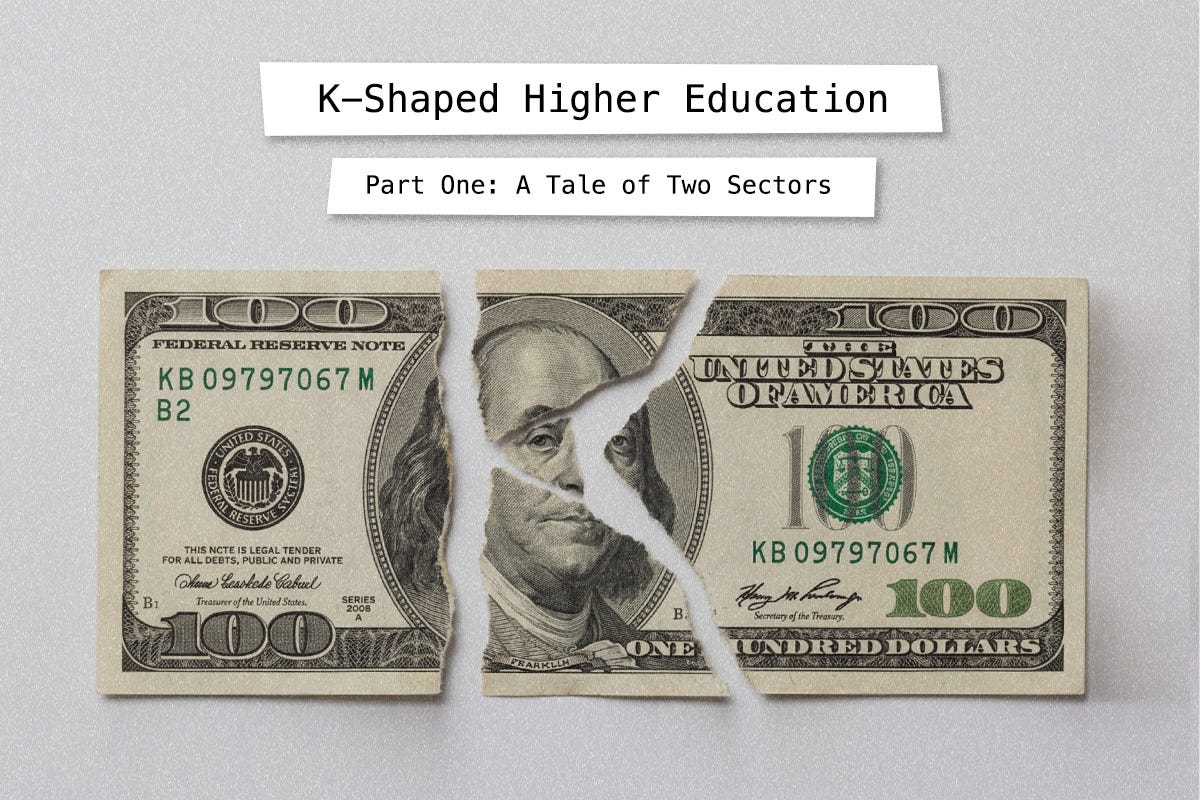
We are no longer working within a unified higher education system. Instead, we are witnessing a stark K-shaped divergence. As in the K-shaped economy, the K-shaped higher education system is fundamentally reshaping who succeeds, who gets left behind, and who pays the price.
To understand the crisis facing postsecondary education, we must first acknowledge that the sector is mirroring the economic fractures tearing through the country. Readers of The Wall Street Journal, The New York Times, The Economist, or Business Insider over the past several years will have noticed a consensus on what economists call the K-shaped economy, characterized by the wealthy getting wealthier and everyone else sliding into financial stress and debt.
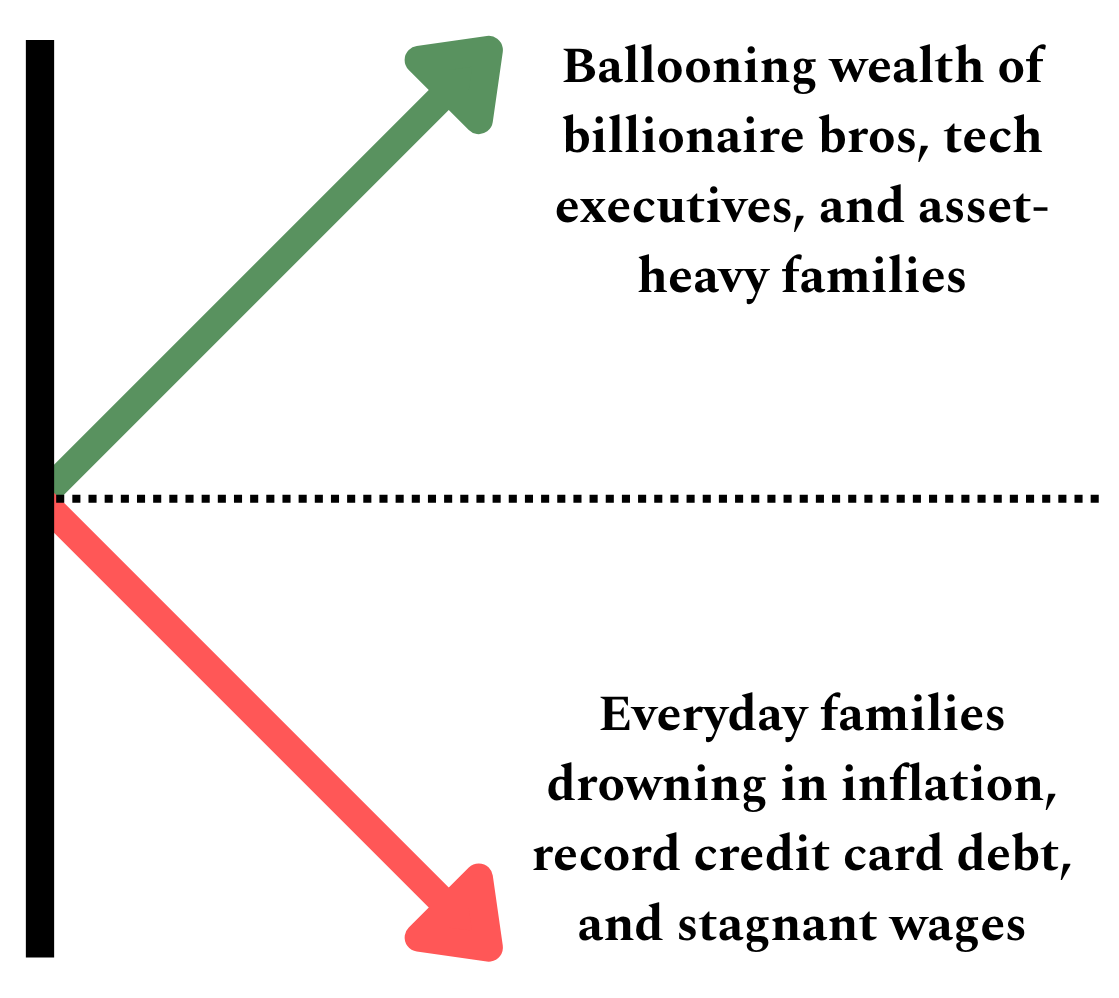
In the broader economy, the upper arm of the “K” captures the soaring fortunes of tech executives, asset-heavy families, and billionaire investors whose capital grows and compounds effortlessly. Their wealth is detached from everyday economic vulnerability through equity, capital gains, and high profit margins. Some have argued that this vast wealth even allows its holders to transcend the laws of the nation-state itself, storing assets abroad and increasingly escaping to international waters (the most famous example being the annual New Year’s gathering of superyachts in St. Barts).
Meanwhile, the lower arm of the “K” captures the exhausting, persistent instability of working-class families, service sector employees, and small business owners drowning under the weight of inflation, record-high credit card debt, and stagnant real wage growth. Their livelihoods depend on paychecks that can’t keep pace, leaving them like rafts buffeted by the slightest shift in the weather, at the mercy of forces beyond their control.
Far from a rising tide that lifts all boats, a K-shaped economy deepens inequality by causing market gains to accrue almost exclusively to the top while the majority of the population struggles just to scrape by.
The higher education sector is no longer merely analyzing this disparity from classrooms and research labs. It has replicated it, dividing the system into its own unmistakable K-shape.
The Upper Arm of the higher ed “K” is made up of a tiny handful of elite institutions hoarding multi-billion-dollar endowments, influential corporate networks, and immense cultural capital. Just as McDonald’s has been deemed a massive real-estate company that sells burgers, and Starbucks a bank that sells coffee, elite universities operate as tax-sheltered asset management firms with highly selective classrooms attached.
The Lower Arm of the higher ed “K” is comprised of tuition-driven institutions with few resources: underfunded regional public universities, community colleges, and broad-access institutions (BAIs) that admit high percentages of applicants. As I explain in Capitalizing on College, these schools operate in a state of perpetual financial triage, managing deferred maintenance while relying almost entirely on volatile tuition revenues to keep the lights on.
This bifurcation has produced a deeply cynical arrangement around equity and access. The elite institutions on the upper track claim the moral high ground by offering a polite “hat-tip” to access as they admit small cohorts of marginalized students, while also welcoming wealthy students who have learned to gain entrée by leveraging admissions resources like consultants, early admits, test prep programs, and donations available only to a select few.

Meanwhile, the work of providing educational access is actually shouldered by mission-driven institutions on the lower track. These are the schools in the trenches doing the heavy lifting of providing educational opportunity but with a fraction of the resources.
How did U.S. higher education arrive at this stark divide? Our K-shaped system was engineered over decades through market-oriented policies and practices affecting institutional wealth, income, and work.
Seventy-five percent of the endowment wealth in U.S. higher education is held by 10% of institutions. These elite colleges and universities maintain robust fundraising divisions focused on maintaining access to wealthy donors and maximizing the rate of return on institutional investments. In traditional philanthropy, wealth attracts wealth, and “scale” refers to the size of the gift bestowed by mega-donors—typically hundreds of millions, sometimes even billions. Elite institutions maintain monopolistic access to mega-donors, commanding headlines with gifts like the $400 million Kluge gift to Columbia, the $1 billion Doerr gift to Stanford, or the $1.8 billion Bloomberg gift to Johns Hopkins. Traditional philanthropy works well for affluent universities, but not for most.
In 2022, half of all independent institutions had endowments of less than $10 million, while the median endowment for public institutions was only $3 million larger. With only a few philanthropists like Mackenzie Scott who strategically focus on large gifts to institutions in need, the leaders of tuition-driven colleges must turn to innovative approaches rather than the methods of Harvard and Yale. In a classic case of necessity being the mother of invention, when faced with seemingly insurmountable financial constraints, some tuition-driven institutions turned to their sole asset to build their endowments—their students.
At some point over the last half-century, our system became comfortable with accumulation. We allowed elite institutions to transform from centers of learning into engines of wealth preservation. By allowing a tiny circle of institutions to operate as tax-exempt hedge funds, we separated institutional wealth from public benefit. These schools do not use their billions to expand enrollment or lower costs for students. Instead, they hoard assets to protect their prestige and preserve their place on the upper arm of the “K”.
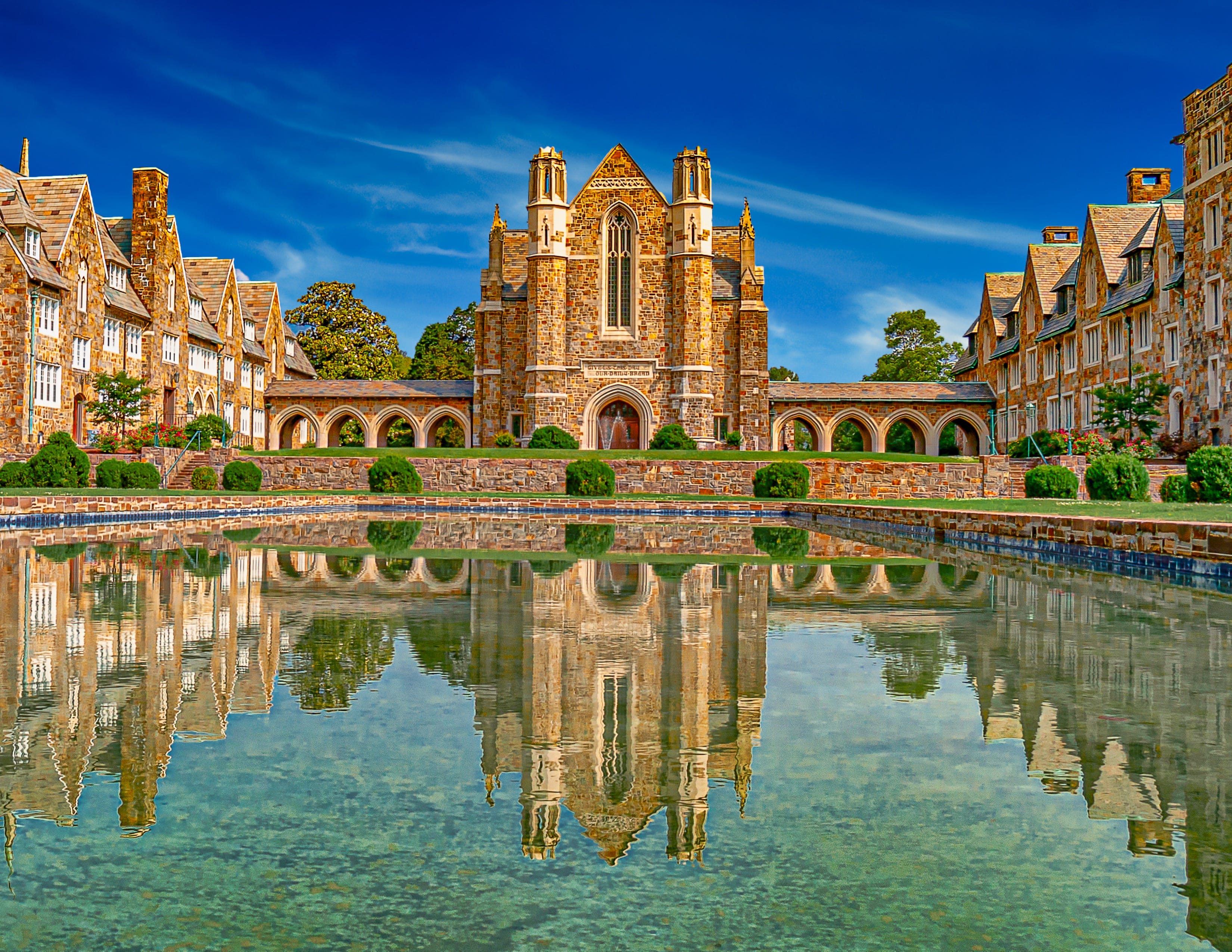
The financial models of the upper and lower arms are fundamentally unequal. Elite and research institutions draw on five primary sources of revenue that serve as their financial engine: tuition, the endowment, executive and continuing education, philanthropy, and research support. They have access to a diverse array of revenue streams and place greater emphasis on maintaining this access than on expanding enrollment—work that falls to those on the lower arm.
Stemming from a mid-20th century shift toward market-oriented policies, the colleges and universities on the lower track rely almost entirely on a single, unstable revenue stream: tuition. They lack access to philanthropic networks, do not possess research infrastructure or the ability to capitalize on the intellectual property it produces, nor do many of them have robust endowments to subsidize operational costs or institutional aid for students. When the national economy suffers, the institutions on the lower arm also suffer. While institutions can develop strategies with varying success to address enrollment fluctuations, most are floating untethered in the harbor, rising and falling with the tide.
The division of labor is also unbalanced. Elite universities do the work of prestige preservation, networking, and legacy continuation—defining their quality not by who they educate, but by how many thousands of qualified applicants they reject. Broad-access institutions, meanwhile, shoulder most of the actual burden, often admitting the least prepared, most financially vulnerable students.
When mid-century market-oriented policies were established, access was expanded to new student populations: first-generation, adult, female, low-income, and racially underrepresented students, ushering in a “Golden Era” of growth in higher education. (You can read more about this in a previous article here.) However, since the gates of the elite universities stayed shut, these populations were segregated into the underfunded lower track, leaving them to navigate the highest-risk, debt-fueled pathways of modern higher education.
The structural crisis of American higher education is not an accidental glitch in an otherwise healthy machine. Just like in the broader national economy, the sector’s K-shape is the predictable outcome of market-driven policies that have operated long enough to distort and displace their original intent.
Like the proverbial frog that has not noticed the warming water, we have reached a boiling point. The rising tide isn’t lifting all boats, and pretending that market competition will magically resolve a deeply fractured system is a dangerous fantasy. Well-intentioned local tweaks, single-campus retention initiatives, and minor administrative adjustments will not fix a sector where wealth is concentrated at the top and risk is offloaded on the rest.
In Part Two, we will look at what a 1949 disaster can teach us about engineering during a crisis and the radical changes required to rebuild a sustainable model for the future.

Issue Soundtrack: K by Night Rider 87
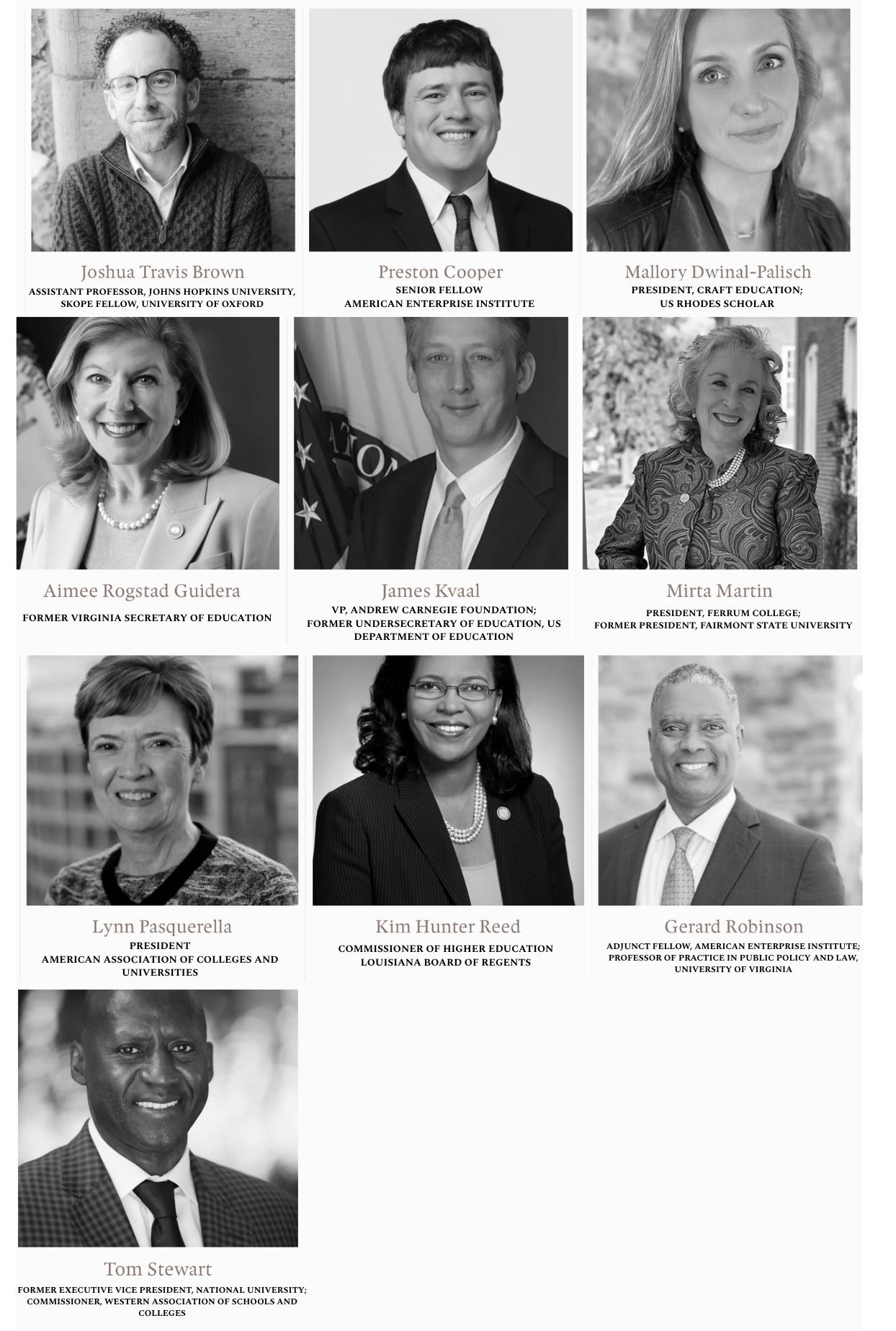
Professor Brown Goes to Washington: We had an amazing time at the American Enterprise Institute (AEI), where Gerard Robinson and I recently hosted the summit “Leading Colleges and Universities in a ‘Back to States’ Era” with the dozens of diverse students, administrators, policymakers, and philanthropists, lobbyists, and researchers who attended. Here is some early feedback from attendees they posted to social media:
“[The summit] felt like what I imagine coming to an oasis after trekking through the desert must feel like.”
“This experience strengthened my capacity to synthesize complex policy conversations and interact with former college presidents, trustees, deans, faculty, employers, and nonprofit executives.”
“I left…feeling optimistic that we can use this moment in time to ensure higher education continues to be the vital institution for our civic, economic, and national well-being.”
“I am buoyed by the mission focused solutions offered…”
“It was refreshing to hear from diverse political and institutional perspectives, and importantly, from students as well.”

Comments
Nothing yet. Say the first thing.
Sign in to join the conversation.