
1970 — Appalled by the surrender of their own bishops to the swelling tide of legalized abortion, a band of Catholics determines that someone must go beyond words in opposing “the country’s blood lust.”
But who?
“Us, perhaps?” they answer themselves.
Driven by an insistent urgency, the group, led by L. Brent Bozell, Jr, and broadly affiliated with the magazine Triumph, plan a direct action. They are surprised to find themselves borrowing tactics and certainty from the New Left and Catholic Left of Dorothy Day and the Berrigan brothers. They choose a date: June 6. For a group highly attuned to symbolism, the date carries no special import; it’s a Saturday, because Saturdays are high-activity days for abortion clinics, and it’s as soon as they can manage. The aim is to find a clinic – they select one on the George Washington University campus for logistical and safety reasons – and engage its director with the demand to halt abortions, or at least let the group baptize and bury the remains of aborted fetuses.
Staff from Triumph mail subscribers and others sympathetic on the East Coast announcing their plans. Students from a small anti-abortion group “The Sons of Thunder” – really an off-shoot of the Triumph circle – with chapters at Catholic universities in Dallas, Detroit, and Philadelphia plan to attend. Their stated goal is to “prevent the killing of babies.”
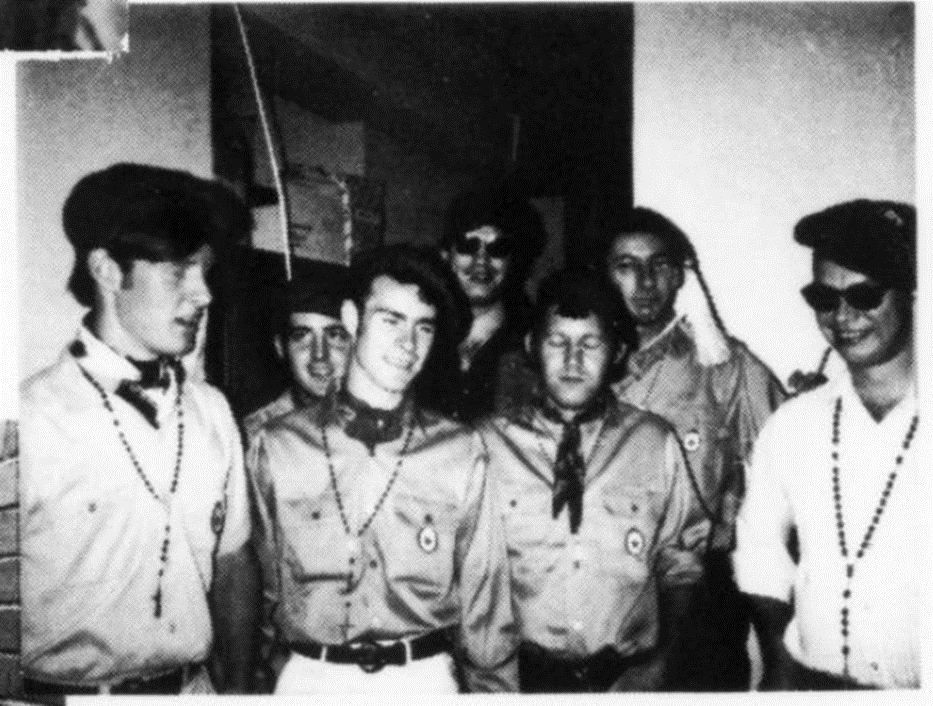
At 9:00 a.m. on June 6, protestors arrive for Mass at St. Stephen Martyr church, an auspicious patron for those engaged in direct action, on Pennsylvania Avenue. Those present lean into the Church’s powerful capacity for symbolism. Four priests of different races wearing the red robes of martyrdom concelebrate the Mass of the Holy Innocents– a solemnity commemorating King Herod’s tyrannical massacre of Jewish boys in an attempt to eliminate Christ. Protestors carry papal flags, signs, wooden crosses, and processional crosses borrowed from other parishes. Fourteen Sons of Thunder ape Spanish Carlists by wearing red berets with khaki uniforms and hanging rosaries around their necks.
The exact number of people who followed Bozell from the church toward the clinic is difficult to determine; estimates suggest at least 70, though some accounts claim as many as 300. Before a statue of George Washington, 20-year-old Michael Schwartz, one of the Sons of Thunder from the University of Dallas, speaks about the dignity of life and the imperative of “one hundred generations of Catholics” to make a stand. A 26-year-old pregnant mother of three, Mary Jo Lawrence, wife of a Triumph editor, speaks about the Virgin Mary and the Incarnation.
Then Frederick “Fritz” Wilhelmsen gets up to speak. At 47, the slender and dark-eyed Wilhelmsen is a philosopher and professor at the extremely conservative University of Dallas. Born in Detroit, he has adopted Spain as his patria and Carlism as his cause. Wilhelmsen’s “body and face contort with rage” as he contemplates abortion. “America – land of the scraped womb. You are about to abort your future because you are daggering to death your unborn tomorrow. The very cleanliness of your sterilized murder factories gives off the stench of death,” he laments. With a prayer, he lays his palm on a silver cross. “We take upon ourselves this morning, and we swear not to lay it down in our lifetime, the Holy Cross of Crusade against the enemies of life and its Creator,” he prays. “Dear God – give us the grace to embrace this Cross.” Coming to a close, he intones in Latin, “Christus vivit. Christus regnat. Christus imperat.” With that, Wilhelmsen gives the battle cry of his adopted Carlist cause: “Long live Christ the King! Viva Cristo Rey!” It’s an alien phrase to the American crowd, but the Sons of Thunder encourage the chant.
When Bozell, Triumph’s leader, speaks, he too evokes the idea of Christ the King. In the next hours, we hope to save a few children,” he says. “We intend to raise a symbol. We are certain of doing our duty as Christians.” Donning a red beret and taking up a wooden cross, Bozell declares, “We leave now to rescue the King” as he and those gathered march toward the clinic.
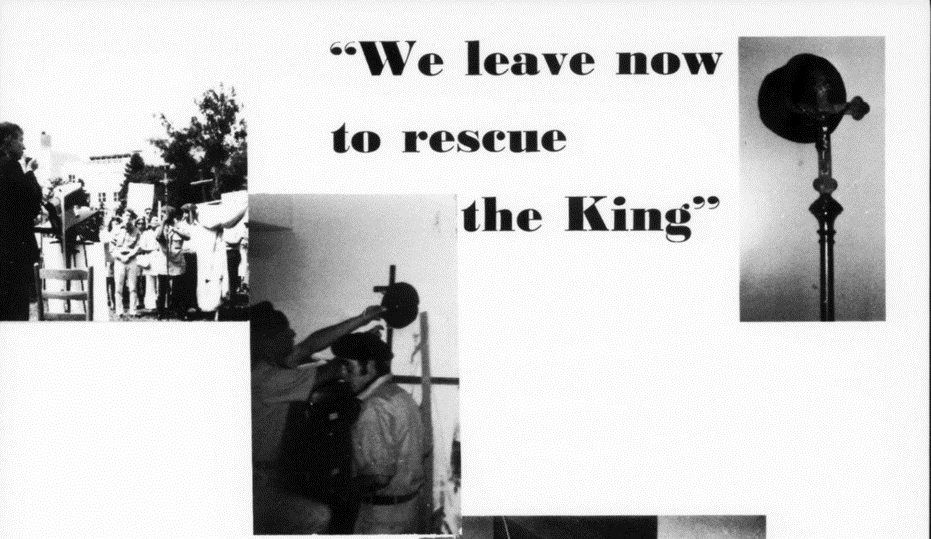
Bozell and a handful of young men approach the clinic door, blocked by a student campus guard. As the guard tries to block the door, Brad Evans, a 6’5” former football player for the University of Louisville and a speechwriter for Kentucky’s Goldwaterite Congressman Gene Snyder, rushes the frame and jams a wooden cross in the gap. Bozell’s son, Chris, another Son of Thunder, grapples with the guard. The half a dozen men gain entry to the clinic and Bozell approaches the desk to explain their mission. By now police begin to arrive. The Triumph crowd later allege police brutality throughout, dealing out beatings with billy clubs. At some point, Bozell’s wooden cross breaks. Within ten minutes, each man inside the clinic has been arrested. Outside, the crowd prays the rosary and Chris Bozell picks up a fallen cross.
As the police bring the arrested protestors out, each acclaims “Viva Cristo Rey!” The crowd, newly baptized in the language of Carlism, shouts it back. “I don’t know what it was,” the Washington Post quoted a police officer as saying, “but it didn’t sound good.”
Brent Bozell, Charles Procida, a New York teacher who had traveled down to join the protest, and Joseph Baker, a founding Son of Thunder from Dallas, are charged with unlawful entry, destroying property, and assault on a police officer. Robert Harrington is charged with unlawful entry, destroying property and simple assault. Evans is charged with destroying property and unlawful entry. The Triumph group deny all violent charges. Evans’s boss, Rep. Snyder waits to see how it plays in Kentucky before ultimately firing him.
The Triumph circle’s self-conscious Carlism – the berets, the khaki, the crosses, the shouts of Viva Cristo Rey – has become the most enduring image of the magazine and its ethos. The magazine and the group it fostered ran for a little over a decade. While it began as an avowedly Catholic spinoff of the wider conservative movement, of which Bozell was a critical component, it became something much stranger and more radical. Its association, mostly via Wilhelmsen, with the last gasp of political Carlism became a symbol and even model of Catholic intransigence against modernity. Carlism approached what Bozell, Wilhelmsen, and their young followers desired. Triumph’s fortunes collapsed in parallel with modern Carlism, which allowed Wilhelmsen and Bozell to reckon, at last and incompletely, with the failures of reactionary despair and violence and to look for new ways of performing “Incarnational” politics.
Triumphistas
When Brent Bozell and his wife Patricia Bozell (the sister of William F. Buckley, Jr) began developing a conservative Catholic magazine in the summer of 1964, it seemed necessary for the moment. In the United States, conservative activists were ablaze with Barry Goldwater’s candidacy. Bozell had actually ghostwritten Goldwater’s path-breaking The Conscience of a Conservative. Among Catholics, 1964 marked the midway point in the Second Vatican Council, which fundamentally transformed the Catholic Church’s relationship with society and destabilized traditional believers in the short term. Conservative Catholics wanted an explicit voice to enter debates about theology, ethics, ecclesiology, politics, and whatever else, all of which seemed up for grabs. The magazine would joust with the much more liberal America and Commonweal.


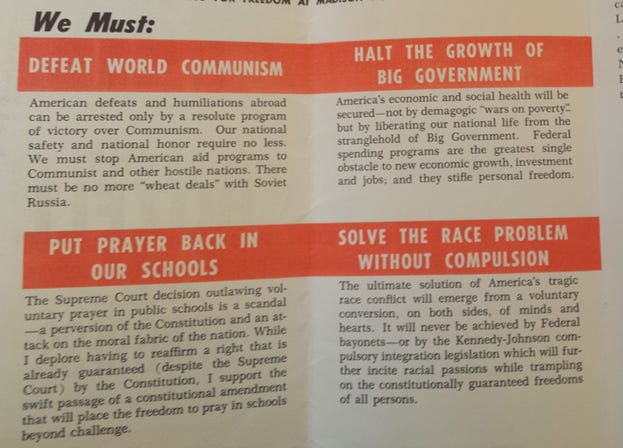
All involved or supporting Bozell’s efforts assumed, with good reason, the magazine would be a more sectarian National Review. Conservatives saw an easy confluence between American conservatism and Catholicism and Bozell had a fine pedigree within the movement. National Review saluted the project, Buckley paid for 100 subscriptions, and a form letter went out under Goldwater’s name that praised the “brilliant group of Catholic laymen” and highlighted the “vital need for such a magazine.” The magazine, initially to be called Future (an implicit defense against charges of nostalgia and traditionalism) but changed to Triumph, would provide a “unique and vital role for the entire conservative movement. Only by having a stirring and effective voice in defense of the Christian West, can we hope to defeat our common enemy.” The reference to “Christian West” suggests Bozell initially approached the magazine from a Christianized but essentially Cold War perspective he had once propounded from the stage at a Young Americans for Freedom rally in Madison Square Garden and had been central to his failed congressional campaign in Maryland.
A funny thing happened, though. While the Catholic Church slowly but generally affirmed the orthodox positions the Triumph editors favored, Bozell, Wilhelmsen, and the wider circle turned against the American project. Triumph came to hold the position that the American republic had failed, and it failed because it was faulty from the outset. The United States had been built on the sand of liberalism, rather than the rock of the Church. Later, Michael Lawrence – Mary Jo’s husband – reflected that Triumph’s throughline was opposition to idolatry. As radical Catholics, they came to see America as the greatest idol of all – at least for their peers. “I think we have all noticed Brent’s new, apocalyptic mood,” noted a friend, Neil McCaffrey, at National Review to Buckley, Frank Meyer, and Garry Wills. “We all admire Brent and have argued with him, so I don’t suppose anything can be done,” McCaffrey continued. “But I think we should be clear-eyed (and nervous) about this development.” The more conventional conservatives at National Review regularly debated Bozell privately about the limits of Catholic politics. NR editor Jeffrey Hart later said Triumph “went sour” because “American Catholics are patriotic, and Triumph wasn’t.” He removed himself from Triumph’s masthead. But Bozell, Wilhelmsen, Lawrence, and the Triumphistas conceived of themselves as operating in a totally different political frame than the cramped fusionist conservatism. In two long open letters they declared their independence of – or transcendence from –the conservative movement. They were for God and the Church before the United States, first, last and always.
Opposition to abortion especially drove the growing chasm between the Triumph and National Review circles. In the late 1960s and early 1970s preceding Roe v. Wade, states rapidly liberalized access to what was known as “therapeutic abortions.” While conservative Catholics like William F. Buckley were personally anti-abortion, they sometimes equivocated in the late 1960s. Buckley hinted religious freedom meant the Church should ease up in its opposition to abortion law reform in the case of “maternal health, rape,[or] defect in fetus.” The column drove a wedge between Buckley and Bozell that never resolved. In another article in National Review, Clare Booth Luce warned against growing permissiveness, but asked how the prohibition of abortion could be sustained against the performance of 500,000 annual illegal abortions. While Luce asserted the fetal right to life, she argued the struggle had to be fought on cultural grounds.
The Triumphistas, meanwhile, made no concession on “the life issue.” To them, abortion and associated questions like birth control, pornography, and euthanasia were the violent corollary of liberal individualism and secularity. They would brook no compromise, and, like anti-Vietnam War protestors, could not countenance being part of a system that facilitated or paid for the destruction of human life. After the protest in Washington, Son of Thunder Michael Schwartz told a Catholic news service that the protest showed that “eventually Catholicism may be illegal.” It may come to pass that it becomes “impossible for Catholic to practice his faith and be good citizen,” especially if the government imposes mandatory limits on family sizes.
The numbers of effectively elective abortions devastated the Triumph circle and stunned National Review types. After its legalization in mid-1970, New York performed 100,000 abortions in under a year. The number of legal abortions grew nationally, rising from 193,491 in 1970 to 485,816 in 1971 (these numbers do not include abortions performed in California, New Hampshire, or Maryland which are not reported to the CDC).
As the mainstream conservative movement became more forthrightly anti-abortion, especially post-Roe, they primarily developed a legal strategy aimed at amending the constitution and, when that failed, overturning Roe. To Bozell and his circle, this approach was small bore: playing legal games when lives were at stake on a daily basis.
For their part, the National Review editors evinced “great sympathy” for Bozell’s “Happening” – note the allusion to New Left performative protests – at George Washington University, but called it “probably worse than useless” politically. Whatever the “virtues” of Spanish Carlism “in its local habitat, is surely exotic in the District of Columbia, and the Sons of Thunder can have moved precious few of the unconvinced over to their side.” Indeed, not even everyone at Triumph was sold on the protest. Before the march, a “bitter” editorial meeting had gone on in the Triumph offices. Like the National Review remarks, Carlist imagery was a sticking point. One of the senior editors, Gary Potter, recalled questioning whether they could “shake down the Anglo-Saxon state by chanting ‘Viva Cristo Rey!’” Potter obviously lost the debate. The Triumphistas soon embraced “Hispanic esoterica” further, leading Potter split from Triumph and found his own journal, Rough Beast.
Counseling against Hispanophilia was always going to be a losing battle for Potter. Bozell had been shaped by Francoist Spain during a formative period in his development in the early 1960s. The other major intellectual influence on Triumph, Fritz Wilhelmsen, embraced Spanish tradition even more.
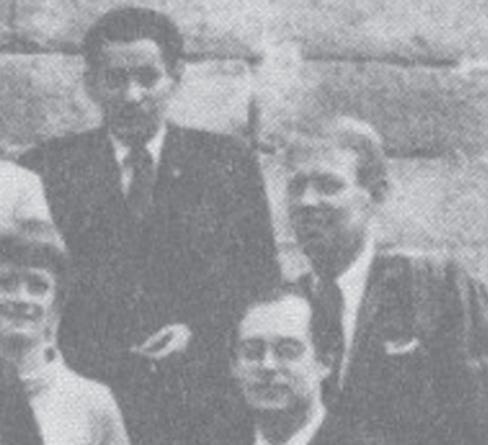
Wilhelmsen was a man out of time. A sensualist, he loved Baroque art and architecture, and smoked “flamboyantly” and drank wine and brandy copiously. Sometimes he wore a cape. Born in Detroit in 1923 and having lived on four continents, he ultimately considered himself a “citizen of Rome.” After studying at Catholic institutions in the United States and serving as a medic in World War II, Wilhelmsen earned his PhD on Maritain at the Universidad de Madrid. In Spain, he imbibed Spanish traditionalism. If every nation had a genius, Spain’s was its commitment to God and the Catholic Church. It had, after all, fended off the two great threats to Christendom, Islam and Communism. “The crescent and the hammer and sickle: ultimately they have but one common enemy, the cross of Christ and that civilization that took root and flourished from the wood of Golgotha.” Teaching at the Universidad de Navarra in Pamplona, a Carlist redoubt, Wilhelmsen became personally involved in the Carlist movement. He wrote a Carlist political treatise, knew Carlist militia commanders, and considered himself a Carlist. Together they were “traitors against the modern world.”
Wilhelmsen’s students at the University of Dallas, where he was chair of politics and philosophy remember him as a spectacular showman – “the greatest teacher I have ever seen.” He made followers of his students. The Sons of Thunder learned the Carlist romance of the red beret, the “Viva Cristo Rey” shout, and the Social Kingship of Christ from Wilhelmsen. Eager to act, in February 1970 – four months before the George Washington march – 24 students calling themselves the Sons of Thunder had disrupted a Planned Parenthood Center in Dallas. They prayed the rosary, and then when confronted they declared the clinic part of a “thinly veiled genocide against those groups which do not conform to the ideal of the middle-class white American.”
Carlism
The Carlists were not the only global actors Triumph had its eye on. The Triumphistas were reflexively drawn to extreme, even violent Catholic forces. In addition to the Carlists, Triumph supported other right-wing Catholic movements. In Latin America, they praised the generals in the Argentine Revolution and Pinochet’s coup d’état in Chile. They retroactively endorsed the French Army in Algeria. Here, the Triumphistas married the typical conservative Cold War mindset with a reactionary comfort with authority and a certain credulity toward avowedly Catholic leaders. The magazine’s support for the Provisional IRA during the Troubles in Northern Ireland, though, suggests a genuine sectarian embrace of Catholic or nominally Catholic extremism.
All the same, the Carlists held a special place for Triumph, having first mentioned the “Spain’s oldest and most cohesive political force” in issue one of volume one of the magazine. Bozell named the family compound in Virginia Montejurra after a mountain in Navarre, the site of an annual Carlist celebration. “By standards TRIUMPH honors,” the Carlist pretender Don Javier was the legitimate King of Spain. Carlism made real what Triumph dealt with in print. They were, according to the British historian Martin Blinkhorn, unquestionably the “classic example of a modern European traditionalist movement.”
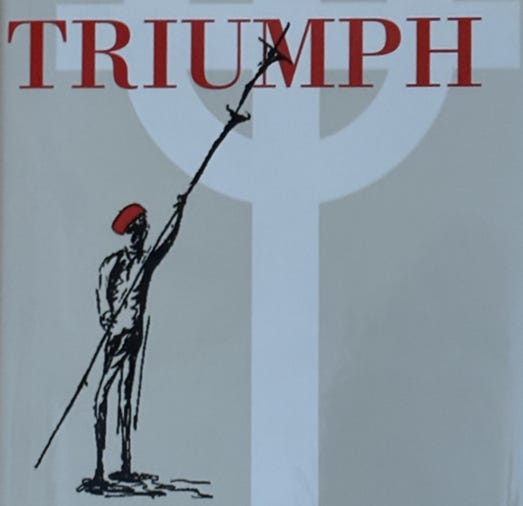
The Carlist movement was both a succession struggle with origins in 1700 and a popular revolt against Spanish liberalism, beginning in the early 1820s. In a series of wars, the Carlists supported a line of pretenders against the liberal Spanish Alfonsine monarchy in the name of “Dios, Patria y Rey” (God, Fatherland, and King). The Carlists posed a real military threat to the state until their battlefield defeat in 1876. But the “spirit of Carlism” lingered. The movement “offered the most sustained and extreme form of organized right-wing opposition to the institutions and values of a system which it regarded as doomed by the fundamental incompatibility of the monarchic principle with liberalism.”
As a political movement, Blinkhorn argues, they were reactionaries opposed, essentially, to the coming of modernity: “urbanism and industrialism, liberalism and capitalism, socialism and irreligion – in short the break-up of the ‘organic’ society idealized by the entire European traditionalist right.”
In Wilhelmsen’s words, “The Spanish Carlists, a mass of poor men constituting the immense majority of the nation in the nineteenth century, rose in three bloody rebellions against the centralizing, capitalist, Masonic government in Madrid-in the name of the rights of the Church and of the ancient liberties of the provinces.” The Carlists’ imagined, Blinkhorn says, an “‘organic’, participationist, harmonious” polity “lacking a powerful state machine and united by a consensus based upon voluntary religious uniformity.” Blinkhorn sees in the Carlists the classic dilemma faced by reactionary traditionalists. Namely, how do they reverse history to restore the – no doubt idealized – past that is constantly receding?
In a sense, the Carlist intellectuals, of whom Wilhelmsen was a descendant, were attempting to reconstitute the medieval order after its fall. This sort of postlapsarian project is to some extent intrinsic to conservative or traditionalist thought. Medieval defenders of the traditional order were in a way unaware and under-gunned. To them, the ancien régime represented the ordinary order – as normal as breathing. To some extent, a socio-political order requires, the challenge of an antithesis to find the analytic frame and language to articulate its own, non-tautological defense. Living in the modernizing nineteenth and twentieth centuries, the Carlists possessed a battle-hardened analytic frame. Further, they had the lived experience of the negatives of modernity and a nostalgia-inducing distance from the medieval order.
By 1931, the Carlists were at a low ebb. A revival would require mass conversions and a collapse in legitimacy of the Alfonsine monarchy. The anticlerical Second Republic revivified Carlism, especially in Navarre, but across the country. By 1934, the newly christened Comunión Tradicionalista had reunited competing Carlist factions and boasted 540 circles, 803 youth sections, and maybe 350,000 members. The Carlists were the elder brother of a wider “catastrophist right” that saw no compromise with the Spanish Republic and sought its destruction. The rival Alfonsists and the much larger fascists ritualistically lauded “Carlism’s heroic role in the war on liberalism, and having done so consigned it well and truly to the scrapheap of history.” For their part, the Carlists dismissed fascism as “a rootless and irrelevant foreign import, superfluous in a nation already blessed with the Traditionalist Communion.”
One of the key points dividing the Carlists from other extreme right factions was the question of centralization versus regional devolution. The Carlists were deeply wedded to their fueros or traditional local rights and privileges. Anti-centralism was a pre-modern aspect of traditionalism setting the Carlists apart from the modernist extreme right of fascists and primoderiveristas, and even Alfonsist monarchists. Among the monarchists, the Carlists were traditionalists and decentralizers; the Alfonsists were liberal and centralizing. Blinkhorn points out that the Carlists’ opposition to the centralized state brought them face-to-face with the problem of achieving their desired regime. By the mid-1930s, leading Carlists “began to toy with the authoritarianism which was, in the final analysis, the only way out of their dilemma.”
To destroy the Republic, the Carlists prepared for violence, training militias, the red-bereted requetés, and seeking support from fascist Italy. They attempted to strike up relationships with the decisive power on the right, the Army, and were kept at arm’s length. The Carlists would not lead the coming crusade against the Republic, but their militias were so tightly wound they would almost certainly fight when the conflagration erupted.
When the coup came, Carlists in Pamplona celebrated in a street festival, chanting Viva Cristo Rey! While the Army was the supreme authority among the Nationalists. The generals most sympathetic to Carlism died early in the conflict and Francisco Franco consolidated his authority and questions of the future governing order of Spain were largely postponed until the end of the war. The Carlists concluded that the “spirit of Carlism” animated the Nationalists, “albeit within a potentially dictatorial framework essentially alien to Carlism.” According to Paul Preston, in the war, the requetés were “often guilty of barbaric excesses.”
In the end, throwing in with the Nationalists had mixed results for the Carlists. Obviously, their favored monarchic line was not restored, and their role in the Francoist state steadily diminished. Whatever new Carlist strength that had flourished outside their Navarrese stronghold evaporated. At the same time, the Republic and wider Left had been crushed, and Carlists, or Carlist-informed thinkers, had considerable sway over the state’s arch-Catholic religious and educational policy. The canny Navarrese also won semi-official status for themselves.
By the time Triumph began publishing, Franco’s rule had become sclerotic and the side-lined Carlists restless. The magazine covered how a dispute over Basque Country autonomy had spread to include Navarre’s relative independence. The Carlists’ opposition to a centralized state was undoubtedly part of the appeal to Americans reared in the conservative movement in the 1950s and 1960s. Triumph literally called the Carlists’ demand for their fueros a “states’ rights issue.”
Throughout the entire run of the magazine, the Triumphistas consciously or not treated Carlism as both a model for the integrated religious politics they wanted to practice and as a bellwether for its possibility in the modern world. The magazine’s launch coincided with a latter-day high point in Carlist demonstrations when 150,000 people attended the annual rally at Montejurra in 1966 to demand regional fueros (up from 9,000 a decade earlier).
Bozell and Wilhelmsen have been called Francoists, and in a sense they were. But their allegiance was truly with Carlism When it became clear that Franco would elevate the Alfonsine prince Juan Carlos over their favored Carlist candidate and suppress Carlist demands for autonomy, Triumph editorialized despairingly in 1969:
Thousands of red-bereted Carlists marched through the city singing and carrying banners of the national colors and of the Requeté, the Carlist military arm that put 100,000 men into the field against the Communist Republic during the Civil War. The protesters were attacked by phalanxes of club-swinging police who trampled underfoot the Carlist national banner emblazoned with the Sacred Heart of Jesus. The resultant chaos was Chicago all over again; but this time it was zealous Catholic adherents to the oldest Catholic political movement in the West who were beaten by the police of Catholic Spain.
Theorizing Carlism let the Triumphistas think about how they understood politics themselves. Drawing on Francisco Canals Vidal, a Spanish thinker in the Carlist orbit, Wilhelmsen depicted Catholic theological and political thought as a unified and coherent whole. It stood outside the dialectic of left-wing modernist challenge and right-wing reaction. Authentic Catholic thought, he tentatively began to suggest, had been co-opted by those trapped in the dialectic. “Catholic politics everywhere have either been drowned in beer and good talk, the fate of Chester-Bellocian Distributism; murdered, as was Dollfuss by Nazi gunmen, because the moment was not ripe; or cynically used as instruments for the restoration of liberal capitalism, as was the Carlist Requeté by Franco,” he wrote. Strongmen like Franco, Pinochet, or the Argentine generals might be heroic bulwarks against Communism and liberalism. But trapped in the modern dialectic, they “fall back into the hands of their sworn enemies once they are in power.” The way out is a unified Catholic politics. “Viva Cristo Rey.”
The Triumphistas like their Carlist models faced the precise dilemma Blinkhorn identified. How do they effect their ideal regime – really, how do they have a political impact – in modernity where the underlying structures of a unified religio-cultural worldview have vanished? In politics, radical traditionalists will either have to resort to centralization and coercion, or face functional irrelevance. In the 1930s, the Carlists had joined the Nationalists and later the Francoist state. This left them in what Triumph termed “the Communion’s classical situation: the King over the border unless and until he returns at the head of his troops.” Lacking a political or cultural base of support, the Triumphista situation was more pronounced. Their hopes were placed not in a pretender, but in Christ the King; not in a king across the border, but one in Heaven whose return they expectantly await. Compared to, say, National Review or the New Right, the Triumphistas’ politics were increasingly symbolic, personalist and radical.
Exiles from Modernity
Less than a month after the George Washington University demonstration, the core Triumphista group departed the United States for Spain. They left behind the sterile commercialism of Nixonian America and found themselves in the shadow of the baroque fortress monastery of El Escorial. Like bohemian Americans in 1920s Paris, they had found their true, albeit temporary home, at the annual Christian Commonwealth Institute summer school. They would spend eight weeks there, a sojourn the Triumphistas would take annually for the next five years.
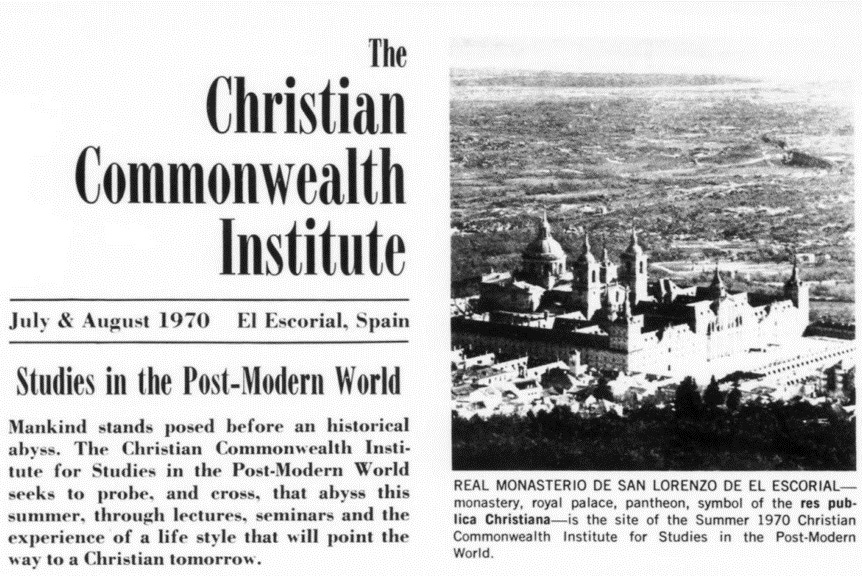
At each summer school, fifty or so students would live a unified Catholic life under Wilhelmsen and Bozell’s tutelage. The students learned theology, philosophy, metaphysics and they prayed and ate and travelled and met with requeté veterans. What began, for the Sons of Thunder, as a classroom lesson, was consummated in the real redoubt of Christendom. One student was said to have been expelled from Spain for being too vociferously Carlist (and therefore critical of Franco). Supposedly 70 students found religious vocations as part of the summer school. The football-playing protestor Brad Evans’ son was born in El Escorial.
Spain nourished the Triumphistas as radical exiles from the United States. “I urge this afternoon, my dear friends, that you go home and attack – attack on all fronts,” Wilhelmsen told the departing students after the 1973 summer school. “We will make America Catholic as the conquistadores made half the world Catholic,” he continued, “and if we do not we will have had the satisfaction of having served the King.” Even so, the Institute’s anti-Americanism wasn’t to everyone’s taste. One student exposed it to Buckley in a letter, which Buckley published in a best-selling book. “It was grim, like the prose in Triumph — where every phrase is a funeral,” wrote the student. The school was apocalyptic and relentless. He noted that while few were openly bigoted – mentioning while not quite alleging anti-Semitism – their views were never denounced.
Unlike the summer school, the Sons of Thunder were relatively short-lived. Concerned by the publicity and violence, the University of Dallas administrators threatened to expel the Sons of Thunder that had demonstrated in Washington, including Bozell’s son, Chris. Seven cardinals and William F. Buckley stayed their hand.
Having lost his job for Rep. Snyder, Brad Evans became an editor for Triumph and the national coordinator of the Sons of Thunder. He grew his hair long and wore a rosary and St. Theresa medal around his neck. In late 1970, Evans and other Sons went to the Hilton hotel that was hosting the National Catholic Bishops Conference and won a meeting with two bishops. Evans asked for money from the bishops’ $50 million anti-poverty Human Development Campaign. The Sons wanted to build a nationwide program of counseling and care for women considering abortions. On the same day as the meeting, the Sons telegrammed the head of the conference saying “rescuing babies now being killed” is “a cause which screams for a Christian response – rather than tacking a few million to the cumbersome poverty war.” Thinking out loud, he told a newspaper “we could buy explosives for the blowing up of hospitals where these baby murders take place.” They would have to “make sure that there were no people in the hospitals when we did this,” he added. In April, 1971, the Sons of Thunder were talking about opening ten crisis pregnancy centers, having started one in Dallas and finalizing another in Georgetown.
The Sons of Thunder led another protest, this time in Manhattan, at Christmas in 1971, leading to further arrests and, for some, jail time. Under pressure from the University of Dallas, disputes over the legitimacy of the United States, and with key members graduating, the Sons of Thunder petered out by 1973.
Both Carlism and Triumph too were under severe pressure in the mid-1970s. The magazine entered 1975 with a dwindling subscriber base of around 5000 and sizeable debts. In Spain, the Carlist regent Prince Carlos-Hugo shifted his movement in a radical, socialist, and independence-oriented direction. Both were in the process of collapsing.
At 50, Fritz Wilhelmsen, the American Carlist, had seen modernity’s unrelenting victory. The self-proclaimed champions of Christendom had amounted to very little. The Carlists had failed. “Argentina today still waits on the sacramentalizing of her political and social order even as Spain seems hell bent on desacralizing her own,” he lamented.” “The beads of failure marking Catholic politics in our time could be extended into a rosary of desolation.” Had they failed Christ or had Christ failed them? Had they “bungled” their chances, or was modernity too vast, too overwhelming? “This last conclusion, of course, is the mark of Integrism,” remarked Wilhelmsen. And in a pair of essays later collected in The Best of Triumph, he searched for a pathway beyond the traditionalist temptation to despair.
Integrism had many meanings in traditionalist factionalism, Wilhelmsen noted, but in these essays he meant a kind of psychological “total intransigence against the going order.” When it turned its followers down self-righteous blind alleys, it was an “aberration”; “when entertained consciously, it is a sin.” A key source of Integrist unreality was idealizing political forms – usually the medieval social order. When, inevitably, that order cannot be revived (even with the violence or coercion Martin Blinkhorn argues is ultimately the traditionalists’ only choice), Integrists turn inward and toward embittered and ornate symbolic personal politics. “Integrism is elitist by nature,” Wilhelmsen wrote. It is “excessively moralistic,” paranoid, and perversely makes its adherents less authentically Catholic in their politics. Integrism was attractive – as Wilhemsen knew. He could have been describing the Triumphistas. But it was insufficient.
The mistake Integrists made was assuming the “ground” – the historic social order in which their idealized Catholic world flourished – was essential to an Incarnational, sacralized politics. It was not. And, indeed, the lost ground could be reborn as a potent aesthetic or liturgical symbol pointing toward a new Christ-like politics. Their power would come from their contrast to modernity. “Restoration of the pastoral life as the ground of society is not merely practically difficult; it is theoretically impossible,” Wilhelmsen mused. “For a symbolic figure can alter the going ground of society only insofar as and for as long as it remains a figure, a contrast.”
Wilhelmsen observed the nascent electronic era and saw reasons to hope. As a spoken and imagistic faith, rather than a written one, Catholicism might especially well-suited to the coming culture and forms of television (and later, we might add, the Internet). The personalist and relational elements of Christianity (embedded in the Trinity) are “uniquely at home” in a culture where “personal loyalty tends to dominate the going political order.” As such, “the technical ground is ripe for a Catholic figure, for an incarnational politics.”
And yet, Wilhelmsen admitted to being “haunted by the scars of our defeats, by my fear that Catholic traditionalists –and I am a Catholic traditionalist; indeed, I am a Carlist – will not respond to this splendid moment in time.” They would be paralyzed by Integrist despair or waste time “condemning the wrong things or condemning the right things for the wrong reasons or simply return, unthinking, to the mainstream political culture. His heroes, Alfonso Carlos, General Onganía, Dollfuss, Colonel Stauffenberg had lived (and often died violently) for the politics Wilhelmsen believed in. “They, at least, had the honor of stitching banners to Our Exiled King in their hearts.” What would Wilhelmsen’s readers have? The “ground,” to use Wilhelmsen’s term, had changed, both in the United States and in Spain.
The last full issue of Triumph ran in July, 1975. Its masthead included Michael Lawrence, now as editor, with Brent and Patricia Bozell, Wilhelmsen and Brad Evans rounding out the core. The magazine had missed its fundraising goals; they suspended publication.
The deeper cause of Triumph’s end, however, was that Brent Bozell, the driving force behind the entirety of the Triumph project, was deeply unwell. Experiencing bipolar disorder (possibly starting, undiagnosed, much earlier), Bozell went into a deep depression in summer, 1975, that crippled Triumph’s prospects. Bozell’s depression was soon followed by a manic episode in early 1976 wherein, animated by a desire to bring Latin Catholic energy to North America, he left Virginia for Guatemala.
Sam Tanenhaus argues convincingly that Bozell was one of the critical strategists and activists of the early conservative movement. Bipolar ended his political-intellectual career. Bozell’s drive and desire for action were evident in the Triumph circle. Now these strengths became liabilities and took a severe toll on the Bozell family. Montejurra had to be sold. Bozell died in 1997. His last years were ones of failing health and deep personal holiness.
When Franco died in November, 1975, Juan Carlos, with whom National Review had cultivated links, became King of Spain. As expected, he began the process of democratizing Spain. While National Review looked forward to morning in America and Ronald Reagan, it was for Triumph, twilight in Spain. The remnants of the Carlist line split bitterly over Carlos-Hugo’s socialist direction. Fearing a populist left-wing independence movement, Spanish security services and right-wing Carlists brought gunmen from the Italian, Argentine, and French-Algerian extreme right to the annual Carlist celebration at Montejurra. On May 9, 1976, neo-fascist gunmen killed two left-wing Carlists and wounded three. In a tortuous editorial in Triumph’s brief successor newsletter, the editorialist – either Gary Potter or Wilhelmsen – ambiguously evinced support for Carlos-Hugo and worried about the violence. Could American Christians “insinuate their ideas into society by the old means and symbols? If they elect new means and find new symbols, what response will they meet?” Carlism evaporated post-Franco, democratic Spain. Partido Carlista won no seats in the 1979 election. At last, Carlism had become pure symbol. For the Triumphistas, it always had been.
Epilogues
The summer school Bozell launched, the Christian Commonwealth Institute, long outlived Triumph. Its administrator, Warren Carroll, expanded the vision of the Institute. In 1977 he co-founded Christendom College, a four-year liberal arts college in Virginia, near the old Bozell home. In 2017, students from Christendom protested an abortion clinic in Falls Church. Christendom dedicated an enormous new chapel to Christ the King in 2023.
The key Sons of Thunder took strikingly different paths. Mike Schwartz, who spoke at the rally in 1970, became a pro-life leader. To him, Triumph “became the seedbed for the pro-life movement of the 1960s.” He co-founded the March for Life, worked with the New Right architect Paul Weyrich, and served as chief of staff to the deeply conservative Senator Tom Coburn. Schwartz died of ALS in 2013, aged 63.
Chris Bozell entered business in Houston, working in commodity trading.
Joe Baker was ordained a priest in 1986. Possessing a heart for the poor, he founded a charity that fed and clothed the homeless in Arizona. He died, aged 59, in 2007.
Brad Evans, the football player who jammed his cross in the clinic door and later mused about bombing hospitals, followed the elder Bozell to Guatemala, abandoning his wife and children. Somehow Evans got involved in paramilitary activities or arms running or drug running or all of the above. He died of a cocaine overdose in 1986. His estranged son, a novelist, called him “the worst catholic in American and one of the finest drinking partners this side of the cross.”
Carlism and its American imitators stand as a warning to our contemporary Catholic political thinkers. The temptations of Integrism, despair, and authoritarianism are constant for those who seek to build a kingdom for Him whose Kingdom is not of this world.
No posts
Comments
Nothing yet. Say the first thing.
Sign in to join the conversation.