
It’s well known, to the point of cliché, that the CIA funded literary and artistic groups and endeavors during the high point of the Cold War. At one point, the CIA was responsible for half of grants outside the “Big Three” of the Ford Foundation, Rockefeller Foundation, and Carnegie Corporation – covertly, of course. The liberal anti-Communist front organization regime collapsed in 1967 when, having gone slack, the paper trails by which the CIA laundered its payments were unraveled by the New York Times and the New Left magazine Ramparts. Exposed and often unwitting, liberal anti-Communists were left holding the bag. “What about the credibility of our most eminent intellectuals?” wondered Christopher Lasch in the Nation. What, indeed.
In some hands, this story, by turns admirable, comic, sinister, and tragic has become part of a mythologized CIA. This narrative reduces not only the complex thought of Cold War liberalism, but also midcentury artistic and literary developments, to a “psy-op” performed by a monolithic and undifferentiated American deep state.
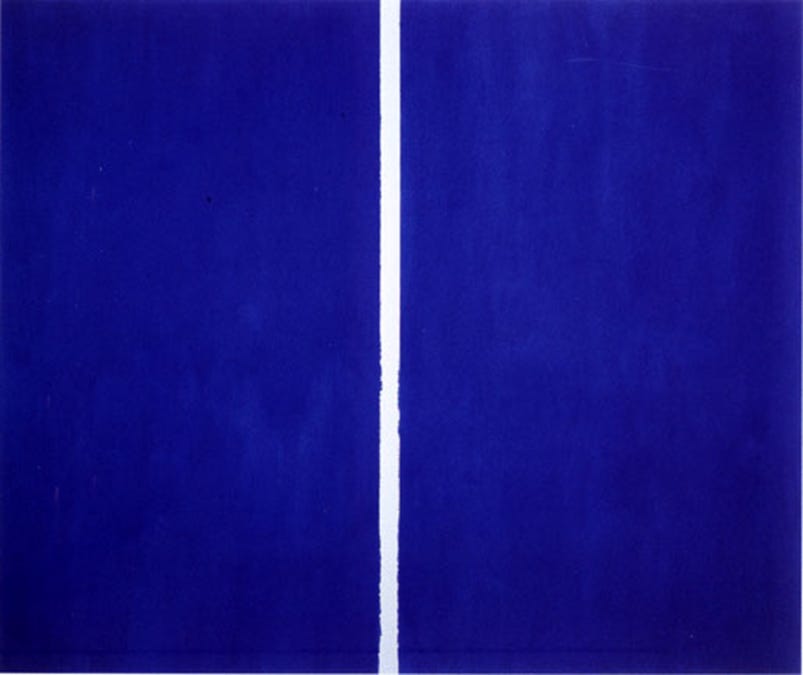
I’m particularly interested in the place Abstract Expressionism holds in this story. In large part because I am an unabashed fan of the art, especially its stunning monumentality when seen in person. One of my favorite pieces is Barnett Newman’s Onement VI. I’m not sure why, but it works for me.
What’s fascinating about the CIA’s promotion of Abstract Expressionist art is how it puts a fine point on the fact that the early Cold War CIA was dominated by a particular and peculiar sense of liberalism, derived from its composition, but also the ascendant values of the era and the structures that promoted them. It may be the case that one of the last gasps of governmental support for artistic sophistication and the avant-garde was at least partially weaponized.
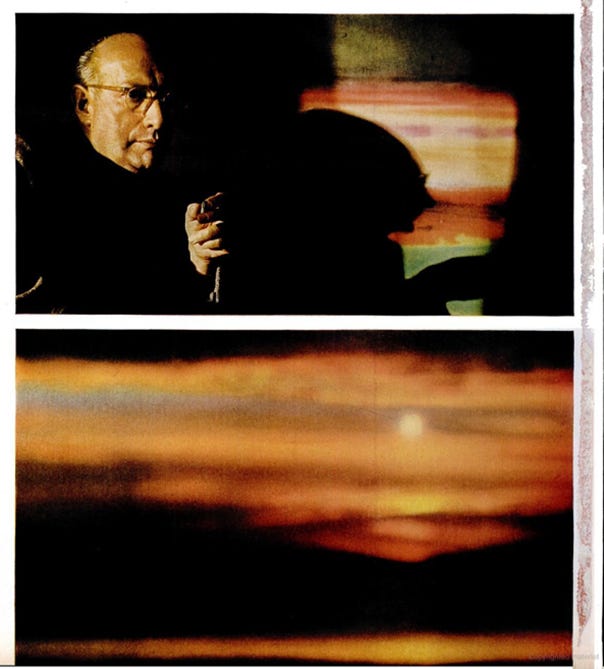
By the late 1940s and especially into the 1950s, the circle of New York-based painters known as the Abstract Expressionists had well and truly broken containment. It was, according to Hilton Kramer, the last of the “unpopular” art movements – confronting and inscrutable. Nevertheless wealthy collectors and tastemakers like Nelson Rockefeller sought their works, and Abstract Expressionists were pushed on the American middlebrow public. Prodded by a sophisticated young art editor, Dorothy Seiberling, LIFE ran a two-part series in 1949 explaining to its enormous readership just why Abstract Expressionism was both great and American. The first focused solely on Jackson Pollock, whom the magazine presented as a rugged cowboy of a painter: macho, taciturn, Western, hard-living and harder-drinking. Critics celebrated his “action painting” as energetic, lively; as sprawling and gargantuan as America itself. The type of work that had to be shown in the well-endowed museums of the American Century.
The second LIFE article attempted to teach readers how to appreciate the work of Clyfford Still, Barnett Newman, Franz Kline, Willem de Kooning, and Mark Rothko by comparing their paintings to the natural (or manmade) world. Still’s fiery canvases are “serene and restless symbols of man’s striving,” while de Kooning paints “explosive images of a dislodged and ambiguous world.”
The arrival of Abstract Expressionism, along with virtually any form of experimental art, was controversial on the right. Conservatives, broadly, were far more interested in traditional forms and especially realistic representation in art. Intriguingly, in art and literature, the leading conservative journal National Review operated on two parallel tracks. The first, favored by their readers, preferred traditionalist aesthetics and high English literature. But a second track that included key contributors Hugh Kenner and Guy Davenport attempted to push conservative readers toward difficult modernist works. “NR is the kulchural New Frontier,” Kenner wrote to Davenport in Poundian slang, hoping to entice him aboard. Its editors were “interested in building up & broadening its kulch base,” but were hampered by a “shortage of contributors, as well as hard core of doctrinaire standpattism among readers.” Yet shortly after, he complained that “Conservatives tend to mistake a glowingly noble attitude for an active interest in the arts; they do not know that the arts are disturbing to general ideas.” For their part, the left “while even more committed to general ideas and moreover to an orthodoxy of attitudes, at least knows that it isn’t chic to be anti-contemporary.”
James Burnham, once deeply embedded in the early CIA cultural front organizations, echoed Kenner’s complaints about conservative views about art. He called the approach of one contributor’s piece about music “utterly stupid, banal, uninteresting, irrelevant” and criticized Editor-in-chief William F. Buckley’s brother’s views on representation in art as “undiscerning, insensitive, uninformed and, also, irrelevant.” “Living art must be new, must be fresh, must be far out (from the point of view of accepted standards),” wrote Burnham. Critics and spectators had to keep up with the true artists, not the other way around. “It may be that the qualities that go to produce the contemporary political conservative do not, generally speaking, permit the sensitive appreciation of living art,” he went on. If so, as conservatives gained status and power in the contemporary political moment, they had to “handle the aesthetic problem also.”
Artistic standpattism rejected experimental art because it broke with realistic depiction and in doing so wittingly subverted artistic traditions and quality. The leading philistine in Washington – at least for Abstract Expressionism’s enthusiasts – was the aged Congressman Robert Dondero of Michigan who in 1949 had charged that “all modern art is Communistic.” His complaints were amusingly well-informed but ultimately McCarthyist. Dondero warned against the penetration of left-leaning or even Marxist artists into American artistic institutions, including the Museum of Modern Art and the Art Institute of Chicago. Not only were Marxist artists sneaking in, they were being actively courted by the institutions themselves. He doubly warned against left-wing artists whose very art was subversive itself.
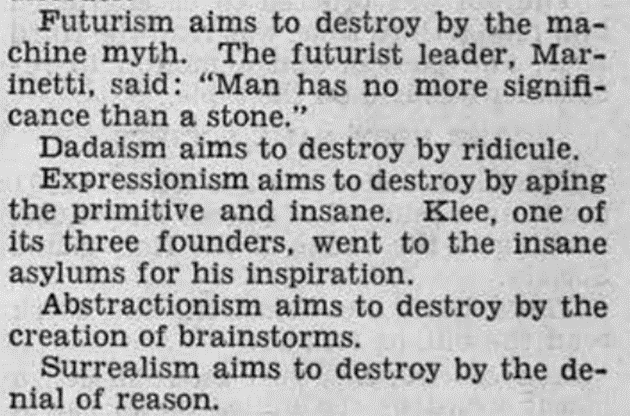
Obviously, Dondero’s criticism easily applied to the Abstract Expressionists. Barely a coherent movement or group, most had worked at some point or another for the Federal Arts Project during the New Deal. Some, like Pollock, had historic communist associations.
For liberal supporters, however, modern art represented precisely the opposite of Communism. Where right-wing critics treated modern art as a subversive force undermining some sort of natural or American order, liberals presented America as a place that was free, vibrant and existentially dynamic – a spirit they saw captured in the Abstract Expressionist paintings they celebrated (and bought). Instead of subverting Americanness, liberal supporters contended that modern art’s very deconstruction of traditional artistic forms showcased American freedom, especially when contrasted with Communist totalitarianism. Indeed, as the MoMA director Alfred Barr Jr argued in the New York Times Magazine, the real-life Communists of the Soviet Union (and the Nazis, for good measure) detested modern art as “formalism, Western decadence, leftist estheticism, [and] petty-bourgeois degeneracy.” Against the saccharine requirements of Socialist Realism, modern art felt alive. “Lenin personally disliked modern art, and so does Stalin, but Soviet art policies are based more on a dialectic of power than on personal feeling. Hitler did not merely dislike modern art, he hated it as only a frustrated academic artist could.” In a way, it reflected the Trotskyist Partisan Review revolt against Stalinism and for modernism in the 1930s having become part of the the liberal line in the late 1940s.
In the aftermath of the Second World War, at the apogee of American liberalism, American boosters could claim New York had wrested artistic leadership away from Europe. The US was not only an economic, political and military powerhouse, it was a cultural one too. (Despite what rubes like Dondero had to say about it.)
The American liberal establishment that clustered in the Northeast was composed of powerful, overlapping circles of men that were filtered through the Ivy League and who composed the white shoe law firms, professoriate, artistic patrons, magazine owners, philanthropists, diplomats, and, critically, America’s intelligence services. For this highly educated, self-consciously sophisticated set, using Abstract Expressionism in America’s soft power efforts seemed a natural step. One of the representative figures from this was Nelson Rockefeller, the liberal Republican powerhouse who dominated New York politics and whose family dominated MoMA. Having run the Office of the Coordinator of Inter-American Affairs during the war, Rockefeller believed in cultural diplomacy, but, as an ardent Cold Warrior, also psy-war. Another, John Whitney, who chaired MoMA’s board of directors, had served in the Office of Strategic Services, the wartime precursor to the CIA. Whitney headed a charity that served as one of many CIA conduits for art and literary funding during the cultural Cold War.
But while it seemed obvious to the liberal establishment to deploy Abstract Expressionism against the Communists, it was not so for the American public. A 1947 exhibition of American art in Europe advanced on exactly these liberal grounds was brought to a halt by Congress, which felt the art to be subversive, depressing and un-American. Un-displayed, the paintings had to be sold at a 95% discount.
If overt support for modern art couldn’t overcome Congressional prejudice, perhaps its liberal Cold Warrior supporters would need to fund it surreptitiously. A declassified internal CIA history notes that “It took a fairly sophisticated point of view to understand that the public exhibition of unorthodox views was a potent weapon against monolithic Communist uniformity of action.”
The American cultural Cold War apparatus came out of a desire to combat the Communist front organization system. In a strategy dating from the revolutionary era, the Soviet Union ran an enormous network of beneficent-seeming paper organizations – or “fronts” –geared toward winning supporters or fellow travelers for the Communist Party and for isolating their enemies. By the late 1940s, there were more than enough ex-Communists or former Trotskyist battlers to give a sense of the front organization system that some, like Burnham, proposed the need for an anti-Communist front system. The CIA battled the Soviet Union for Europe’s workers, young people, and intellectual classes, and saw a particular opening with the intelligentsia.
In particular, the European-oriented Congress for Cultural Freedom was the key node in the system. Founded in 1950 by Sidney Hook and a Murderer’s Row of midcentury intellectuals, the CIA underwrote the CCF and through it a series of literary but ultimately anti-Communist journals across Europe, including Encounter, edited by the unwitting Irving Kristol and Stephen Spender, in London.
The line between cultural diplomacy and political interference often rests on secrecy – on deception. In many ways, the kneecapping of the credibility of CCF organizations could have been avoided if the funding had been out in the open from the outset. But, would critical intellectuals from the European non-Communist left have been persuaded to take American money? Probably not. In the aftermath, defenders of the strategy have pointed out, rightly, that the CIA exhibited limited censorship over their array of magazines and those who wrote for them would have made the same arguments anyway. The CIA and their assets, like Melvin Lasky, merely paid for and boosted pre-existing thinkers and artists. More than a few felt prostituted by the system, and the credibility of the European non-Communist left suffered immeasurably by the deception.
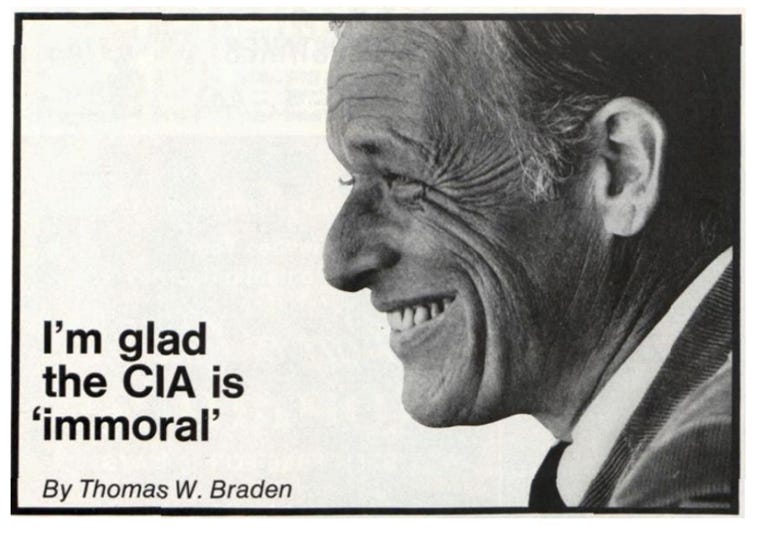
Another representative figure of the post-war liberal establishment floated at the center of much of the early cultural Cold War. Tom Braden directed the CIA’s cultural activities from 1951 to 1954. Prior to this role Braden had been executive director of MoMA. In his early thirties, Braden exemplified the liberal CIA that believed self-consciously in expressive, intellectual and political freedom, democratic norms, procedural liberalism, rationality, and progress.
Leveraging MoMA, whose leadership happily supported the cultural Cold War program, Braden boosted Abstract Expressionism domestically and exhibited works overseas as “benevolent propaganda for foreign intelligentsia.” The work was never produced as a Cold War weapon – indeed, it may well have been misunderstood. As high-brow propaganda, liberal Cold Warriors conceived of Abstract Expressionism as anti-totalitarian art. As August Heckscher declared at MoMA’s 25th anniversary, “We know that where tyranny takes over, whether under Fascism or Communism, modern art is destroyed and exiled.” By contrast, modern art “is individualistic, experimental, eclectic –all qualities which the totalitarian state cannot abide.” And American. Covert funding allowed cultural elites to circumvent Congressional – and perhaps public – artistic prejudices.
As American leadership once understood, cultural power, soft power is a real force. Sure enough, in 1962, hundreds of Muscovites went to see American abstract paintings in part because Khrushchev derided them as “absurd.” The Soviet press appealed for a return to realism that would serve Communist causes. Pravda complained about “Jazz mania” in Russians who copied “cheap western music” and the “thoughtless imitation of the West.” As Eva Cockroft put it, “Intelligent and sophisticated cold warriors like Braden and his fellows in the CIA recognized that dissenting intellectuals who believe themselves to be acting freely could be useful tools in the international propaganda war.”
Several abstract expressionists were members of the American Congress for Cultural Freedom, including Robert Motherwell and a drunk Jackson Pollock. Rothko became an art world anti-Communist. Seduced by wealth and prestige, the Abstract Expressionists had sold out, joined the establishment, critics lamented. A significant early supporter of Abstract Expressionism, Harold Rosenberg, sought to defend Abstract Expressionism from its own defenders, namely Alfred Barr, who highlighted Communist and Nazi hatred of modern art. “In politics the opposite of revolutionary is conservative or reactionary,” wrote Rosenberg attempting to situate the relationship between art and revolution. “In art the opposite is the Academy, which can adopt any mode, even the most ‘advanced.’” But where conservatism is a political force, “The Academy is outside the struggle of art and can only produce commodities.” What is more official, more the “Academy” than not only the approval of the Establishment but the state’s national security apparatus as well? Thus, it’s with real irony that Rosenberg wrote this analysis for Encounter, one of the flagship journals of the cultural Cold War and a recipient of CIA funding.
The intersection of art and wealth and political power and hegemony is and always has been an awkward one. The Abstract Expressionists were, in a way, fortunate to live in a world in which the liberal pieties of the leading powers had been trained to follow the artists. It’s almost possible to be envious of a government regime that sponsors art because its quality speaks well of the United States. Abstract Expressionism was no psy-op. It first succeeded as an artistic movement on its own terms, with its own celebrators, like Rosenberg and Partisan Review. But it became bound up with the great political and cultural conflict of its patrons who read into it the meanings they wanted and needed. Abstract Expressionism, at least officially, went from subversive and avant-garde to a carefully curated part of the establishment. And more: it became a symbol of Cold War American liberalism – freedom in visual form. Tellingly, Nelson Rockefeller called Abstract Expressionism “free enterprise painting.”
For his part, Braden remained unapologetic when the walls came down on the cultural Cold War project. The Cold War was a war, he insisted, “fought with ideas instead of bombs.” With the confidence of his class and Cold War liberalism, Braden remarked that “The choice between innocence and power involves the most difficult of decisions. But when an adversary attacks with his weapons disguised as good works, to choose innocence is to choose defeat.”
The CIA’s liberal composition in its early decades created an awkward situation for conservatives. On one side of the ledger, they supported, strongly, the CIA’s anti-Communist mission. Under Buckley, National Review reflexively supported the CIA, including (especially!) in the fallout from the Ramparts affair. Buckley, briefly a CIA man, had a latter day career as a novelist writing adventures about a CIA agent. He was directly inspired to present a heroic vision of the Agency to counter the morally ashen depictions of intelligence operations in Le Carré and Greene. On the other side of the ledger, though, conservatives despaired at the CIA manned by liberals: overmatched and naïve against the Communist threat and altogether too clubby and polite. Liberals had drummed Burnham out of the CIA, and with it, conservatives thought, hard-headed analysis and determination. For many conservatives, the ne plus ultra of liberalism wasn’t Tom Braden of the CIA, but Alger Hiss, formerly of the State Department.
Conservatives would continue to resent the liberal establishment – in an increasingly generalized way divorced from its historic Northeastern bastions – including in the CIA. Braden had a second life as a media figure. He hosted Crossfire, which pitted him as the liberal against Pat Buchanan (and later Robert Novak) as a conservative. An especially heated episode featured right-wing arch-critic of the CIA, Angelo Codevilla, squaring off against Admiral Stansfield Turner, former Director of Central Intelligence. The whole thing descended into chaos as Codevilla accused Braden of classist snobbery.
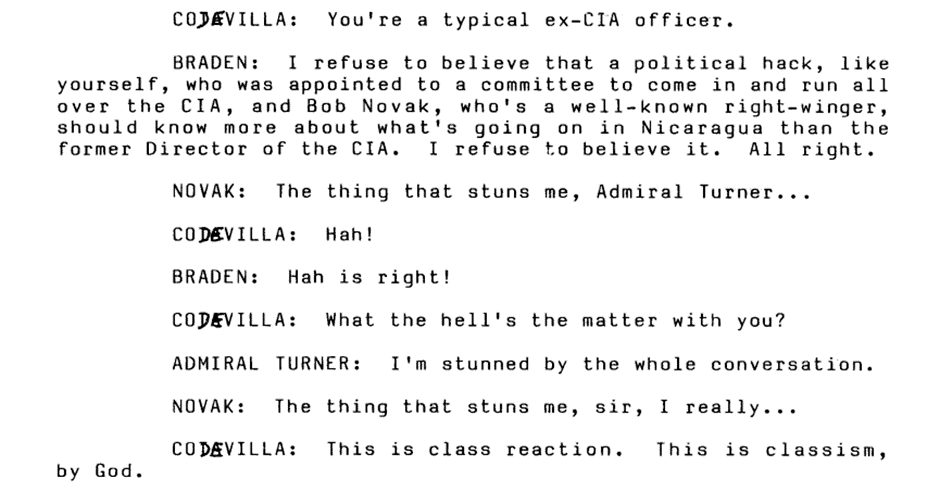
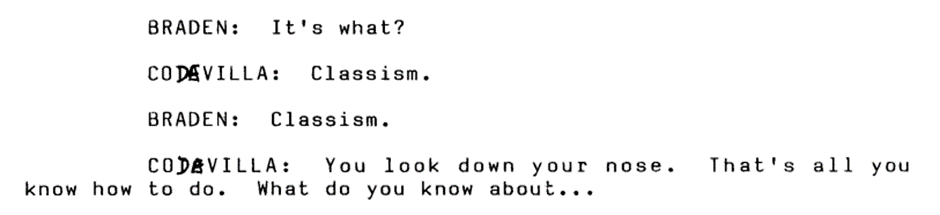
Absent the Cold War to prosecute, it becomes easier to see how the right might have come to imagine a liberal Deep State that works toward its own class interests and prejudices.
It has also become all too clear that conservatives did not solve their aesthetic problem. Conservative art tends to fall into either fusty traditionalist retreads or vulgar populism. (Or, in certain circumstances, deep-fried and fascist adjacent.) The hopes that Kenner, Davenport, and Burnham nursed swiftly fell by the wayside. It’s almost possible, then, to be envious of a confident regime that sponsored experimental art because its quality – and the qualities they saw in it –spoke well of the country in which it was produced. Speaking of “free enterprise art,” the market eventually proved Rockefeller correct in the most literal sense. The painting I like, Onement VI, sold for $43.8 million in 2013.
No posts
Comments
Nothing yet. Say the first thing.
Sign in to join the conversation.