
The following essay was largely written for a panel on history and nostalgia and presented at the Cities on a Hill retreat convened by the Ronald Reagan Institute.
In mid-May, the CEO of the conservative website the Daily Wire resigned. In his outgoing message, he described the site as “the largest and most impactful digital media company for people who love this amazing country.” Most observers were paying attention to the turmoil at the company, a victim of changing algorithmic winds and shifts in the ideological makeup of the right. But what struck me was the lazy assertion about the Daily Wire—and conservative media generally—being for people who love America. It’s a canard, but one accepted as a truism on the right, that liberals, progressives, anyone in media outside explicitly conservative outfits, does not and can not love America.
The idea that liberals don’t love America is itself the result of a historical process. But history—and contemporary actors’ relationship with it—can play an important legitimating function in politics. (Although this is perhaps less true in our current political moment). Broadly speaking, history creates precedents and norms; it binds our political imagination about what is possible in the normal sweep of things.
The grasp of history has a special pull here in the United States. Because we can point to an explicit, well-attested, deeply memorialized founding date, there is very often a strong popular and elite desire to ensure politics conforms with the American tradition—whether this is the hallowed Framers, or a second Founding in Lincoln or perhaps Frederick Douglass. In his of-the-era but nonetheless perceptive The Genius of American Politics, Daniel Boorstin described this tendency as the “givenness” of the American order. The United States received its political order as a gift from the past, perfect and complete and adequate for all future needs. This givenness occludes most real political theorizing, submerging it into the peculiarities of the “American experience,” and leading Americans to see “our national past as an uninterrupted continuum of similar events so that our past merges indistinguishably into our present.”
In critical respects, this account is less true now than it was when Boorstin wrote in the 1950s. Even so, I think it captures some of the ways American history has a special hold on modern politics. Political actors have regularly worked to effectively drape their programs in the flag of history. We might think of the career of Arthur Schlesinger Jr, the great midcentury historian, who placed FDR and the New Deal in progressive historiographical but also political tradition, and later sought to give JFK the legitimacy of history.
In the middle of the twentieth century, liberals and radicals drew on America’s revolutionary tradition: born in a declaration of independence from an arbitrary power in which all men were created equal. This historical appeal gave liberals certain unspooling imprimatur to expand the franchise, political rights, and the provision of welfare. “When the architects of our republic wrote the magnificent words of the Constitution and the declaration of Independence, they were signing a promissory note to which every American was to fall heir,” Martin Luther King Jr declared in his great clarion call for civil rights.
The conservative right recognized but fundamentally rejected the liberal use of history. Conservatives made a concerted effort to lay claim to the Founding and American political tradition in the latter half of the twentieth century—a claim that continues today. By re-reading and re-emphasizing the Constitution and Declaration of Independence, conservatives made dominant a political reading of the American past as ironclad and timeless.
This version of the American past is reverent—in important ways accurate—but also inescapably nostalgist. When it veers into hagiography, it delimits our political imaginations and makes political theorizing impossible. As Christopher Lasch wrote about the modern age’s sense of nostalgia in his critical history of progress, “Idealization of the past had come to rest not on respect for ancestral wisdom but on the assimilation of the past to images of childlike innocence.” The worst forms of this history are utterly flattening. In this respect, per Lasch, “Nostalgia evokes the past only to bury it alive. It shares with the belief in progress, to which it is only superficially opposed, an eagerness to proclaim the death of the past and to deny history’s hold over the present.”
They at once assert the authority of an idealized past, while downplaying the long-term impacts of historic social relations and their justifying ideas. Criticism, including the honest engagement with the ways slavery and white supremacy and normative patriarchy shaped the—again, binding—founding order too often treated as illegitimate questions on the right. It’s calcifying. It risks treating the United States less as a democracy of the dead than a dictatorship.
The articulators of this nostalgist vision rejected the New Deal out of hand as an illegitimate rupture in America’s great tradition. Over time, versions of this conservative interpretation, particularly but not exclusively out of the Claremont school, extend the critique to Woodrow Wilson and the Progressive era. In sum, there is a prevailing conservative worldview, based on a certain reverent, nostalgic, and flattening history, that has not come to terms with the modern liberal democratic state.
The impulses of MAGA—literally Make America Great Again—are inescapably nostalgist, down to a hazy abdication about when, exactly, America was great. We see in MAGA the dangerous proximity between political nostalgia and populism—if not authoritarianism. MAGA filters the conservative rupture thesis through the predilections of one man. The restoration Trump offers is not “it’s morning in America,” but “I was saved by God to make America great again.”
I would suggest, though, that in the face of this conservative effort to claim the totality of the American political tradition, liberals and progressives have conceded too much. Rightly critical of the real and deep inequalities and hierarchies embedded in the American past and present, liberals too often give the impression—intentional or not— that America is uniquely flawed and irredeemable. In doing so, this approach likewise flattens history, missing the remarkable, the serendipitous, the heroic, the ironic, and the good in the past too. Crucially it cedes to the right the still potent symbols of our past and civil religion. It lets the right paint calls for equality, for rights, for progress as alien when they are, in their own way, authentically American.
Academic historians can be guilty of writing and thinking in this tenor. In our scholarship, we are, of course, both chroniclers and critical analysts. But somehow we have let too many conclude that we hate the past. Obviously, this is false—how could we dedicate our lives to something we abhor? It runs against the way I was taught to do history: to extend empathy to the past; to understand my actors as they understood themselves; to contextualize. But we must admit that we have let ourselves be caricatured as the self-appointed hall monitors of the messy American experience.
Our political moment is an urgent, unstable one. The public hungers for historical narratives that situate and explain Trump and Trumpism, the broader right, the disorganization of the Democratic Party, the cluster of policies that shape our politics, and the meaning of the Constitution and Declaration of Independence. As scholars and thinkers, we must avoid the Scylla of disdain or sanctimony (real or perceived) and the Charybdis of nostalgia and revanchism.
Nuanced, thoughtful, serious reflections—and celebrations like this one—are needed for the 250th anniversary of the signing of the Declaration of Independence. Yet, this is difficult given the ways President Trump has used the commemoration of the 250th anniversary to celebrate himself in ways that run counter to the American tradition: namely, putting his visage on passports and a commemorative bill, turning a commemorative event into a political rally, and setting the stage for a wrestling match on the White House lawn. The vulgarization and politicization of American memorialization leaves few liberals eager to celebrate America right now, despite liberal patriotism being both urgently needed and hard to muster.
Finally, I worry about how authentic public history can even be done today. Our culture has become a place where personality driven video, particularly short-form, is far and away the dominant form of media. For virtually the entirety of its existence as a professional discipline, history has been a chiefly written enterprise. We valorize the archive, engage with texts, and write manuscripts. Do new forms of media consumption—YouTube essays, TikTok appeals, memes, and videogames—which regularly outcompete reading as the wider public’s source of historical knowledge, foster the same type of critical engagement and analytic response that reading does? I don’t know, but I don’t think so. When history becomes content it is often reduced to another front in the culture war. But high quality history is as vital now as ever.
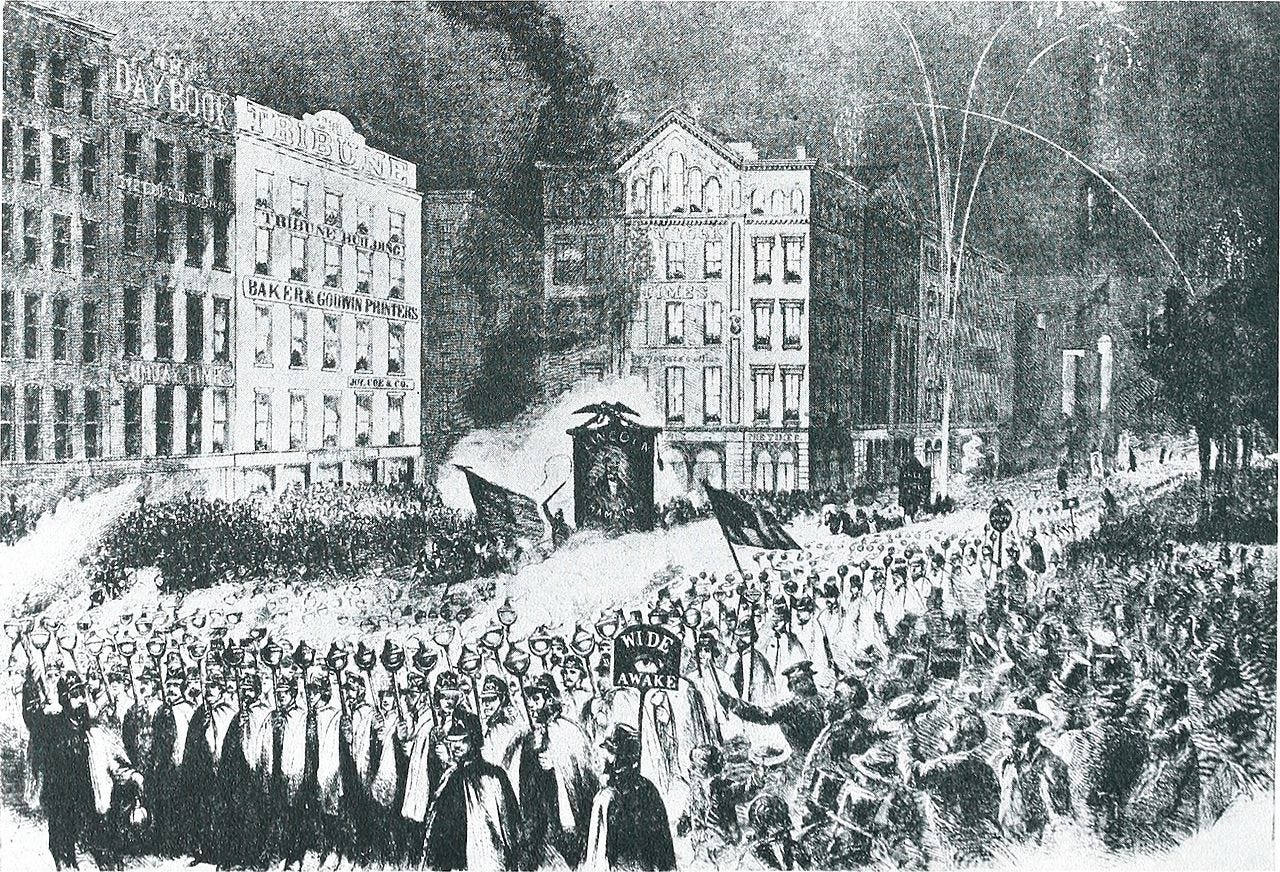
When I first gave a version of these remarks, the convenor pushed me to say whether I thought there could be a politically productive form of nostalgia. One might imagine a Rosie-the-Riveter-type muscular liberalism sort of thing. And I suppose that’s true. I’m drawn to this slightly knowing celebration of the Wide Awakes and Union forces in the Civil War, for example. I, too, think there’s a place for heroes in the American, or any, story. Yet, I would still distinguish principles embedded in the American tradition from a nostalgic worship of that past. I prefer my heroes to be flesh-and-blood, not reduced to some otherworldly hagiography.
This sentiment gets me to what I hope is my guiding approach to history, which is this: We are privileged in some special way to be able to look at historic men and women in the totality of their lives. While as human beings live moment to moment, responding the best we can to everyday events and extraordinary crises, when we take someone from the past, we are often able to lay their lives out on a table, from childhood unto death, and reckon with that fullness of life in ways that are rarely evident to someone day-to-day. In some ways, this leads to judgment and condemnation, and inevitably this is so, and sometimes, perhaps often, justified. But it should also demand from us a certain grace—not forgiveness or even tolerance, necessarily—but a recognition that humans are fallible, the past is a foreign country, and someone’s actions or thoughts or statements at a given time do not exhaust the extent of their human dignity. There are limits to this approach, of course, and we should not be afraid to call evil what it is. Even so, I hope this approach, which I can only pull off haltingly, can be a useful guide in my work and perhaps others.
Now, Some Professional News:
I was recently hired as an editor at The Bulwark. I’ve written essays for the website on a freelance basis for years, and I am thrilled to be part of a top-notch editorial team at a place that shares my values and, it must be said, interest in conservative history. Career-wise, it’s a big and important step, and one I made gladly. But it does reduce my personal writing and research time. Life is about trade-offs. I still have some book reviews coming down the pike, as well as other research pieces, either for professional panels or for my own interest, and I will continue to write for this newsletter.
At the same time, my new role has given me an enviable vantage point from which to seek out and commission other authors to write on things that interest me, and I think you too. I have linked five of my favorites below.
Daniel Ruggles on the hard right panic over Neil Gorsuch’s creedal Americanism and the effort to abandon originalism.
Laura K. Field on how Michael Anton and the Claremont Institute have abandoned Lincoln, the Declaration of Independence, and their own patrimony.
Bret Devereaux’s devastating analysis and takedown of statue-faced anons and their fixation on an imagined antiquity.
Nicole Penn and her journey through the strangeness of Revolutionary-era religious belief, and its afterlife.
And Matt McManus’s blistering read of the paleo influencer who I like to think of as the crown jurist of the chuds.
We publish a lot of thoughtful commentary and reporting on politics, foreign policy, history, and culture. I hope you will consider checking out the whole site.
No posts
Comments
Nothing yet. Say the first thing.
Sign in to join the conversation.