
When the Reaganite consensus finally buckled under the weight of Trumpism, it revealed a fault line that had been widening since the mid-1980s. A series of set-pieces divided old-time traditionalists from neoconservative arrivistes. The paleo book of grudges, most comprehensively kept by Paul Gottfried, includes other men who either missed out on jobs or lost theirs. First Mel Bradford, then Joe Sobran, Samuel Francis, John Derbyshire, Pat Buchanan, and Gottfried himself. Each man a victim of either neocon perfidy or Buckleyite squeamishness regarding allegations of racism or anti-Semitism. Gottfried called them the “Never-Ending Purges.” Cumulatively, they neutered the right, paleos argued, until it was little more than the circumspect liberalism of a David Brooks.
The paleocon litany primarily includes unprovoked attacks by neoconservatives or their Buckleyite running dogs. Some, like a confab in 1990 on the future of conservatism, have been blown far out of proportion. Others, like Richard John Neuhaus’s acrimonious break with the Rockford Institute, have been disputed by partisan magazines of both sides.
For a long time, it looked as though, if there had been a battle for conservatism, the neocons had won. Or at least they had brought about a fusionist-neoconservative synthesis based in the think tanks of DC that kept the hard right elements at bay. In 2015, it was possible to write about the paleocons as a historical dead end: an Old Right last stand that petered out with Pat Buchanan’s political career. From 2026, however, I think it perhaps makes more sense to talk about a three-decade neoconservative interregnum that separated populist, anti-intellectual, anti-immigrant, tariff-loving, isolationist iterations of the American Right. I don’t want to overstate this thesis; I don’t think there’s enough evidence to call the Trump era a reversion to the “natural state” of the American conservatism. But I think it’s fair to say that, at least inside the Beltway, the neoconservative-influenced respectability politics and policy positions were dominant for a spell, divorced from the impulses of the conservative voter base. Trump obliterated those norms.
In 1986, critical elements of the paleocon grievance narrative were not yet in place.
Nevertheless, as traditionalist conservatives looked about at the state of the world after five years of Reagan, they were despondent. Some of this was temperamental. If a traditionalist isn’t despairing about the state of the world, is he really a traditionalist? Those drawn to jeremiads will, of course, be over-represented in traditionalist literature. And so it was in a symposium hosted by the Intercollegiate Studies Institute on “The State of Conservatism.” Seven traditionalists – Gregory Wolfe, Clyde Wilson, Gerhart Niemeyer, George Carey, M.E. Bradford, Paul Gottfried, George Panichas – depicted Reagan’s America awash in greed and filth. Casting around at the conservative movement, they saw compromisers, a narrow politicization, populism, and activism over ideas.
Conservatism had failed the country, they wrote. But it had failed in large part because it had accepted into its ranks a caste of false conservatives. These “interlopers” and “refugees” were liberal victims of a mugging. They had turned to the right without abandoning their core commitments. The conservative movement, entranced by the neoconservatives’ credentials and access, embraced them with open arms and, in doing so, unmanned themselves. Gottfried saw the elevation of neoconservatism as a liberal gambit to narrow the bounds of acceptable discourse. “Liberal intellectuals have designated the neoconservatives as the official conservative opposition, sparing themselves the necessity of taking seriously any thinker to the right of Cold War liberals.” “Lines of demarcation must be drawn, and swiftly,” wrote Bradford.
The traditionalist-dominated symposium was a shot across the bow at some of the most prominent articulators of conservative sentiment. It left no readers unclear as to how traditionalists saw the neoconservatives. Six of the seven essayists found fault with the neoconservatives in some way or another for the state of the world.
The timing of the symposium, published in early Spring 1986, cast a shadow over a second event intended to at least get paleos and neos in the same room if not to force a complete rapprochement. The setting was the annual meeting of the Philadelphia Society, a conservative academic society where traditionalists had considerable sway, to be held that April at the Drake Hotel in Chicago. In fact, Mel Bradford had put the meeting together in his capacity as the society’s president for 1985-86. Officially titled “Conservatism: Identity and its Limits,” in reality everyone knew the meeting was meant to settle the place of neoconservatism on the right. Did conservatism’s “limits” extend to Brooklyn or not? Was this to be a line of demarcation?
The conference’s main panel would dissect “The Neoconservatives: The Species and Their Origins.” The afternoon’s roundtable was billed as “A Necessary Conversation.” Bradford gave the presidential address on his specialty, rhetoric, and for good measure Elliott Abrams, representing both the Reagan administration and neoconservatism, gave the keynote address the night before.
Bradford had done a good job balancing the ticket. The panel and roundtable had paleoconservative prosecutors, neoconservative defendants, and fusionist referees.
In the spacious Walton Room, the chair of the panel, John Ryan, a former president of the Society, began lightly by riffing on collective nouns. There might be a “quandary of libertarians”; a “doubt of liberals”; a “despair of Democrats”; a “complacency of Republicans”; a “confusion of conservatives”; and “an awakening of neoconservatives.” As with other fusionists, he pled ignorance about the gulf between conservatism and neoconservatism. His panel of Edward Shapiro, Paul Gottfried, Burton Yale Pines, and Stephen J. Tonsor would illuminate him.
Shapiro, a Jewish historian, briefly outlined the rise of conservatism as a legitimate intellectual force in American politics, and the emergence of neoconservatism alongside it. He took up the criticism from the ISI symposium, including Panichas’s call for a conservatism “lean, ascetical, disciplined, prophetic, unswerving in its censorial task, strenuous in its mission, strong in its faith, faithful in its dogma, pure in its metaphysic.” On the contrary, Shapiro suggested in a theme neocons and fusionists would repeat, “diversity is a sign of vitality for any movement.” Yet, he continued, conservatives and neoconservatives were aligned where it mattered. The aggrandizement of political authority threatened the family, local institutions, and “private economic organizations.” All present could learn from Tocqueville – an increasingly important reference point in neoconservative thought. “As heirs of Tocqueville’s intellectual legacy, conservatives and neoconservatives are natural allies and not foes,” he concluded.
So far, so good. Except that next to present was Paul Gottfried. Mild mannered and somewhat nebbish, Gottfried hoped to give no offense, but knew that he would. Like Shapiro, Gottfried was a historian and, significantly in a debate that became bound up with accusations of anti-Semitism, also Jewish. Professionally frustrated, Gottfried was in the process of leaving Rockford College in Illinois for the Moonie-funded Washington Times Company in Washington. He planned to use the move as a stepping stone to a professorship at Catholic University of America promised by a friend with influence in CUA’s history department. Although Gottfried was connected to the conservative movement – he co-edited ISI’s history journal Continuity and he occasionally wrote for National Review – he ranged beyond its normal boundaries. He wrote a history of conservatism teasing out repressed Hegelian aspects, and described himself as a “qualified defender” of Carl Schmitt. Above all, believed in the need for an authentic hard right.
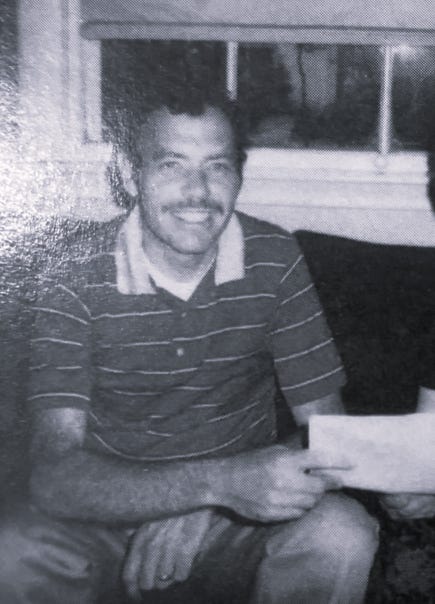
More than most traditionalists, Gottfried contended that the neoconservatives were essentially social democrats. They had been called “neoconservative” as an insult, and were always reluctant participants in the right bloc. Whatever differences they had with McGoverniks in the Democratic Party, Gottfried said they were “largely symbolic.” Gottfried laid out several related allegations in his case against the neocons. First, that they, unlike conservatives, were happy with the modern transformations in American politics and political culture – up until the late 1960s.
Second, that they were globalists and universalists (a point Gottfried later suggested was a Trotskyist undertone in their thought, a charge later paleocons have taken more literally than I think intended at this conference). The goal of neocon foreign policy was the promotion of “a worldwide, secular, politically egalitarian society with a mixed economy.”
Third, that neocons did not care about the right. They used the conservative movement “as an unpleasant but useful base to be occupied in pursuing their love-hate struggle with old comrades.” Their signature move was to place themselves at the political center and excoriate “crazies” on both sides.
I’ve heard Gottfried plausibly described as humorless. In this paper, though, he got some good laughs from the audience. Neoconservative “hearts, in most cases,” he joked, “are with the Left, even though their expense accounts come from the Right.”
Conservatives needed more self-confidence, Gottfried argued. Don’t be snookered by neoconservatives’ mainstream prestige. Conservative intellectuals and institutions were just as good. Likewise, for all the much-vaunted neocon emphasis on data, many of their polemicists were just as reliant on anecdote or first principles. Conservatives ought to have more self-respect.
By the time Gottfried finished, the panel chair was overwhelmed by his arguments. The cards were on the table now. After Gottfried came another fusionist: Burton Pines, who was a research director at the Heritage Foundation. Once a New Right vehicle, Heritage had become more ecumenical. As part of the great joining ranks, Midge Decter, the neoconservative writer and wife of Norman Podhoretz, had become a trustee of the think tank in 1981. Pine pointed out that conservatives have debated fine-grained differences for a long time; and heck, neocons were more pro-market than some trads anyway. Overall, Pine’s argument was pure fusionism of the trenches. They all united “to repeal the 1970s,” something that had “transformed much of the traditionally cerebral right into activists.” Indeed, one divide Pine noticed evaporating was a class one between “genteel conservatives who long have waged the battle of ideas and those street-smart conservatives who’ve recruited legions of activists for the battle.” In the heart of genteel conservatism, Pine elbowed his audience by suggesting some had “enjoyed being a tiny band of intellectual warriors bereft of political power but comforted by the thought that we were of the elect.”
This was a second line of defense for neocons. They may not be pure, but they fight and they win. Pine pushed for a united, big tent, governing majority led by Ronald Reagan.
At last, one of those intellectual warriors closed out the panel. The historian Stephen J. Tonsor had demons to exorcise. Tonsor was a sophisticated historian, from the University of Michigan, but his sense of conservatism was and remained idealized and Kirkian. More than thirty years earlier, Tonsor had read Kirk’s description of conservatism and found it articulated his own deep sensibility. He put this down to good judgement and, in a move that stunned those present who understood the contours of conservative intellectual history, made it the basis of his attack on the neocons. As Tonsor put it, “One’s starting point and the way in which one achieves an identity have very important implications for what one becomes.”
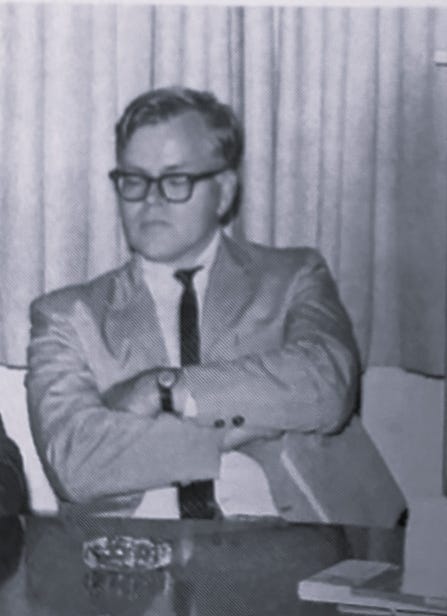
The problem with the neocons, Tonsor argued, was twofold. Their (exaggerated) earlier embrace of Marxism reflected poor judgement, but more critically marked them with a pernicious dalliance with modernity. By modernity, Tonsor meant, following Voegelin, a “revolutionary movement in culture which derived from a belief in man’s radical alienation, in God’s unknowability or non-existence, and in man’s capacity to transform or remake the conditions of his existence.”
This wasn’t a left and right thing. In fact, Tonsor suggested the right more regularly engaged modernity because it thought “consequentially.” But a modernist right that emerges radical and revolutionary in the wreckage of a failed conservative project would invent and impose an order on society in a dangerous fashion. Thus “we recognize that the social and political consequence of modernity is in fact totalitarianism” and the denial of transcendence is “a one-way street to Dachau.” The allusion to Dachau is a staggering one to make in 1986 in an argument criticizing a group that was heavily, though not exclusively, Jewish.
“Now it is a matter of fact that most of those who describe themselves as neoconservatives are or have been cultural modernists,” Tonsor went on. He did not argue neoconservatives were proto-Nazis, although I think that is an implication of the argument he set up. Instead, he contended that conservatives and neoconservatives would be forever divided on the question of modernity. Neocons had been “baptized in the fiery brook,” he said, borrowing “an elegant pun” from Peter Berger. Meanwhile, “We conservatives have been baptized in the Jordan.” These competing baptisms were indelible. To be sure, neoconservatives had moved somewhat to the right. But Tonsor, the purist, had always found it “perverse that former Marxists have been permitted—yes, invited—to play such a leading role in the conservative movement in the 20th century.” This statement, as everybody knew, included not just neocons, but some of the most significant thinkers in the conservative pantheon. Whittaker Chambers, whom Tonsor dismissed as “beguiling,” but also James Burnham, Frank Meyer, Willmoore Kendall, Willi Schlamm, Will Herberg, Max Eastman, and on and on.
If Tonsor hadn’t been clear enough, he would make his point extremely colorfully. In the conference’s most enduring comment, he declared: “It is splendid when the town whore gets religion and joins the church. Now and then they make good choir directors. But when she begins to tell the minister what he ought to say in his Sunday sermons, matters have been carried too far.” Someone guffawed. To follow this riff, Tonsor added that if Trotsky had survived assassination, he would “no doubt have spent his declining days in an office in the Hoover Library writing memoirs and contributing articles of a faintly neoconservative flavor for Encounter magazine and Commentary.” With this joke, which received scattered laughter and applause, Tonsor leaned hard on the Trotskyist connection. He equated neoconservatives with Trotsky himself while mocking both Sidney Hook – a friend of many neoconservatives – and the conservative institutions that funded or published neocon scholars. In yet another comic image, Tonsor said of the neocons that yes, the wagons are under attack so we “arm the women and the children, even though they may in their ineptitude occasionally mistake a friend for the foe.” Reformed whores, doddering butchers, and children. That’s how he saw the neocons in the room.
Conservatism to Tonsor was “essentially Roman and Anglo-Catholic.” It was Christian humanism. Modernists, not just the neocons, but secular libertarians, were outside the fold. “Unbelief is incompatible with conservatism,” he insisted. Responding to an article on Nietzsche by Werner Dannhauser, Tonsor claimed that the line dividing neocons and conservatives was the same that separated “Burke from Nietzsche.”
Tonsor’s paper turned out to be the most controversial thing he wrote, especially after National Review published the remarks in full. Even his friends in the room were astonished. The anti-communist scholar Arnold Beichman asked whether Tonsor intended to disqualify all the major ex-communist conservatives (and later made the case in a Washington Times editorial). “Would you accept an ex-Nazi?” Tonsor replied rhetorically. The paleoconservative E. Christian Kopff recalled shortly after that Tonsor’s equation of conservatism with Catholicism (or Anglo-Catholicism) was met with “polite irony to open scorn.” Dannhauser wrote to Tonsor via National Review questioning Tonsor’s interpretation of his article. “In my Commentary piece,” Dannhauser wrote, I gently took to task neoconservatives and conservatives, including myself, for being too much concerned with the utility of religion and too little with its truth.” Furthermore, he wrote “as a believer.” Dannhauser couldn’t shake the feeling that Tonsor “does not want us Jews in his neighborhood,” alien as they were from the Roman and Anglo-Catholic tradition.
“Amused and outraged,” Tonsor called Dannhauser on Straussian evasions. “A believer in what?” he sputtered. “That is the nub of the question.” Dannhauser at best represented “the pious agnosticism of so many of the Straussians.” More to the point, Tonsor asked, “is everyone who presses a Jewish intellectual hard in debate to be charged with anti-Semitism?” On the contrary, he said, he didn’t think the neocons were Jewish enough. Not long later, the paleocon Sam Francis called this conference the last real effort to get paleos and neos in a room in good faith, but not long after, a whispering campaign of paleo anti-Semitism began – no doubt referring in part to this exchange.
If the meeting had been intended in good faith – and you get the sense in hearing about Bradford, the organizer, that it probably was – then putting two dyspeptic cultural pessimists on the panel was perhaps an error. The afternoon’s roundtable, chaired by Anthony Harrigan who subbed in for Ernest van den Haag (himself a proto-neocon), dealt with the fallout.
The neocons on the panel attempted to defend themselves. Brigitte Berger, the sociologist, didn’t know whether she “should cry or laugh” at the discussions. “I had not realized I was asked to a hanging,” she remarked. But “the hanging is imminent.” In an effort to intellectualize the difference, Berger suggested the difference between conservatives and neoconservatives lay in their cognitive approaches to certainty and pluralism. She thought pluralist argumentation would succeed in a democracy more than the assertion of certainties.
Leslie Lenkowsky of the Institute for Educational Affairs was more defensive. The neocons were seen as “a bunch of Johnny-come-latelies, or ‘Irving-come-latelies’ if you will.” They hadn’t been for Goldwater, but that was down to the cultural and geographic history of the country. They were never included in the coalition. Now, for New Yorkers, they were pretty good. Lenkowsky emphasized neoconservative effectiveness in their critiques of the left, and the need for unity and the absurdity of so much sectarianism on the right.
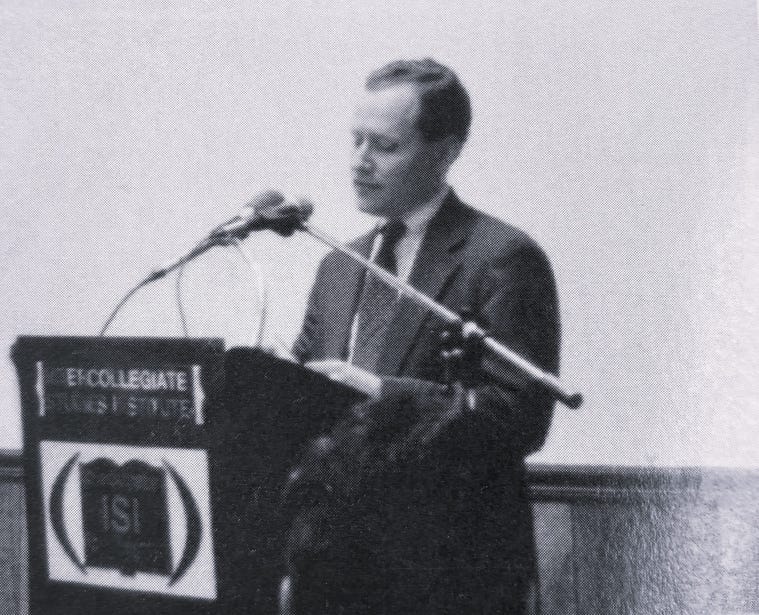
And in his third appearance at the Philadelphia Society, a 33-year-old Bill Kristol, then a senior figure in the Department of Education, gave a winsome performance. He joked about spending up on his right-wing expense account, ribbed Gottfried, quipped that there really were only eight neoconservatives, harkened back to significant ex-communist conservatives, suggested that intellectual diversity was a vibrant sign, and argued, rightly, that paleos and neos did not divide neatly over any issue in particular. He also shrewdly noted an “injustice has been done” by the paleocons to the Old Right by defining them so narrowly. “All the depth and subtlety and complexity of both individual thinkers on the Old Right and of course the varieties of thinkers seem to me to be sloughed over.”
Meanwhile, Stan Evans, Bob Tyrell and even Russell Kirk pled for a ceasefire. “I think I can clear up this whole thing,” Evans said to howls of laughter before making a fusionist argument about the intertwining of biblical religion and free political institutions. Tyrell, the editor of the American Spectator, complained that Gottfried “always managed to leave just a little something out” in his brief against the neocons. But really they should be directing their energies against the left, in defense of “the development of Ronald Reagan—the conservative point of view—as the pre-eminent point of view in our country.” The doyen of traditionalism, Russell Kirk, closed the roundtable with a paean to the “permanent things,” and, fighting old wars, called for a united front against libertarians.
In National Review, Jeffrey Hart, a Burkean English professor, wrote the event up as “Gang Warfare in Chicago.” “It was some reassurance to discover upon arrival at the hotel that weapons were not being carried openly” he joshed. Hart found Lenkowsky persuasive and said Kristol “embodied the spirit of collegiality in a relaxed and undeniably conservative performance.” Hart, at least, came down on the neocon side. “One had the sense that it is past time certain Old Right conservatives stopped griping about the neos.” What’s more, it struck him that “the Old Right assertion of Christian claims seems unduly aggressive, more a weapon or password than is at all appropriate in a political context.”
The editor of the traditionalist journal, Chronicles, Thomas Fleming, “with friends and allies in both camps,” was relatively circumspect. Gottfried’s arguments couldn’t be ignored, and neocons needed to do the traditionalist reading. But “it must be conceded that the neocons do a much more credible job of analyzing policy issues with the tools of the social sciences.” Practical politics and youthful dynamism were problems for the traditionalist right. Fleming found Gottfried, Kristol, and Berger most compelling.
The neocons had won on points, or at least fought to a draw on an unfavorable ground. While they may be incomplete conservatives, they were useful, effective, and committed Reaganites. Used to an ideologically fractious coalition, intellectual conservatives thought they could handle neoconservatism as another persuasion among many.
Even though I find the dividing lines simplistic – especially modernity and religious belief – clearly something was at stake that day in Chicago. Over the next five years, the paleoconservatives moved further and further to the populist, national right. They would find themselves on the losing side in repeated run-ins with neoconservatives (some of which may have been one-sided, or at least exaggerated.) The Paleos – Gottfried chief among them – developed a profound sense of persecution and martyrdom as neoconservative furies (allegedly) chased them further and further from Washington. At Kristol’s Weekly Standard, he and other neocons tracked and attacked Pat Buchanan’s quixotic paleocon efforts to (re)claim the GOP.
In his recent appearance on Know Your Enemy, Kristol says he no longer considers himself a conservative, and that his sense of conservatism was always, really, a form of liberalism. If so, perhaps Gottfried was right all along. I think Kristol overstates his case here. He was a real conservative, but he, like all of us, has been on a journey.
Of course, looking back, the irony is how different it all looks from 2026. Pluralism over certainty? Aggressive assertion of Christianity dismissed as mere passwords? Neocon political acumen and youthful energy? All have been inverted. The rehabilitation of Gottfried as a cult figure and the neocons being “mugged by reality” once again marks the end of an era. The neocon awakening has given way to NeverTrump exhaustion; the paleos and their insane offspring are now the core of the conservative intellectual firmament. With luck, we’ll be spared the hangings.
Thanks for reading To Live Is To Maneuver! This post is public so feel free to share it.
No posts
Comments
Nothing yet. Say the first thing.
Sign in to join the conversation.