
We talk constantly about declining attention spans. Videos are shorter. Headlines are clickbaitier. Podcasts are clipped into reels or TikTok videos. And subjects are condensed into 30-second explanations designed to survive one more swipe of the thumb.
The usual response is to lament what the internet has done to us.
But that’s probably the least useful way to think about it. People haven’t lost the capacity to care about complicated things. They haven’t suddenly become incapable of learning. And they haven’t stopped wanting meaningful connections with the people explaining the world around them. They’ve just been given an almost infinite number of alternatives.
That changes the job and makes it a lot more complicated.
I recently sat down with Ally Berry, an environmental scientist and the creator of Aqua Diary, a fast-growing podcast and YouTube channel focused on water quality. On paper, it shouldn’t work particularly well.
Water-quality research is technical. Scientific papers are generally written for other scientists. The terminology is dense. And answering one question about harmful algal blooms can quickly become a conversation about land use, agriculture, septic systems, climate, drinking-water treatment, municipal infrastructure and public policy.
It’s almost designed to lose the average person. Yet Ally built an audience of more than 10,000 subscribers in less than 90 days. One episode has already reached more than 500,000 people. That didn’t happen because people woke up one day desperate to read scientific literature. It happened because she understood the difference between possessing information and effectively communicating it.
She uses a lot of different methods to get the job done — but most importantly, she doesn’t use her own familiarity with technical language as a reason to glaze over those details. Analogies, tone changes, jokes, and common language are all part of the equation.
It’s anything but simple.
A lot of institutions still communicate as though the public has an obligation to pay attention. Government agencies do it. Journalists do it. Scientists do it. Nonprofits do it. Heck, even local officials do it — after telling residents they’re “one of them.”
They publish the report, hold the meeting, post the video, or issue the news release. Then they become frustrated when nobody engages. I’ve written before about the whole “If we just explain this better people will understand why our policy is so important,” issue in politics.
This is no different.
But putting information in public isn’t the same thing as making it accessible. And making something accessible isn’t the same thing as building a community around it. Those are three different jobs: Distribution, communication, and relationship-building.
Digital platforms are exceptionally good at distribution. An algorithm can put a video in front of hundreds of thousands of people almost instantly. It can’t make those people trust you. It can’t make them feel heard. And it can’t turn their momentary interest into a durable connection.
That part requires an important skill.
One of the more interesting things Ally described was how comments from viewers shape future episodes. People ask follow-up questions. Those questions lead to narrower explanations, deeper investigations, and sometimes an entire series. The audience isn’t simply consuming the finished product. It’s helping decide what the next thing should be.
That feedback loop is where an audience starts becoming a community.
It also runs against the way a lot of traditional media has operated. For decades, information moved mostly in one direction. A newspaper published. A television station broadcasts. A radio host talks. The audience received whatever was delivered. End of story. Digital media broke that model, but many organizations are still trying to reconstruct it online.
They use social platforms as electronic billboards. They post links, collect impressions, and call it engagement. Then, they wonder why their followers don’t feel any loyalty. The problem isn’t necessarily the platform. It’s that they’re still broadcasting when they should be participating.
A community is not created because 10,000 people clicked subscribe. That’s an audience. A community begins forming when those people believe their questions matter, their participation has value and the person on the other side is listening.
That doesn’t mean handing editorial control to the loudest people in the comment section. It doesn’t mean chasing every trend or letting an algorithm determine what deserves attention. It means recognizing that communication is no longer complete when something is published. Publication is the beginning of the exchange, not the end.
There is an obvious tension here. To reach people, creators have to work within systems that reward speed, emotion, and simplicity. To serve people, they often need to provide context, restraint, and complexity. They don’t coexist very well.
The temptation is to choose one. Some creators optimize everything for attention. They build enormous audiences around outrage, conflict and constant stimulation, but very little beneath it is durable. Others reject the mechanics of digital communication entirely. They produce thoughtful, substantive work, but present it in ways that almost guarantee few people will ever encounter it.
Neither approach solves the problem.
Depth without accessibility becomes isolation. Accessibility without depth becomes noise. The real work is connecting the two.
That is what makes Aqua Diary an instructive example. The science isn’t stripped out to make the content entertaining. The entertainment creates an entry point to the science. The jokes aren’t the substance. They help carry the substance. The shorter attention span isn’t treated as a personal failure on the part of the viewer. It is treated as a constraint that the communicator has to understand.
Too often, institutions blame the public for not paying attention to them. They rarely ask whether they have done anything to earn that attention. Because attention has to be earned now. So does trust.
And trust is probably the real currency behind any meaningful digital community.
People supported Ally’s work financially even when the tangible benefits of membership were limited. They weren’t simply buying early access to a video. They were helping sustain something they believed should exist.
That’s community.
It is not measured only in views, likes or subscriber counts. It is measured by whether people return, participate, ask better questions and eventually take some degree of ownership in the work. She said something really interesting as we were coming toward the end of our conversation.
“I think at first it felt like I had created a new friend group of people that were all interested and concerned about water quality issues, which was really cool.”
The internet has made it easier than ever to reach a crowd. But crowds are temporary. They gather around whatever is interesting, outrageous, or novel in that moment. Then they move along.
Community requires more. It requires consistency, responsiveness, credibility, a shared interest and some evidence that the relationship travels in both directions.
Shorter attention spans don’t make that impossible. They make the opening harder. The challenge is capturing enough attention to start a conversation, then creating enough value that people choose to continue it.
That is a fundamentally different goal than going viral. Virality asks: How many people saw this?
Community asks: How many people felt like they belonged here?
In a digital world overflowing with content, the second question is the one that will matter.
Where was the coverage?
·
Jul 31
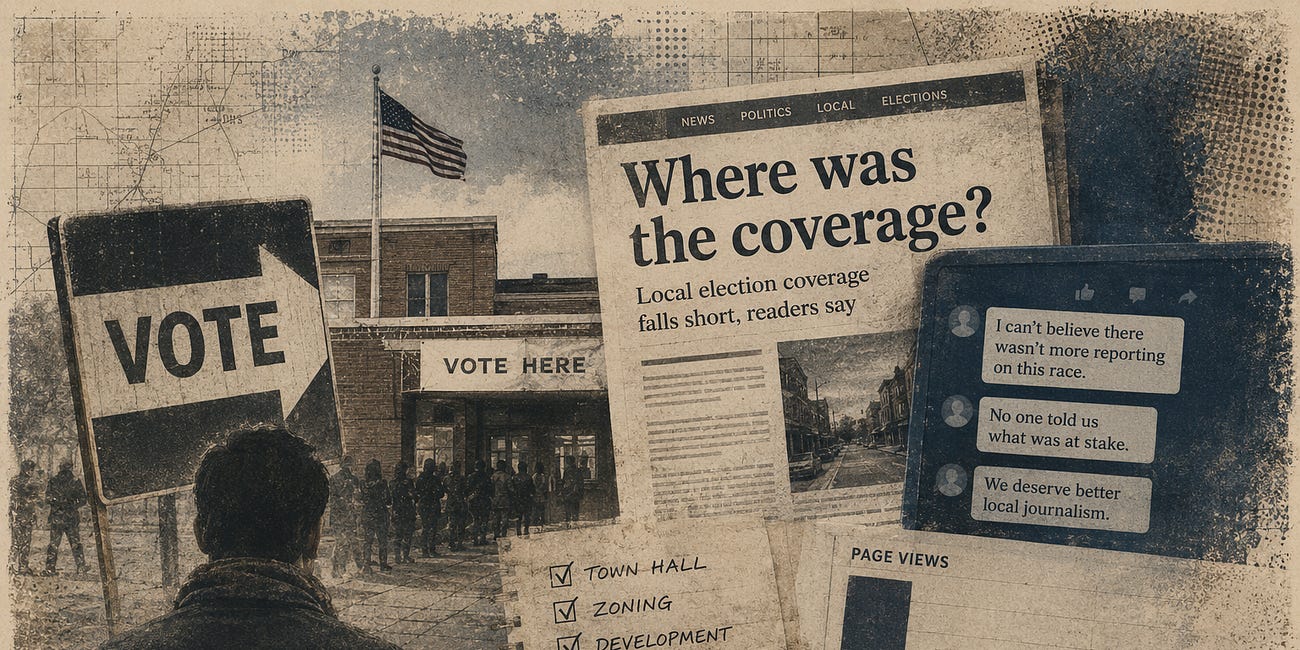
Last month, Primary Day came and went here in New York. There were a series of consequential races across the state. But, as the dust settled, I heard a familiar refrain: “Where was the coverage?”
Comments
Nothing yet. Say the first thing.
Sign in to join the conversation.