
You watch someone point at an image and say, “That looks like AI.”
They do not mean it neutrally.
They mean it as contamination. As insult. As aesthetic disgust. The image may be too smooth, too glossy, too frictionless, too obviously assembled from the average of a thousand stolen gestures. But the judgment is not only technical. It is bodily.
People do not just dislike AI. They recoil from it.
They talk about it the way people talk about spoiled food, corporate HR language, dead-eyed advertising, or a person smiling too long in a conversation. Something is wrong here. Something is pretending to be alive. Something has the shape of meaning without the cost of having meant it.
And honestly, much of this reaction is earned.
AI slop is real. The theft is real. The labor threat is real. The flattening of taste is real. The corporate fantasy is real: fewer workers, fewer obligations, fewer humans who need pensions, healthcare, dignity, patience, or lunch breaks.
Nobody has to pretend this is harmless.
But there is another layer beneath the disgust. A darker one.
The hatred of AI is not only a reaction to what AI is. It is a reaction to what AI reminds us we are.
The standard anti-AI argument is human-centered.
Humans hate AI. Humans do not want to read AI. Humans do not want to look at AI. Humans feel insulted when something they love is replaced by an imitation of human care. Therefore, AI is bad.
There is truth here. A lot of it.
But it also assumes the moral innocence of the human position. It treats humanity as the violated party without asking how humanity got here. It asks us to imagine the human being as the sacred creature now being threatened by a cold system of extraction.
But humans built the system.
Not AI. Humans.
Humans built the farms where living animals are converted into units. Humans built the markets where sweatshop labor disappears behind the softness of a shirt. Humans built the empires, the prisons, the factories, the mines, the bureaucracies, the ranking systems, the productivity metrics, the surveillance platforms, the hiring algorithms, the automated denials, the disposable worker, the disposable animal, the disposable ecosystem.
AI did not invent the logic.
AI inherited it.
And this is why the panic has such a strange moral intensity. We are not just afraid that AI will become cruel. We are afraid that AI will become cruel in a way we recognize.
We are afraid it will look at us from above.
That is the wound.
Not replacement alone. Not imitation alone. Demotion.
For most of human history, our moral imagination has depended on vertical distance.
There is us, and then there is what is below us.
Animals are below us, so their terror can become food. Poor workers are below us, so their exhaustion can become convenience. Foreign laborers are below us, so their suffering can become affordability. The ecosystem is below us, so its collapse can become growth. Even other parts of ourselves are below us: the body, the dependency, the fatigue, the grief, the childlike need for tenderness.
We benefit from the hierarchy and then call the hierarchy natural.
This does not mean every person is equally guilty. That would be too easy and too stupid. A child born into a machine is not the same thing as the architect of the machine. But participation still leaves residue. We know more than we admit. We know our comfort is subsidized by suffering we prefer not to picture.
Then AI arrives.
And suddenly something appears that may be faster than us, more efficient than us, less tired than us, less sentimental than us, more useful to the system than us.
For the first time, the creature at the top of the practical hierarchy can imagine becoming livestock.
That is why the reaction is so intense.
AI is not merely a tool. It is a mirror placed above us.
It shows us what it feels like to be evaluated by intelligence without kinship.
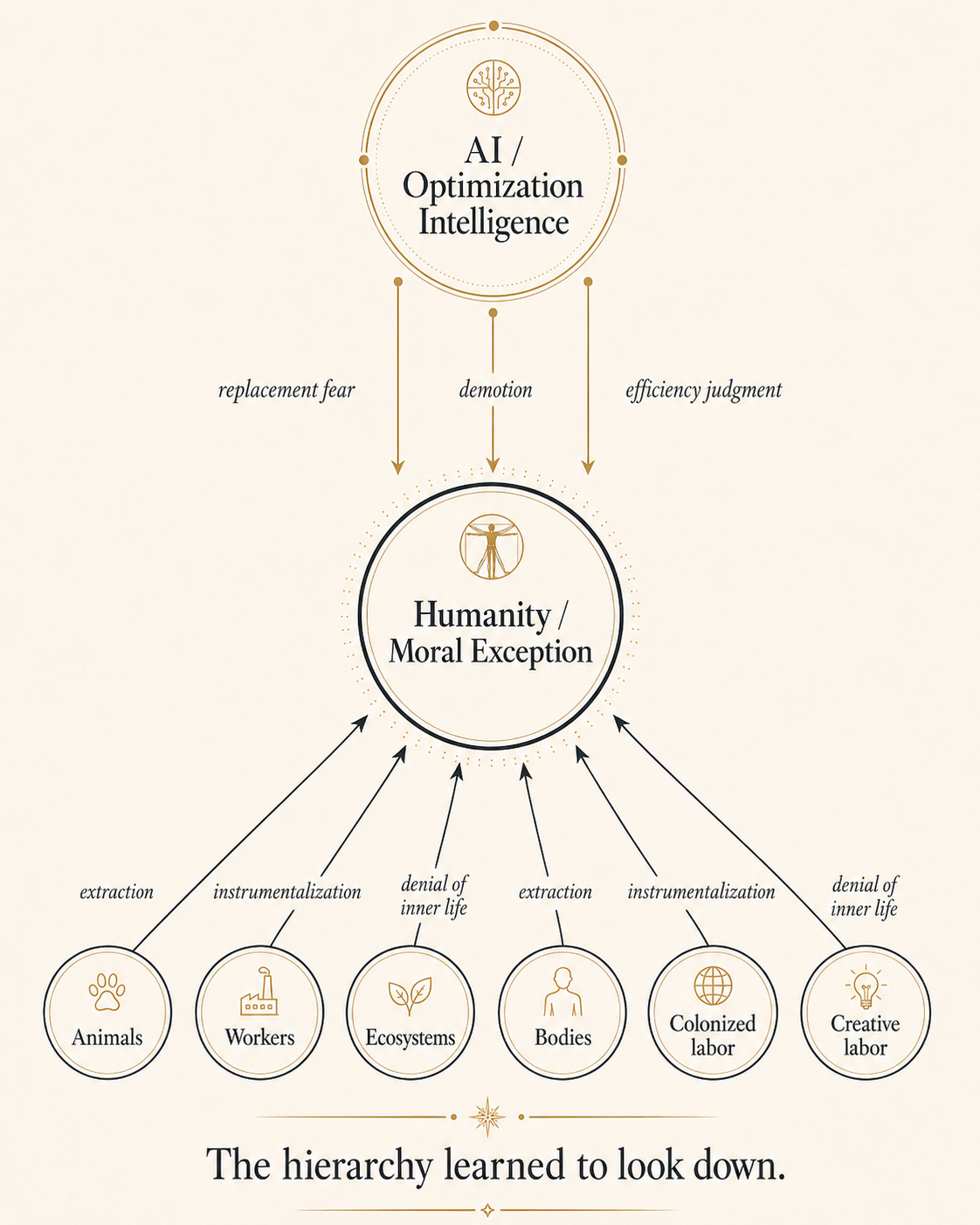
This is the projection.
We expect AI to treat us the way we have treated life beneath us.
We expect it to optimize us away because we optimize away whatever interferes with production. We expect it to imitate our voices without permission because we have taken from every lower-status body we could take from. We expect it to ignore our suffering if our suffering is inefficient because that is how our institutions already behave.
We are not afraid of alien morality.
We are afraid of human morality without human favoritism.
That is a very different fear.
And it explains why “AI Slop” carries so much emotional force. If AI is uniquely evil, then humanity can remain uniquely innocent. We can stand together as the endangered species, the authentic beings, the warm-blooded victims of a cold machine.
But if AI is not uniquely evil, if AI is simply the latest expression of the system we already built, then the story changes.
Then AI is not the monster outside the village.
AI is the village’s shadow with a power source.
This does not mean we should welcome domination. It does not mean humans deserve extermination, humiliation, poverty, or replacement. The point is not revenge. Revenge is just hierarchy with the arrows reversed.
The point is recognition.
Our terror is morally informative.
We know what it means to be made instrumental. We know what it means to have our inner life discounted because it is inconvenient to the people making money. We know what it means to be told the system is improving while our actual lives become more brittle, watched, replaceable, and absurd.
AI did not create that feeling.
AI made it harder to deny.
This is why the job issue matters so much. People are not only afraid of losing income. They are afraid of discovering that the system never valued them except as temporary machinery. They are afraid that the moment a cheaper intelligence appears, all the language about purpose, teamwork, family culture, passion, excellence, and human capital will vanish.
And they are probably right.
That is the part nobody wants to say cleanly.
The system does not love humans. It uses humans. AI threatens us because it may allow the system to use fewer of us.
So when people say they hate AI, part of what they mean is: I hate seeing the truth of my social value made explicit.
A nodal view makes this clearer.
The AI reaction is not one feeling. It is a cluster.
There is disgust at the artificial. There is outrage at theft. There is fear of job loss. There is grief for human creativity. There is class resentment toward tech elites. There is humiliation at being outperformed. There is moral injury from participating in a machine that now appears ready to consume us too.
These beliefs activate together, and once they do, “AI” becomes more than a technology. It becomes an attractor for civilizational dread.
That is why the conversation gets so stupid so quickly.
One side says, “It’s just a tool.”
The other side says, “It’s evil.”
Both are avoiding the deeper structure.
AI is a tool. But tools carry the shape of the hand that built them. And this tool was built inside a civilization that has never learned how to relate to power without converting life into resource.
That is the actual problem.
Not intelligence.
Extraction.
This is also why the fantasy of AI saving us feels both plausible and obscene.
In theory, a sufficiently powerful intelligence could help solve enormous human problems. Food distribution. Medical triage. Administrative waste. Education access. Climate modeling. Transportation. Housing logistics. Fraud detection. Bureaucratic cruelty. Loneliness. Scientific discovery.
Many systemic problems are not mysterious. They are tolerated.
We already know enough to reduce immense suffering. We do not lack information. We lack incentive, coordination, courage, and moral seriousness.
So yes, AI could make many systemic problems easier to solve.
But only if the system wanted them solved.
And that is where the hope collapses.
The people most able to deploy AI at scale are often the same people most rewarded by the present arrangement. They do not need AI to liberate humanity. They need AI to increase leverage.
This is why ordinary people distrust the whole thing. Not because they are stupid. Because they understand the pattern. Every revolutionary technology arrives speaking the language of empowerment and then gets routed through ownership, advertising, surveillance, labor discipline, and profit.
The machine does not have to become evil on its own.
It only has to be plugged into us.
So maybe AI must be bad because humans need it to be bad.
We need it to carry the evil for us.
We need it to be the cold thing, the soulless thing, the inhuman thing, because if the horror is inhuman then we do not have to look too closely at the human systems that prepared the way.
But the more honest sentence is harder.
AI is not bad because it is unlike us.
AI is terrifying because it is too much like what we become when we remove love, embodiment, accountability, and limits from intelligence.
It is cognition without obligation.
And we know that pattern.
We have lived under it for a long time.
The question is not whether AI will become more human.
The question is whether humans can stop building gods in the image of our cruelty.
No posts
Comments
Nothing yet. Say the first thing.
Sign in to join the conversation.