
Text within this block will maintain its original spacing when published
As soon as the soles of his winged feet touched ground,
He saw, beyond the huts, where Aeneas was
Building towers and houses; he carried a sword
Embellished with fiery stars of golden jasper
And from his shoulders there hung a glowing Tyrian
Purple cloak inwoven with threads of gold,
A gift to him from Dido's treasure of riches.
"So is it that you are, for the sake of this woman,
Building a beautiful Carthage, forgetting about
The city that is your destiny? The god
Whose power is over the gods and earth and heaven
Has sent me down to you from shining Olympus.
What are you doing? What are you hoping for,
To waste your time like this in these Libyan lands?
If the glory of your fortune does not inspire you,
And if you do not wish to undertake
This labor for the sake of your own fame,
Think of Ascanius, your growing son,
And of the promise made to him, your heir,
To rule Italia and the Roman world."
These are the words Cyllenius said to him,
And in the saying he faded form his sight
And vanished far away into thin air.
Aeneas was struck wordless, in terror, his hair
Stood on end, his voice got caught in his throat.
Dumbfounded by the gods' rebuke he burned
With the desire to get himself away
And leve this dulcet country as the gods
Commanded him to do.
[...]
As Jove commaned him he did
Not look at her in response; he looked at the future
He was required to look at, and resolutely
Suppressed the anguishing sorrow in his breast.
[...]
It's as when high in the Alipne mountains the boreal
Winds assault an ancient strong oak tree,
Contending how, this way, now that, to fell it.
There is a groaning, the great trunk shakes and rocks,
Its wind-shattered foliage scattered on the ground,
But it holds to where it is upon the mountain;
As far as its crown extends to the high heavens,
Its roots reach down, as far, to Tartarus;
So he, though shaken in his grieving heart,
Buffeted this way and that by what he heard,
Still stood unmoved; the tears that fell are nulled.
We live in a particularly distracted age. I know I experience it daily. And it’s not simply the distractions of entertainment, convenience, idle comforts, political rage-baiting, and increasing social othering. Nor is it simply the distraction of the alert mechanisms designed to keep you productive — notification on notification reminding you that your time is valuable and everyone, friend and stranger alike, is bidding for it. The distraction of the present age comes from two unexamined beliefs: “I can do anything” and “I can’t do anything.” The focus of this reflection is on the former, though. Hyper-empowered, positive thinking has become fertile ground for an open-endedness that distracts us from the questions that examine destiny and vocation with sober self-accounting.
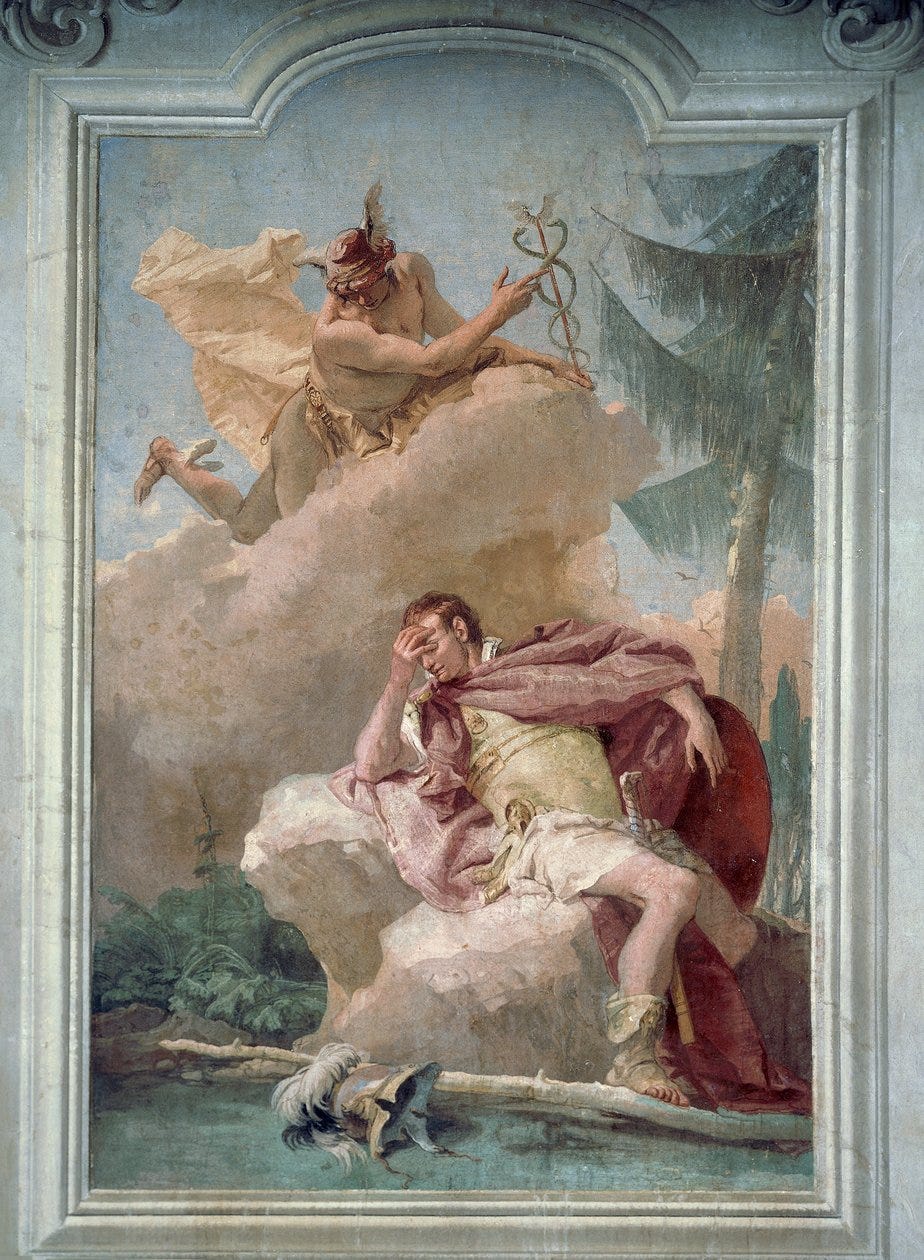
In this passage, we see Aeneas confronted with his own toleration. He has landed in Carthage after wandering in the Mediterranean in pursuit of his divine calling to found a new great city after the destruction of Troy. In Carthage, he finds a great city in process, ruled by a capable, energetic queen. Love blossoms between them, and Aeneas begins to enjoy the comfort of her courts. “Mercury challenges him at once,” one translation reads.
I want to focus on three things in this passage. The first is Mercury’s challenge. I remember a critical conversation I had with my second in command during a very difficult season in my own life and leadership. I was seeking all sorts of comforts and avoiding the responsibilities of my position, feeling depleted after a year of grief, slander, and vocational confusion. She challenged me with the same frankness that Mercury had: honest, cutting, and advocating. She called me forward. Everything about Mercury’s challenge is for Aeneas. And if that isn’t enough, he does it for Aeneas’ son, Ascanius. The most effective challenges are the ones that remind us of vision. We have purposes for ourselves that are larger than moments or seasons. We must have people on our side fiercely advocating for us when we drift.
Secondly, destiny is an idea we have drifted away from in the 21st century. The less religious we claim to be, the less we give any currency to the idea that there is something appointed for us to live into and fulfill. Yet, I’d like to believe that the idea of heroism still has life in it and can still animate our behavior and our plans. The recent bumper crop of superhero movies nods to that, yet they put forward a version of heroism that misses the value of thinking through destiny. The heroism that we see in epics like The Aeneid is accessible to more than just a few legendary persons who came along once every century. The glory of destiny is a common good, and when accessed, it becomes a filtering tool for specific goods. This is what the modern mind resists, though, preferring the openness of “I can do anything” to the demand of “This is mine.” The former leads to drift. We forget what we are called toward, and the divine indicts us when we “waste time” building what is not ours.
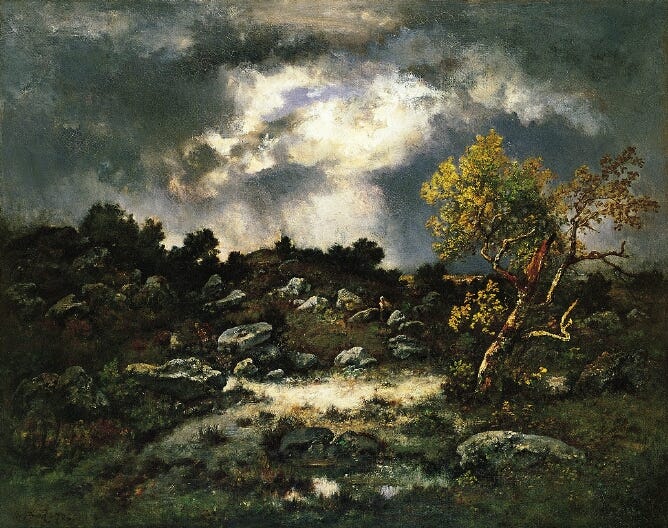
Lastly, the resolve that Aeneas shows after being reminded is a model for us. Dido’s story is fraught and problematic. It is utterly tragic to watch these two powerful rulers brought together in passionate, well-matched love, only to see destiny cruelly separate them. Aeneas’ sorrow is written well from within his resolve. When it is our turn to stand buffeted and assaulted by the forces that come to uproot our purposes, even when it shears and quivers us, we must cling to the rocks reaching down into the depths of our conviction. The distractions are all around us, as reliable as the weather itself. Yet, we too can “hold to where [we are] on the mountain” even though we are “shaken in our grieving hearts,” unmoved on purpose.
No posts
Comments
Nothing yet. Say the first thing.
Sign in to join the conversation.