
Text within this block will maintain its original spacing when published
When, early in the morning, day's bright light
Had put the stars to flight, Aeneas gathered
All his fellows from all along the shore,
And from the mound of a hill he spoke to them thus:
"Great scions of the race descended from gods,
The months as those go by have reached the number
Completing the year since we put down the ashes,
Here, into the earth, of my father, divine Anchises,
And consecrated here these altars of sorrow.
We are upon the day, if I am not
Mistaken, which, according to your will,
O gods I'll keep forever as the day
of honor and the rituals of grieving.
[...] So let us all
Together celebrate the joyful rites,
And pray for favoring winds, and pray that he
Vouchsafe that when my city has been founded,
We'll celebrate the sacrifice each year
In temples we will dedicate to his name.
[...]
I will command that there be festive contests,
Trojans competing with Trojans: first the swift ships,
Footraces then for those who are best at running,
Then he who glories in his strength to show
His skill in the flight of javelin and arrow,
And he who dares to challenge in the fight,
With lead-wrapped rawhide gloves -- let those
Who seek to win the victor's prize step forth.
Be slient now, and wreathe your brows with leaves."
[...] And then Aeneas went,
Accompanied by many thousand people,
An enormous crowd of which he was the center...
In the middle of a new land, and with the hard prospect of establishing new homes on the Italian peninsula, pious Aeneas decides to hold something like an informal Olympic Games strictly for the purpose of celebrating the memories of their beloved dead. This passage echoes Vergil’s love for Homer, who told the story of the funeral games that Achilles held for Patroclus in Book XXIII of The Iliad. While we, as readers, could chalk these inclusions up to something anachronistic, quaint, or specific to different times, places, and customs, that would be a mistake. Unless we see ourselves clearly through these men and women, we fail to complete or perfect the interaction between ourselves and the text.
What can we know from the story of Aeneas’ journey? Threats were more present and active, doom was nearer than anyone here reading this substack likely has experienced. Hardship, loss, and tragedy have been the path that Aeneas and his men have traveled over harsh land and unrelenting seas. He has finally reached the place appointed for him, arriving upon land he is to subdue and establish. The work of centuries stretches out before him, his son, and their descendants.
None of this escapes him. In fact, it’s the context of his decision. He decides to hold the games as a way of participating in this work.
What is piety? What does it mean to be pious, the way Aeneas is? What does it have to do with celebration, honor, and destiny? Being of any kind is made known in behavior; action reveals identity. Pious Aeneas follows the will of the gods. He submits to the dutiful order of filial loyalty (honoring his father and his son as both son and father). He loves his country of origin, Troy, which he leaves when it falls and he loves the country he founds because he loves his own people, whom it is meant to care for. He honors reality.
Aeneas’ choice to hold an athletic festival is a particularly appropriate celebration of life. Let us strain at the edges of our capacity to honor those who can no longer. Too often, our encounters with celebration (that is, the ones that we’re invited to participate in, not just observe) are not very alive. Top Golf is a poor substitute for being “superior with javelin and slight arrows.” Pizza in the breakroom does not appropriately “celebrate the sacrifice with joy.” Perhaps what we’re missing is piety.
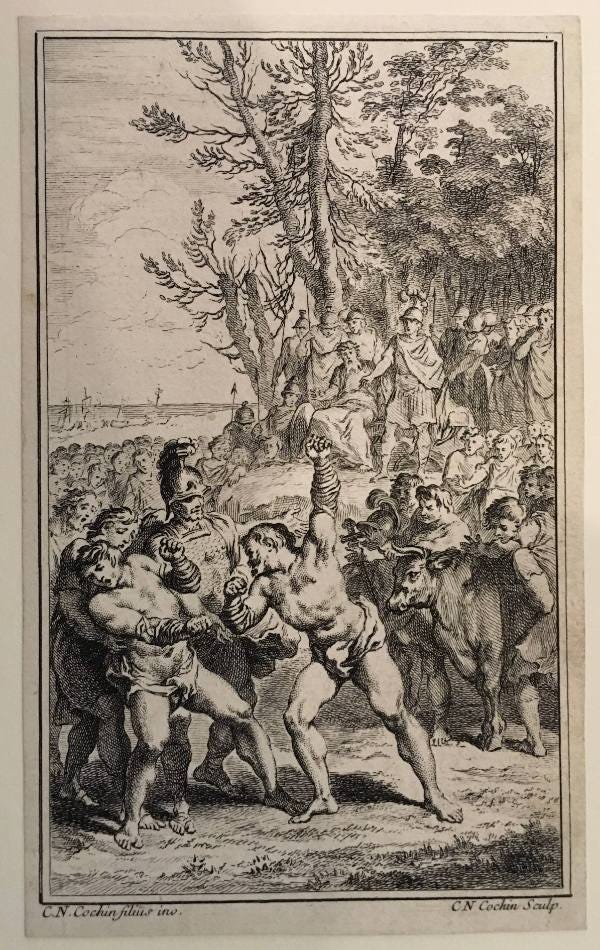
To celebrate is to honor. Mourning is a celebration, an honoring. Feasting & dancing is more obviously a celebration, yet it is something I learned in my own walk with grief: that mourning is a way of giving what’s due to reality. I was talking with a colleague recently, and I remarked that I had noticed a decline in any appeal to fittingness, or what’s appropriate, in my own lifetime. In speech, we do not talk about what’s appropriate or inappropriate as much as we used to. That is, we are not looking to reality to determine how we should position ourselves to it as much as we used to. We have fallen out of practice in piety.
Aeneas teaches us two things about excellence here. The first comes from his multidoxical approach to joy and sorrow. He proclaims to the crowd of thousands that he will honor his father’s and kinsmen’s death, keeping forever the “rituals of grieving.” Just a few lines later, he provokes a different attitude, “So let us all/together celebrate the joyful rites.” F. Scott Fitzgerald is often quoted for his observation that “The test of a first-rate intelligence is the ability to hold two opposing ideas in mind at the same time and still retain the ability to function.” My hunch, though, is that joy and sorrow are not opposing ideas in the classical mind, or at very least in Vergil’s characterization of Aeneas’ heroic mind. Rather, they’re concomitant ideas, necessary and amplifying. The first-rate mind of a heroic leader not only sees this, but leverages it so that others can as well.
The second thing that Aeneas shows us about excellence has to do with creating real stakes, doing something 100%. “Let those who/wish to win the victor’s prize step forth,” he commands. This is not an idle contest, yet, neither is it life or death. A phrase I hear often with my clients is that they’re “struggling” with a task, challenge, relationship, etc. Not defining the kind of struggle they’re in gets in their way. What kind of struggle is it? Fighting for your life? Trying to get a pickle jar open? A game of pick-up basketball? Let’s define the stakes and let those stakes be those that draw out your full participation, your best bet at achieving the victor’s prize. Another wise and classical mind, who lived around the same time as Vergil recommended this to his listeners: “Do you not know that in a race the runners all compete, but only one receives the prize? Run in such a way that you may win it.” Are you, leader, creating the conditions that draw out “festive contests” & “glories of strength” to invite the fullest participation from those we lead? If not, look to your piety.
No posts
Comments
Nothing yet. Say the first thing.
Sign in to join the conversation.