
Text within this block will maintain its original spacing when published
Then deeply troubled he spoke to his own great-hearted spirit: 'What
will happen now, and what in the long outcome will befall me?
For if I wait out the uncomfortable night by the river,
I fear that the female dew and the evil frost will blow from the river; but if I go up the slope
and into the shadowy forest,
and lie down to sleep among the dense bushes, even if the chill and
weariness let me be, and a sweet sleep comes upon me,
I fear I may become spoil and prey to the wild animals.'
         In the division of his heart this last way seemed best,
and he went to look for the wood and found it close to the water in a
conspicuous place, and stopped underneath two bushes
that grew from the same place, one of thorn, one of wild olive, and
neither the force of wet-blowing winds could penetrate these nor could the
shining sun ever strike through with his rays, nor yet could the rain
pass all the way through them, so close together were they grown,
interlacing each other; and under these now Odysseus entered, and with his
own hands heaped him a bed to sleep on, making it wide, since there was
great store of fallen leaves there, enough for two men to take cover in or
even three men
in the winter season, even in the very worst kind of weather.
Seeing this, long-suffering great Odysseus was happy,
and lay down in the middle, and made a pile of leaves over him.
As when a man buries a burning log in a black ash heap
in a remote place in the country, where none live near as neighbors,
and saves the seed of fire, having no other place to get a light from, so
Odysseus buried himself in the leaves, and Athene shed a sleep on his eyes
so as most quickly to quit him
by veiling his eyes, from the exhaustion of his hard labors.
What ought we to do after “the exhaustion of hard labors”?
In this passage, we encounter Odysseus wrecked on the shore after finally setting off for home again after years of waiting on an island, stalled by the gods. He has already been away for over a decade, fighting at Troy. He has been blown off course repeatedly, even when he was within sight of the shores of Ithaka, his home. Bereft on the beach of a strange and wild land, he barely has enough energy to make the crucial decision on which his very survival rests. Neither of his options carries any guarantee.
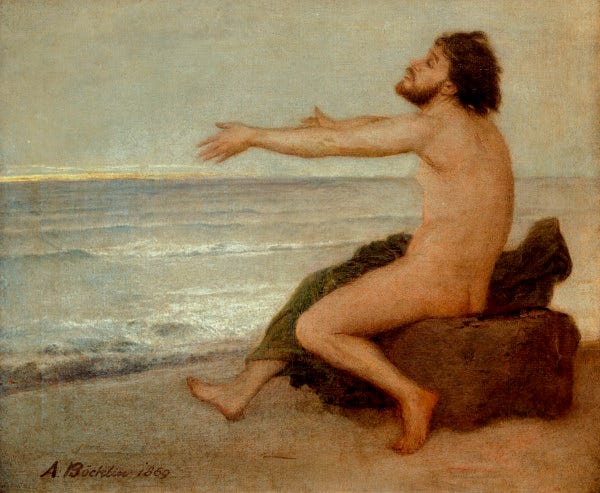
Perhaps you have been in similar straits. A long sprint on a project that didn’t turn out as planned. Losing a job in an unfavorable hiring climate. Left alone after leading well, sabotaged by your own crew. Perhaps you’ve experienced the “division of the heart” from which Odysseus must make his decision. We are often caught between poor options that leave no guarantee when the stakes are high.
Three things stick out to me in this passage that are worth our reflection.
Firstly, the internal conversation. Odysseus speaks “to his own great-hearted spirit.” His discourse is honest — honest about reality and the threats all around him. Honest about his own uncertainty, “What in the long outcome will befall me?” Not acting is not an option, though. This conversation is critical. For us, we must take the time to listen to the internal conversation of our great-hearted spirit, listening intently to reality. Too often we move into action panicked, listening to the fear that shrinks our spirits too easily and invents its own narrative about what threatens us, that it is too great to be faced, or about our own capacity, that we can persevere through “damaged strength” when rest is called for. Listening to reality in a great-hearted way provides the clarity to act well.
Secondly, Odysseus chooses a hedge. He opts for the way that seemed best into protective elements that, though still exposed to predators, provided the conditions for recovery that would most likely lead to survival. He chooses a place between shrub (also translated “thorn”) and olive, between hardship and peace. He makes a refuge “with his own hands”, in the shadow of these protective branches. What are the protective contexts where we can make our own resting places? Our homes, our communities, our friends, our places of prayer, worship, and stillness. Nature. What I appreciate most about this passage is the emphasis on “his own hands” — that even though our contexts exist, it takes ownership and intentional activity to turn these into resting places.
The last insight comes from the great Homeric simile that compares Odysseus’ rest to the preservation of a fire. He “saves a seed of fire, having no other place to get a light from.” This is a vivid image of the responsibility required to care for our own energy after the exhaustion of our own hard labors. Odysseus' stewardship of self is unflinching, participative, and personal. To make his journey home, he must care for himself sensitively to save the seeds of fire that he will use to blaze into light, angry flame, and ultimately the warming center of his home upon his heroic return.
No posts
Comments
Nothing yet. Say the first thing.
Sign in to join the conversation.