
A few days ago, I received an email from Allie Miller inviting me to take an “AI-First” assessment.
Naturally, I had to take it.
I spend enough time thinking, writing, experimenting, and occasionally arguing with artificial intelligence that I was curious where I would land. I also wanted to understand what the test considered “AI-first” in the first place.
My score was 68.2%, classifying me as a Curious Tinkerer and describing me as the kind of AI chef who might bake a cake with a blowtorch.
Funny, and fair.
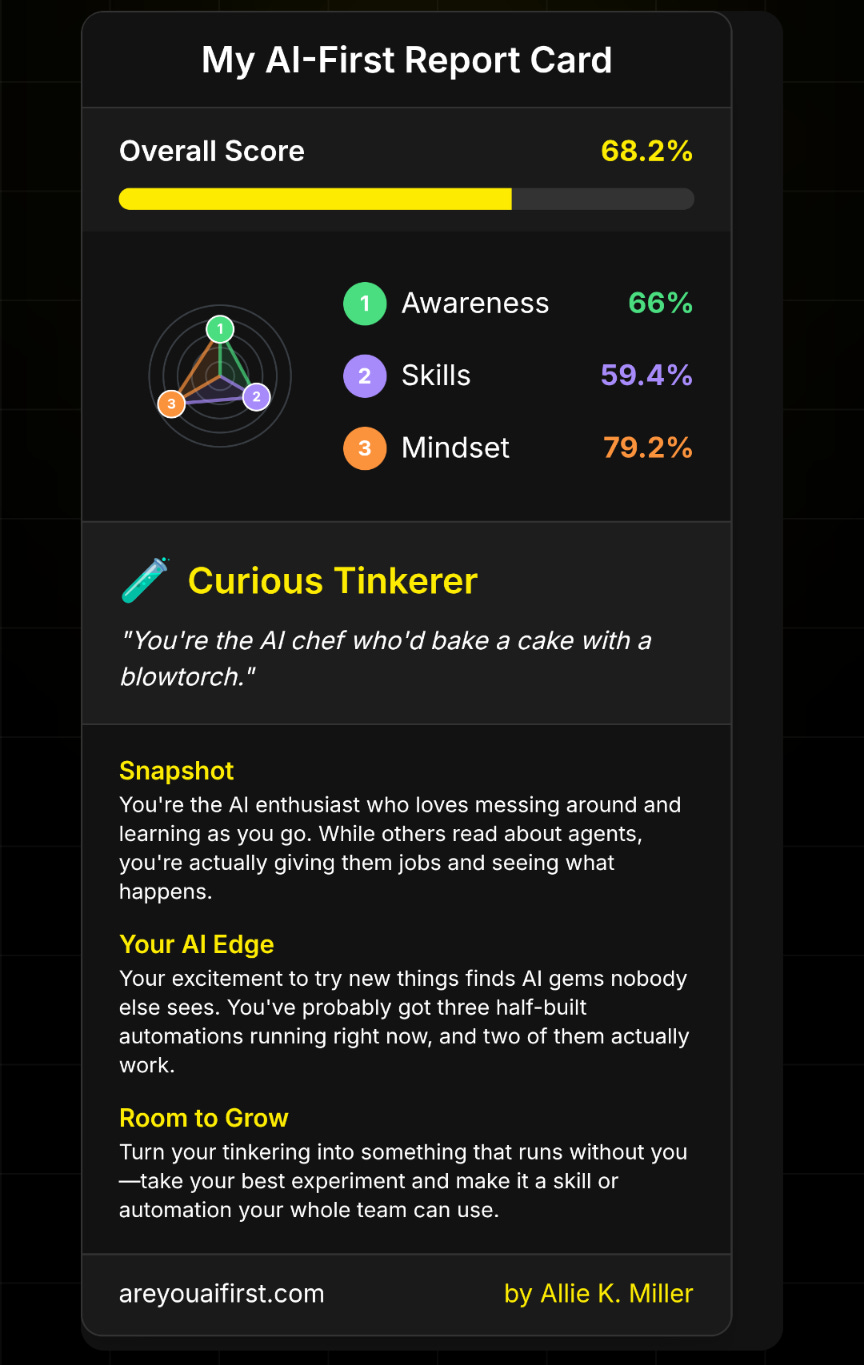
My mindset score was considerably higher than my skills score, which also felt about right. I am willing to experiment, deconstruct a problem, test prompts, and choose between tools based on the work in front of me. At the same time, much of what I do still depends on me being present to guide, interpret, redirect, refine, and occasionally rescue the process.
Although I use AI regularly, I am not yet living inside an elegantly automated system that hums along in my absence. Thus, the recommendation was straightforward: turn more of the tinkering into something repeatable that other people can use.
Hmm, perhaps. Let’s just say “work in progress” for now.
Regardless, I think the test was seamless, visually polished, and specific enough to feel personal without becoming clinical. It gave me a score, an identity, a description of my advantage, and a development opportunity. It also led naturally into the broader learning platform behind it: curiosity became diagnosis; diagnosis illuminated identity; identity signaled a gap; and the gap pointed toward a call to action. Net, good product design.
Still, I have notes.
On more than one question, I found myself moving the cursor between two answers; I wanted to pick more than one answer, or I wanted to write in my own. For example, one described how I work when I am exploring. The other described how I work when I already understand the problem. Subsequently, sometimes I use one tool; sometimes I use several because they are better suited to different parts of the work. Sometimes I begin by deconstructing the prompt altogether or run different prompts concurrently.
In other words, like with any self-assessment, the test required only one version of me—it wanted a lane.
Which makes sense and I’d argue is an important evolution (and, I hope, maturation) of the technology itself. Are we moving from hype to heuristic perhaps? Is measurable value creation next?
As the old Chinese parable goes, “maybe”.

Any scored assessment has to reduce some ambiguity. Otherwise, there is no score, comparison, archetype, or clear recommendation—no benchmark, no starting line.
An assessment — incomplete or elegant — takes a moving set of behaviors and turns them into a point-in-time identity. The result becomes easier to understand and act upon, even if the behavior underneath it may be more conditional than the number suggests.
As a result, my interest shifted away from whether 68.2% was flattering, disappointing, or oddly specific.
The more interesting development is that there is now an AI-first score to receive in the first place. AI has entered the report-card phase.
(Side note: I recognize that there are likely others; they just haven’t hit my feed yet, and I admittedly am a fan of Allie).
We have moved beyond asking whether people have tried it. Increasingly, we are asking what kind of AI user they are, how advanced they are, what they should do next, and are asking each other, “What prompts do you use? When? For what purpose?” and, my favorite…
“Can you send me your prompts?”
(Another side note: just sit with that sentence for a bit. Did you ever imagine that in less than 5 years, we’d be asking for each other’s prompts? That there’s going to be a whole generation of folks that are/will be born with prompts as a default? Fascinating.)
A similar instinct is appearing around organizations through maturity models, capability maps, adoption measures, workflow inventories, training completions, and collections of success stories.
I.e., individual fluency and organizational maturity are not interchangeable. An individual assessment can focus on habits, skills, judgment, and repeatability. An organizational assessment, on the other hand, has to account for funding, governance, technology, workflows, incentives, and outcomes distributed across a system.
Still, the arrival of assessments, archetypes, academies, certifications, and development pathways suggests that AI is moving beyond informal experimentation. Or perhaps the market forming around the desire to become AI-mature is moving faster than maturity itself.
I am not sure the two can be separated yet.
The scorecard may tell us something about the capability. It certainly tells us that AI-firstness is becoming an identity that individuals and organizations may feel expected to demonstrate. And it’s not the first time we have seen or felt this way.
The phrase “AI-first” sounded familiar the first time I heard it.
I have lived through digital-first, mobile-first, cloud-first, data-first, and several related declarations that a new capability needed to move from the edge of the business to its center.
At one point, I briefly imagined earlier versions of the same idea:
Are you computer-first, or do you still begin every important document on paper or a typewriter?
Is your transportation strategy automobile-first, or are you over-indexing on the horse?
The comparisons are imperfect (but fun). They are also a reminder that technologies which eventually become ordinary often pass through a period when just using them is treated as a distinguishing characteristic.
I posit that “First” language tends to appear when a capability is important but not yet natural. It reverses the inherited default:
Mobile-first asked companies to stop treating the desktop experience as the real product and mobile as a smaller version added later.
Digital-first challenged organizations to reconsider analog processes rather than placing a screen in front of them.
AI-first appears to be serving a similar purpose:
Do not begin with the inherited workflow and ask where AI can be inserted. Instead, reconsider what the work could become now that AI is available.
That can be useful inside organizations with established routines: existing incentives, decision rights, and operating rhythms tend to reproduce the current workflow. A strong phrase can interrupt the pattern long enough to create room for experimentation, investment, and redesign.
In that sense, AI-first may be less a destination than a transitional management technology. It directs attention, shifts resources, creates expectations, and challenges the assumption that yesterday’s process should remain the starting point. It’s a phrase that can be catalytic.
It can also turn a capability into an identity, and the identity into a test of competence, organizational innovation, or cultural change:
Are you AI-first enough?
How many use cases do you have?
How many employees are trained?
How much time have you saved?
Those measures can show whether experimentation is spreading. The risk, however, begins when they become the primary evidence of progress (versus the value created):
Did the decision improve? How?
Did the customer receive more value? By how much?
Did the organization stop doing anything? Are we tracking this?
What happened to the time that was saved? And how often do we check?
A company can become more AI-active without becoming more AI-integrated. In other words, people can also learn to perform the visible behaviors of AI-firstness without materially improving the value created.
Allie also offers an organizational assessment. I was curious, but alas, I stopped short of taking it simply because I think scoring (viewing, assessing, etc.) an organization from one seat can create the illusion of enterprise knowledge that no individual really possesses.
As I wrote recently, AI destabilizes functional identity:
A technology leader may see architecture, security, integration, and platform readiness.
Finance may see funding discipline and whether promised value is appearing in the economics.
A commercial leader may see customer use cases and field adoption.
HR may see capability building, role design, and managerial readiness.
Legal may see risks others underestimate.
Frontline employees may know whether the tools are helping or merely adding another expectation to the day.
The same company could plausibly receive very different scores depending on who answers. Yet, the variance may be more informative than a single composite number.
Perhaps the first problem with an organizational AI-first score is deciding who is qualified to answer on behalf of the organization. A more revealing assessment might ask people across functions, levels, and workflows to complete it independently. The gaps between their answers could expose where ambition, capability, governance, and lived experience are misaligned:
The executive team may believe the organization is scaling.
The frontline may believe it is experimenting.
Technology may believe the foundation is immature.
Finance may believe the costs are more visible than the returns.
All of them may be accurately describing the part they can see because measurement can surface differences that vague aspiration allows people to avoid. It can also compress those differences into a number that looks more conclusive than the underlying system deserves.
Besides, organizations rarely move through maturity stages in a linear sequence anyway. A company may be experimenting, scaling, retreating, standardizing, and declaring victory at the same time, depending on the function or workflow.
One score has trouble holding all of that.
I’d offer that organizations need visible examples to make change feel possible. Early AI success stories tend to be workflow-based: time saved, steps removed, drafts accelerated, summaries generated, content created, or repetitive work automated.
And that’s ok…for now. They make the technology concrete and create permission to experiment. But, again, workflow improvement is not automatically value creation:
A faster process may still produce an unnecessary output.
A shorter meeting may simply create room for another meeting.
More content may increase volume without improving relevance.
An automated task may be efficient and still sit inside a workflow that should have been redesigned rather than accelerated.
And yet still, the report-card phase may encourage companies to document more of these examples, which is probably healthy. Naming what changed is better than relying on broad statements about transformation.
Eventually, though, and as I’ve argued before, the workflow story has to connect to the contribution story.
Making Contribution Legible
·
Mar 7
Over the last two essays, I’ve been sitting with a tension that many modern organizations can feel but don’t always name: value is increasingly created through teams, networks, and systems, while recognition still tends to resolve down to the individual. That mismatch isn’t hypocrisy. It’s usually the byproduct of two operating systems moving at different speeds.
I am glad I took the assessment.
The “Curious Tinkerer” label was recognizable, and the development suggestion was practical. I should turn more experiments into repeatable methods and workflows that do not depend entirely on my presence.
But the score also pulled on another thread: an AI-first assessment may be most useful as a prompt to consider the next transition rather than as a permanent declaration of identity.
For me, that means less tinkering for its own sake and more discipline around what should become repeatable, what should remain situational, and when AI is simply not the right answer.
A team faces a different challenge: turning scattered individual habits into shared practices without standardizing away useful judgment.
An organization may still be trying to distinguish visible activity from integration, and integration from value. Different parts of the same company may be in all three places at once.
Eventually, some capabilities become ordinary.
A genuinely digital organization does not need to remind everyone that computers are permitted. A mature mobile experience does not announce itself as mobile-first. The capability becomes part of how the work is designed.
Perhaps the same will eventually be true of AI.
Perhaps not everywhere, and perhaps not cleanly.
Some organizations may keep performing AI-firstness long after AI has become ordinary. Others may abandon the language before the underlying work changes much. And in other cases, the phrase may remain commercially useful even after it becomes operationally vague.
The report cards may help while the capability remains difficult to see, describe, and develop. But if integration deepens, the phrase may begin to feel less necessary.
In the end, perhaps the point of becoming AI-first is to stop needing to say that you are.
Simple, not easy.

Thanks for reading Big Things F@$t™! This post is public, so feel free to share it.
Comments
Nothing yet. Say the first thing.
Sign in to join the conversation.