
Reading time: 5 minutes
We are floating in space. Nobody truly knows what’s going on. I love you. —Paraphrased from Spiritualized, Ladies and Gentlemen We Are Floating in Space
A Note to My Readers
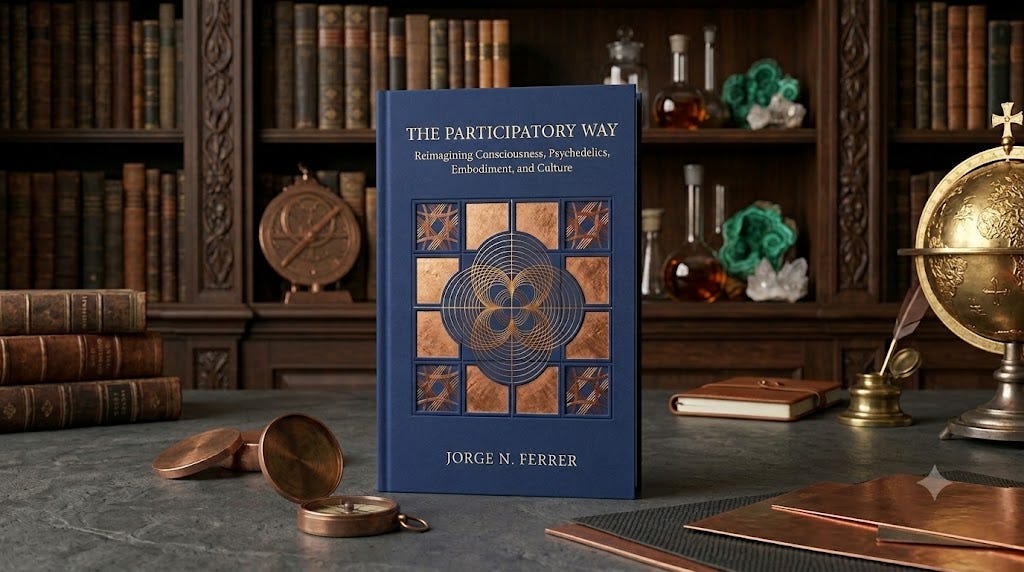
If my voice has been quiet in this space recently, it is because I have been deeply immersed in a labor of love: bringing the core themes of this Substack to their full, mature fruition. I am thrilled to share that the manuscript for my forthcoming book is now in its final stages.
This book is not merely a compilation; it is a thoroughly revised, structurally woven, and substantially expanded evolution of the ideas we have explored together in these essays. It represents a comprehensive exploration of the participatory paradigm as it touches consciousness, spiritual diversity, sacred medicines, somatic arrival, relational freedom, and gender, among other areas of contemporary relevance. I am currently completing the final editorial review and preparing the text for self-publication on Amazon.
As a profound thank you for your patience and support, all paid subscribers to this Substack will receive a free online version of the complete book as soon as it is officially released.
Once the book is out in the world, you can expect a return to much more regular essays in this space. Moving forward, we will be diving into fresh dispatches on the integration of sexuality and spirituality, exploring controversial topics such as nudism and the healing of perception from patriarchy, and interrogating the future of love and sex in the age of AI.
Below, you will find the book’s full Table of Contents—offering a roadmap of the terrain we will cross—followed by the complete Introduction.
Thank you for walking this path with me. The dance depends on our willingness to arrive.
Note to the Reader
Introduction: The Participatory Way
Part I: Consciousness
Chapter 1: Is Consciousness Fundamental? Beyond Materialism and Idealism
Chapter 2: Not a Summit, But a Forest: Spiritual Diversity and the Ecology of Religions
Chapter 3: The Participatory Self: Individuation in an Age of Disconnection
Chapter 4: The Participatory Field: Collective Consciousness Without Homogeneity
Part II: Psychedelics
Chapter 5: Enacting the Multiverse: Beyond Psychedelic Perennialism
Chapter 6: Shared Visions: The Mystery of Collective Psychedelic Experience
Chapter 7: The Unicorn Dilemma: Visions of the Impossible and the Nature of Reality
Chapter 8: Skipping Seasons: The Hidden Trap of Psychedelic Integration
Part III: Embodiment, Gender, and Intimacy
Chapter 9: The Art of Arrival: Why the Spiritual Revolution Is Not Body Optimization
Chapter 10: The New Gender Essentialism: Archetypes, Cultures, and the Spectrum of Identity
Chapter 11. The Omega Man: Reimagining Masculinity
Chapter 12: Relational Sovereignty: Beyond the Mono–Poly Divide
Part IV: Culture and Society
Chapter 13: The Last Taboo: Genetic Selfishness and the Crisis of Human Solidarity
Chapter 14: The Portera’s Library: Rescuing Gossip from Internalized Patriarchy
Chapter 15: We Teach What We Need: Impostor Syndrome and the Myth of the Expert
Chapter 16: The Poetics of Participation: Nature and the Art of Plenitude
Conclusion
A Note on Names and Lineage
Epilogue: The Questions That Found Me
Acknowledgments
Bibliography
Introduction: The Participatory Way
“One has to cross out that old word ‘observer’ and put in its place the new word ‘participator’. In some strange sense the universe is a participatory universe.”
— John Archibald Wheeler
In the midst of our busy lives and endless cultural noise, we easily forget that we are hurtling at over 1.3 million miles per hour on a minuscule but miraculous planet—racing through a vast, ever-expanding cosmos whose origins, limits, and future remain profoundly unknowable. Rarer still is the realization that we are not separate onlookers peering into this dark expanse. We are participatory expressions of this mysterious unfolding—a universe that has somehow become capable of knowing itself from within.
A sense of awe and vital curiosity permeates every page of this book, accompanied by a commitment to an undefended form of love in the face of existential uncertainty. As the opening epigraph of this book suggests, our shared ignorance does not have to lead to nihilism, cynicism, or narcissism. Instead, it can lead to a radical softening of the heart. It is precisely this vulnerable condition we all share that can foster a deep kinship not only among human beings, but with all life.
Yet when we turn our gaze from the luminous horizon of the cosmos back to the immediate realities of our collective life, we find a radically different picture. The human soul is currently caught in a metaphysical crossfire. For centuries, our civilization has been shaped by competing visions of reality: is the universe an accidental byproduct of dead matter, the projection of an absolute mind, or something even more enigmatic? This tension does not remain confined to philosophy departments; it secretly shapes how we love, how we heal, how we build culture, and how we experience ourselves.
When we look closely at the modern landscape, the fractures of this divide appear everywhere. They shape a medical system that treats the body as a biological machine to be optimized. At the other extreme, many spiritual subcultures regard both the body and the physical world as ultimately illusory or inferior realities to be transcended. They condition our approach to psychedelics, which oscillates between corporate medicalization and reductive New Age universalism. They appear even in our most intimate spheres—our relationships and our understanding of gender—where we struggle to reconcile enduring archetypal patterns with the complexities of lived experience.
This book offers a way through this cultural and philosophical impasse. It is neither a new dogma nor another metaphysical system, but a different way of inhabiting the world. It invites you into the Participatory Way.
As you navigate the chapters ahead, you will notice a recurring pattern: the consistent dismantling of rigid binaries. Whether we are examining materialism and idealism, autonomous individuality and participatory belonging, the mystical summit and the spiritual forest, or monogamy and polyamory, the same integrative impulse is at work. This repetition is deliberate. The modern mind has been conditioned to force existence into these stark either/or extremes. By repeatedly exposing the limits of these false dichotomies across different domains of life—from the nature of consciousness to the intimacy of the bedroom—we begin to recognize a deeper coherence. The habit of polarizing experience may itself be one of modernity’s structural flaws. Our task in this book is not to resolve particular debates. It is to retrain perception itself, learning to inhabit a participatory “third way” that breathes between and beyond the extremes.
To walk this path, we first need to become familiar with three foundational concepts: metaphysics, ontology, and epistemology. Although often regarded as abstract philosophical ideas, they are directly relevant to the questions explored throughout this book.
· Metaphysics is the broad branch of philosophy concerned with the fundamental structure and nature of reality. It asks what the universe is ultimately like, how it is constituted, and how its physical and nonphysical dimensions may relate, interact, or interweave.
· Ontology is a central branch of metaphysics, focusing more specifically on what exists. It asks: What kinds of things are fundamentally real? Are minds, values, mathematical entities, and perhaps even the subtle realms described in contemplative and shamanic traditions ultimately reducible to the physical world, or do they possess a reality of their own? In short, ontology explores the different modes and categories of being.
· Epistemology is the branch of philosophy concerned with knowledge. It asks: How do we come to know what is real? It examines the lenses through which we perceive reality and the methods by which we evaluate our beliefs and knowledge claims.
In the dominant modern worldview, ontology and epistemology are treated as strictly separate. The prevailing assumption is that there exists an objective reality “out there”—one that exists independently of us. Ontology asks what that reality consists of. Meanwhile, our task is thought to be simply to observe that reality as accurately as possible through the telescope of our minds—the domain of epistemology. The participatory perspective begins by questioning this separation, asking whether being and knowing may be more deeply intertwined than we have long assumed.
More specifically, a participatory vision suggests that the world is neither a collection of inert objects nor a purely subjective construction. Instead, consciousness and world participate in a living process of mutual co-creation. Our ways of knowing help shape the realities that come to be disclosed. The cosmos thus appears less as a finished structure than as an ongoing process of participatory becoming. That process includes human cognition, the wider community of life, and perhaps even more-than-human dimensions of the cosmos, such as nature’s diverse intelligences, possible subtle realms, or forms of being we have yet to imagine. When we engage the world through this lens, spiritual practice is transformed from a ladder of ascent into an ecology of arrival. Psychedelic experience shifts from either chemical optimization or abstract mystical universalism toward an open-ended dialogue with a living, multifaceted reality. And our relationships move beyond the binary of traditional versus alternative, emerging as laboratories of mutual becoming.
The architecture of this book is not accidental. It is organized as a balanced four-by-four lattice: four parts, each containing exactly four chapters. In Jungian psychology, the quaternity symbolizes the integration of disparate elements into a more balanced whole. A trinity moves; a quaternary stands, establishes a field, and inhabits space. The exploration is anchored in four foundational pillars: Consciousness, Psychedelics, Embodiment, and Culture. Together, the sixteen chapters form an archetypal grid that invites us to step away from a fragmented, linear view of existence and enter into an unbroken, multidimensional circle of inquiry. The geometry of the book is designed to hold the very integration it champions.
The chapters are designed to be self-contained and may be read independently. Even so, the book has an intended inner architecture. Parts I (Consciousness), II (Psychedelics), and III (Embodiment) form sequential arcs. Later chapters build upon earlier ones, progressively developing and applying the participatory vision across increasingly diverse domains of human experience. Part IV, by contrast, is more exploratory and non-linear in its internal organization, inviting readers to enter its chapters in any order. Readers are therefore encouraged to follow each part sequentially where possible, while remaining free to navigate the book as a whole as a field of exploration.
At their core, all of the chapters point in the same direction: away from the impulse to hack, control, or escape our lives, and toward arriving more fully within them. This orientation should not be mistaken for a closed metaphysical doctrine. It is offered as a generative hypothesis—an evolving cartography of experience. Its value lies in inviting further inquiry, conceptual refinement, and lived exploration rather than final assent. By participating consciously in the unfolding of reality, we move from being passive spectators in an indifferent universe to active co-creators of a living world.
Advanced Praise for
The Participatory Way
“Jorge Ferrer and his participatory turn remain a kind of ‘north star’ for me in transpersonal studies, consciousness studies, and the future of religious pluralism. I am delighted to see this new book. It offers a radical, liberating alternative to the old dogmas, showing how human consciousness and the living cosmos dynamically co-create our realities.” —Jeffrey J. Kripal, author of The Flip: Epiphanies of Mind and the Future of Knowledge
“Jorge Ferrer argues that across consciousness, psychedelics, embodiment, and culture, we force essence and existence into false binaries and that the remedy is ‘participation’: the radical claim that reality is something we co-create. He charges all theories of consciousness with the same error of ‘premature ontological closure,’ and calls for ‘ontological reverence.’ While I myself may not subscribe to the participatory way, I have long said that understanding consciousness at this point cannot be limited to selected ways of thinking or knowing, but should seek expansive yet rational diversity. Here, The Participatory Way makes an original and worthy contribution.” —Robert Lawrence Kuhn, Creator and Host, Closer To Truth. Creator and Editor-in-Chief, Landscape of Consciousness
“With characteristic wisdom and compassion, Jorge Ferrer carries participatory philosophy out of ivory tower abstraction and into the thicket of lived experience. The Participatory Way shows how reality is neither something we might passively observe nor a screen for our private projections, but a continually co-created relational nexus. Ferrer’s gift is to combine spiritual depth with humane discernment. This is a generous, adventurous, and deeply timely book.” —Matthew David Segall, Associate Professor and Chair of the Philosophy, Cosmology, and Consciousness Department, California Institute of Integral Studies
“In this beautifully written and extremely provocative book, Jorge N. Ferrer challenges the widespread assumption that all mystical experiences are fundamentally identical. Grounded in wide-ranging scholarship and recent advances in psychedelic science, The Participatory Way demonstrates the relevance of this vision not only for consciousness studies, but also for contemporary questions surrounding embodiment, gender identity, intimate relationships, and human solidarity. This important contribution brings uncommon rigor and depth to spiritual, transpersonal, and psychedelic studies.” —Stanley Krippner, co-author of Personal Mythology and former president of the Association for Transpersonal Psychology
“In this brilliant and original cultural and philosophical contribution, Jorge Ferrer outlines a new vision of participation and reciprocity, building on his earlier pioneering work. As he explains, we are embedded in a mystery, in a living process of mutual co-creation, and in an ongoing participatory becoming. This demands a new way of living, being, and acting in the world—a recognition of harmonious multiplicity, of unity in diversity. Ferrer encourages us to free ourselves from one-sided dogmas, inherited dualities, and rigid patterns of behavior, embracing instead a radical wholeness and a relational openness to life. Essential reading for our time.” —David Lorimer, Global Ambassador, Scientific and Medical Network
“In rigorous, elegant, and accessible prose, The Participatory Way is an inspiring distillation of insights from three decades of deep and wide-ranging research, exploration, and experimentation, both personal and interpersonal. Integrating the fruits of his labor in the fields of religious studies, transpersonal psychology, sexuality and relationships, and psychedelic studies, Ferrer invites us into widening circles of belonging beyond reductive binaries. With a rare combination of intellectual curiosity and ethical daring, this text will help many become more present to the fullness of life, love, and the great Mystery.” —Sean Kelly, author of Becoming Gaia: On the Threshold of Planetary Initiation
“I am convinced that the best framework for exploring the various expressions of consciousness is ‘the Participatory Way.’ Jorge Ferrer has gifted the discussions surrounding consciousness with deeper meaning and dignity. Every page delivers profound insights that feed both intellect and soul, offering promise for a healthier human future.” —Sharon G. Mijares, Lead Faculty, California Institute for Human Science
“A friendly, accessible guide through the troubling terrain of either/or binaries such as materialism/idealism, mind/body, nature/culture, and monogamy/non-monogamy. Ferrer offers us the possibility of moving away from the right/wrong thinking that so often underpins such binaries, into a deep participatory relationship with everything. The Participatory Way is of great relevance to a wide spectrum of people from philosophical thinkers and spiritual practitioners, through ecological and social justice activists and therapists, to gender, sex, and relationship explorers and creatives. A must-read book for the times we are living through.” —Meg-John Barker, author of Rewriting the Rules and co-author of Life Isn’t Binary.
“In this nuanced, sophisticated, and yet down-to-earth work, Jorge Ferrer offers a panoramic view of conscious existence as fully participating in an open Mystery. Relational becoming is the participatory core—shared insights, deeply felt emotions, a new shared maturity. With steadfast commitment, Ferrer offers an elegant summary and cogent articulation of the primary features that make participatory becoming one of the great teachings for a positive spiritual future.” —Lee Irwin, Emeritus Professor of Religious Studies, College of Charleston
“What we urgently need is a truly relational spirituality: one that engages us with the living world, the spiritual mystery, and the hard work of living together with other humans. For this, there is no better guide than Jorge Ferrer, and no more complete expression of his life’s work than this new book. The Participatory Way is not about disembodied transcendence; it is about embodiment—not just in our own skin, but in our web of relationships, human and other-than-human. This is the participatory turn that our time demands.” —Michel Bauwens, Founder and Director of the Peer-to-Peer (P2P) Foundation
“In The Participatory Way, we are given the opportunity to dive into the engaging, provocative, and stunningly erudite thought of Jorge N. Ferrer, arguably one of the premier transpersonal theorists of our time.” —G. William Barnard, author of Liquid Light: Ayahuasca Spirituality and the Santo Daime Tradition
Comments
Nothing yet. Say the first thing.
Sign in to join the conversation.