
MTD Training’s 2026 leadership trends research makes a claim that sounds bold but is backed by a convergence of evidence from multiple research streams: middle managers are about to become one of the most important roles in any organization’s success. Not because the role is growing in size. Because it is growing in strategic consequence.
As AI automates task execution, as organizational structures flatten, and as the pressure to translate executive strategy into ground-level behavior intensifies, the manager who sits between leadership’s intentions and the team’s daily actions is the most consequential human variable in whether anything actually changes. And most of them are not equipped for what this role now requires.
The old version of middle management was coordination and oversight: passing instructions downward, passing progress reports upward, and handling the operational exceptions that fell between the cracks. AI is automating that version of the role. The scheduling, the reporting, the monitoring, the first-pass analysis — all of it increasingly handled by systems.
What remains — and what is growing in strategic importance — is the part that cannot be automated: thinking commercially, understanding change, aligning people behind decisions rather than simply passing instructions, coaching capability, influencing without authority, leading with clarity through uncertainty, and translating organizational direction into human motivation at the team level.
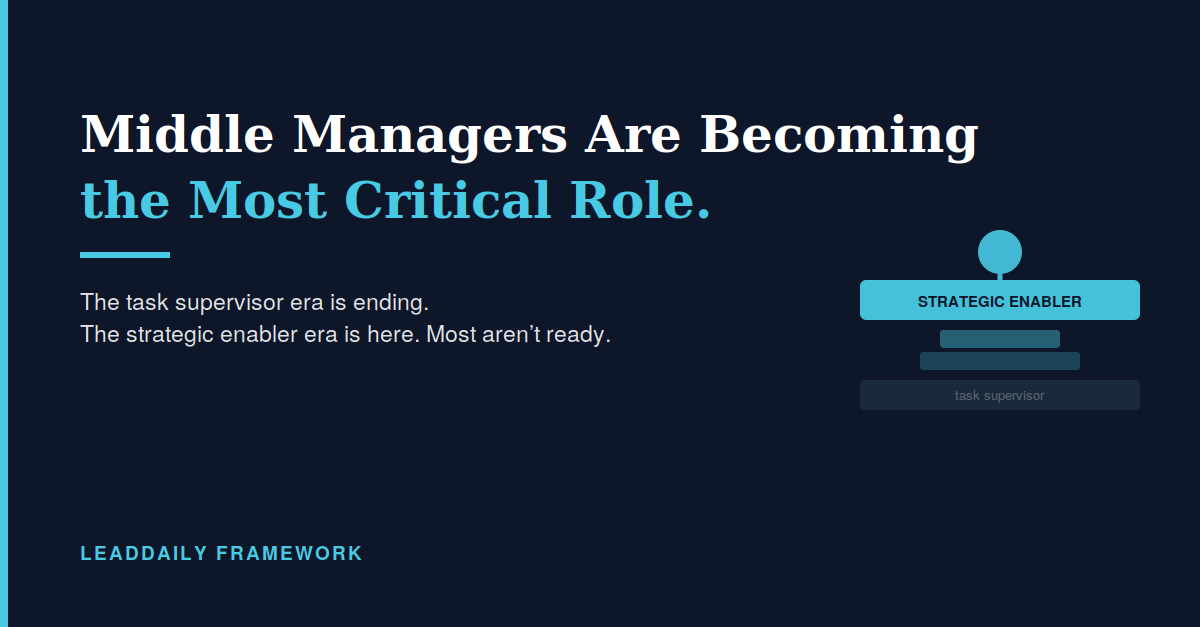
MTD’s framing is precise: middle managers in 2026 become strategic enablers, the people who make the organization’s priorities happen at ground level. This is a fundamentally different job from the coordination role many of them were hired and developed for. It requires different skills, different daily behaviors, and a different relationship to authority, uncertainty, and team development.
The research is consistent: most middle managers were promoted based on technical performance in their previous role, received minimal formal development, and have built their management style through trial, error, and imitation of whoever led them. This preparation was adequate for the coordination role. It is not adequate for the strategic enabler role.
A manager who has been trained to pass instructions and check outputs has not been trained to build commercial awareness, develop genuine coaching capability, or lead through organizational ambiguity with the kind of calm, directional clarity that gives teams confidence. These are not natural extensions of the previous role. They are different skills that require deliberate development.
The strategic enabler role has a specific AI dimension that makes it different from any previous version of middle management. The manager who becomes a strategic enabler in an AI-augmented organization must be genuinely AI-fluent — not as a technical operator, but as someone who can identify where AI adds value in their team’s workflow, set quality standards for AI-assisted output, and model the AI use that drives adoption across the team.
MTD’s research is explicit on this: managers will not be judged on how well they perform tasks. They will be judged on what their team can deliver — and increasingly, on how effectively that team uses AI to deliver it. The manager who has not developed this capability is not just behind on a technology trend. They are behind on the core performance metric of the role they are now in.
The organizations that develop their middle managers for the strategic enabler role before it becomes urgent will have the most consequential competitive advantage available in the next three years: a management layer that can actually translate AI investment into AI outcomes, and actually translate executive strategy into team behavior. Both of those translation functions are currently failing in most organizations, for the same reason — the managers responsible for them were developed for a different job.
So the question every organization needs to answer now, before the transition becomes a crisis: what is the development plan for your middle managers — for the role they actually need to play in 2026, not the role they were hired for in 2021?
Recommended reading from jordanimutan.com:
1. Soft Skills, Strong Impact: Elevating Middle Management for Tomorrow’s Leadership
2. Bridging the Gap: Addressing the Lack of Formal Development for Middle Managers
No posts
Comments
Nothing yet. Say the first thing.
Sign in to join the conversation.