
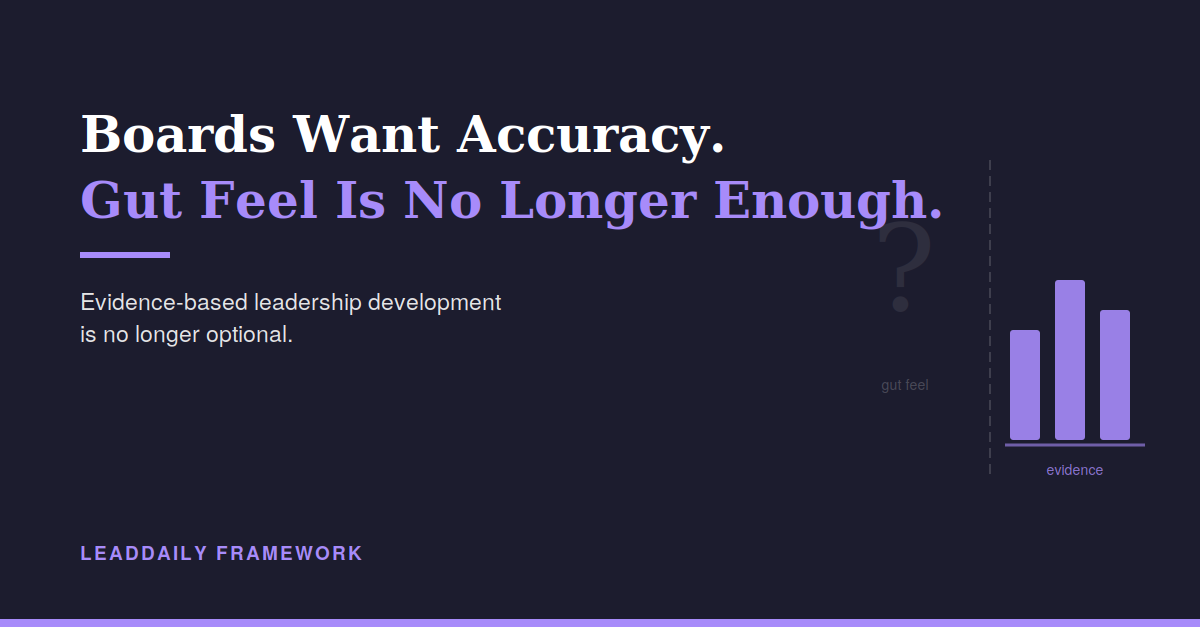
Something has shifted in how organizations make leadership decisions — and it is visible in what boards, CHROs, and HR professionals are now explicitly requesting. Leadership Circle’s 2026 Workplace Trends research and the Worthy Leadership Forum’s parallel findings are both direct: evidence-based leadership development is moving from a trend to a standard. Intuition-based promotion decisions, gut-feel assessments of leadership potential, and subjective performance ratings are facing a level of scrutiny they have not previously encountered.
The pressure is coming from three directions simultaneously. Boards want accuracy in succession decisions — the cost of a wrong senior appointment has become too visible to continue making those decisions on impression and anecdote. HR wants fairness — validated assessments reduce the bias that subjective evaluations consistently introduce and that legal and reputational exposure consistently punishes. Leaders themselves want clarity — they want to know what “good” looks like in their organization’s specific context, not a generic competency model that could describe any manager in any industry.
Evidence-based leadership is not the same as data-heavy leadership. It does not mean subjecting every manager to battery after battery of assessments. It means grounding development decisions — who gets developed for what, in what sequence, through what methods — in evidence from validated research rather than in the assumptions and preferences of whoever is making the decision.
At the individual level, this means using assessment that identifies a manager’s actual behavioral patterns, blind spots, and development priorities rather than their self-reported strengths and a manager’s impression. At the organizational level, it means measuring whether development programs produce behavioral change rather than whether they produce positive feedback forms. At the succession level, it means selecting for promotion based on demonstrated capability in specific leadership behaviors rather than on high performance in the previous role.
The combination of economic pressure and AI transformation has compressed the margin for error in leadership decisions. An organization navigating significant change with a wrong appointment in a senior role does not just underperform for a quarter — it misses the window for the transformation that the change required. The cost of getting leadership appointments wrong has increased precisely when the pressure to get them right is most intense.
At the same time, AI has made evidence collection and analysis less resource-intensive. The behavioral data that used to require expensive assessment centers can now be gathered, analyzed, and reported in ways that are more accessible for more organizations — which is accelerating the shift from intuition-based to evidence-based decisions.
Evidence-based development has a specific and immediate application to AI fluency in management: organizations can now measure whether managers are actually using AI differently in their daily leadership behaviors — not whether they attended a training session, but whether their meeting preparation includes AI-assisted analysis, whether their feedback is more specific and frequent since AI made preparation easier, whether their teams’ AI adoption rates have increased under their management.
These are behavioral outcomes. They are measurable. And in an evidence-based development system, they become the standard against which AI fluency training is evaluated and iterated.
The organizations that build evidence-based development systems are not just making better individual leadership decisions. They are building a learning system for the organization itself — one that gets better at developing leaders over time because it knows what works, in its specific context, for its specific leadership challenges.
So the question for every organization still making leadership decisions based primarily on impression and tenure: in a year where boards want accuracy and HR wants fairness, what is the evidence base for your most recent promotion decision — and would it hold up to scrutiny?
Recommended reading from jordanimutan.com:
1. Mastering Critical Thinking: Problem Solving and Decision Making for Filipino Managers
2. Why Your Leadership Training Isn’t Working (And What To Do Instead)
5. The True Leadership Currency: Why Trust Is More Valuable Than Talent
No posts
Comments
Nothing yet. Say the first thing.
Sign in to join the conversation.