
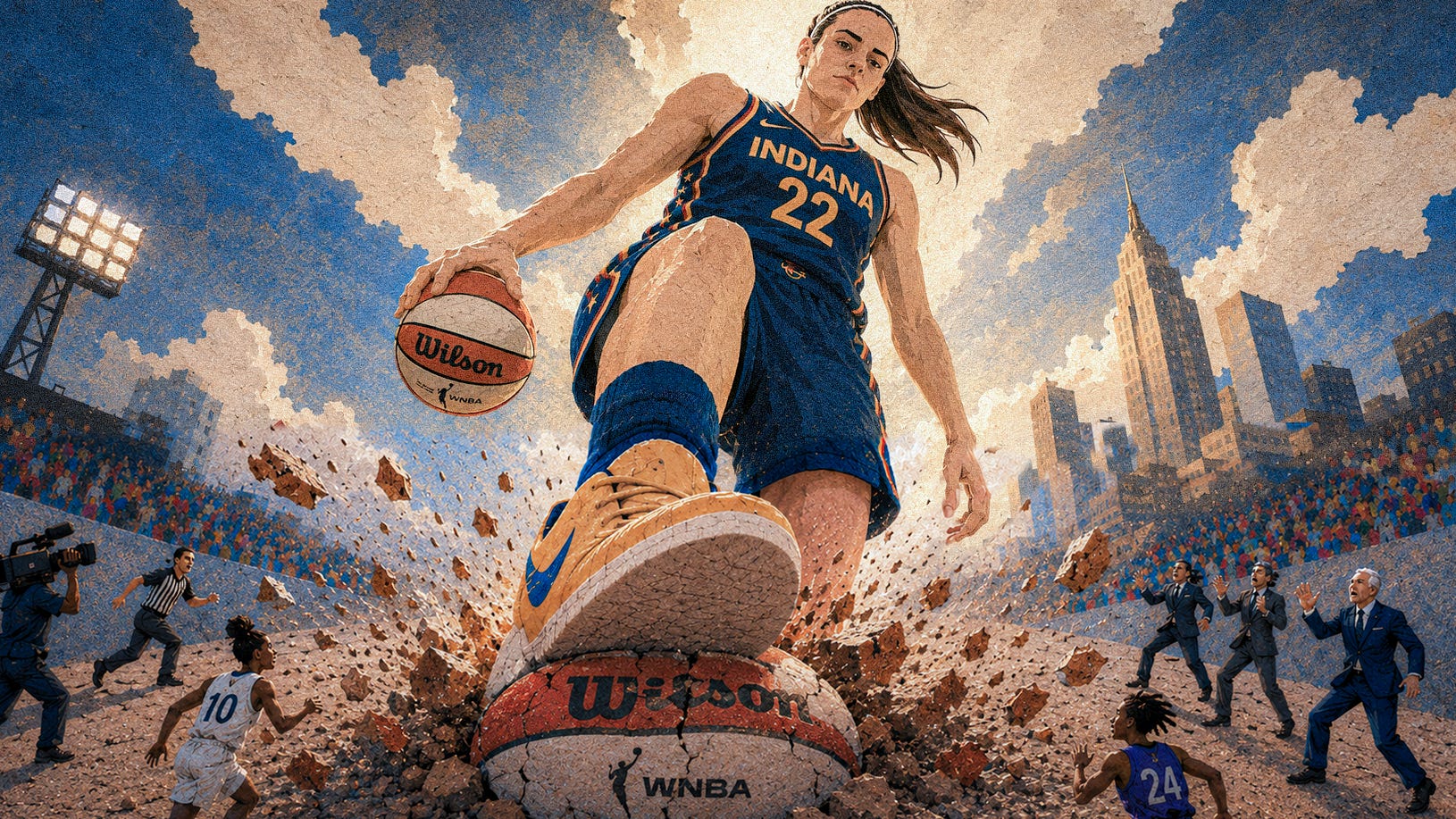
The WNBA is in the middle of the greatest growth period in its history. Franchise values that were measured in the millions five years ago are now measured in the hundreds of millions. Players are becoming mainstream stars. More people are watching than ever before.
And somehow, the league can’t get out of its own way.
I wanted to find out how this happened. Not the culture war version of the story, not the Caitlin Clark version of the story — but how the WNBA started in 1997 and decided to run through every PR disaster, every congressional letter, every press conference the league office didn’t know how to handle. It’s about what gets built inside an institution that spends decades running from its own identity, and what happens when the whole world suddenly starts watching.
I talked to Seerat Sohi, who hosts The Ringer WNBA Show and is one of the sharpest voices covering this league. Her answer to my first question — what is the state of the WNBA right now — is such a good metaphor that I hired an animator to visualize it. I’ll let her tell you herself.
The question I kept coming back to while making this video is one that I think gets lost in all the noise: how does a league with this much talent, this much cultural relevance, and this many people genuinely invested in its success keep ending up here?
After watching The Odyssey, I felt like I had to go back and watch one of the few Christopher Nolan movies I hadn’t seen yet, Memento. It’s crazy to see how much Nolan has both changed, and not, in the last quarter century. His budgets have gotten so much bigger, his movies much more stylized, some of the biggest spectacles in all of Hollywood. And yet, through all of this, his voice remains remarkably consistent. His interest in memory, time and how that shapes her identity is more rough around the edges in this movie, but it’s there.
Memento is Nolan working with almost nothing for his standards now — a $9 million budget, a cast of character actors, a handful of locations — and somehow that constraint is what makes it feel so alive. There's a rawness to it that his later work, for all its technical mastery, rarely achieves. You can feel him figuring out what kind of filmmaker he wants to be in real time, and the fact that he's doing it through a story about a man who can't form new memories feels almost too perfect in retrospect.
Chris Spargo put out a video recently about the BBC’s World Cup microphone — specifically the type that requires the reporter to press their face directly into it, which you never see in American sports broadcasting. It’s one of those details I’d noticed without ever consciously registering, the way a BBC sideline reporter looks like they’re almost eating the microphone while an ESPN reporter holds theirs at a comfortable distance.
The explanation is more interesting than the visual is funny. The European solution is more elegant in a way — it’s a piece of hardware doing with physics what American broadcasters do with money. It’s a small window into how two broadcasting cultures developed in completely different directions to solve the same problem.
Thanks for your support.
Joon
No posts
Comments
Nothing yet. Say the first thing.
Sign in to join the conversation.