
Today is the first day of school. I’m 55, and I’m working on a Bachelor of Science in Physics. Before the break, I asked my advisor whether I should take any summer classes. He said, “You’d better take the summer off!”
I kind of did. Like, I didn’t take any classes.
I did build two websites. Just two, though.
There’s one I want to show you, because most of you know me as a musician. It’s music-related, and you might enjoy playing with it. If you do, I’d love to know what you think. But first, I want to give you an intuition for what it does.
Do you know what a harmonic is? When a guitarist barely touches a string with their left hand and picks with the right, and there’s a sound like a chime?
An A string on a cello vibrates 220 times per second. Because the ends of the string can’t move up and down, only multiples of that frequency can sustain on an open A string. 440, 660, 880, and so on. Touch your finger to the string over the 12th fret— that’s 440. 7th fret, 660. 5th fret, 880. These harmonics were the original inspiration for musical scales, because they all sound good together.
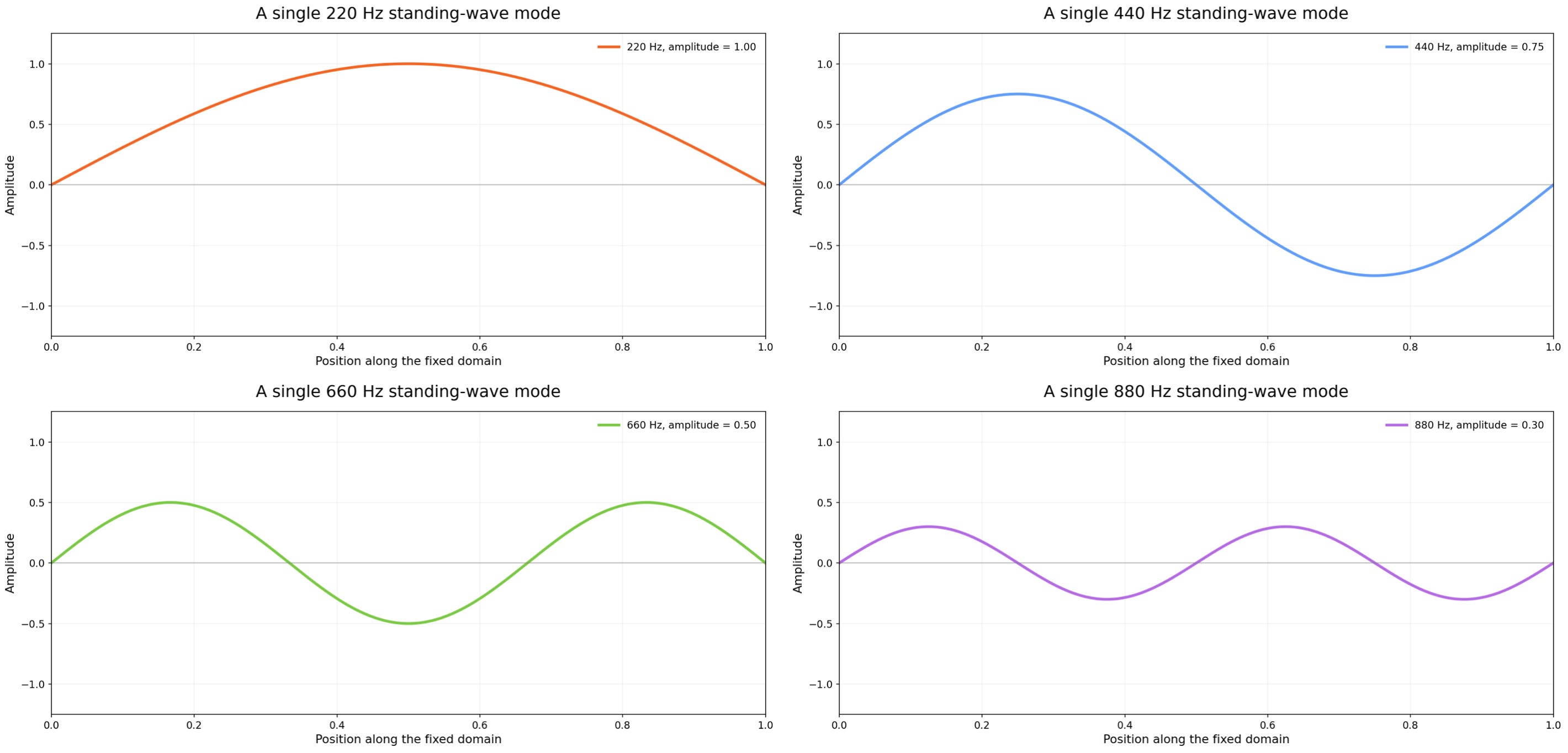
In fact, not only do they sound good together, they all happen together. When you play an open A string, you hear a combination of all those multiples. If you play guitar, you may have noticed that when you play closer to the bridge, it sounds brighter. When you play over the neck, it sounds warmer and rounder. That’s because you’re choosing which of these frequencies get more energy. In the middle of the string, you’re activating the biggest, lowest vibrations. Toward the ends of the strings, you’re encouraging the little high ones. Either way, you’re always getting a combination of them. Like this:
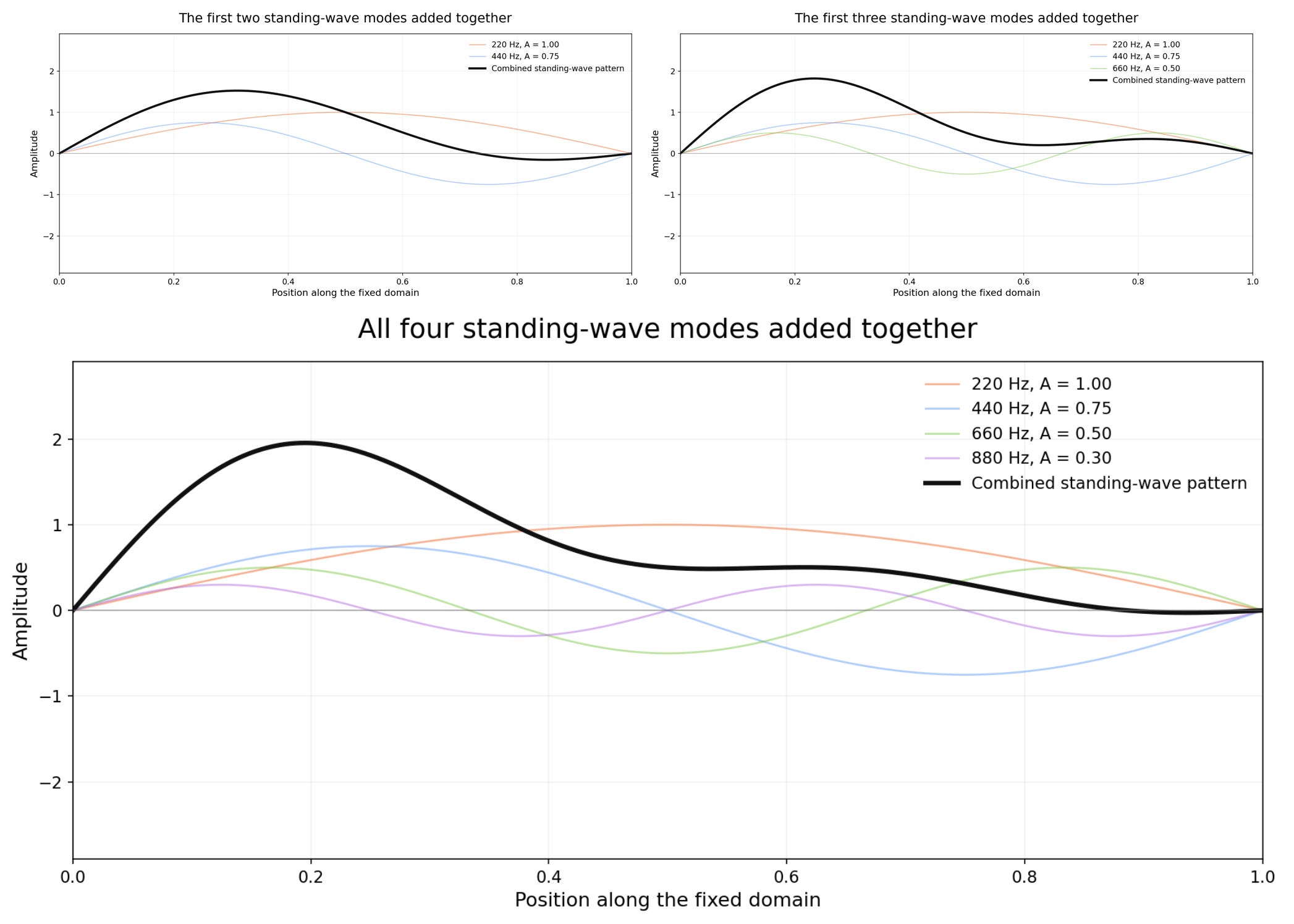
That’s superposition, often discussed as one of the weirdest concepts in physics. But here, it’s just how music works.
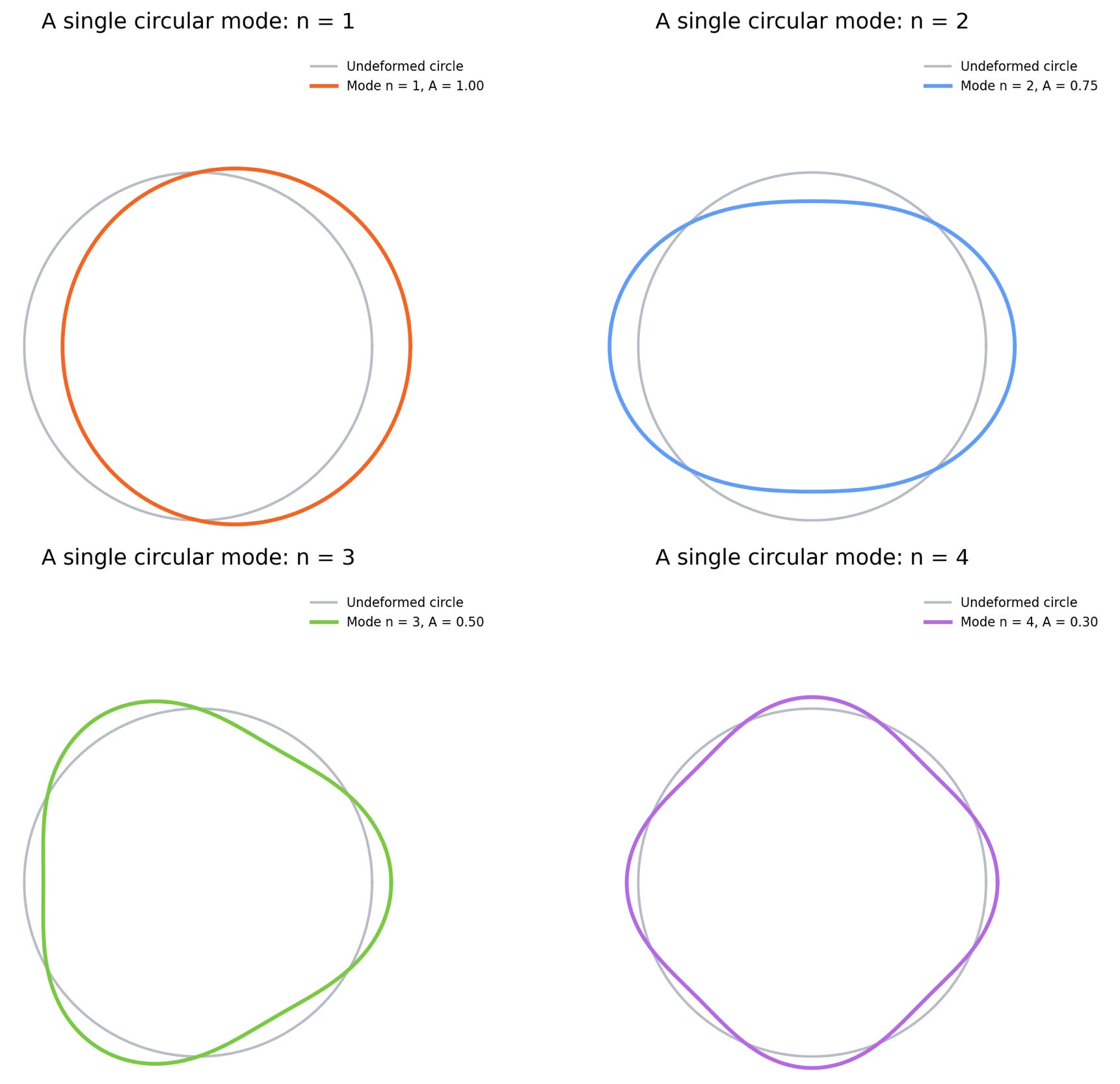
Harmonics can also be defined on a circle. There’s no ‘end,’ so the condition is that the wave repeats itself perfectly within the circumference of the circle.
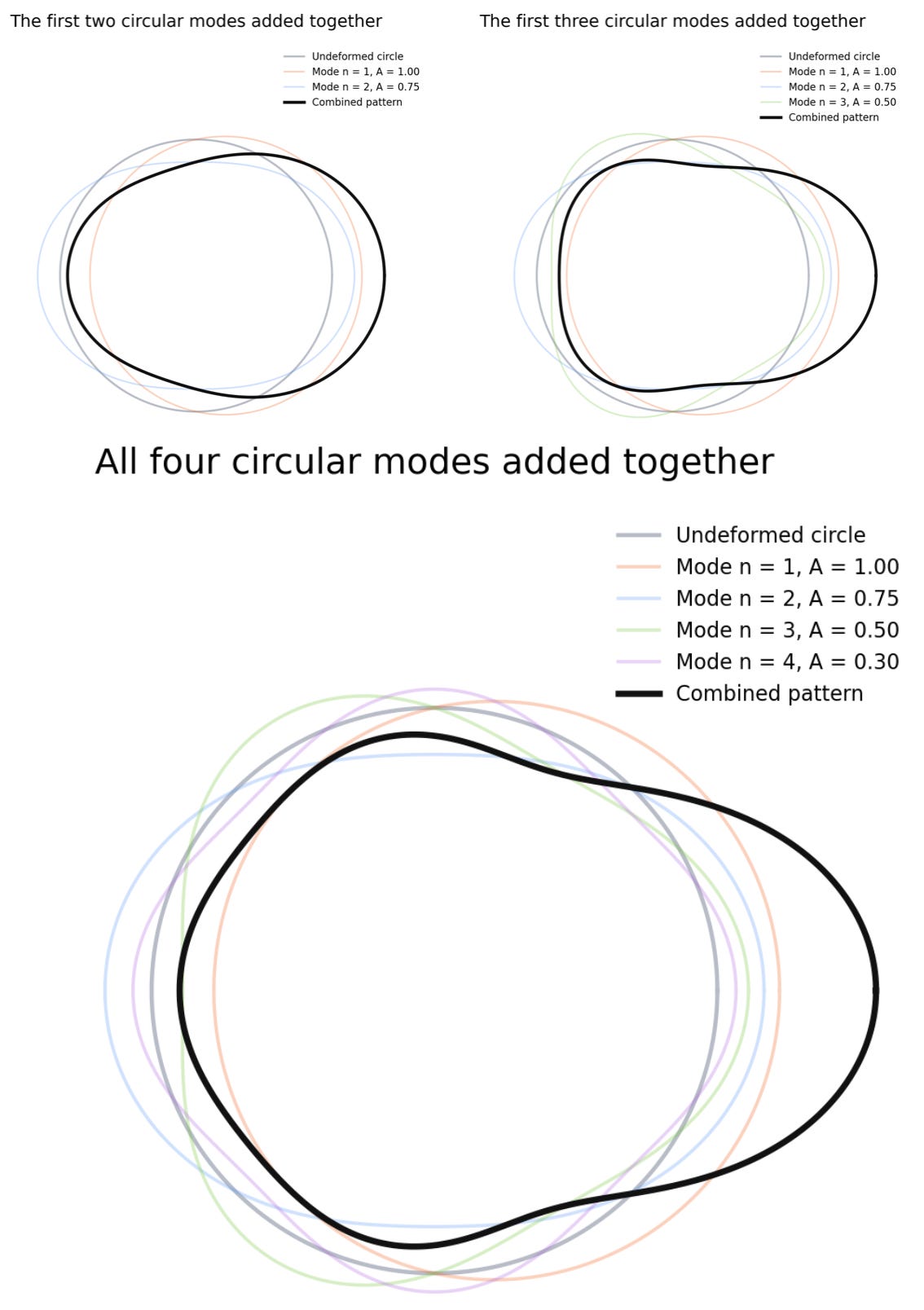
Yes! We can superpose modes.
Now, here’s the step that takes you to this fun website I made. Harmonics can be defined on a sphere. Imagine a hollow metal ball hanging on a string. You hit it, and it makes a sound. Just like the guitar string, there are only certain notes that can sustain on the sphere. Those notes are called spherical harmonics.
Atomic orbitals obey similar rules. Explosions. Magnetic fields. Almost any phenomenon that has spherical symmetry can be modeled using spherical harmonics.
This is a screen recording of me playing with the website I built.
If you’ve seen pictures of atomic orbitals in chemistry, the left panel will look familiar. It shows a single spherical harmonic with a radial displacement from the origin (like the probability of finding an electron some distance from the nucleus). The numbers ℓ and m determine the pattern’s complexity and orientation.
The right panel shows the same spherical harmonic on the surface of a sphere using a Mollweide projection, like this:
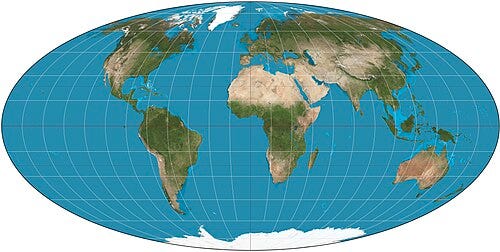
I can superpose many spherical harmonics with different amplitudes up to the maximum ℓ I select with the slider, adding progressively finer structure, like the harmonics on a string instrument. Pressing “BUILD UNIVERSE” starts an animation that adds modes up to the current maximum ℓ value on the slider. The largest features appear first, while smaller details emerge as higher-order harmonics are added. It says “BUILD UNIVERSE” because the map is built from data collected by a satellite that measured the oldest free-traveling light in the universe: the cosmic microwave background.
Maybe you’ve heard someone online break down a song into “stems.” Software can separate the bass, guitar, keyboards, vocals, etc. These programs decompose complex sounds into simpler components that can then be recombined to reproduce the song.
The cosmic microwave background is the sky-song of the early universe. The temperature of photons from the young universe can be decomposed into spherical harmonics.
But wait. There’s more.
This supernova simulation advances an explosion for 454 years, approximately the present age of Tycho’s supernova remnant. You can check “Show only current (ℓ, m)” to see the contribution of a single spherical harmonic mode to the remnant’s structure. Uncheck it to see the superposition of all modes. Random superpositions of modes introduce large-scale asymmetry and finer structures.
Earth’s magnetic field is often shown like the field around a bar magnet, but higher-order modes add fine structure near the planet. Again, click “Show only current (ℓ, m)” to see the contribution of one harmonic, “BUILD FIELD” to see a random superposition of modes (more like a real field), and “EARTH-LIKE FIELD” to see a magnetic field resembling Earth’s. You can click and rotate them!
For the pedantic: these are great simulations for a web browser. I don’t show the distortion from the solar wind, etc. Just have fun with space glitter. ✨
There’s a third page with a step-by-step breakdown of the math. At the bottom of the page, there’s copy-and-paste Python code if you’d like to see how the modeling works for yourself. Get creative and make something I never would have imagined!
Start here: https://jonathanbyrdmusic.github.io/CMB_spherical_harmonics/index.html
Enjoy the musical universe. Your fan,
Jonathan Byrd
Thanks for reading! This post is public so feel free to share it.
Comments
Nothing yet. Say the first thing.
Sign in to join the conversation.