
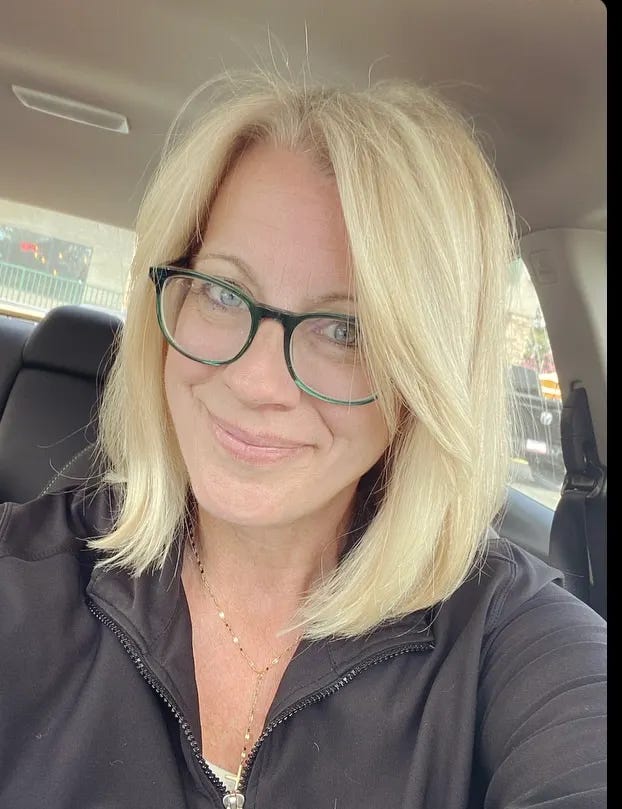
This is a selfie of me in Spring 2024 — with a fresh haircut and a blow-out. But that’s not what this post is about.
This post is about my glasses. In this photo, I’m wearing progressive multifocal lenses to correct astigmatism, -3.50 nearsightedness, and +2.00 farsightedness.
In other words, I haven’t been able to see far-away distances clearly since I was 12 years old, and reading support was added to my prescription in my early 40s.
I don’t know if I will get back to 20/20 vision, but I’m really excited about the gains I’ve made so far. I’ve already passed the point my holistic eye doctor thought I’d reach, which was -2.00. I’m now wearing -1.25 lenses, and she’ll re-check my eyes again in September. It’s been 40+ years since I’ve had “perfect” eyesight. And yet here I am in my mid-50s healing my eyes naturally—no surgery, no LASIK.
I know. It sounds crazy. That’s why I want to share my experience with holistic vision training.
I’ll start by explaining why I’m interested in this in the first place, and also just a quick note: I use eyesight and vision interchangeably throughout this post, but they are not the same thing.
Eyesight is your optical prescription number like 20/20, etc.; it’s the measurement of your nearsightedness, farsightedness, and astigmatism.
Vision is the functional side: how well your eyes, brain, vestibular system, and even emotional state work together to process what you see.
You can have perfect eyesight and still have poor vision. You might have trouble tracking, focusing, paying attention, coordinating both eyes, or feeling dizzy or overwhelmed, dysregulated. Things like a concussion can create significant vision problems without impacting eyesight.
A positive or negative change in your vision often reflects a corresponding change in your brain and nervous system.
The eyes are the primary neurological input for your whole system. In somatic embodiment work (aka nervous system regulation work), we always start with orienting to the environment WITH OUR EYES. There’s a reason for this. It’s not just something to do for the sake of doing something “somatic.” The connection between our visual input and our brain’s output is directly connected to how we feel physically and emotionally each day.
For the past decade, I’ve taught other coaches and my private clients the foundational somatic practice of “coming back to our five senses,” beginning with the visual sense. That’s because vision occupies roughly half of our brain’s total processing capacity.
Our eyes are constantly searching, scanning, sensing: “Am I okay?” “Is this overwhelming?” “Am I safe”? Our eyes begin as outgrowths of our developing brain in the first weeks of pregnancy, and they never fully separate. The optic nerve is actually brain tissue.
Some of what gets labeled ADHD, anxiety, or “just needing to take the edge off with a drink” may be a nervous system responding to a visual system working far harder than it needs to.
Very early in my Functional Medicine training in the early 2000s, I remember hearing people talk about “The Bates Method.” Essentially, you take your glasses off, wear them less, and your eyesight improves. But I knew there was more to it than that. There are specific exercises and supportive tools needed, along with an eye doctor trained in natural vision healing. Frequent eye exams are needed to replace prescription lenses and adjust/reduce the prescription strength.
But I didn’t know who to work with. I obviously wanted a good doctor who knew what they were doing. As interested as I was, I never took the time to find a practitioner to work with.
Then I went through a hard year last year. When I returned to Colorado in the fall, I made a passing comment to my very hard-to-get-into lymphatic massage therapist, who has a three-month waitlist, and said, “I wish I could toss my multi-focal glasses and improve my vision; I think that would help my nervous system right now.” And she said, “I know a great holistic eye doctor in Denver. Many of my clients rave about the results they’ve gotten with her.”
I called the next day for an appointment.
Here’s a picture of me, September 2025, after my first holistic vision appointment. I walked in with glasses at a -3.50 prescription. I walked out of that appointment with contacts at a -2.75 prescription, and these dark purple Syntonic glasses.
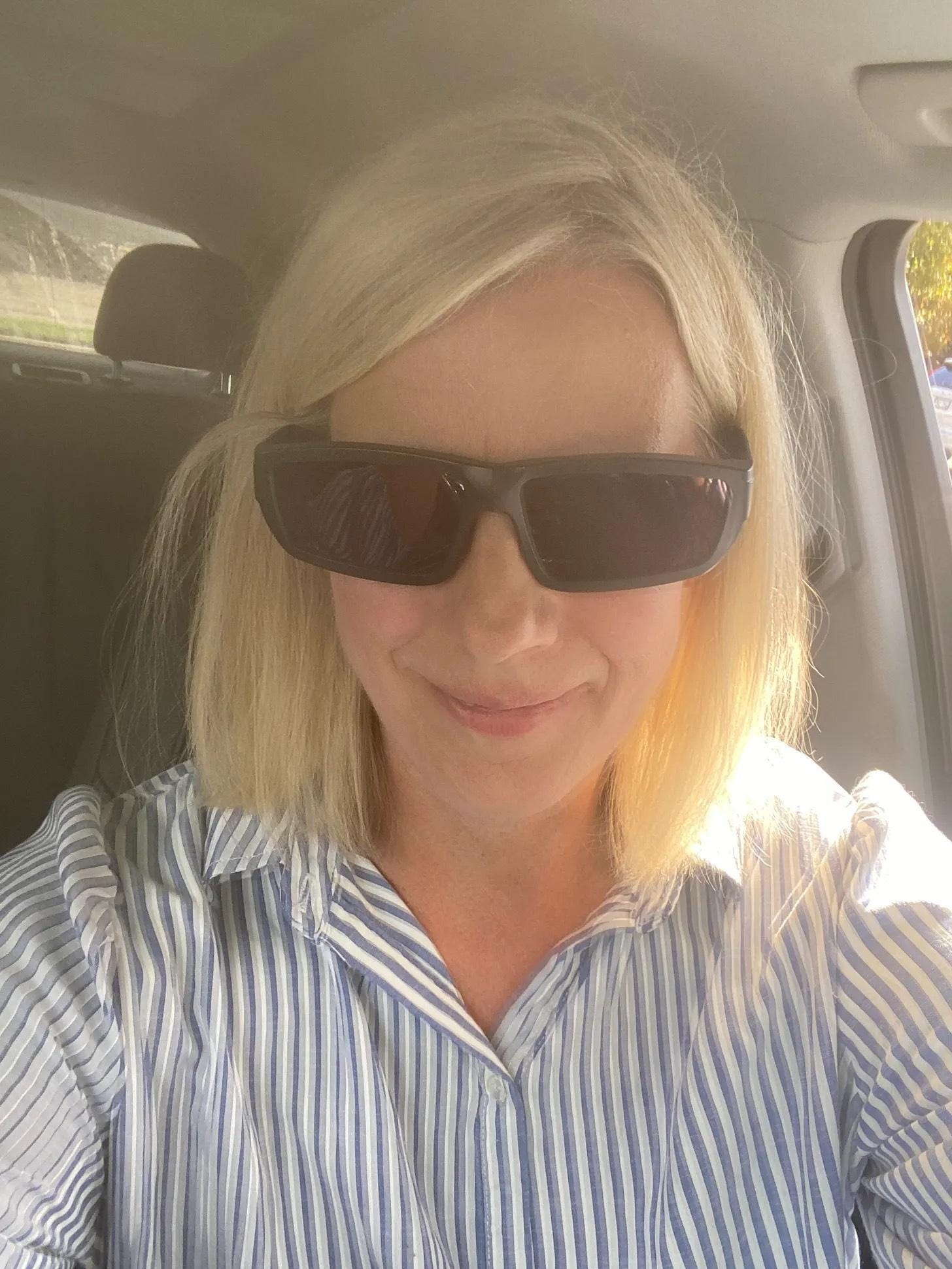
This was day one of my vision healing.
I immediately felt calmer, like my nervous system just dialed down 50 notches. Seriously, it was nuts how much better I felt emotionally and mentally after reducing my prescription load by almost one diopter and then looking at the color purple through the in-office Syntonic machine for 12 minutes.
And for reference, I had just put Java, my cat, down five days prior to this photo. We were in the thick of things, trying to manage care for my dad and his declining health. I was back in Colorado for an undetermined amount of time, driving with South Carolina license plates on my car while all my belongings were in a storage unit in Durham, NC. So my life was in total upheaval. But this vision appointment helped my nervous system feel notably settled when things outwardly were very unsteady.
I did various things, both directly and indirectly, to support my vision (nervous system), which I’ll write about in future posts. But I also stopped wearing my high-powered multifocal glasses. I haven’t put them back on since I walked out of that September appointment. I switched back to contact lenses, and we reduced the prescription strength over the months from -3.50 to -2.75, -2.25, -2.00, and now I’m wearing new glasses that are a -1.25 prescription. I don’t wear my glasses or contacts when I’m at home or when I'm outside walking. I don’t understand a lot of what my eye doctor does when she makes prescription adjustments. That’s on purpose.
She doesn’t want my over-analytical mind to scrutinize every detail, so she handles titrating my prescriptions down without me overthinking things. All she wants me to do is tell her “how I feel when she gives me certain lenses to look through versus other lenses.” She’s working with the somatic sensing process in my body, not my mind, which of course is speaking my language. But it means I don’t have many clinical details to give you.
The essential idea behind natural vision healing is that wearing high-powered prescription lenses 24/7 “tenses” the eyes and eye muscles; it reduces vision over time, and results in progressively stronger prescriptions. Most traditional ophthalmologists think natural vision healing is ridiculous; they don’t believe it’s possible to improve eyesight naturally, especially at my age! But I was in -3.50 prescription lenses in September 2025, and now it’s July 2026, and I’m in -1.25 prescription lenses. So I’m not sure what else to say to the non-believers until they try it themselves. Of course, everyone’s eyes and brains are different, and the power of belief is probably a factor in this. I believe in and love this kind of stuff, and I was more than ready to embark on this level of healing when I found it, so I jumped in with both feet.
Furthermore, Dr. William Bates, founder of The Bates Method, was an ophthalmologist who developed this method in the early 1900s. So this isn’t some new fringe idea; it’s over a century old. And he wasn’t a lone voice. A whole lineage of practitioners has built on his work: Meir Schneider, who was born legally blind and taught himself to see; Jacob Liberman, an optometrist who studies the relationship between light, vision, and consciousness; and today, an entire field of behavioral and developmental optometry, along with functional neurology, is trained specifically in this kind of vision rehabilitation. It’s just never made it into the mainstream conversation the way LASIK or “get stronger lens” has.
It helps the brain/eyes complete incomplete stress cycles, restores nervous system flexibility, and reduces frozen holding patterns.
We’re not meant to have such sharp, perfect sight all the time. Depending on fatigue, stress, and emotions, our vision modulates throughout the day. So when my doctor reduces my prescription, I can still see to drive and function throughout the day without eye strain. My eyes continue to adjust to the less-than-sharp prescription, and my vision gets stronger over the following weeks and months. Most importantly, I felt calmer.
I wear the purple glasses my doctor gave me during her assessment at my first appointment. She told me to wear them outside, first thing in the morning sun for 12 minutes. I can’t drive or walk with them; they are too dark to be “sunglasses”. So, I just sit with the purple glasses on and relax.
Syntonic phototherapy has been around for 70 years (also called optometric phototherapy). It’s a great, albeit unknown, alternative for conditions like lazy eye, reduced peripheral vision, and depth perception.
There are various color options: green, yellow, red, and blue. But my doctor chose purple for my vision healing. Again, I don’t have a lot of detail on why she chose that particular color (or the 12-minute time frame) for me right out of the gate; I’m not supposed to over-analyze things; it’s part of my healing, remember :-) But here’s what I can tell you.
Widening peripheral vision is an important part of vision training. Wide-field vision creates a safe neurological state. Narrow focus vision equals threat. This is why eye movement is used in trauma therapies.
When my doctor tested my peripheral vision with her measurement tool, it was 5—not good! It should be 30-35, which I eventually got to in future appointments. My peripheral vision had gotten way too narrow over the years. Looking through my high-powered prescription glasses made me feel like a feral animal ready to pounce. My fight-or-flight system was way over-stimulated from the prescription I had been wearing (and from the stress and grief in my life).
Here’s what I’ve learned: violet light activates our parasympathetic nervous system — our “rest and digest” branch — which lowers adrenaline. My nervous system down-regulates from using the purple Syntonic glasses for 12 minutes a day, and somehow, so do my eyeglasses and contact prescription.
Basically, my eyes stop working so hard. Whatever extra energy they were using up, I get back —in better focus, concentration, stress regulation, and just feeling less frayed throughout the day.
But for now, that’s my N of 1, a clinical term for a study with a single participant, on how vision and eyesight healing has been possible for me. Like I said in My Little Life Update, I’ve essentially been creating my own piecemeal “out-patient” program for nervous system repair and physiological replenishment over the past year. This is one of many things I’ve been learning, discovering, and rebuilding through this “storm year.”
So pull up a chair, grab a cup of tea (London Fog with a splash of vanilla and almond milk is my favorite), and hit the subscribe button. I’m just getting started, and I have so much more to share with you.
Jolene Park is a functional nutritionist, Well Coaches health coach, SSP provider, Duke Divinity student, and a member of the American Association of Drugless Practitioners. She has 25 years of client-facing and group training experience. She’s a pioneer of the Gray Area Drinking movement and the creator of the NOURISH Method, a nervous system program rooted in functional medicine, somatic practices, and cutting-edge neuroscience. Her TEDx talk has been viewed over 500,000 times. Click here to work with Jolene.
No posts
Comments
Nothing yet. Say the first thing.
Sign in to join the conversation.