
James Burrows Tells a Thousand Tales
A 2022 talk with sitcom director James Burrows, who discussed his legendary career directing Taxi, Cheers, Friends, and every single episode of Will & Grace.
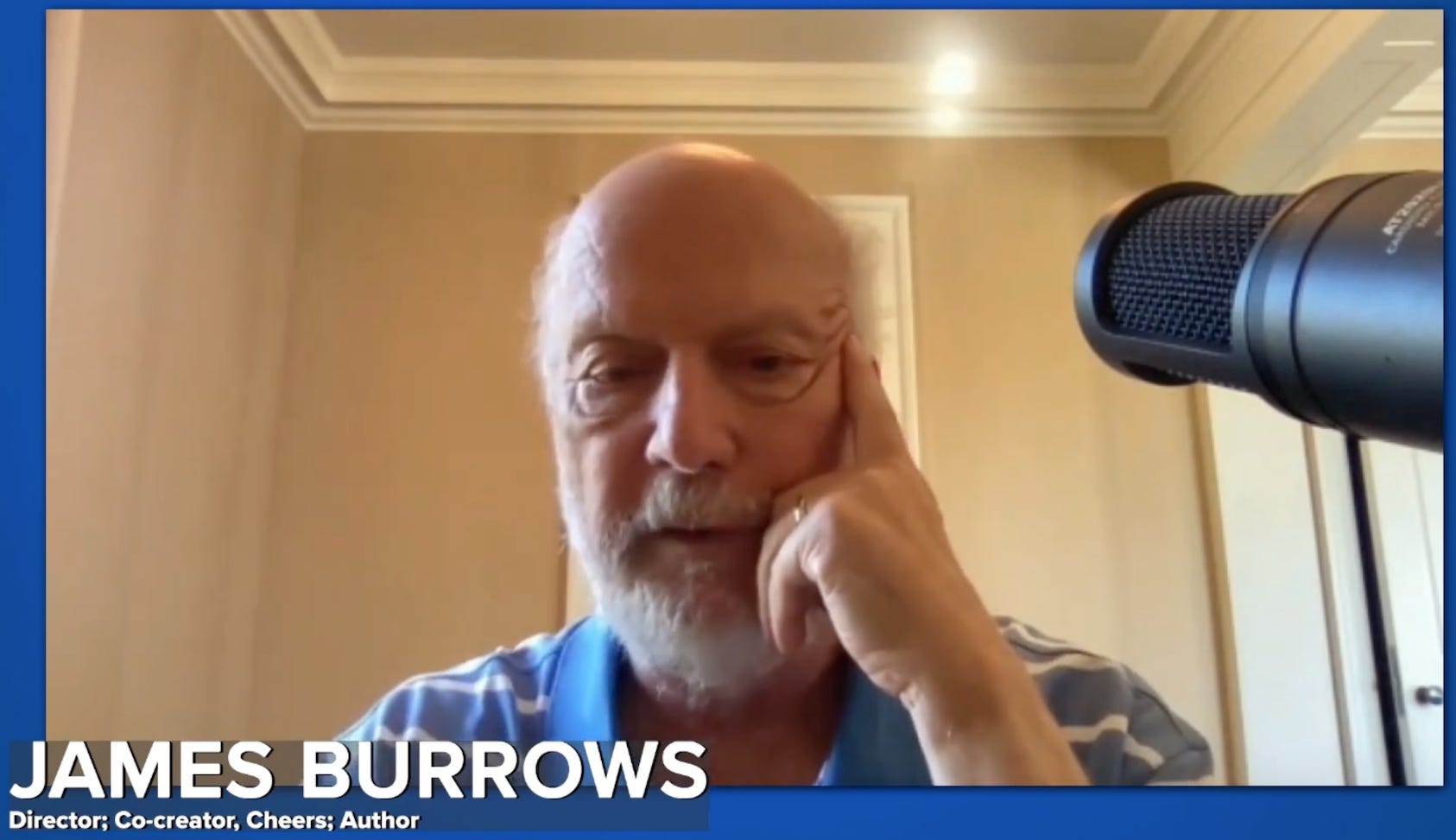
Today, the man who directed or even created some of the most iconic sitcoms of the past half century passed away. James Burrows died, age 85.
If there is one moment in the life of James Burrows that ties together his past, his present, and his illustrious future, it was in December 1966, while Mary Tyler Moore sobbed uncontrollably in his arms. The occasion was the disastrous Broadway previews for Breakfast at Tiffany’s, written by Burrows’ father Abe Burrows.
“We were hooted off the stage,” Burrows remembers. The play closed after only four shows, but the bond he created with Moore would launch him into what would become a legendary career of directing more than 1,000 episodes of sitcoms over the course of five decades.
“I was the assistant to the assistant stage manager on Breakfast at Tiffany’s—a musical based on the Truman Capote novella—that my father wrote,” Burrows says. “It was not Abe’s best work, but they cast Mary Tyler Moore and Dick Chamberlain as the leads. So you had Laura Petri and Dr. Kildare, who were two huge television stars back then. I was in charge of the two of them, making their life easier, making sure they had their lunches, making sure they knew their lines. I ran lines with them, making sure they knew when they came off stage that they had to change. I was the liaison between them and the production.”
Producer David Merrick didn’t like the show, “so he fired my dad. I said to my dad, ‘Is it okay if I stay on the Titanic?’ He said, ‘Sure.’ So I stayed on. They brought in Edward Albee to rewrite my dad, not your major musical comedy person, and Joseph Anthony to direct. The show opened on a Monday night in New York previews and we were hooted off the stage. The audience hated us. When I was waiting in the wings for Mary to come off, she would come off and throw her arms around me crying; it was just the worst experience for her.”
Merrick decided to cut his losses and closed Breakfast after four previews. That Wednesday night, Burrows sat with Moore during the play’s wake at Sardi’s and waited until her husband, Grant Tinker, came from California. “So Mary and I formed this bond,” he says. “We had this relationship at the core.”
Son of Abe
Tony- and Pulitzer-winning humorist, writer and director Abe Burrows was more than happy to give his son a boost in the world of theater, but James Burrows did not want a career connected to the stage. Still, the younger Burrows grew up in an environment others only read about.
“It was daunting, [Abe] was a legend in New York City,” Burrows says. “Both my sister and I were born in California, and then in 1945 we moved to New York. My mother and father divorced, and then my dad came [to New York] to do Guys and Dolls. He was dad to me, but I was trundled along with my sister to rehearsal. Dad would bring us there an hour before he would take us to dinner, and we would run around the theater and see these people on stage acting and not knowing quite what it was. Little did I know that he taught me while I didn’t know I was learning.
“He would have great New Year’s Eve parties; Truman Capote was there, and Cole Porter, and John Steinbeck, and Eddie Condon, and Adolph Green, and all the literati in New York. But I had no real idea of who they were or what shows they did, because I didn’t see a lot of theater when I was growing up. He was my dad, and as I grew older there was no way I was going to go into his business.”
In the early ‘60s, Burrows attended Yale School of Drama, thanks to a student deferment and no need for a physical. Eventually, though, he did take his physical, but “I was let go because I think I was too funny,” he jokes dryly.
His aversion to a stage career notwithstanding, Burrows got experience as an assistant stage manager and stage manager. He developed a sense of what directing was watching his father work, and those experiences helped form his approach to working in television—it’s a stage play. “I’m a theater rat, I was brought up in the theater, I know theater, I love opening nights,” he says. “And every Tuesday or every Friday when we shot a show, it was opening night for me. All my upbringing was perfect for the form that I went into.”
While directing a production of 40 Carats with Joan Fontaine in Wallingford, Connecticut, Burrows turned on the TV one Saturday night, and there was The Mary Tyler Moore Show [TMTMS]. I looked at it and they were doing 20, 22, 25 minutes in a week and I was doing a two-hour play in a week, and I said, ‘I can do that.’
“I had a connection with Mary Tyler Moore, a very deep connection on the first show I ever worked on. So I wrote her a letter. . . . She gave me the opportunity to do one show, and she was great. In fact, just before we shot the first Mary Tyler Moore [Show] I ever did, the first [TV sitcom] I ever did, she came over to me and said, ‘We feel our investment in you has worked out.’ She was in essence my champion and they took a risk on hiring me. I had not done any TV, and I had to spend four months learning the technical aspects of it, which is the camera work, how to cover the show, because you have three cameras rolling simultaneously, so you have to get all the comedy and all the shots. They were wonderful to me.”
A Sitcom Career Is Born
Following his TV debut, Burrows found steady work in TV sitcoms, directing three more episodes of Moore’s show, 19 of the spinoff Phyllis, 11 of The Bob Newhart Show, 4 of Rhoda, and others. He also directed outside of the MTM production company, including a handful of episodes of Laverne & Shirley, one of the top-rated shows in the late 1970s.
“I was hired because of my reputation on the Mary show,” says Burrows. Laverne & Shirley creator Garry Marshall brought him over to do Laverne and Shirley, and he says he had a great time with the cast, which included Cindy Williams, Penny Marshall, David Lander, Michael McKean, Eddie Mekka, Phil Foster, and Betty Garrett.
“I really liked doing the show, but there was always tension on that show. Garry Marshall took me to lunch off the Paramount lot. He asked me if I wanted to become the resident director and I said I had to pass, I had other avenues to explore. There was a lot of tension on that show that I didn’t want to be a part of.”
Burrows’ work on the groundbreaking Taxi would lead to his work on Cheers. Burrows did serve as the resident director of Taxi, the quirky comedy that debuted in 1978 and told stories about a New York City cab company populated by bizarre characters, all centered by the rock-solid Alex, played by Judd Hirsch.
“You need to get your audience to identify with the characters, so they have to have vulnerabilities. In Taxi, they all had vulnerabilities,” he says. “The one major vulnerability that all of them except Judd Hirsch had was they all aspired to get out of the garage, they all had dreams. In the pilot, the character of Alex says, ‘Look over there, she’s an art dealer, that’s a boxer, that’s an actor, I’m the only one who’s a cab driver here.’ They all had aspirations to get out, so that was the vulnerability they all had. You knew they weren’t going to get out. All those characters had that, and that’s how you get an audience in; that’s how you draw them in.”
Burrows had met the brothers Glen and Les Charles when they all worked on Phyllis, but he really got to know them on Taxi, where the Charles brothers were producers. He calls Taxi “probably the most difficult show I ever worked on—and for them, too,” with co-creators James Brooks and Ed. Weinberger making changes and then changing the other’s changes.
“It was all for the better of the show, but it was difficult work. I had to deal with that, plus I had to deal with Taxi being the first four-camera film show. Mary Tyler Moore, Newhart, Laverne & Shirley, and Happy Days were all three film cameras rolling simultaneously. Taxi, because the set was so big and there were seven major characters, we added a fourth camera so I could get more of the original [action]. The first time we shot it, I could get more reactions and I could get the jokes more easily having more cameras.
“And I had an interplanetary cast. I had people from different walks of life. I had theater rats like Judd, Mary Lou [Henner], Danny [DeVito] and Chris Lloyd. Danny and Chris Lloyd were in Cuckoo’s Nest, and Mary Lou was in Grease. I had a boxer, Tony Danza, and I had—people call him a comic, but Andy Kaufman was a performance artist. So it was difficult to try to mold these people into the homogeneous group that I like. I like my cast to love one another, because if they love one another that’ll transmit across the screen. We finally got there midway through the first year, because everybody had different things. Andy Kaufman had day/night reversals; so as a comic he would stay up performing and writing until 5 in the morning, so Andy didn't have to come in until 1 [p.m.], and people in the cast resented that. I didn’t, because that’s what you had to do to make the show work. And there was also dealing with Andy’s alter ego, Tony Clifton, and so it was a really difficult show for me. And I think difficult for the Charles brothers, too.
“Eventually, through guile and psychology, everybody came aboard and it was one of the funniest shows I ever did. I did I think 75 of them—because I left in the fourth year to do a movie, and then in the fifth year I did Cheers. It was just difficult, because it was also my first really coming-out show. This was [the first] show that I was the resident director on.”
Co-creating Cheers
While working on Taxi, Burrows and the Charles brothers heeded the advice of their shared agent to do their own show. Burrows’ old friend Grant Tinker was running NBC, and Burrows and the brothers got a deal to do a program. But a program about what?
“The Charles brothers and I sat around for a long time discussing what the show would be,” Burrows recalls. “We were big fans of Fawlty Towers, and we thought about doing our show about a hotel; then we thought maybe the main part or most of that show would take place in the bar of the hotel—and maybe we don’t want to do a hotel; maybe we want to do a show about a bar.”
After considering various locations to set the show, the creators settled on Boston. They then populated their show with memorable characters. “We wanted to do an evolving relationship. We wanted to do a Tracy-Hepburn relationship, and we wanted it not to stay in the same place, we wanted it to evolve. So we had these characters, Sam and Diane. Originally when the boys [the Charles brothers] went off to write it, Diane Chambers was a woman Sam worked for, a very tough woman in the Suzanne Pleshette vein. When I came back from a vacation, the script was on my doorstep; it was amazing. I called them and I said, ‘You brought radio back to television,’ because it was so literate. They created the character of Diane Chambers. We had talked about the character of Norm, because everybody knew a Norm in the bar—‘Just one more, then I’m on my way home.’ Those guys. We talked about Coach, an old player that Sam used to [work with]. We knew about Rhea Pearlman, so we created the character of Carla. We wrote the script and NBC loved it. The rest is 11 years of history.”
Burrows’ father lived to see his son’s career blossom. “He did see the success on Taxi, but on Cheers, my first show that I had control over with the Charles brothers, my dear friends, he didn’t really see that. He did see the pilot and he called me and said, ‘I wish the bartender had more dirt under his fingernails.’ I understood what he meant, because Teddy was not an athlete, not at all. He was a farceur from Carnegie Mellon. I took him to his first baseball game. We hired [actor and former NFL player] Fred Dryer to be on the show as a sportscaster so Teddy could see what a peacock Fred was, because Sam Malone is a peacock. So my dad was right, and unfortunately he passed in 1985. Cheers won the Emmy the first year, but my dad was not in a good mental state, so he didn’t see that. It’s the one regret; I wish he could have seen my success as I saw his.”
After a very low-rated first year, Cheers was discovered by audiences during summer reruns and its ratings improved. By its third season it had reached 13th place, and for its final eight seasons the show never left the top 10. But that popularity was threatened at the end of its fifth season with the departure of one-half of the Tracy-Hepburn team.
“We were scared out of our shot glasses, because Sam and Diane drove the show,” says Burrows. “People would ask me, ‘What’s happening with Sam and Diane?’ Stuff like that; we knew they were the juggernaut. So when Shelley [Long] said she wanted to leave, we were devastated; we didn’t quite know what to do. We thought about it and we decided to go back to the first permutation, which was Sam working for a woman. The boys went off again and wrote the script, and when we told our casting director Jeff Greenberg we want Sam working for a Suzanne Pleshette type, the first words out of his mouth were ‘Kirstie Alley.’
“None of us knew her, but I knew she had worked in front of an audience, because I had seen her do Cat on a Hot Tin Roof and she was amazing. So I knew she had the gumption for that. She came in to read; she read with Rhea and Teddy, and they came up after to discuss it. Teddy said, ‘I want to hug her.’ We thought that was interesting, because that was not the intent of the character. We did the first show, and we had written her as a martinet, a really strict, tough woman. She came in and Teddy had the great line when he first met her when he goes, ‘Booah.’ Because that’s not what he’s expecting of the person. She was just incredibly mean to him. The first two days it wasn’t really working, and we didn’t quite know why; we forgot that Teddy said ‘I want to hug her.’ The rehearsal the second day, Kirstie has to go into her office. She’s very strident; she said, ‘I have to go to my office and work.’ And the [door] knob doesn’t work, so all of a sudden she goes, ‘It’s not working.’ All of a sudden that opened our eyes, we said, ‘Oh my God, this is a woman who thinks she’s tough, but she’s a powder puff on the inside.’
“We used that and we made a definite choice when Shelley left not to have another waitress, and Sam not to be in another relationship, although he pursued her and it was just for laughs. But we got the right person, we were very lucky on that show.”
“When Nikki [Colasanto, “coach”] passed, unfortunately at the end of year three, we were then in the schedule following Family Ties, and we said, ‘We’re not going to go older, we’re going to go younger,’ because the breakout character in Family Ties was Michael J. Fox. So we went younger. Woody [Harrelson] came in for his audition; he blew his nose, that was the first thing he did. Everybody started to laugh. And then we were lucky enough to get Bebe Neuwirth, who Glen Charles had seen [on stage], and you know about her as Frasier’s relationship. So we were incredibly lucky on that show, and it doesn’t always happen. But we ran six years with Kirstie and only five years of Shelley. Also, because Sam and Diane were not driving the show, you got to see how dynamite the rest of the cast was. Johnny and George, and Kelsey and Bebe, and Rhea, and Woody—Woody getting married. It was amazing.”
Making Friends
When Burrows saw the pilot script for a new sitcom based around a group of twentysomethings in Manhattan, he got in on the ground floor of another long-running hit. He was sent the script by Friends co-creators Marta Kauffman and David Crane at the end of the pilot season of 1994. “I read that script, and it was just amazing. In fact, 95 percent of what was on that page from the original script ended up being in the pilot of the show. It was smart, it was literate, it told three stories in a half hour rather than two. It’s casting—those six people were available at the end of pilot season of 1994. That’ll tell you how much luck is involved with the right actor being available at the right time for the part that comes along that he’s right for or she’s right for.
“I only did 15 shows. I would’ve done more except I had a production company at that point, and I had to do the shows that were coming out of the production company. I would’ve done more because I loved the kids, I loved the writing; the writing on that show was genius. It took nine years for the [Television] Academy to realize it and give them an Emmy. In the beginning when that show started, people were saying, ‘Oh my God, it’s Generation X; they’re just pretty people.’ They didn’t realize how gifted actors they were and how comedic actors they were, and how genius the frigging writing was. I’ve bitched about this for—it’ll be 30 years in 2024—because that show was just brilliantly written.
“I loved working with the kids, I’m still friendly with them, they still call me Papa. I’ve always maintained contact with them and the writers. It’s just a show that will keep appealing to young people. The people who started watching that show in ’94 are now parents and their kids are watching the show. It’s an endless cycle, because it holds up.”
Will & Grace and Will & Grace
Burrows’ reputation as the pilot wizard—he has directed more than 50 pilots—continued in the late 1990s when he was sent David Kohan and Max Mutchnick’s pilot script for Will & Grace. “I loved it, and I wanted to do it,” he says. “The pilot episode was through the roof. The test audience we had three days before we shot it loved it, and when we shot it, [they] loved it.
“I wanted a Will and Grace kiss at the end of the show. It was a situation comedy that happened to have two gay characters, and I knew that would turn off 25 percent of the country. But it was so funny, I thought if I could get people just to watch maybe 10 minutes of a show, they’ll see how funny it is and they’ll hook into it. We put a kiss at the end of the first episode between Will and Grace. The audience was thinking, well maybe Will will become a straight man and marry Grace—[that plan was] never in our heads, but it was out there.
“Max, David, and I never thought about proselytizing at all on that show. Occasionally we did a show about conversion therapy, or a show where Will got so upset with Jack he called him a fag, and so it was the relationship with two boys, how they dealt with it. But it was never a proselytizing show and we never set out to change the world. We like to say Ellen opened the door and we came through and busted it wide open.
“I didn’t know how much of an effect that show had until, on Thursdays, which was the night that Will & Grace was on, I would drive carpool for my 13-year-old daughter; I would pick up three other kids and we’d be on their way to school, and invariably one of the kids would say to me, ‘What’s on Will & Grace tonight?’
“I knew that this show was being watched by kids before they had a preconception of gay people. I had no idea what happened; neither did the boys. Then when Joe Biden said we had done more to promote the gay agenda than anybody else, I was shocked and incredibly flattered, because we never set out to do that. We set out to do a funny show; we like to say we did a fairy tale, literally and figuratively. We did a show with jokes that broke the television screen, the laughs were so big, by four characters who could have never done those jokes on other shows.”
Will & Grace ended its eight-year run in 2005, but that wasn’t the end. In 2017, Will & Grace returned to TV with 52 more episodes spread over three seasons. With the visibility of gay characters on TV and in real life, with even a Republican president appointing gay ambassadors to allied countries, the show was no longer near the cutting edge of the culture. But it did continue to mine the four characters at its center in strongly written stories. Like he did with every single episode of the show’s first run, James Burrows directed all 52 of the revival’s episodes.
“When we first started the show, gay rights wasn’t where it is now,” he says. “It’s come a long way now. So we were dealing with different things back then. There were a lot of people who weren’t aware of it, and by dint of the show people became more aware of it. Now the reboot didn’t do as well because the agenda isn’t the same, gay people are more accepted now. It was equally as funny in the second incarnation, and I think the stories were better because it was stories about older people, especially older gay people, Will and Jack, and the loneliness maybe and what’s involved with that. But it probably wouldn’t work if we rebooted it again, because it doesn’t carry the same cachet that it had back when we originally started.”
Nearly 50 years after he first broke into the sitcom business with an assist from Mary Tyler Moore, Burrows declared himself to be semi-retired. During the pandemic, his wife convinced him to write his memoirs, Directed by James Burrows, and he still directed the occasional sitcom pilot. In his free time, he enjoyed indulging his lifetime passion for sports. And, of course, he enjoyed watching quality shows, professing to be a big fan of The Connors, Curb Your Enthusiasm, and even non-comedies such as Ozark. “That’s what I watch,” he says. “Blast me, I haven’t seen The Crown, and I watched a couple years of Sopranos, never finished it. So people hate me for that—but hey, hate me.”
Interview by Michelle Meow and John Zipperer; article by John Zipperer.
###
No posts
Comments
Nothing yet. Say the first thing.
Sign in to join the conversation.