
Dion Lim is a household name in the world of San Francisco Bay Area TV journalism—or, if viewers don’t know her name right off the bat, they know her face. This veteran journalist was a mainstay of the ABC station in San Francisco, KGO TV, for years, covering—as she admits in her book Amplify: My Fight for Asian America—often light-hearted feel-good stories, when she began to cover overlooked reports of anti-Asian violence and hate.
It wasn’t a change she had been seeking, but she felt she couldn’t ignore the disturbing stories. She also found that Asian families who were afraid or resistant to talking with reporters or the police felt comfortable sharing with her the details of attacks on themselves or their loved ones.
Earlier this year, Liim and I connected over Zoom for the interview that follows.
ZIPPERER: This is your second book. Does it get easier the second time around?
LIM: You know what? In so many ways, it’s harder this time around because of the subject matter. [My] first book is totally different than who I am today, just based off of the experiences. I would also say the hurdles, the challenges that I went through in getting this book done were almost insurmountable. So it feels like quite an achievement to get this finally out into the world.
ZIPPERER: You’re no longer on the air at KGO. Do you still get a steady stream of tips about anti-Asian violence?
LIM: Oh my God, all the time. I will say this. It is not necessarily physical violence. It is a lot of underhanded passive aggressive commenting—what is it called? Unconscious bias. But we’re facing a new crop of anti-Asian hate where it is driven because of anti-China sentiments. It’s also driven because of the immigration debate and battle. So it still exists. It has just morphed in what it looks like. I think we’re also dealing with more issues of racism at the forefront when it comes to the Jewish community, for example. Or I mean, just today I read an article about Indian Americans being such a large part of the Bay Area tech scene and how they feel like they’re being pushed out and made to feel like they don’t belong. So yeah, I think it’s just morphed in its form.
ZIPPERER: Earlier in your book, you say that Asian American victims of these crimes often saw you as an alternative to reporting to the police. Has that changed at all, do you think, over the course of the pandemic and the aftermath, or is it still the same?
LIM: It’s a good question. I think people still see me as an outlet that they want information to go to.
Do I think they expect it to be on TV? Of course not. I think more so than anything, they want someone to just pay attention and to care. I think they also know that I can reach now more people on social media and from a digital standpoint, and that many people are able to share the content and in different ways. It doesn’t require the same level, the same bar of editorial approval. So for some people, that’s enough.
Something that really touched me, if I could go off on a small tangent, is that at my book launch at the Commonwealth Club, one of the moments that touched me the most was a family in Oakland that had been the victim of gun violence. They lost a key figure of their family. I had not heard from them in more than two and a half years. I was still pregnant when I went to their home. We never actually did a story together on TV, but they told me that me being there in their living room never left them, that they wanted to show their thanks to show support for me telling stories of others. I think that’s a really powerful thing, and it’s a responsibility that I understand and want to carry.
ZIPPERER: I can see that need to be heard and to have someone pay attention to you being really powerful when you’re the victim of a crime and you feel that the system is not helping you.
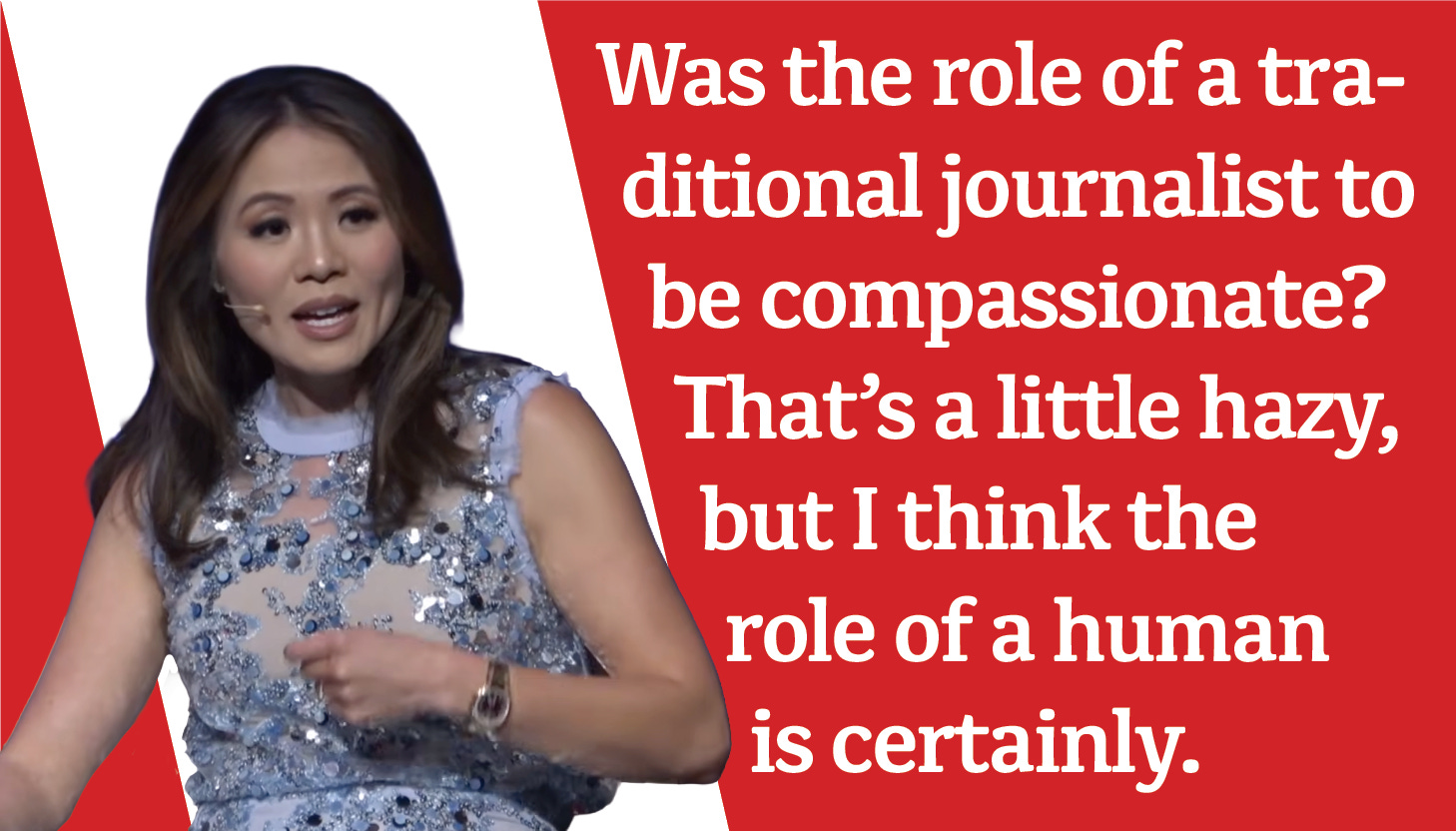
LIM: That’s it. That’s it. And it’s a helplessness, and sometimes all you need is an ear. All you need is a little bit of compassion. Was the role of a traditional journalist to be compassionate? That’s a little hazy, but I think the role of a human is certainly. And I attribute the success that I had in the business to a level of that.
ZIPPERER: Near the end of the book, you write quite a bit about the importance of mental health protection for yourself and for others in the AAPI community. Have you seen the AAPI community provide this help? Has it gotten able to handle the situation they’re facing? Are the tools there? Are the networks there? Or is there still some way to go?
LIM: This is a great question, because I just spoke about it at Stanford yesterday for a lot of people who were in the health department, and it’s twofold. I see new organizations popping up. We have Asians for mental health. We have Creating Space surrounding discussions and bringing in young people, but it is on the Asian-American population themselves to seek it or to be okay with it culturally. I grew up in a family where crying was not allowed—only at your mother’s funeral. I was told that if I needed to see a therapist, that meant I was a crazy person. So that in turn is what prevented me from seeking help earlier and what caused the on- air breakdowns and the mental health struggles. I met a woman who has daughters who are I think in their late teens, early twenties yesterday. She told me that the stigma is definitely going down for young people, because there’s so much discussion about suicide and taking care and all of these influencers making it okay.
That to me is a lot of hope. I see the new generation similar to them speaking out during the pandemic, reaching out via Instagram or social media. Now they’re taking on the cause of mental health, and I think that’s cool.
ZIPPERER: A while ago I interviewed Carly Schwartz, former [San Francisco] Examiner editor, whose new book is about her going through a lot of stuff as well as dealing with a realization that she had both mental health issues and was an addict. The blurb on the back of the book is from her mother and it was something like, “I will not read this book.” Because there’s so much she knows in there that’s going to be very upsetting for her. It wasn’t a non-loving comment. It was “I don’t think I can handle this.” Has your mom read [Amplify], and is she still a Trump supporter?
LIM: From what I know, she is still a Trump supporter. We try not to engage in those conversations. I do not think [my parents] have read the book. They have not asked about how the book tour or launch [is going], but I do know that my mother and father check my social media; I’m very cognizant of that. They know it exists, but now I’ve come to terms and am at peace with the fact even if they don’t read it, they played such a large role in shaping me and how we got to this point, not only as a professional, but as a person.
ZIPPERER: When you were in the real heat of the moment during the pandemic and all the pressures that were going on there, and there was this explosion of anti-Asian violence, [did you think] “Oh my God, is this the new normal” or “Is this a spike?” I mean, how did you wrap yourself around it, both journalistically and personally as what is this situation actually that we’re in?
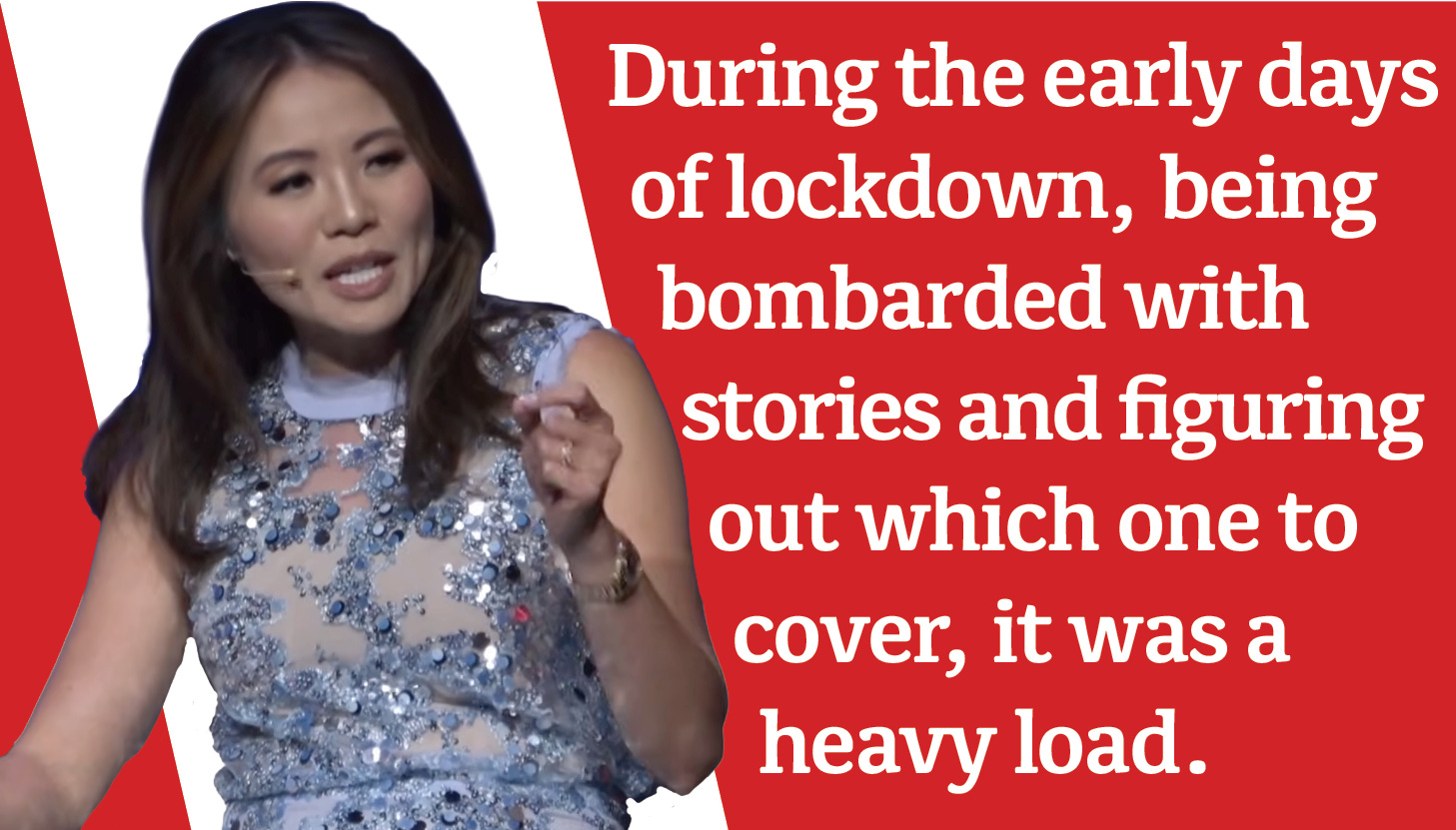
LIM: In the beginning, it was utter panic. It was: I feel unprepared. Later on, it became, Am I the right person to champion these stories because—am I Asian-American enough? I had to figure out what role I played. Did I have the chops to do this? And let’s be frank, nobody teaches you how to cover racism, not in school, not after ... By the time I got to San Francisco, I think I had been in the business at least a dozen years or so, but never in all of the markets I worked in did this ever come up. Yeah, maybe there was a reader about the KKK, but never was I so deeply embedded in a series of stories. I recall it becoming normal. I just wondered when it would stop. Truly, being at my kitchen counter during the early days of lockdown and just being bombarded one after another with stories and figuring out which one to cover, it was a heavy load and I just at some point realized this was normal.
ZIPPERER: Let’s talk a little bit about political leadership in the area. Were there any folks who stood out as having done the right thing in response to this?
LIM: Yeah.
ZIPPERER: Anyone you want to call out?
LIM: Yeah, totally. I think if you read the book, you know who politically was very challenging over the course of my reporting, so much so that there was a hit piece in The Washington Post—which by the way, I take as a badge of honor these days, truly.
From a political standpoint as a journalist, I am always very wary of people who may only be aligning for political gain, very cautious of it. However, I did find the level of empathy from Brooke Jenkins, our current district attorney, exemplary, especially after what I experienced with the district attorney in Oakland at the time, Pam Price. I also in a more contemporary sense appreciated now [California State] Assemblymember Patrick Ahrens down in the South Bay. I actually said this at an event that he hosted for South Bay leaders, that unlike many politicians who just showed up at Asian American events or tried to align with my reporting because it curried favor with the audience, I appreciate that Patrick actually showed up and spent time and asked his own questions and didn’t do things for the photo op only when I wanted to take photos or others wanted to take photos.
I think that goes a long way. The funny thing is that neither of those people are Asian American. Those people were of different backgrounds. I actually think of Matt Dorsey also as someone. [San Francisco Sheriff] Paul Miyamoto always showed up as well, but when it came to Matt, I will never forget in public how many times he would underscore the importance of these conversations, and even though he was not Asian American as someone in the LGBTQ+ community could align with those same prejudices and feeling the victim of those things.
ZIPPERER: So aside from the political leaders we talked about, what could the average Bay Area person do to help, whether it’s to be an ally or to pitch in even more?
LIM: I would say for me, the people who mattered so much during the reporting years, and also post, were the people who did not look like me who decided to show up or to learn. I would hear from men who said, “Oh, my partner is Asian American and I had no idea she was going through this. “ Brooke Jenkins actually spoke at another conversation we had at the Commonwealth Club, and her response to this was that we need to just show up for each other. It sounds cliche, but yes, if there is a festival for Cinco de Mayo, go check it out; just learn. It is as simple sometimes as learning mahjong, going to an Asian-owned business, just talking to the proprietor, and those everyday things, super low-barrier to entry, I think are what has resonated the most.
What I get to do now in my current roles, you’ll see it on my Instagram, being able to go meet the store owner who is Filipino and is making dimsum, but yet has a French background and is making croissants. You look through the comments and a ton of people are not Asian American. So making us as easy to incorporate into everyday life, that would be my answer.
ZIPPERER: What are you up to now?
LIM: It’s so funny because before, for so many years, almost two decades, the answer was so easy. Anchor and reporter, everybody knew what that was and it was a very pleasing answer to a lot of people. But what I do now is an amalgam of many things, and I wouldn’t have it any other way. I will say this, that it was gut-wrenching and very traumatic in the months after leaving [KGO TV], because when you have an identity for so long, you wonder what your new life will look like. On top of that, my husband was diagnosed with leukemia, so that added an extra layer of complexity. Being in the Bay Area, I had mentors who said, “You should go into tech. It’s the easiest thing to do. Take a comms job, a PR job. The money is great.” And for the longest time, I thought that’s what I was going to do.
But when my husband got sick, and when I started aligning with people and understanding the need to ask for help and guidance, I discovered that my soul would die. I said, “I need to do storytelling in some form or fashion.” Actually everybody told me that I had such a strong brand that I did not need a television station attached to it in order to be successful. So getting to the answer, that was a very long drum roll to what I do now, my day job is I am the spokesperson and chief strategist for Asian American Voices, which is Garry Tan, president and CEO of Y Combinator, his foundation. What we do is we help uplift over a dozen grassroots nonprofits that are Asian American that started during the pandemic, help them become the next great leaders in our communities, because they align with the values of safety and education and prosperity. That is my day job, but it’s really wonderful because it’s so flexible and I don’t have to be on TV at all hours of the day. It allows me to do two other things.
I also do executive keynote advising for major companies. I have a client at Google; I have another client in the works at a major Fortune 500 company; because my passion is that one underlying theme is that if there were more Asian Americans or people in leadership positions making decisions, feeling confident about their communications, then we would have better representation overall. So that is a passion of mine.
And then the third thing that I do is that I’ve been very excited and happy as a creative outlet that I get to do storytelling on social media and people will pay me for it. I mean, it’s a world that I didn’t even know really existed, but I think people have found valuable because of my journalism background. So I feel incredibly blessed and I wouldn’t want this any other way.
A shortened version of this interview previously appeared on The Voice of San Francisco.
No posts
Comments
Nothing yet. Say the first thing.
Sign in to join the conversation.