
Why We Struggle With Odysseys:
My Personal Journey
‘I Tiresias, though blind, throbbing between two lives,
Old man with wrinkled female breasts, can see
At the violet hour, the evening hour that strives
Homeward, and brings the sailor home from sea,
The typist home at teatime, clears her breakfast, lights
Her stove, and lays out food in tins.’ – T. S. Eliot, “The Wasteland”
“What a long, strange trip it’s been.” – the Grateful Dead
After my father’s funeral lunch, my Dad’s cousin Bernadette approached me with a family myth.
“You know Stanley (my estranged grandfather) paid for your Dad’s college education.”
“No he didn’t,” I replied with the paring-knife edged, harsh truth, at which point she buzzed out the door like a June bug on a July night.
I had never met Stanley during my lifetime. He never contacted my three brothers and I. He spent time either drinking or moldering in his brother’s basement. I also know he spent some time in the local mental hospital “drying out,” as was the practice at the time. Still, his brother Ted approached us at Stanley’s wake to seek a rapprochement.
My brother Tom was so incensed he raged of the funeral home, slamming a screen door. The pronounced “bam” was the last most of Stanley’s family heard of us Wasik boys. We were not residing in a place where his family embraced us in any way. Ever since, we have been searching for a facsimile of home and family.
So I have been on my own odyssey ever since. Not that I had a firm, geographic home to return to or a place I could call my mini-kingdom. Several distractions slowed my journey. As journalist, I met and wrote about mobsters, corrupt cops and politicians in Chicago Heights and South Chicago. One mobster-politician had his one evil-eye on me, ready to devour. I wasn’t particularly clever in those days, although dead silence can be confused with courage. Honestly, I didn’t think I’d make it to age 30, engaging in ribald drinking, driving, carousing and dangerous activities writing about people whose souls were more fouled than the toxic Calumet River.
My own personal odyssey was an attempt to find a spiritual home. It’s a universal struggle for many Americans. Was it in the world of conformist suburbia? Was it in Chicago? Was there someplace else I needed to be? Sojourns abounded from Vienna to Boston, although you can travel around the world and still not find home within your soul.
In pilgrimages over the past half century, I had hoped to find a soul place. It was elusive as melting butter. My first trip to England 50 years ago landed me in Canterbury Cathedral: An emotional moment, perhaps feeling the presence of martyred St. Thomas A Becket, engulfed me in tears. Maybe, though, I deeply wanted to escape the oozing estrangement from my own family. Not even a solitary night in the Lake District camping by the side of the road communing with 19th century poets was a suitable balm.
In love with the woman who would be my wife, I ventured to Thoreau’s Walden Pond, wandered up the New England Coast to explore Acadia National Park. New York City called to me countless times like a seductive siren. (Too much energy and distraction). The redwoods in Northern California offered some peace, although the surrounding area was unaffordable to a Midwesterner. Los Angeles was a non-starter. Alongside my Irish bride, we climbed St. Patrick’s sacred peak (Croagh Patrick). It didn’t bring me closer to home. Still, my odyssey continues in refinement of self and soul.
This is real human stuff. None of this newsletter’s words or images were produced by AI. They are opinions and insights based on my own experience and activism. I didn’t hallucinate any of this. If you like what you’re reading, please upgrade to a paid subscription. Thanks!
Over the years, I imbibed the epic Homeric poem The Odyssey as if I was engaged in a wine tasting. Each episode is a different vintage, year and variety. James Joyce captured its diverse message best in his “Ulysses,” which profiles one day in the life of a Jewish wanderer in Dublin. Every chapter presents obstacles, temptations, lust, drunkenness, arguments, comic relief and music. Like the “Odyssey,” Joyce’s Ulysses was on my nightstand for years like a street dog awaiting rescue. Homer was an even more Olympian challenge.
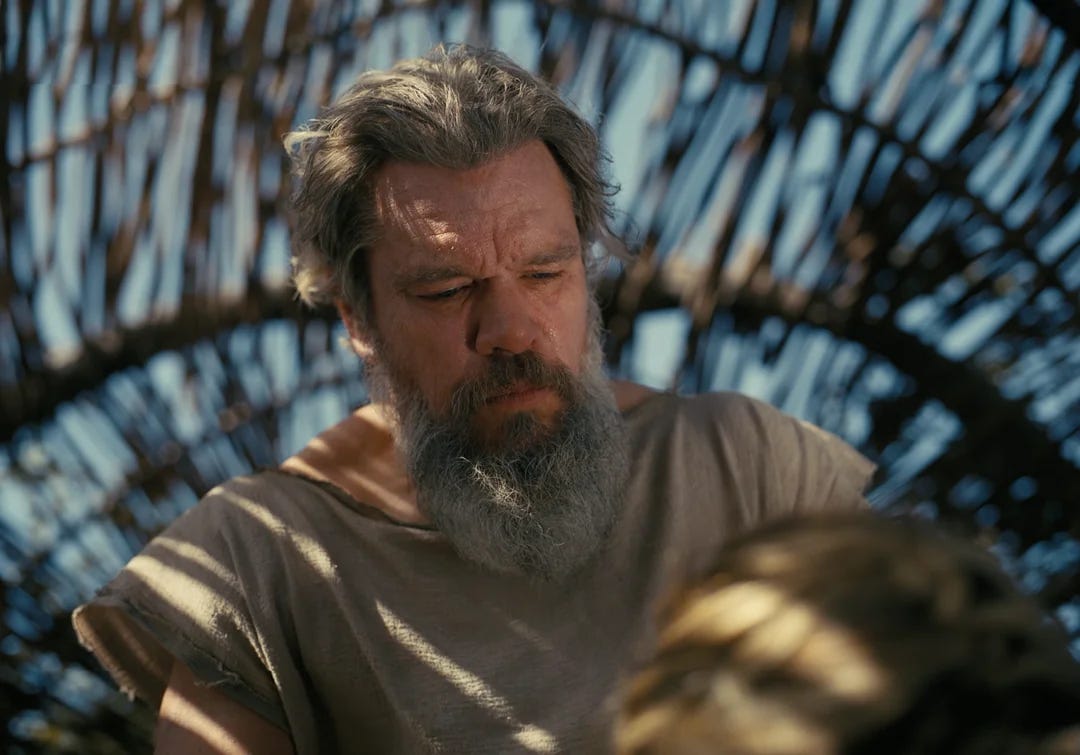
Christopher Nolan’s “Odyssey,” the big-screen epic, is a meditation on not just the poem, but a radiotelescope peering at humanity. The sights and sounds of war, tempests and greed are all encapsulated on a 70-mm screen. Dazzling Dolby sound, stunning cinematography and gripping performances by Ann Hathaway, John Leguizamo and Jon Bernthal breath life into the impossibility of this poem. It was a great reason to return to a mammoth-projection movie theatre (despite $10 popcorn).
We Know Odysseus Today
Although I know Nolan’s inspiration for the screenplay was Emily Wilson’s updated idiomatic translation of the Odyssey –- one of the most accessible versions for modern ears -- Nolan is more tightly focused on who Odysseus is to us in an age of corporate greed, oligarchs, needless warfare, global warming and AI.
In Nolan’s vision, Odysseus is the CEO or powerful politician who wants to return home “to spend more time with his family” after 20 years of warmaking, pillaging and becoming lost in his own ethical whirlpool. He’s preternaturally clever, inventing a faux gift horse that eventually unleashes the pent-up rage of his warriors who sack Troy and commit crimes against humanity. Think tech bro oligarchs and the addictive, harmful cyberpower of social media, which lodges in people’s brains like bytes of lotus flowers. There’s a good reason why hacking software is called a “trojan horse.”
More importantly, our anti-hero character, explored in more depth in Nolan’s “Dark Knight” series, chooses to ignore the rage of the gods. He angers Poseidon, the god of the oceans, by blinding his son the cyclops. He defies Zeus, the king of the gods, by ignoring his “rule” by not treating strangers with respect and hospitality. Burning, raping and sacking Troy was way over the top.
Although we only see one of the gods – Athena, the goddess of wisdom and war (played in a somber tone by Zendaya) – it’s the nature of emotional defiance that’s not explored enough in Nolan’s screenplay. Yes, there are nods to Greek exceptionalism (“We are the greatest civilization ever known”) and avarice (“the war wasn’t about Helen, it was about profitable trade routes.”) Yet the underlying theme that unbridled greed and misplaced passions ignite wars and defy nature lies submerged in Nolan’s wave of turbulent images. The invisible gods during the bronze age up until the age of enlightenment -- hello Kant and the Golden Rule -- are stand-ins for humanity’s ignorant defiance of nature itself, which could not be a more contemporary crisis. We are overheating Poseidon’s realm and it’s killing us in the form of droughts, wildfires and violent storms. Below the surface is the feudalism and colonialism of fossil fuel barons and oligarchs.
It’s ours and we’ll take it to get rich. Damn the doomsayers. Prophets and scientist-soothsayers have told us this is a doomed voyage, but we choose not to listen.
My favorite scene in the movie is when Odysseus visits the blind prophet Tiresias in Hades and then converses with the ghosts of men who were slain in the Trojan War. Tiresias tells him that his surviving veterans are doomed because they will eat the cattle of the sun god Apollo. (no spoiler alert, this is in every translation of the poem). Shades of Shakespeare’s opening to “Hamlet,” another son grieving/raging over loss of a father.
Still, Nolan’s emotional fulcrum is the remorse of its uber-clever warrior. He knows what’s he’s unleashed. As a cross between Oppenheimer, Einstein, Batman and the most brutal billionaire or dictator you can think of, Odysseus in Nolan’s eye is a creature whose soul is riven with guilt, spiritual concepts that wouldn’t really take hold in Western philosophy and religion until about a thousand years after the Odyssey was committed to written form and/or performed by “rhapsodes” throughout the Hellenic world, which lasted in various forms until 1453.
While the Odyssey is not as great a film as “Interstellar” or “Oppenheimer,” it’s a must-see. Think of it as a prequel to all of his films, which should be seen, particularly Oppenheimer and Interstellar. One key criticism, though: I wouldn’t have cast Matt Damon in the lead. He just doesn’t have the gravitas or depth of character displayed by Ralph Fiennes in “The Return” with Juliette Binoche, which is a more powerful rendition that explores Odysseus’s revenge and damaged marital relationship when he’s back in Ithaca. Since Universal/Comcast gave Nolan hundreds of millions of dollars to produce this film, the producers rightly guessed that Damon would be a better draw alongside Ann Hathaway. It truly deserves to be a billion-dollar box office smash, but not for that reason. See it in a 70mm screen theatre with Dolby. You’ll enjoy the majesty of the sets (almost art-deco-like in Troy), the horror of the monsters and fight scenes, beauty of the costumes and the other-worldly score.
More importantly, read the poem. In addition to the Emily Wilson translation (a bestseller now even though she trashed the film) there are durable translations by Robert Fagles (who leans into contemporary poetry and prose) and Daniel Mendelsohn. Fagles and Wilson provide generous introductions. Like Eliot’s “Wasteland” or Joyce’s “Ulysses,” don’t read it like a thriller, mystery or romance novel. Give it a cozy perch on your nightstand and read it over several years. It’s a solid companion for life.
Here’s a snippet from the Fagles version in Book 1, quoting Zeus:
“Ah, how shameless—the way these mortals blame the gods. From us alone, they say, come all of their miseries, yes, but they themselves, with their own reckless ways, compound their pains beyond their proper share.”
Going Back Home
Still, the Odyssey enchants and informs. Returning to one’s home is always agonizing. Where is spiritual home for most Americans, especially those whose forebears (like mine) came from the ruins of European civilization? Is it where we spent our childhood, teenage years or young adulthood? Is it where we relocated to after our work lives evaporated? Is it a bland suburb, gated community, rural hamlet or lively city? Is anywhere truly sacred to modern Americans?
It’s no small coincidence that Euro-Americans were told that they were entitled to a home that they could consider their castle. Even with Enlightenment concepts of equality and freedom, loosely constructed to originally mean white, Protestant, land-holding men, the acquisition of land in North America was still a feudal enterprise. Even land “granted” to railroads, universities and settlers through the Morrill, Pacific Railway and Homestead Acts was taken from Native tribes by force or coercive treaties. Large expanses of cotton and sugar plantations were cultivated and harvested by enslaved Africans. Colonizers all thought they were morally and mentally superior to those they dominated, heirs of a “Golden Age” that never really existed. If you take a close look at plantation manors, banks and many government buildings, they are neo-classical in style resembling Greek temples.
War with the purpose of stealing land and “resources” by force was certainly not a new concept when the Trojan War began. Large Greek armies and city-states likely saw it as an economic opportunity, an initial public offering (IPO) with ships and swords. Helen’s infidelity was a convenient meme to give them cover. Persians, Romans, Mongols, Napoleon's Grand Armee and 20th Century Nazis and fascists didn’t even offer nominal political reasons for invasions hundreds of years later. In the Persian Gulf today, war is merely an exercise of faux masculine power, vanity and unrelenting greed. What’s changed?
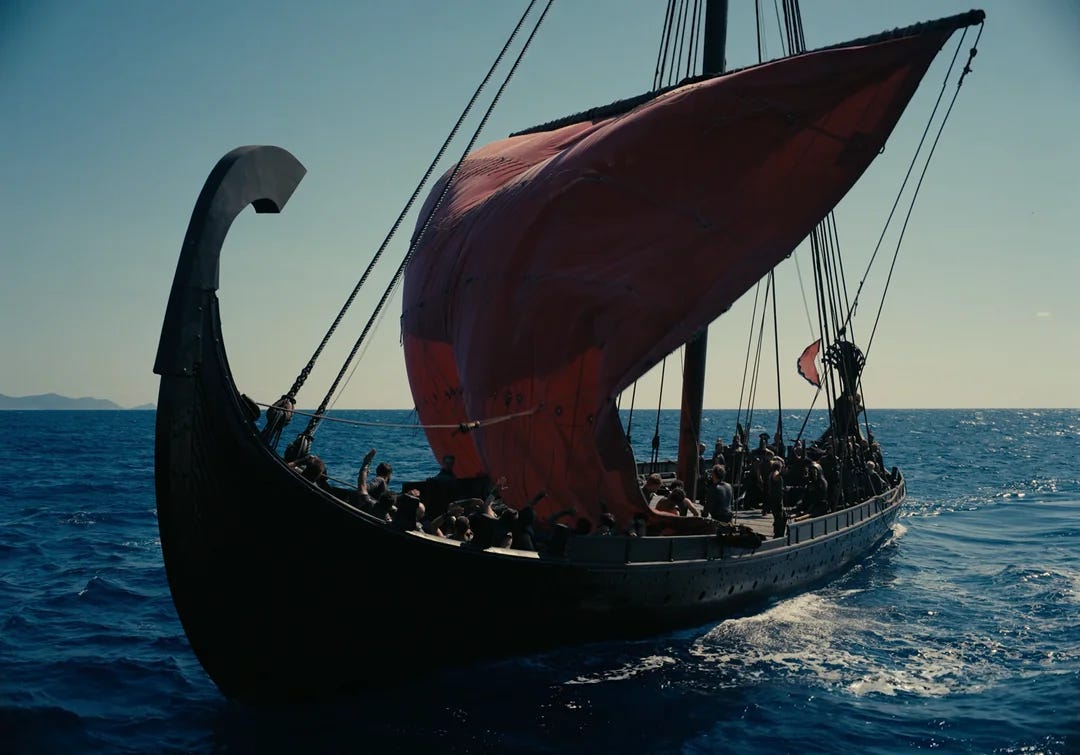
Yet where are we? We sail aimlessly, lost in the wine-dark sea of infinite information, data centers and AI. Is home really somewhere we feel a primal need to subdue nature with airports, shopping malls, parking lots, factories, subdivisions and smartphones? Are we afraid of being alone, dying or just overwhelmed by the legion of trojan horses loaded with addictive, lotus-eating intentions?
Confession: I never considered my true home to be the South Suburbs of Chicago. My most transformative, maturing experiences were on the Southeast Side of Chicago, where I developed my worldview. My intellectual mycorrhizae extend from an industrial wasteland to a biodiverse county north of the city.
I call the biosphere I occupy home, wherever that may be. Love is the anchor that keeps me in place with family, friends and community. All my life, though, I’ve witnessed how we are defying the gods of nature. Even if you don’t believe that God is an ancient, bearded white guy, it’s clear the wrath of Zeus and Poseidon are upon us.
How do we navigate to friendly seas and a homeland? My domicile is where my loved ones are -- and in the literature of the stories that inform our humanity. I don’t have to travel to find such spiritual moorings. If I wander elsewhere, I can return anytime.
Vincit Omnia Veritas (in truth, there is power)
Please consider upgrading to a paid subscription. As a bonus, subscribers receive free access to my new book “The Natural Neighborhood,” which is serialized in this newsletter: A new chapter every month. To contact me about speaking and writing or offer even more dangerous ideas, email me: johnwasik@gmail.com
No posts
Comments
Nothing yet. Say the first thing.
Sign in to join the conversation.