
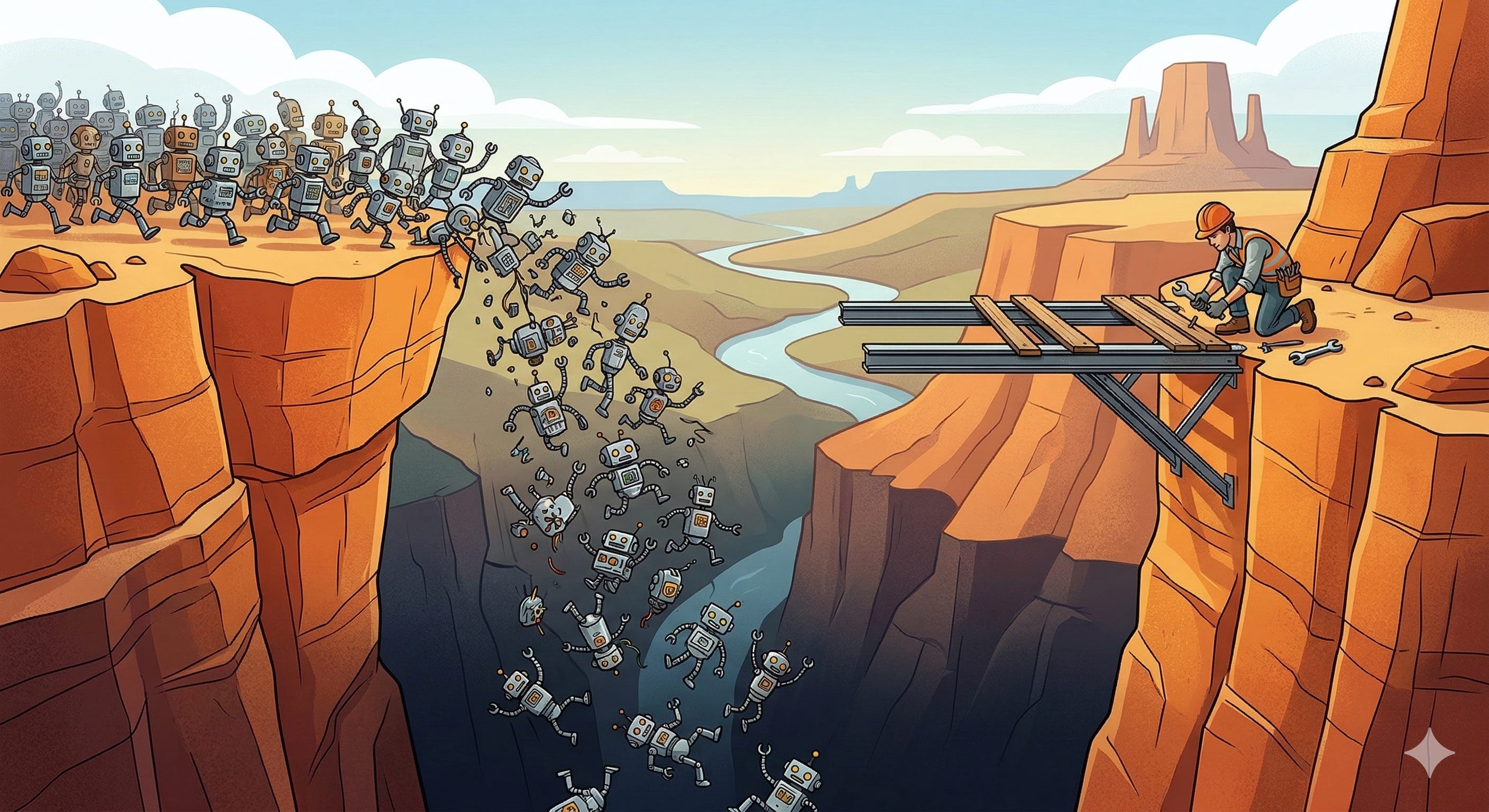
One of the predominant AI news cycles in early 2026 has been the data, stories and anecdotes about AI replacing more and more human jobs. Entry level hiring is weak, Block laid off 40% of its workforce, and just today overall jobs took an unexpected drop. How directly these moves are tied to AI is not always clear, but the correlation is glaring: As models get smarter, there are more data, stories, and anecdotes about AI replacing human labor.
So two journal articles caught my eye recently that, taken together, might provide a glimpse at the cap on AI replacement. In one, Princeton researchers observed that while frontier models are becoming more capable at an rapid and consistent rate, their reliability is still unpredictable or in some cases falling. The researchers identified a ”reliability gap” that proves that frontier models are making fewer gains in safety than they are in intelligence.
And then, a separate study from Cognizant’s AI Lab outlined a AI system (system is an important distinction here) they created that solved an “impossible” 1,000,000 step problem using AI with zero errors. In other words, 100% reliable.
Surely, AI that is more capable than humans and 100% reliable means that we are just at the beginning of an employment apocalypse. But let’s break down the articles and see the story they tell about where AI maxes out and humans excel, and how we can take advantage of that in this climate.
Article: Towards a Science of AI Agent Reliability
In the first article, Princeton Professor Arvind Narayan and his colleague make the observation that even though frontier models continue to become more capable, the advances have been much more variable--even regressing in some cases--when it comes to reliability. In other words, the model can do more and do it faster and smarter...but it still makes mistakes.
They call this phenomenon the “reliability gap”. While standard benchmarks show accuracy on longer and harder tasks rapidly increasing, these gains are not translating into consistent or safe behavior in the real world.
The most compelling finding from this study is that larger, more “intelligent” models can actually be less reliable. Because frontier models like Claude 4.5 Opus or GPT-5.2 have “more ways to solve a task,” they exhibit higher run-to-run variability. This creates a paradox where an agent might solve a complex reasoning puzzle on Monday but fail a simple database update on Tuesday.
The data across twelve metrics reveals three critical failure modes that “raw intelligence” cannot solve:
The Consistency Crisis: Outcome consistency remains low across the board; models that _can_ solve a task often fail to do so repeatedly.
The “What but Not When” Gap: Agents are remarkably good at picking the right tools but struggle with stable planning, often reordering execution steps in ways that would be catastrophic in a production environment.
Fragile Robustness: Models that handle genuine technical API faults gracefully remain highly vulnerable to “surface-level variations” in instructions—changing “cancel my plan” to “please end my plan” can cause a high-capability model to fail entirely.
It isn’t clear if this is because the frontier AI companies are more incentivized at this point to show progress in the capabilities “arms race” across models, or because these problems are fundamentally intractable for generative AI. The answer is likely a bit of both.
---
Article: Solving a Million-Step LLM Task with Zero Errors
The second article comes from consulting company Cognizant’s AI Lab. And it puts forward one viable solution for the reliability problem: break the task into tiny enough tasks so that--with testing--the tasks become essentially infallible. The task at hand here was a Tower of Hanoi problem that traditional LLMs cannot solve because the solution involves millions of potential solutions. But the researchers broke up the process into testable pieces that an LLM rarely gets wrong. So rarely that if you run the task a few times and take the most common answer, the chance of a wrong answer drops to nearly 0.
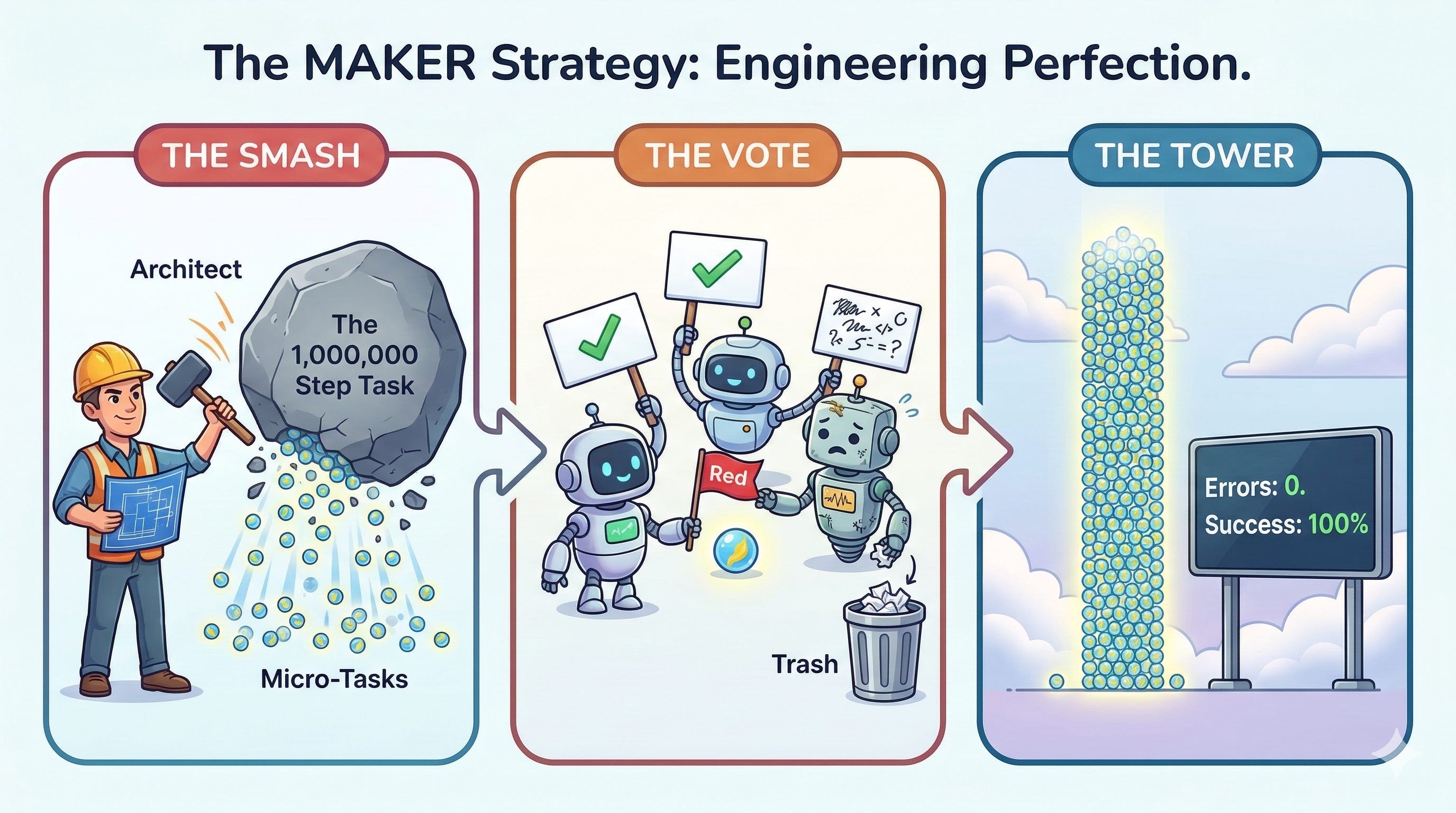
In bit more detail, humans designed a system with the following three pillars:
Multi-Agent Voting: Instead of trusting one “smart” model, the system uses a battery of smaller LLMs voting on the solution to a tiny task with a very small error margin. This voting system effectively filtered out the inherent randomness of LLMs.
Human-Defined Red-Flagging: The researchers identified a few patterns that indicated bad behavior by an LLM. Namely, incorrect formatting of outputs and long thinking processes that indicated the AI was stuck in a loop. Rather than leaving these “red flags” in there like a large thinking model would or trying to handle these outliers, the application simply drops them. The redundancy built in by the multi-agent voting system allows this and made the tool ultimately cheaper and more reliable.
The “Nano” Advantage: In a complete reversal of the “bigger is better” trend, the study found that small, non-reasoning models (like GPT-4.1-mini) actually outperformed massive reasoning models when placed inside this human-engineered pipeline. This calls back to the Princeton article where thinking models are simultaneously more capable and can think itself into unreliable outputs.
They call this process Maximal Agentic Decomposition (MAD). And the authors admit that this example Tower of Hanoi is a bit manufactured to prove the point, and not all tasks can be broken down into machine-like, infallible tasks. But I find the fundamental principle to be compelling and obvious: Well designed AI pipelines are context-specific and they aim to measure, evaluate, and minimize errors.
I found this to be the most compelling chart, from the Cognizant article:
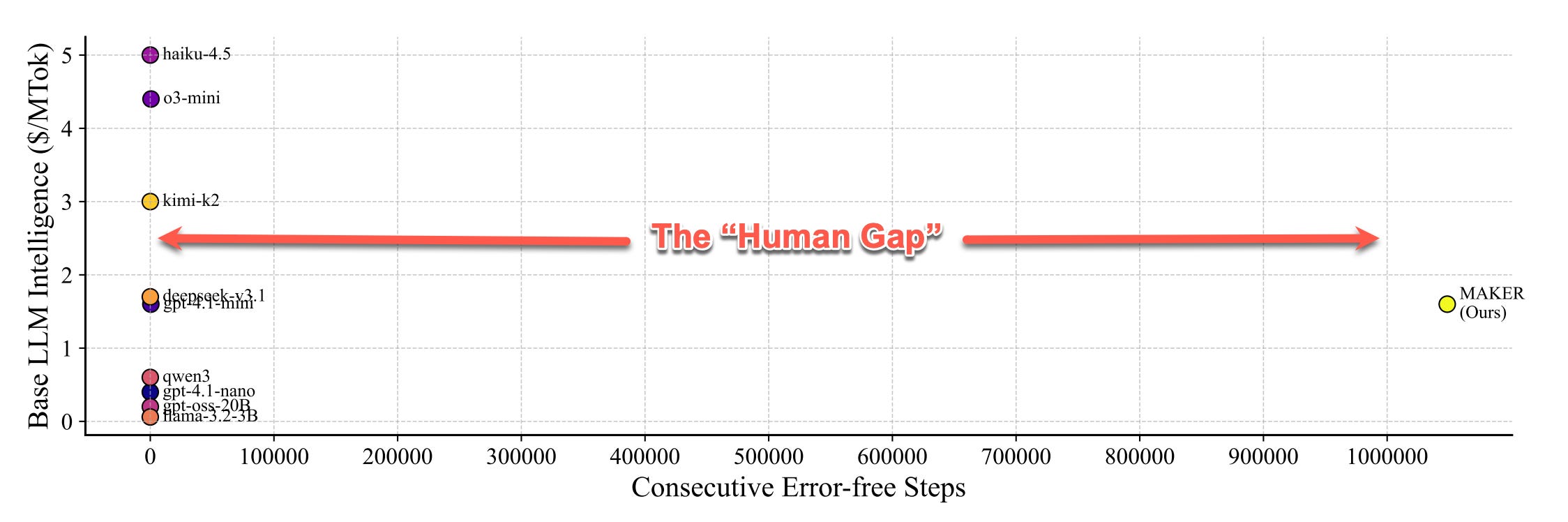
It is a wonderful demonstration of scale. When we reach highly complex tasks like the Tower of Hanoi problem, AI fails so fast that any differences in reliability between models don’t even register on a chart this size. Only a human-built framework can pull that reliability into an area that LLMs aren’t even sniffing. And the human designed system is doing it with small, testable tasks and not just throwing more and more inefficient compute (thinking) at the problem.
This is a roadmap to staying ahead of AI in your own context. The path to becoming irreplaceable is to intentionally push into the territory where raw AI breaks. If your current workflow is a “three-disk” Tower of Hanoi problem—something an LLM can solve perfectly every time—you are at high risk of being automated. But if you push the context to an “eight-disk” or “twenty-disk” problem, you move into a space where monolithic models invariably fail. Your value then isn’t in your own “solving” ability, but in your ability to design the human-engineered scaffolding—the decomposition, the voting margins, and the red-flagging—that drags that impossible task into the realm of high reliability.
For the Cognizant team this was a fairly technical framework involving red-flagging and AI voting algorithms, but it isn’t an inherently technical task. I’ve worked with faculty who are very good at designing rubrics that are highly understandable to an AI and therefore more reliable. Nontechnical subject matter experts are invaluable reviewers of AI systems to find errors in the output and brainstorm ways to fix them.
And I would hypothesize that finding reliability gaps will never truly go away. Even AI and it’s seemingly unstoppable advancements are limited by bottlenecks. Today, we hear about data or compute power. Tomorrow it might be your own institutional budgets and highly specific domain context. But there will always be reliability gaps to be found.
Here is how I sum up the lessons from the two articles.
1. General generative AI has a reliability gap. It isn’t clear how much it’ll be able to close that gap in the future. But with AI’s inherently stochastic nature and the broad domain that it operates in, it won’t eliminate it.
2. Human devised systems can reduce that reliability gap.
So find the gaps, build the systems to bridge them, and become indispensable in your domain.
AI Disclaimer: Google Gemini was used for brainstorming and summarizing articles in this piece. Images generated by Google Nano Banana.
No posts
Comments
Nothing yet. Say the first thing.
Sign in to join the conversation.