
“I know I'm doing it the hard way / But I kinda believe in the hard way / Like the time I was twelve years old / Jumped out the car and walked the whole way home / Choirs of voices on my phone / Just make me feel alone / There's a moment of control / Then Hannah goes down the rabbit hole”
(Middle Kids, “Your Side, Forever”)

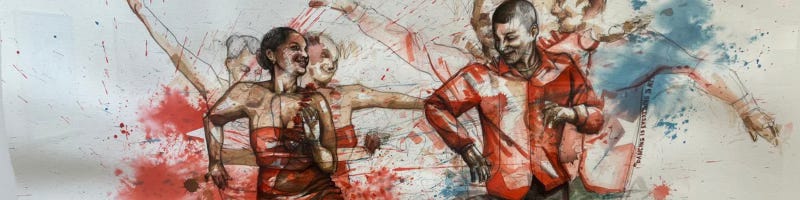
I went out to see some art at the Cultural Arts Center of Glen Allen last week.
Part whim, part responding to an email from Culture Encounters, a Richmond non-profit that’s focused on building bridges through cultural experiences.
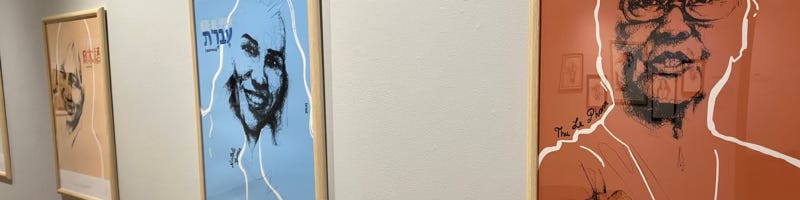
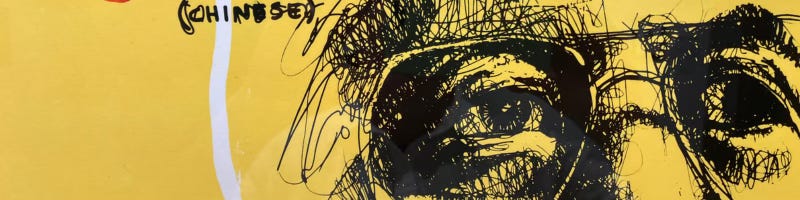
And I discovered the amazing artwork of Alfonso Pérez Acosta — a handful of images from the exhibit (cropped to fit Substack) are scattered throughout this issue. I had a chance to chat with Alfonso briefly, ran into Noah Scalin, and had a cookie.
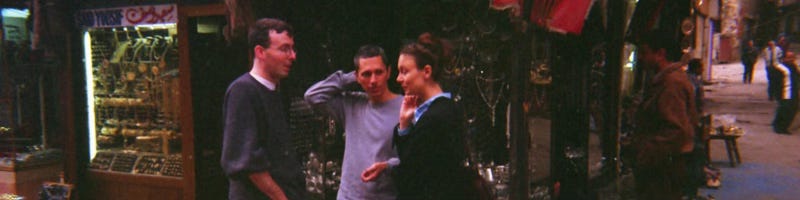
Years ago, I spent a long month in Cairo with my friend Matt.
While he was in class, I passed the hours in run-down cafes — wandering tribes of cats playing at my feet and jumping into my lap to nap, a cup of Lipton steaming in front of me — trying to teach myself Arabic. I practiced the alphabet, letter by letter, in careful script. I wrote words, transcribed sentences. I silently repeated sounds over and again in my mind.
Old men wandered by, paused and praised my written script — in English, once they realized that despite my excellent penmanship I had no verbal mastery of their native tongue.
I berated myself, frustrated by my slow pace and the distance that was not closing at all between where I started and mastery.
One evening, Matt and I were walking through one of the city’s beat-down old neighborhoods. He asked me to wait while he ducked into a small hardware store crammed into a concrete nook. He emerged fifteen minutes later, grinning like a kid.
“I just learned fifteen different ways to say ‘nail,’” he said.
I liken what Matt was doing in that hardware store to Shoshin, the Zen concept of beginner’s mind. Approaching a subject or a practice with openness, eagerness, a lack of preconception. Matt walked into that hardware store not just knowing that he didn’t know, but believing that it was entirely fine to not know.
What I’ve been thinking about lately is Shoshin’s more outcome-focused cousin — an apprentice mindset. Its attributes are not dissimilar: humility, curiosity, and a willingness to start at square one. But less about belief. More about effort.
Ego gets in the way of belief. The scorecard gets in the way of the work.
Matt walked into that hardware store an apprentice. I sat in those damned cafes with hubris and a red pen.
When I reflect back, I’ve spent most of my life as an apprentice — dating, college, journalism, raising tiny humans, leadership development, nonprofit strategy, more dating, tiny humans becoming larger humans.
There’s little in my life that hasn’t demanded I do the work before I get good at doing the work. When I allow myself to just do the work — humbly, and without keeping score — I get better at it. With effort. Over time.
And when I get better at being an apprentice, I sometimes find myself drifting toward Shoshin. Because they’re not sequential, these approaches — they’re adjacent.
The last two years have felt different. Somewhere between Shoshin and being an apprentice.
I approached the first six months of living alone and coparenting as a project, because it’s what the moment demanded. Or maybe it was the only skillset I brought with me from my old life. Whatever. It worked. It created stability, continuity, a rhythm that helped me find a stride most days.
But variables change in every project lifecycle.
A rental house. Two kids. An aging mom. A bored cattle dog. Too much and not enough work. Too much, if there’s such a thing, writing. An evolving social circle.
At some point, improvisation became more important than management.
Meal planning. Calendaring. List making. Consistency. They didn’t go away. They just became gentle tools, not permanent constructs.
If Jack wanted hummus for breakfast, I set the scones I baked aside. If I didn’t want to see a band alone, I’d buy two tickets and invite Chris or Jim to go. If Jerry texted about a movie, I’d check in with myself first. If I saw a friend when I walked Addie at the park, our path would change.
Every moment becomes a choice, not a rule.
It’s funny when the smallest things get us fired up. Funnier still how rarely we learn from the past.
Maybe funny’s not the right word for it.
It was just over 50 years ago that the Nixon administration inked a law making daylight saving time permanent — a two-year experiment, largely driven by the era’s energy crisis.
It lasted a few months. That Americans hated sending their kids to school in the dark was something of a national lightbulb moment.
And now, here we are again.
Last week, the House passed a bill to make daylight saving time permanent. And once again, people are screaming (on their social feeds and Substacks) about kids going to school in the dark.
They’re not wrong. They’re just under-arguing it.
Having a consistent clock year-round is not a bad idea, most biological scientists say. Just pick the right clock.
The ranking, according to sleep researchers, goes like this: permanent standard time first.
Why? Our bodies operate on a 24-hour biological clock. We call it our circadian rhythm. It’s triggered by sunlight, not by the time on our iPhones. And standard time is more closely synchronized with the sun.
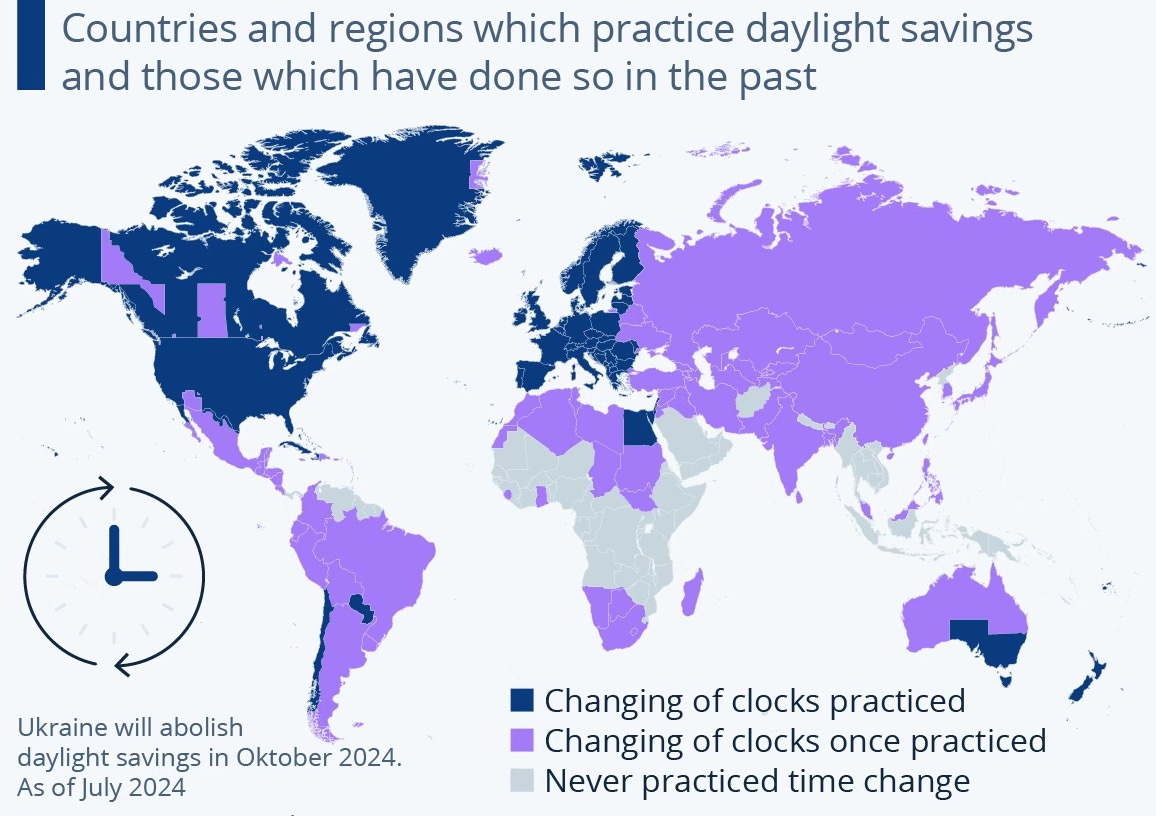
The map I’ve shared shows you (light purple) the countries that have abandoned time change for a permanent standard time.
Our current system — the one where we all grumble twice a year about the lost hour and the microwave that stays wrong until June — comes second.
Permanent daylight saving time comes last. That’s the House bill that’s now going to the Senate. That’s right. The bill on the table manages to lock in the one option worse than the thing it’s fixing.
Later sunrises are bad news for our brains and our bodies. Morning light tells the brain to wake up — and quietly sets a biological timer that helps us fall asleep that night. Push the sunrise an hour later, permanently, and you’ve unplugged the timer.
Hopefully the Senate wakes up and votes no.
Hot Analogue Summer continues.
I read a good chunk of Fab 5 Freddy’s autobiography when I was in Norfolk three weeks ago. Last week, I got distracted in Shafer Court by my friend Ben, but recovered by muscling through the unwieldy first chapter of “I See You’ve Called In Dead” by John Kenney — a lightly poignant exploration of grief and connection. Sort of my wheelhouse.
The Internet, it turns out, struggled with the same first chapter I did. Bud Stanley has non-dramatically hit rock bottom by the time we meet him, and it’s hard to believe that will change once he walks out of his apartment. And I sort of didn’t want to invest in a novel where the main character doesn’t look like he’s moving.
But I did. And he does.
Accepting a meh narrator at the front door of a novel is a hard ask. It’s also the point. Once Bud’s friends Tim and Clara arrive, Kenney’s rhythm as a writer shows up more fully — and Bud’s flatness turns out to be the thing the rest of the book is quietly repairing.
This coming week is a kids week, but I’ll be back at it the week of July 27. Reading an actual book by myself somewhere in public.
A piece on Threads caught my eye in the middle of the night last week.
It was about the concept of Robin Hooding — shining a light on how systems are stacked against people, and on ways to slip past the gates.
Maybe a better way to think about it is as a form of subversive literacy — understanding the gatekeeping well enough to turn it into a tool for self-defense, survival or success.
Most of the posts were really just professional tips on navigating systems.
The one pro tip I appreciated — reading as a former journalist in a city thick with alternative news outlets — was about proactively reaching out to local reporters to talk about whatever the heck is going on in your life.
It started: Some people have gone their whole lives without having met a journalist.
Which is crazy, and probably true.
When I was managing editor at the Commonwealth Times at VCU, I spent a solid chunk of every day showing up. Board of Visitors and Faculty Senate meetings. Press conferences. Dropping in on faculty and administrators — people like Murray DePillars and Cliff Edwards and Mike Brooks and Grace Harris — just to chat. I wanted to talk to everyone, all the time. Keep my finger on the proverbial pulse.
Reporters do less of that these days. Or more of it digitally.
Either way — old gumshoe approach or browser-driven reporting — it’s still a one-way street. The journalist finds the source. The journalist cultivates the relationship. The journalist shapes the story.
What if, the Thread suggests, we — average people with careers and kids in school and problems with food deserts or water pressure or potholes — flipped that? What if we believed that sharing our story, or experience, or observation might make for good news — news that feels good to read, or news that helps others living in the same community we call home?
Here’s the pitch — the Robin Hood move — this journalist on Threads suggested: Just call your local reporters. It doesn’t have to be a big fancy phone call, either. It can be “Hey, just want to let you know who I am and what I’m working on, because you might be interested...”
Do a Google search for your favorite local news site’s reporters, or contacts. Drop them an email or text. Buy them a cup of coffee. Let them see Richmond through your eyes.
Dammit.
What is love worth when it can’t rescue anyone?
That’s the throughline on a new novel I just concepted and began mapping this week. Because I’m an idiot, and cannot stop.
It gets worse.
The first half is inspired by The Iliad — the household under doom; the scene of Hector, Andromache and Astyanax; love cannot control mortality.
The anchor in the middle that forces everyone to change? An old Mesopotamian fable, “Appointment in Samarra.” We meet our fate on the path we take to avoid it.
The second half? Anabasis by Xenophon. The expedition that fails far from home; the death of the general; the long march as the army shrinks. Finally, the sea.
A family in Wilmington, North Carolina. A death in Scottsdale, Arizona. And a 2,200-mile drive that changes everything. Iliad. Samarra. Anabasis.
Comments
Nothing yet. Say the first thing.
Sign in to join the conversation.