
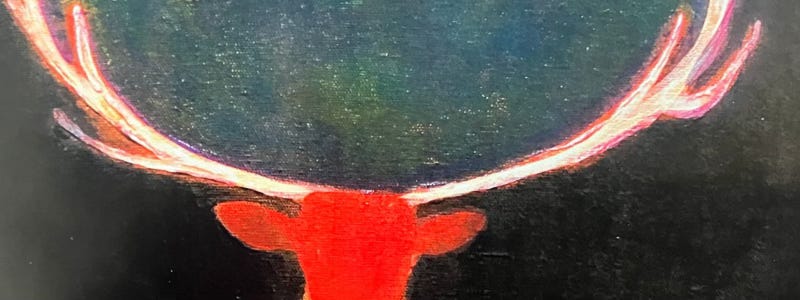
“See you soon, but not like this / Afraid I am to think / I haven't heard /
I haven't heard from you in weeks / All your letters, photographs/
So far out of reach”
(The Silos, “Tennessee Fire”)

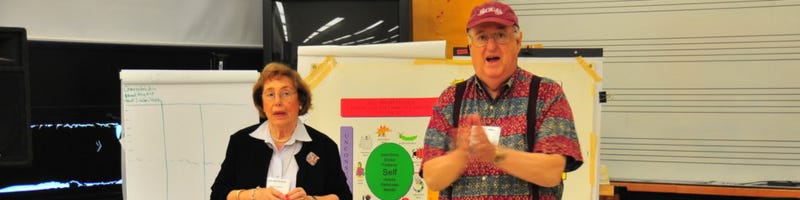
Years ago, I went to Cape Cod for a week to hang out with older, smarter people and learn things.
Our instructors at the Cape Cod Institute? Charlie and Edie Seashore, who were among a small group of people in the 1950s who did breakthrough work in organizational psychology in Bethel, Maine. They spent their careers transforming others.
I often describe them in larger-than-life language, because that was my experience with them.
Charlie projected a bit of an aw shucks Midwestern vibe. A big man with a big grin, he wore his hat high on his head and his pants pulled high to his waist.
Edie was smaller, an easterner who favored black, and pearls, and who facilitated with a bottle of water (and later told us that she used to sip from a water bottle filled with gin to calm her nerves in front of groups).
They were profoundly influential — individually, and as partners in work and life for more than 50 years. They changed the profession of organizational development, and in the course of several days they changed me.
I’ve been thinking about feedback this week. Not the kind you don’t want to get at work, but rather the endless cascade of signals we receive every single day that tell us something about ourselves, about others, about the world we’re passing through.
In Cape Cod, Charlie threw out three pieces of feedback jiu-jitsu that took me three days to process.
Feedback is just information. Just data.
Feedback tells you more about the giver than it does about the receiver.
When Charlie is giving feedback to John, there is no John. Only the John in Charlie. And when John is receiving feedback from Charlie, there is no Charlie. Only the Charlie in John.
Or in the vernacular, “You know nothing, Jon Snow.”
Sometimes I feel like I’ve received more feedback in the past three years than I can possibly absorb. The end of a marriage. The death of a parent. Two children growing through changes they couldn’t anticipate. My work as a consultant. My work as a novelist. Navigating and sustaining relationships, old and new. Buckets of feedback, data, information.
Not all of it required action.
And not all of it was about me.
How do we stay open to signals when some of them are brutal? What do we do with information that feels weaponized, intentionally or not?
We often treat feedback like a verdict. Something chiseled in stone that has been handed to us to hold forever.
But it’s not. It’s an invitation. Brutal or generous, accurate or hateful, it asks something of us — even if all it asks is that we set it down and walk away.
Edie had a move.
When someone said I don’t believe that or I can’t do that or that’s just how I am, she’d reframe it as something that was true up until now.
I just received information. About something that was true. Up until now.
Because what I do next changes everything.
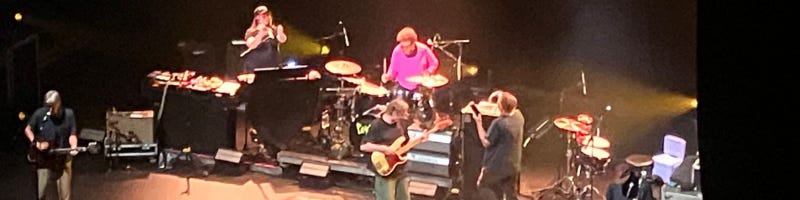
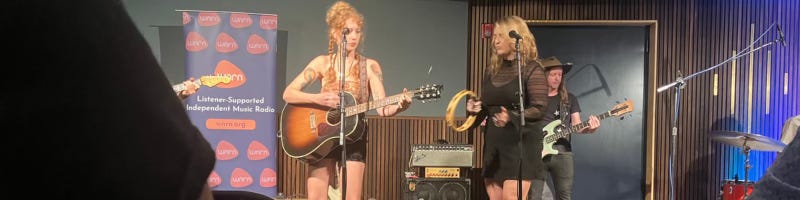
A week ago, I took my soon-to-be college freshman to In Your Ear Studios in the middle of the day to see The Hotpants play a fast but furious live-in-studio set for WNRN’s 30th anniversary.
We sat in comfortable chairs with 30 other people and enjoyed a rocking show. Then we went to Millie’s Diner for lunch — a first for her.
Turns out, it was a week of firsts, old favorites and things I’d been waiting years to do.
The next night, I went to the National to see Pavement. The last time I saw them, Thea was with me — a high school freshman. The show was outdoors on a warm summer night in Raleigh on the heels of an amazing Alvvays set.
I can still remember listening to an early release of their first album when I was her age. Scratching my neanderthal punk rock head. It was sonically discordant, a little snotty and precious, damned catchy. It took half a second.
Musically, the National show was great. They hit the right notes. They almost appeared to be enjoying themselves (especially Nastanovich, who always seems to be having fun). But after five songs I traded the sardine-packed floor and other people’s endless beer spilling for a nosebleed seat in the balcony. Enjoyed another hour, including two favorites, “Shoot the Singer” and “Frontwards,” and went home happy.
The trifecta closed at Chilton House.
The Silos were one of the few non-punk bands in constant rotation in my room my freshman year at VCU, and I’ve never seen them live.
So when singer Walter Salas-Humara locked in a date at Chilton, a house venue in Westover Hills, I grabbed two tickets. I went with a friend — a recent refugee from Charlottesville, still getting her Richmond bearings. We played pinball, bought two of Walter’s paintings, and enjoyed the hell out of the show. Sitting in two of the six comfortable chairs in the house.
We even enjoyed the shenanigans of the very drunk woman next to me, who had no filter, no social awareness and no volume control.
There was something deeply satisfying about hearing Salas-Humara stalk through a few Silos tunes and a collection of his own songs. He knew how to use his voice. He had amazing range. He belted through a repertoire of great songs. Perhaps the best show of the week, and my favorite Chilton House performer to-date.
Three great shows in a week. A daughter on the edge of college. Bands that have followed me for decades. Seats comfortably away from the beer-spilling crowd.
I know it’s only rock-and-roll.
But I like it.
It’s been a week of vanishing and reappearing murals in Richmond.
And while I’m more interested in the new mural that nods to Bill Martin eight months after his death, I can’t help but start with the other one.
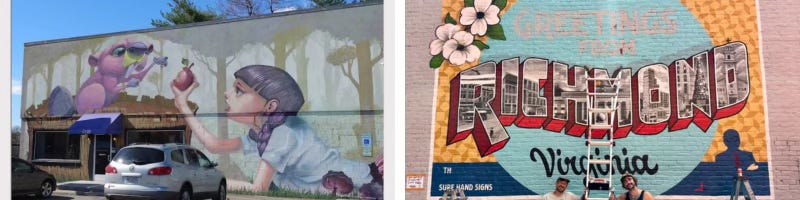
It was, perhaps, the cutest mural in Richmond. It just happened to be on the large exterior wall of a sex shop. And to carry a bit of innuendo.
Yes, I’m talking about the beaver mural on the former Taboo building on Midlothian Turnpike, out near NBC12.
Karri Peifer has the sexy update at Axios: The “Feed Ur Beaver” mural that drew outrage, jokes and international attention when it went up more than a decade ago, is being painted over with a new design.
The replacement? A woman playing with a cat. With a feather toy.
New mural. New innuendo. Hopefully still adorable.
The more somber mural news comes from Sabrina Moreno, who has the story of the return of the “Greetings from Richmond, Virginia” mural at 311 West Broad Street. First there was the original, with images of the city tucked inside the block letters. Then came the 2020 update, which folded in the protests and the community takeover of Monument Avenue. That one was painted over, and nobody ever explained why.
Now it’s back. Less controversially. As a tribute to Bill Martin, the longtime director of the Valentine — and the face of Richmond to so many people. It’s a quite visual nod, but one that will resonate strongly with people who knew Bill.
The most direct nod is a silhouette. Artists Mickael Broth and Ross Trimmer painted Bill in his signature pose and tie, with “In loving memory” just below it.
Everything else is deliberately oblique. The new mural honors Bill’s his lifelong mission of getting people downtown — to appreciate Broad Street, to watch the city thrive. The form is the tribute.
Then the hidden ones. Each letter holds a Broad Street landmark across time, from the streetcar era to the Science Museum — with St. John’s Church inside the “D” because Martin lived nearby, and newer landmarks like the VPM building marking the corridor’s ongoing change. And tucked in somewhere is the parquet floor pattern from the Valentine’s Wickham House.
Two walls. Three changes. Evolution, not dilution.
Public art at its best.
Just before the pandemic dropped, Danish musician Carl Martin wrote a melody. He thought it was beautiful. And he thought it was original.
The tune rises, and then it falls, and then it rises again — circling back to the start. Four simple notes.
“I thought this is the best thing anybody in the history of music has ever written,” Martin, now 27, told the Washington Post. “I was just waiting for the record labels to come knocking.”
And once he wrote it, he couldn’t stop hearing it. Not his own melody in his head — but the melody he thought he’d discovered in a Bruno Mars song, in pop songs, in a song by Danish heavy rock band Volbeat, in a song by Italian singer Damiano David. Everywhere.
The more he looked into it, the more he realized he hasn’t invented anything.
He ultimately documented more than 500 songs that were built on this simple melody. It’s a deeply emotional melody, one that projects what he calls a “yearning quality.”
Maybe that’s why it keeps resurfacing: not because musicians lack originality, but because yearning has a limited number of shapes. (Truth.)
Okay so everybody’s copying everybody and they are basically doing an interpolation of this melody. But who made the melody?
Clairo pops up. Her hit “Sophia” contains the melody, and the melody gained traction not long after she released the song. Martin followed the music — back to 2010 and Lady Gaga. He kept digging, all the way back 2004 where he found the oldest use of the melody.
Martin eventually traces it back to 2004. I’ll let him reveal the originator.His YouTube video provides the better pleasure of hearing the melody travel across two decades of songs, changing just enough each time to feel newly discovered.

Finally.
I had the last call.
Heather Demetrios and I chatted this past week about Ophelia Doesn’t Drown; we’ve been working on it together since February.
The book is done — not perfect, but so much better. The focus of our call was on what happens next.
What do you do with a story that poured out in a matter of weeks, and was beaten and hammered into a purer, clearer shape with six months of developmental editing?
First, you learn. I still hate structure. I still fight structure. But I’m learning to use structure to write better the first time.
My old impulse: dive in and write, and trust the story will show up.
My new impulse: dive in and shape the story — the arc, the characters, the point-of-view, the broad roadmap to a final destination — and then write, and know the story will show up better.
Second, you go sell the book.
Heather and I spent most of the hour on positioning, which is its own puzzle. She says it reads YA, because there’s too much heart in it to be anything else. But it isn’t a coming-out story, exactly. Leah and Kira’s world doesn’t fracture because of who they love — their friends don’t turn on them, their families don’t implode. It’s a story about a group of people moving through a stretch of their lives, and the love is inside that rather than on top of it.
Whether I can find an agent who knows what to do with that is one question. Whether that agent is enough of a unicorn to know what to do with me — a fifty-eight-year-old cis man writing two teenage girls in love — is another.
I’ll have to answer that one out loud at some point.
So, I identify the literary agents, and I write the query letters, and I wait.
And in the meantime, Heather’s reading Off Belay, so we’ll start revisions on that as I’m pitching Ophelia Doesn’t Drown. And writing Down to the Sea. And getting Thea to college, Jack into middle school, and rolling my sleeves up for one of Floricane’s biggest project lifts in several years.
I probably need more structure in my life.
Comments
Nothing yet. Say the first thing.
Sign in to join the conversation.