
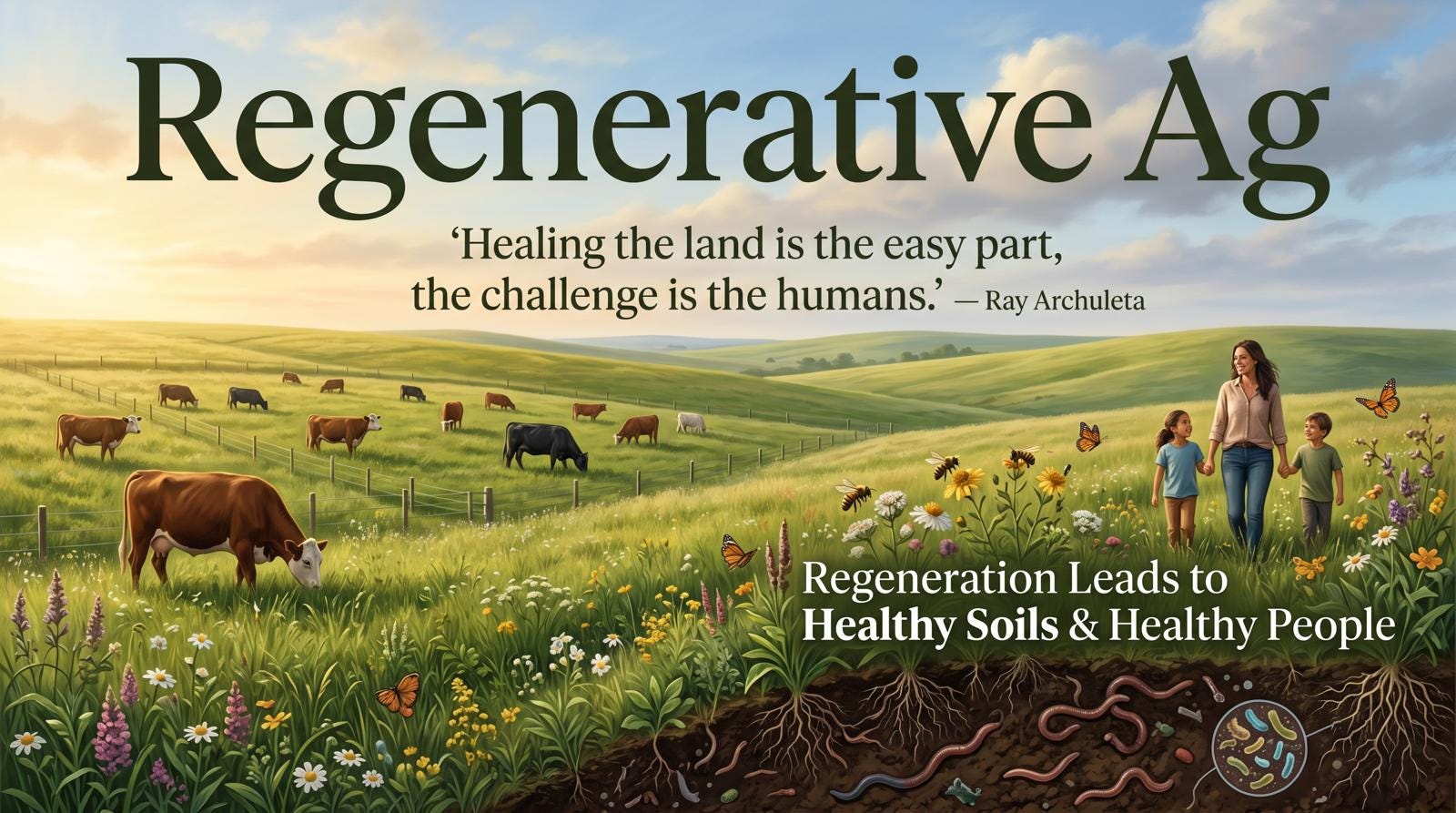
Over a decade ago, “regenerative agriculture,” AKA “soil health,” was a niche term known mostly to soil scientists and a few experimenting farmers. Things have really changed since 2013, when I started my regen journey and went looking for filmmakers to produce a movie on regen ag — which led to the 2020 release of the Kiss the Ground film. Today regen ag shows up in grocery aisles, farm bills, White House meetings, CNN, Amazon Prime Video, and national development plans abroad.
That’s real progress, yet progress is never a straight line. Regen ag in 2026 is a mix of genuine momentum, frustrating setbacks, and a few developments that should concern anyone who cares about our food system. As my good friend Ray Archuleta reminds us, “Healing the land is the easy part, the challenge is humans.”
I just returned from a trip to Eastern Washington meeting with regen producers. Last month I was in the Texas Hill Country doing the same. Here’s my honest look at where things stand.
I wrote in my 2021 article, Making America’s Rivers Blue Again:
“Today’s agricultural practices result in rainstorms washing pesticides, fertilizers, feedlot manure, and bare soil into our waterways and oceans, turning rivers from clear reflections of blue skies to hues of greenish brown. The good news: there are profitable and earth-friendly ways to grow nutrient-dense food, draw down carbon, and return our rivers to their natural blue appearance. Soil regeneration is the solution. ‘Regenerative Agriculture’ describes farming and grazing practices that build soil organic matter and restore degraded soil biodiversity — resulting in both carbon drawdown and an improved water cycle. There are five recognized principles of regenerative agriculture: keep the soil covered, minimize soil disturbance, maximize crop diversity, maintain living roots in the ground year-round, and integrate livestock.”
(Read the full article: Making America’s Rivers Blue Again)
That framework still holds true.
THE GOOD
Groundswell, the closing chapter of the Kiss the Ground documentary trilogy — which began with Kiss the Ground and continued with Common Ground — premiered in June on Prime Video and is already the #1 documentary, putting regenerative farming in front of a mainstream audience. Shoppers are demanding better food, and the MAHA movement has pushed soil health and food quality into the national conversation. Kiss the Ground’s latest consumer research shows understanding of regenerative agriculture nearly doubling in three years, from 7% to 13% of U.S. adults. Hearts and minds are truly shifting.
Politically, something genuinely encouraging is happening: farm country and conservative lawmakers, once skeptical of anything that sounded like an environmental program, are now far more supportive of soil health and pesticide reform than a decade ago. USDA’s new $700 million Regenerative Pilot Program lets farmers adopt regenerative practices through one streamlined application. Abroad, El Salvador is pursuing regenerative agriculture as a national strategy. Grassroots agroforestry programs are gaining adoption. Agroforestry Regeneration Communities (a network I co-founded in 2020) has helped plant over 30,000 food forests for smallholder farmers (under 1 hectare) in East Africa and Guatemala.
Natural Farming, a term used in India, demonstrates how regenerative methods restore the soil sponge, hold water where it falls, cool the land, improve plant health, and strengthen farmer resilience. (More on Natural Farming)
The European Alliance for Regenerative Agriculture conducted a multi-year study across 14 EU countries, showing regen farmers achieving similar yields with 61% less synthetic nitrogen, 75% less pesticide use, and 20% higher gross margins per hectare. (Study details)
New tools are accelerating adoption — here are a few examples. Halter (halterhq.com), a New Zealand tech firm, is building wireless cattle collars connected to Starlink that help ranchers rotate cattle. Greenfield Robotics (greenfieldincorporated.com), based in Cheney, Kansas, builds autonomous robot fleets that mechanically chop weeds and apply liquid biostimulants without herbicides. Drone technology is following suit, with larger-tank flying drones now applying biostimulants like EnSoil Algae (ensoilalgae.com) and Biodel Ag Sequester (biodelag.com) across more acres.
Consumers are voting with their forks, too. A recent article, “5 CPG Brands Fueling the Regenerative Agriculture Surge,” shows demand for regeneratively grown food is growing.
Regeneratively raised food is popping up at new restaurants: Cōpow Foods (copow-foods.com) in Idaho and Sovereignty Ranch (sovereigntyranch.com) in the Texas Hill Country each bring farm-direct, regeneratively raised meals to diners. The Food as Medicine movement is gaining real traction with Rockefeller Foundation funding. FreshRx Oklahoma is one of the largest purchasers of locally grown produce. Expect to hear more about nutrient density and soil health linked to human health.
THE BAD
Not everything is moving forward, and it’s often messy. The European Union is relaxing its GMO rules for new genomic techniques, worrying advocates concerned about seed sovereignty. In the U.S. and Canada, certified organic acreage keeps declining as farmers face certification costs, weed pressures, and thin margins.
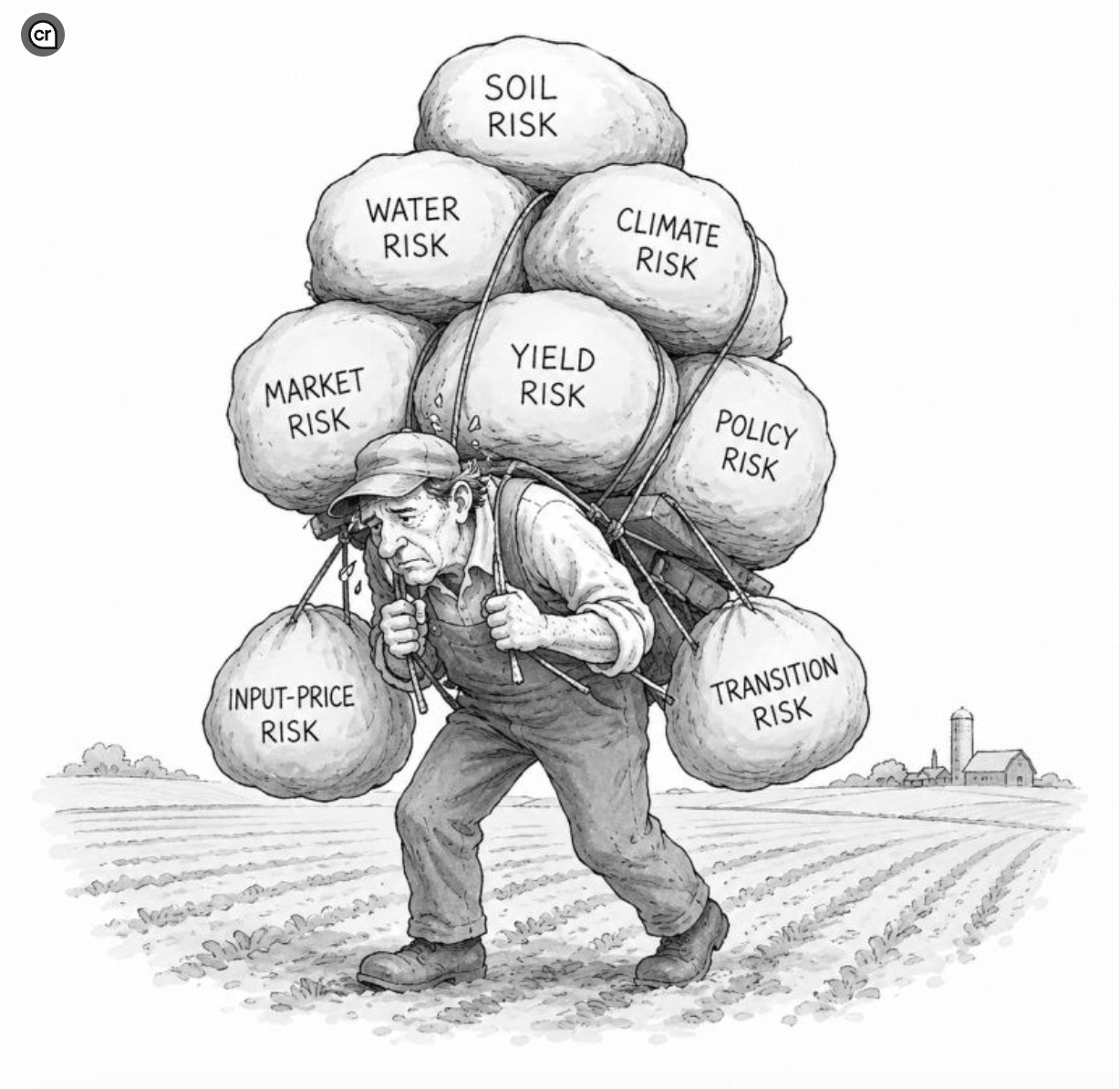
Glyphosate use has increased under every president since George Bush Sr. — a reminder that, despite the growing health concerns, this issue is not easy to resolve. Since 1970, the U.S. dollar has lost roughly 97% of its purchasing power — a fact too often overlooked, and one that’s contributed to making farming a deeply unprofitable venture. Economics is pushing many farmers and families to the brink. The U.S. loses an average of 2,000 acres of farmland and 41 farm operations every day. And many of the remaining farms are being purchased by large corporations and other countries.
Many regions are seeing large-scale projects — from data centers to giant solar farms — built on prime farmland. The fact that this isn’t more of a focus tells us everything we need to know about today’s elected leaders.
Underneath it all, farm economics keep worsening. Fertilizer and diesel costs are up sharply this year while crop prices stay flat, leaving growers paying 2026 input prices for 1980s-era crop checks. Net farm income is forecast to fall again, pushing producers toward whatever cuts costs fastest — not always the regenerative path, even when it’s the better long-term bet. One bright spot is cattle: with herds at multi-decade lows and beef prices near records, producers are seeing rare profitability.
THE UGLY
Some of this is harder to stomach. Big Pesticide’s ongoing legal and political fight against the MAHA movement and everyday people over glyphosate shows how entrenched corporate interests resist change. Their documented history of funding university research keeps muddying the science.
Recently, the U.S. Supreme Court ruled 7–2 to block a specific class of pesticide lawsuits. Even as Bayer celebrated the ruling in Monsanto v. Durnell, plaintiffs’ lawyers, lawmakers, and advocates were vowing to keep fighting. (Coverage of the ruling)
PFAS “forever chemicals” are turning up in pesticides and now in crops. Aggressive use of synthetic ag pesticides and herbicides remains the default. Residue testing keeps spotlighting what’s actually on our food.
Much of the western U.S. is starting to dry up due to poor land management, leading to longer, more intense droughts and soil collapse. The Ogallala Aquifer beneath the Great Plains continues to decline, dropping an average of 0.57 feet in the latest 2026 measurements, far outpacing the aquifer’s natural recharge.
Could we revisit a 1930s-style Dust Bowl era? Sadly, humans don’t seem to learn from history.
We’ve spent 75 years telling farmers that chemistry is the solution, and only in the last few years have we started teaching that biology is a farmer’s friend. It’s going to take a while to shift practices.
And while farm-gate prices stay low and grocery prices stay high, the soil underneath it all keeps collapsing in too many regions. Meanwhile, rates of cancer and other chronic disease keep climbing, worrying the moms who serve as their families’ chief health officers. Frankly, it’s not just food that’s failing us — it’s healthcare, transportation, and household products, to name just a few sectors.
GOOD NEWS
The good news is that the people doing the work — farmers, founders, scientists, investors, and increasingly, shoppers — aren’t waiting for politics to sort itself out. That’s where the real hope lies.
Regeneration leads to healthy soils and healthy gut microbiomes, impacting societal health.
Support your local farmers markets and local producers. Let’s say yes to soil health and regeneration.
No posts
Comments
Nothing yet. Say the first thing.
Sign in to join the conversation.