By John W Roulac Founder of Coco Clean & Nutiva , Executive Producer of Kiss the Ground
In 2012 I worked with others to successfully persuade Hershey’s, Cheerios (yellow box) and Sabra humus to remove genetically modified organisms (GMO) ingredients. Since 2021, I helped direct about $3M for 35,000 small famers in Guatemala and Malawi east Africa plant abundant food forests. For thirty years, I’ve focused my career on food systems that heals-not harms.
CONSUMER PACKAGED GOODS (CPG) COMPANIES DOMINATE
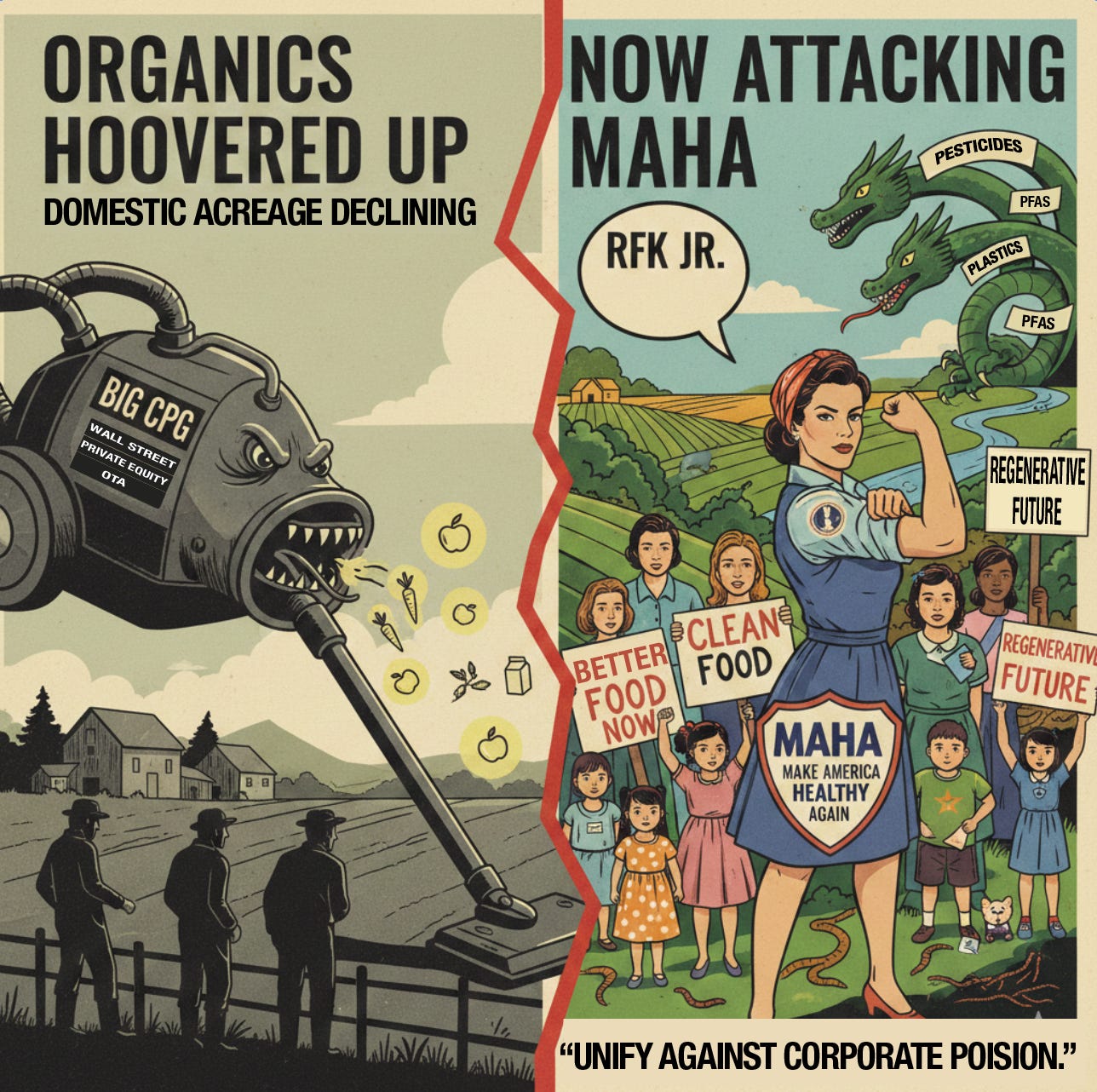
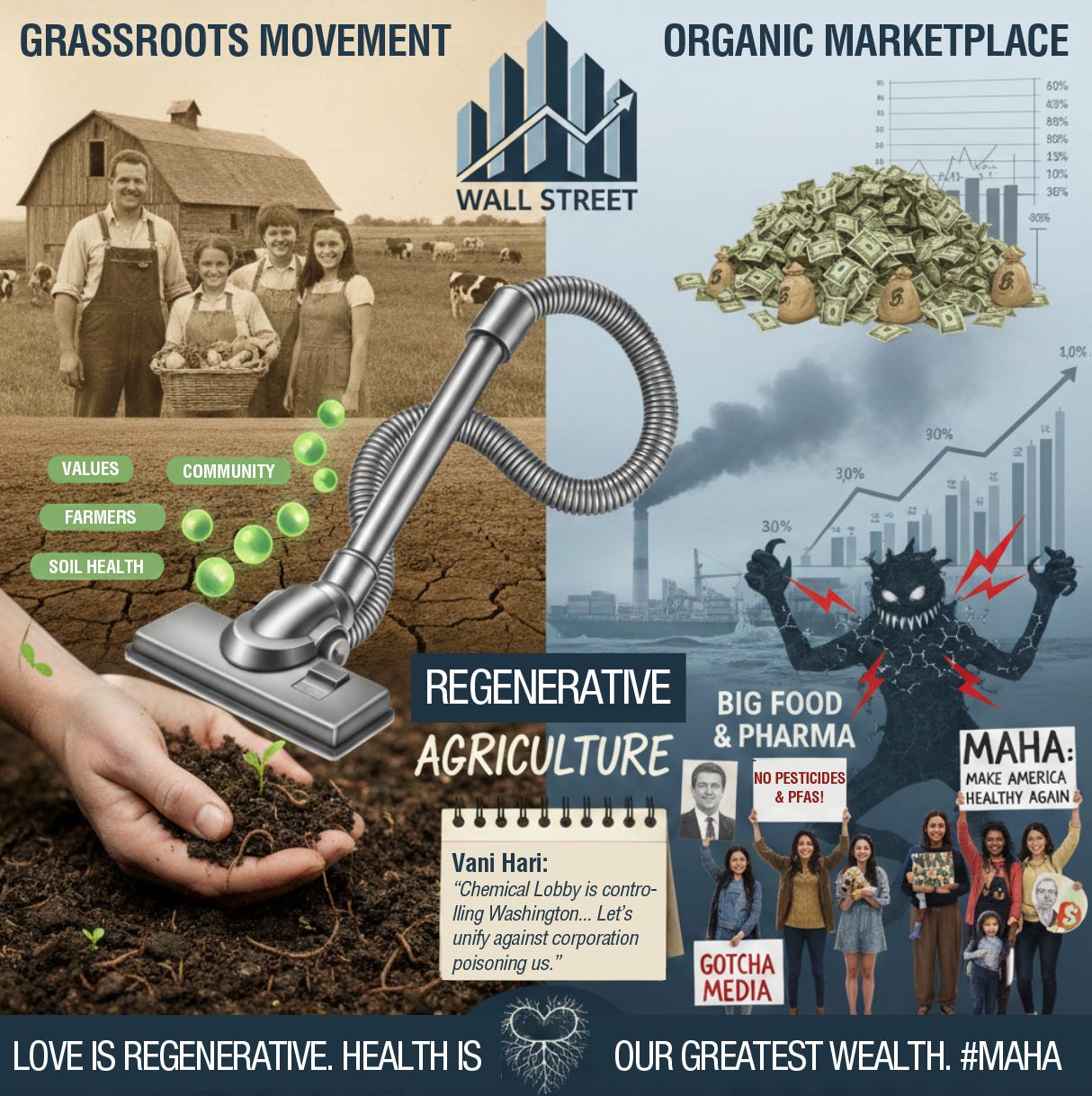
I’ve witnessed over the decades the soul of the pioneering organic food movement be swooped up by Wall Street and venture capital - who’ve reduced those values to a marketing line. Players like Horizon Dairy and Kraft shifted “organic” from a grass roots movement to a marketplace - and then to their piggy bank.
11 of the largest CPG brands (that dominate organic foods) including Mondelez, Pepsi, General Mills and Nestle were recently sued for selling addictive ultra-processed foods (UPFs) that created a public health crisis of obesity, diabetes, and heart disease. The UPFs are loaded with pesticides and GMO seed oils.
Instead of investing in U.S. farmers to transition to regenerative agriculture, these same CPG giants, shifted to overseas sourcing - enjoying lower costs and looser standards –and ultimately funneling their increased profits to shareholders.
The result? While U.S. organic sales reached a record $71.6 billion in 2024, according to the Organic Trade Association, certified organic acreage in the U.S. dropped by 6.8%. Put another way, 6% of food sales in the U.S. are organic while only about half a percent of U.S. farmland grows organic food. People clearly want organic. A key missing piece is domestic supply.
FARMERS NEED SUPPORT
Franklin Roosevelt once remarked, “A nation that destroys its soil, destroys itself.”
Farming is a brutally hard, low-margin business. Add complex federal organic paperwork, minimal corporate support for transition, weed pressures, and rising input costs and American farmers are being pushed out of the very market they helped create. Since 2000, thousands of small organic dairies and food farms have closed - decimating rural communities and small family farms. After 2019, 400,000 acres exited organic crop production in western Canada. This is the harsh reality facing rural farm country.
For decades Universities have taught farmers that chemistry is their primary tool for productivity. The regenerative agriculture movement invites a different paradigm: biology as ally rather than enemy. But it takes time to shift from degenerative farming to soil health, increased earthworm populations, and cleaner streams and lakes - and farmers need practical pathways to reduce chemical reliance without experiencing economic collapse. The end result will be more regenerative and organic farms, and thus more nutrient-dense food.
THE CHEMICAL TREADMILL
The overuse of glyphosate reflects decades of chemically dependent agriculture. According to my friend and MAHA leader Vani Hari (The Food Babe)
“Every president since glyphosate was invented has increased the amount of glyphosate being sprayed on our farmland. The chemical lobby is controlling Washington, no matter who is in charge.”
Meanwhile glyphosate’s impact on ecosystems and human health continue to fuel debate, research and legal challenges. Glyphosate not only kills weeds - but destroys human gut bacteria - and now has found its way into our bloodstream and women’s breast milk.
Yet breaking our chemical dependency cycle is shall we say complicated. Simply banning chemicals or relying solely on China without supporting viable alternatives, does not solve the underlying issues. Regen growers are experimenting with new technologies such as laser robots and PH balancing of tractor tank water to reduce overall herbicide use. Henry Rowland’s latest article : MAHA, America’s Farmers & the Glyphosate Dilemma is very sobering.
THE MAHA MOVEMENT
Make America Healthy Again was born by frustrated moms who witnessed rising chronic illness in their children. Its supporters argue that pesticides, plastics, PFAS, vaccines and ultra-processed foods contribute to declining public health.
Critics of MAHA, predictably Big Pharma and Agribusiness, are spending hundreds of millions each year demonizing MAHA leaders, especially RFK Jr, with divisive corporate narratives and social media that further amplify conflict over solutions. Dividing us is far easier than dealing with the facts.
Meanwhile leaders in regenerative agriculture and food transparency - from rancher Gabe Brown to food activists – continue to share information and spark important conversations, all the while they face criticism and Goliath style push back. The upside is it’s fueled a national discussion on the central issue dear to MAHA’s hearts : that Americans have been poised for decades via our food, drugs and consumer goods.
Mom’s Across America founder Zen Honeycutt shared, “Trump is not the MAHA movement. The MAHA movement was created by a tidal wave of moms. Trump and Kennedy just gave the movement a collective name and brought parts of it into the administration. We were around long before and we will be around long after.”
The reality is - whether it’s coming from the legacy “eco” crowd or the new MAHA movement – the goal is the same: to end poisoning Americans. The journey to a vibrant food future will not be simple and may at times feel chaotic or heated – some even say it’s impossible.
HEALTHY SOIL IS OUR FUTURE
As a young man I fondly recall listening to old time farmers talk about the importance of honoring our soils. Yes healthy soil, healthy food and healthy families are not luxuries - they’re national security. Let’s regenerate !
A CALL TO ACTION
· Grow food in your window sill or garden.
· Buy directly from American farmers and ranchers. Shop at farmers markets.
· Watch award-winning documentaries like Kiss the Ground and the follow-up film, Common Ground, now streaming on Amazon.
· Stay Connected and subscribe to my Substack for more deep dives into the intersection of food, health, and corporate accountability.

Comments
Nothing yet. Say the first thing.
Sign in to join the conversation.