
When Troy premiered in 2004, I bought tickets for nearly everyone in my graduate Classics department at Florida State who wanted to go. We had spent years reading Homer in Greek, discussing the ancient world in seminars, and waiting for Hollywood to bring one of civilization’s greatest stories to life.
We walked out disappointed.
Not because Troy was a bad film. It wasn’t.
It simply wasn’t Homer.
Twenty-two years later, I found myself sitting beside my father on opening weekend for Christopher Nolan’s The Odyssey. This time, my expectations were different. Nolan is one of our finest filmmakers, and his commitment to practical filmmaking, large-format cinematography, and practical effects made him an ideal candidate to bring Odysseus’ journey to the screen.
As the credits rolled, I realized I had experienced something remarkably familiar.
I had admired what I had seen far more than I had been moved by it.
That realization led me to a question far more interesting than whether Nolan had faithfully adapted Homer.
What happens when a filmmaker who excels at realism adapts one of the greatest myths ever told?
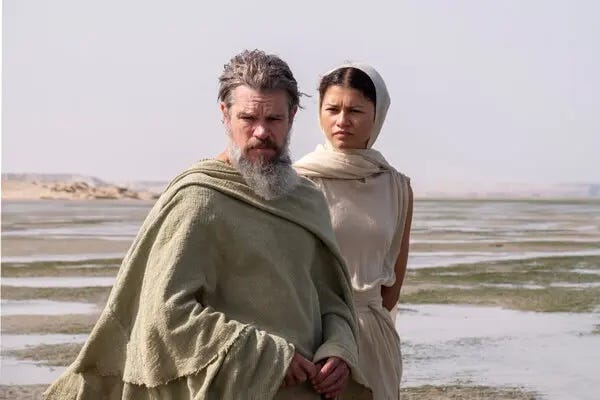
Let me begin where every review should: you should see this movie.
Not because it is the definitive adaptation of The Odyssey, but because any filmmaker willing to bring one of humanity’s greatest stories to a modern audience deserves our attention.
The craftsmanship is undeniable.
Nolan’s commitment to practical effects, IMAX photography, real locations, and minimal CGI gives the film an extraordinary sense of physical scale. Every crashing wave, every weathered cliff, every crowded ship feels tangible.
In an age increasingly dominated by digital spectacle, there is something refreshing about watching a film that remembers the weight of real bodies moving through real landscapes.
Christopher Nolan has created a magnificent historical adventure from one of history’s greatest myths.
With regard to the movie’s accuracy, I will state the following: if this movie inspires thousands of people to pick up Homer for the first time, then it has accomplished something worthwhile. As a classical philologist and trained archaeologist, I could spend an inordinate amount of time breaking down inaccuracies regarding the film’s adaptation of the established record, but that is beside the point.
The better question is not whether Nolan reproduces Homer scene for scene, but what he believes The Odyssey is actually about. Adaptations are interpretations. They reveal as much about the age that produces them as the age they depict.
No film will fully satisfy such a small, niche group as experts, and anyone claiming to do so on their behalf is only dwelling in Tartarus. At best, they become Sisyphus. Likewise, I will restrain myself from such a feeble attempt. Let’s continue.
One visual decision stayed with me long after the credits rolled.
In the exterior shots, human beings are tiny; nature overwhelms them. Mountains soar above while the oceans swallow them. The horizon seems endless as they scan it for their search home.
Yet whenever Nolan moves indoors, everything changes.
Rooms become cramped. Bodies are compressed together. Hallways feel narrow, while strained candlelight shimmers across faces glistening with sweat. The camera squeezes people into dense, claustrophobic spaces.
Whether intentional or not, the visual language constantly reminds us that humanity has very little control over its surroundings. Outside, nature dwarfs us. Inside, civilization confines us.
The exterior compositions recall the paintings of J. M. W. Turner, in which the human figure is nearly consumed by the overwhelming power of the natural world.
Turner understood something Homer also understood: nature is never merely scenery. It is an active participant in the human drama.
It is one of the film’s most effective artistic choices.
Visually, Nolan’s Bronze Age is remarkably restrained.
The color palette is dominated by weathered stone, muted browns, faded greens, beige, and taupe. If beige and taupe blow your chiton up, this may be the ancient world you have been waiting for.
The aesthetic recalls the realism of Gustave Courbet more than the heightened imagination we usually associate with epic myth. Think The Stone Breakers: monumental scale applied not to idealized heroes, but to physical bodies inhabiting a hard and tangible world.
Like Courbet, Nolan seems less interested in idealizing his subjects than in presenting them as tangible, physical, almost ordinary people. “Show me an angel, and I will paint one,” Courbet quipped.
Ordinary people are made extraordinary through scale. Nolan nods in agreement with this intellectually coherent aesthetic.
Yet, it is also one that slowly drains the mythical world of its wonder. The Bronze Age becomes believable. It also becomes smaller.
The cast is uniformly competent.
Matt Damon delivers the restrained, capable performance audiences have come to expect from him. Tom Holland remains recognizably Tom Holland—earnest, likable, and sincere. Jon Bernthal’s brooding Menelaus does not depart greatly from the intense figures he frequently plays.
Zendaya’s Athena is interpreted in a more psychological register. She possesses a quiet intensity, but the role gives her surprisingly little room to become the strange, commanding divine presence found in Homer.
None of these are poor performances. Rather, they feel safe.
The actors rarely disappear completely into their characters. Each seems to play a variation of the screen persona the audience already knows. The screenplay seldom allows these legendary figures to become larger than life. They remain grounded, psychologically familiar, and emotionally restrained.
Perhaps that is precisely what Nolan wanted. Yet Homer’s heroes rarely feel psychologically ordinary. They are larger than life because myth itself operates on a larger scale than realism permits.
Before the film’s release, much of the online conversation centered on its casting. The battle lines of the modern culture war had already been drawn before most people had seen a single frame. Typical of today’s audiences, where public opinion is shaped by social media.
Everyone seemed eager to answer one question: “Is this historically accurate?” I found myself asking a different one: “Is historical accuracy even the right standard for judging myth?”
Yet, that debate ultimately has little to do with whether the adaptation succeeds.
Once I realized Nolan himself was not attempting strict historical reconstruction, many of the online arguments simply ceased to matter. Homer is not writing ethnography. He is writing myth. Those are not the same enterprise.
Lupita Nyong’o brings dignity and emotional presence to Helen. Elliot Page’s appearance as Sinon also works within Nolan’s interpretation of the story. Whatever one thinks about the film’s historical or genealogical departures, the actors themselves are not obstacles to its effectiveness.
That distinction matters. It is entirely possible to question an artistic choice without reducing the entire film to that one choice.
The casting choices are compatible with the kind of adaptation Nolan intended to make.
The deeper problem is the screenplay.
That problem casts a far larger shadow because it raises the film’s central artistic question: how does Nolan understand Homer, myth, and the ancient imagination?
This is where my admiration for the film begins to diverge from my love of Homer.
Christopher Nolan prefers grounded stories.
Even when he works with superheroes, dreams, or black holes, he searches for rules, structure, and realism. That instinct serves many of his films brilliantly.
I’m not convinced it serves The Odyssey.
Modern audiences often think of the gods as fantasy characters. The Greeks did not.
Athena, Poseidon, Hermes, and Zeus are not simply colorful additions to an adventure story. They represent a universe alive with purpose, justice, chance, wisdom–even rage. They are the subjective aspects of nature itself.
For Homer, the gods are not decorative. They are essential to the poem’s understanding of reality.
Modern readers often imagine the gods as optional fantasy elements that could simply be removed without altering the story. Homer would likely have found that incomprehensible. Remove the gods, and you have not simplified the poem—you have changed the universe in which it takes place.
When those divine forces are reduced—or reinterpreted primarily as psychological experiences—the story inevitably changes. The color is drained, and the artist begins working with a limited palette.
The sea becomes weather.
Athena becomes memory.
Miracles become coincidences.
Mystery becomes explanation.
The result is a historical adventure assembled from mythological material.
But The Odyssey was never merely a historical adventure.
It is myth.
Classicist Mary Beard recently observed that what she missed most in Nolan’s adaptation was the humor, irony, and sexuality that animate Homer’s poem.
I found myself agreeing, though my disappointment came from a different direction. What I missed most was wonder.
The Odyssey is strange. It is unsettling. At times, it is even absurd.
Its islands seem to exist outside ordinary geography. Its monsters are both physical threats and embodiments of moral danger. Its gods intervene openly. Its world refuses to be completely mapped, categorized, or explained.
The strange encounters of Odysseus’ voyage feel like mariners’ tales gathered from the uncertain edges of the known world—stories brought home by sailors who had witnessed things their audiences could scarcely imagine. Because that is what they were.
Whether every tale was literally true is beside the point. Homer understood that sailors returned home carrying stories that expanded the boundaries of the known world. Myth gave shape to those mysteries rather than explaining them away.
Nolan replaces much of that mystery with psychological realism. The film becomes more understandable and intellectually satisfying. It also becomes less mysterious, less enchanting.
A myth that explains everything is no longer much of a myth. It is no longer a mystery–and mystery is something about which something can be said, but not everything.
As the credits rolled, I realized I appreciated this film far more than I loved it.
Its craftsmanship is extraordinary. Its ambition deserves praise. Its technical achievements are undeniable.
Yet I remained emotionally distant from it.
Homer never asked his audience merely to believe that Odysseus survived the sea. He spoke of a world in which the sea itself was alive—a world where frightening things existed beyond the horizon and inhabited the dark corners of what human beings could observe or understand.
Odysseus does not merely struggle against bad weather, hostile strangers, and his own trauma. He struggles against a universe that is alive—one in which every storm may carry intention, every island may conceal the unexpected, and every encounter may reveal something about the human condition.
That is the enduring challenge every filmmaker faces when adapting myth.
History can be grounded.
Myth cannot.
So yes—go see Christopher Nolan’s The Odyssey. Then go read Homer.
If the film leaves you wanting more, as it did me, you will discover that the greatest voyage has been waiting nearly three thousand years for you to begin.
And perhaps, by the end of it, you too will find your way home.
Did this essay give you a new way of seeing? Share it with someone who enjoys thoughtful conversations. The best ideas spread from one curious mind to another.
No posts
Comments
Nothing yet. Say the first thing.
Sign in to join the conversation.