
It would have been sometime today, I imagine, that Concord, Massachusetts’ constable and tax collector Sam Staples would have freed Henry David Thoreau after a night spent in the Concord jail for refusing to pay his poll tax.
Sam Staples had no idea what he had just done. The resulting essay Thoreau penned, which has evolved into what we now know as “Civil Disobedience,” impacted protest movements all across the globe from Mahatma Gandhi to Dr. Martin Luther King. And you can only imagine what Thoreau would have to say about ICE, the Supreme Court and the current Administration.
It’s just a guess but my strong suspicion is, having taught and shared Thoreau’s words for years and I read him still, his tone would be a lot more fiery than the rather reasoned way he started “Civil Disobedience.”
“I heartily accept the motto,—”That government is best which governs least;” and I should like to see it acted up to more rapidly and systematically. Carried out, it finally amounts to this, which I also believe,—”That government is best which governs not at all;” and when men are prepared for it, that will be the kind of government which they will have. Government is at best but an expedient; but most governments are usually, and all governments are sometimes, inexpedient.”
Sometimes?
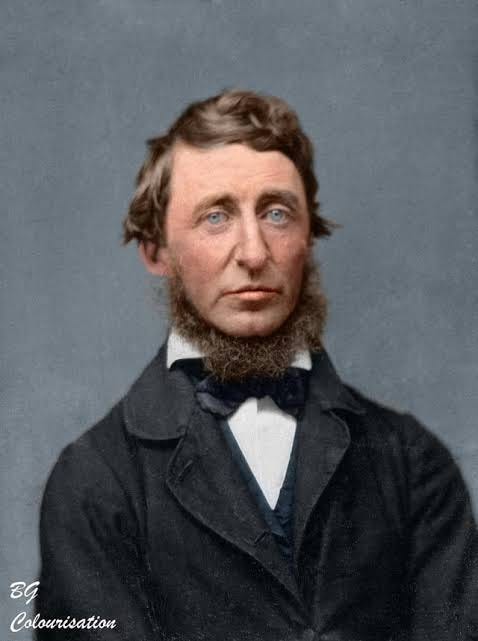
It was originally called “Resistance To Civil Government” and from what I’ve read, he first aired it at the Concord Lyceum in January of 1848. It was then published in a magazine called “Aesthetic Papers” and after his death in 1862, it was collected in a book of his writings called “A Yankee In Canada, with Anti-Slavery and Reform Papers” with the revised title “Civil Disobedience” four years later. No idea about the Canada angle. (I guess it was about a Thoreau travelogue.)
Oddly enough, visiting the Books A Million yesterday, what are they displaying as a “new” book but a pamphlet-sized re-printing of Thoreau’s “Civil Disobedience” with a counterargument from Hannah Arendt’s firm rebuttal in the New Yorker from 1970? You may draw your own conclusions as to why Books A Million thought these essays were topical. (And they may be.)
When Thoreau gave this lecture at the Lyceum, the windy title was “The Rights and Duties Of The Individual in Relation To Government.” The Lyceum must have been a happening place but it’s hard to imagine that packing them in. I’ve read that Thoreau, contrary to what you might think having read him, was somewhat comical on the stand. And there was certainly no questioning his commitment to what he wrote or how he spoke about it.
After a colleague offered me a textbook of the wonderful play “The Night Thoreau Spent in Jail,” I knew I had to share it with my classes. The school I taught at was all African-American, with only a few Hispanic students, and had historically been a well-below average school. As revealed in the play, here was a white American writer who was sticking up for black people, twenty years before Abraham Lincoln’s “Emancipation Proclamation.” And he was contrary enough and funny enough - as shown in the play - to catch their spirit, I thought. And I was right.
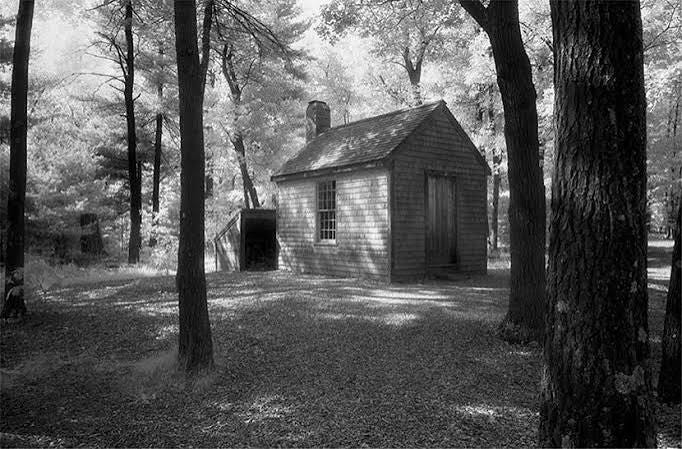
Doing a play in class was fun. And so was blowing the kids’ minds. There’s a passage in “Walden” where Thoreau talks about taking all his furniture - all three chairs (“for society”) and putting them outside his little house and how it seemed freeing to them.
So when we got to that part in class, I said “OK, everybody, get your stuff. We’re going outside.” And we did. You should have seen the stunned looks on their faces when we went out and sat at the picnic tables, a beautifully sunny afternoon and had them reading Thoreau’s words, maybe written in pencil in that little hut on Walden Pond out loud on in the middle of a Florida campus all those years later. It would have made the old crank smile, I bet.
As you may remember, at the end of March, I wrote about the recent PBS series on Thoreau. It was terrific, voiceovers from all sorts of big names, and it gave you a sense of how Thoreau was truly ahead of his time. While he wasn’t as big a star in his day as his mentor, Ralph Waldo Emerson, his words have endured.
As I wrote back then, I grew up just 31.8 miles from the guy and I didn’t know a damn thing about him until I got to college. Nothing. Not his name, not his work, not a stinking word. Some of that’s on me. Some of that is on the teachers, who ought to have smartened up. Especially with all the social change that was going on around us. He helped inspire a lot of that.
After we finished the play, I asked the kids to write him a letter. They wrote with great warmth and affection for a guy who might well not have responded in kind. And thinking of Thoreau, I always remember what one of my students wrote. There was a genuine connection there.
“Dear Henry: Thank you for your writing. I truly wanted to see if I could find in nature what you do. After I got home from school, I went out in the woods behind my house, thinking about all the things of yours we read. There were a lot of things I’d never noticed before. Maybe that was your point. It was fun. It was beautiful. Thanks, Henry.”
Near the PBS’s shows end, actor Jeff Goldblum, reading as Thoreau, says: “There is a season for everything. You must live in the present. Launch yourself on every wave. Find your eternity in each moment. Fools stand on their island of opportunities and look toward another land. There is no other land. There is no other life but this.”
Which, in a way, was kind of what my student was getting at. The teacher was, too.
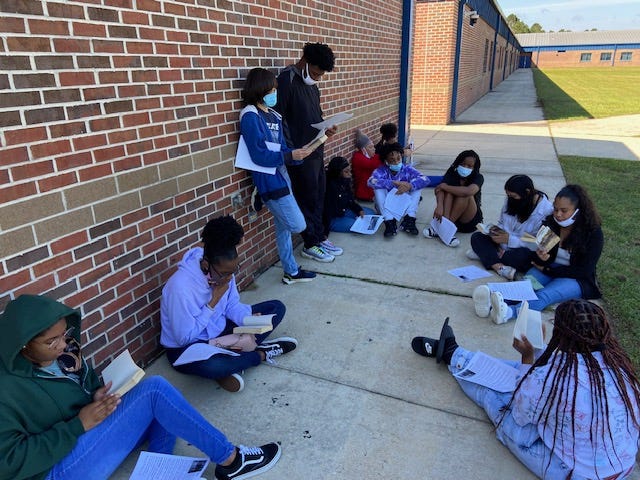
Action photo of some of Nogo’s students, taking in a little bit of “Walden.” The young lady to the left, foreground, recently emailed me and told me she was going to become an English teacher. And she wasn’t blaming me. That makes, I think, seven students I’ve taught that went into teaching despite having my class. (Wink). Since retiring in 2023, I’ve been writing a Substack and working on books. I’ve published three editions of “Bob Dylan: A Descriptive, Critical Discography and Filmography” and have a forthcoming “Neil Young: A Descriptive, Critical Discography and Filmography” due in 2027. I’ve written two books on baseball - my son was a former major-league first baseman for the Cardinals and Pirates - “Diamond Duels” a look at the game’s historic pitcher-hitter matchups (Hank Aaron was 1-for-23 against Don Drysdale until he figured him out and hit 17 HRs against him.) Also two editions of “Last Time Out” a collection of stories about the MLB farewell of some of the game’s greatest players. Like Satchel Paige, at age 59, throwing three shutout innings against the Boston Red Sox. Or Dizzy Dean, retired for years, blasting the sad St. Louis Browns all season long, getting called to the owner’s office, handed a contract for $1 and told he was pitching that day. He went out and threw four shutout innings and hit a double. Take that! All my books are available on Amazon. I’m on Year Three of my Substack and now have over 700 posts. Stop by. You might find something fun.
No posts
Comments
Nothing yet. Say the first thing.
Sign in to join the conversation.