
One of your correspondent’s strange quirks is enjoying watching old-time boxing matches on YouTube. I’ve written a few times already about my Christmas gift of a DeJur projector and my spotting a Ring Magazine ad for Ring Classics, a company that offered 8mm silent boxing movies for $8.50 that set me off on a quest that I guess, at 72, still hasn’t ended.
It took a few years before I realized that the Ring Classics library was, uh, abbreviated. Yeah, you could get a Rocky Marciano fight but it was against Rex Layne. Not against Jersey Joe Walcott or Ezzard Charles or even Archie Moore, the fights you wanted to see.
So, historically speaking, you could say there were holes in my boxing knowledge that I’ve been catching up on. Or it might simply be that watching the intense strategies of two fighters is good viewing late at night when it’s quiet, the sound is off (other than maybe Liz’s gentle snoring) and the kid can wind down watching a good swift sock to somebody’s kisser.
Then it hit me. It seemed every third fight I was watching on YouTube was involving Jerry Quarry. I’d seen him fight plenty of times before, of course, most memorably in the Muhammad Ali comeback fight in Atlanta in 1970. What I didn’t know or realize or even comprehend was just how many top-notch fighters Quarry fought. And how, there’s no question that such a rugged, relentless schedule led to his horrific post-boxing life and early death.
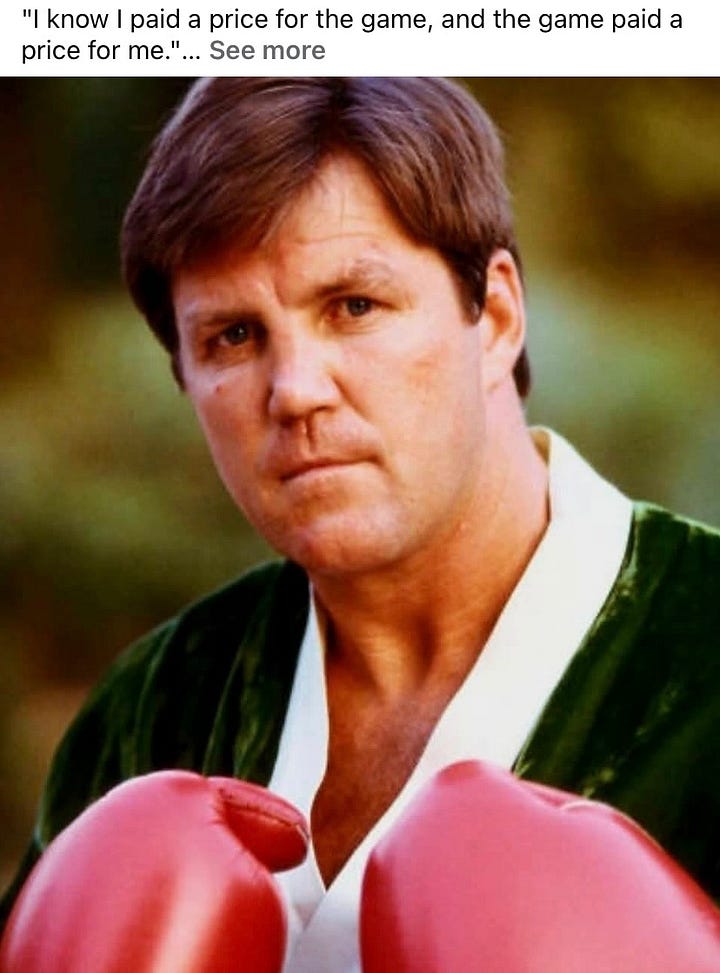
There is no schedule in boxing. You fight, pretty much, who you choose to fight. As I wrote earlier about the career of Smokin’ Joe Frazier, his manager Yancey Durham was exceptionally clever about who and when he matched Joe. When they held an elimination tournament to determine who would be recognized as champion once they stripped Muhammad Ali of his title, Joe said “I’ll fight the winner.”
In other words, the heck with everybody else, who will all have to go through some tough fights to get to the finals. I’ll wait. It worked out. Frazier easily handled Jimmy Ellis and won the overall title. While Frazier did fight Oscar Bonavena (who knocked him down twice) and a couple other decent fighters, his schedule was much softer. And smarter. He also, of course, fought Jerry Quarry, whom he beat twice.
So, then I took a look at Quarry’s record, who took the exact opposite approach to Frazier. And I was stunned. Look at who the guy fought in chronological order:
1966 - Eddie Machen, a top challenger, L 1967 - Brian London, top British fighter W
1967 - Floyd Patterson, former two-time champ Draw (he knocked him down twice!) 1967 - Floyd Patterson, re-match W
1967 - Thad Spencer No. 2-ranked heavyweight W 1968 - Jimmy Ellis for the WBA world title L
1969 - Buster Mathis, a top five heavyweight W 1969 - Joe Frazier, Ring’s Fight Of The Year L (on a cut)
1969 - Brian London W 1969 - George Chuvalo, top Canadian heavyweight L
1970 - Mac Foster, top five heavyweight W 1970 - Muhammad Ali, former champion L (on a cut)
1972 - Muhammad Ali (rematch) L (by KO) 1973 - Ron Lyle, top-five heavyweight W
1973 - Earnie Shavers, top-five heavyweight W (by KO1) 1974 - Joe Frazier L (by KO)
1975 - Ken Norton L (by KO) LIFETIME RECORD: 53 - (32 KO) - 9 - 4 record
This is the best of the best. Why would you take on so many great fighters? At the time, Muhammad Ali called him “the last of the White Hopes,” which sadly might have been true and maybe the impetus for Quarry to take on so many difficult fighters, way more, than you would think, would be wise or healthy.
Network TV at the time had discovered that heavyweight boxing, with the inimitable Howard Cosell at ringside, got ratings and that meant larger purses for the fighters. So Quarry kept signing on (and these are only the prominent fights I listed. There were others.) Did his race figure into the whole picture? Interesting question.
The whole unfortunate “White Hope” thing started back when the first black heavyweight champion Jack Johnson, ranked by Ring Magazine founder Nat Fleischer as the greatest of all time, was mowing the competition down. Sportswriters at the time started a campaign to bring the undefeated (at that point) ex-champion James J. Jeffries out of retirement to challenge Johnson for the title. They fought on July 4, 1910 in a steaming hot Reno, Nevada and Johnson toyed with Jeffries, winning easily.
Ken Burns’ documentary “Unforgivable Blackness” about Johnson’s life and career, tells that story very well. There’s also a fictional film of Johnson’s life with James Earl Jones in the title role called “The Great White Hope” which gives you an idea of the racial climate at the time. It wasn’t one of boxing’s proudest moments. And neither, sad to say, was the end of Jerry Quarry’s life.
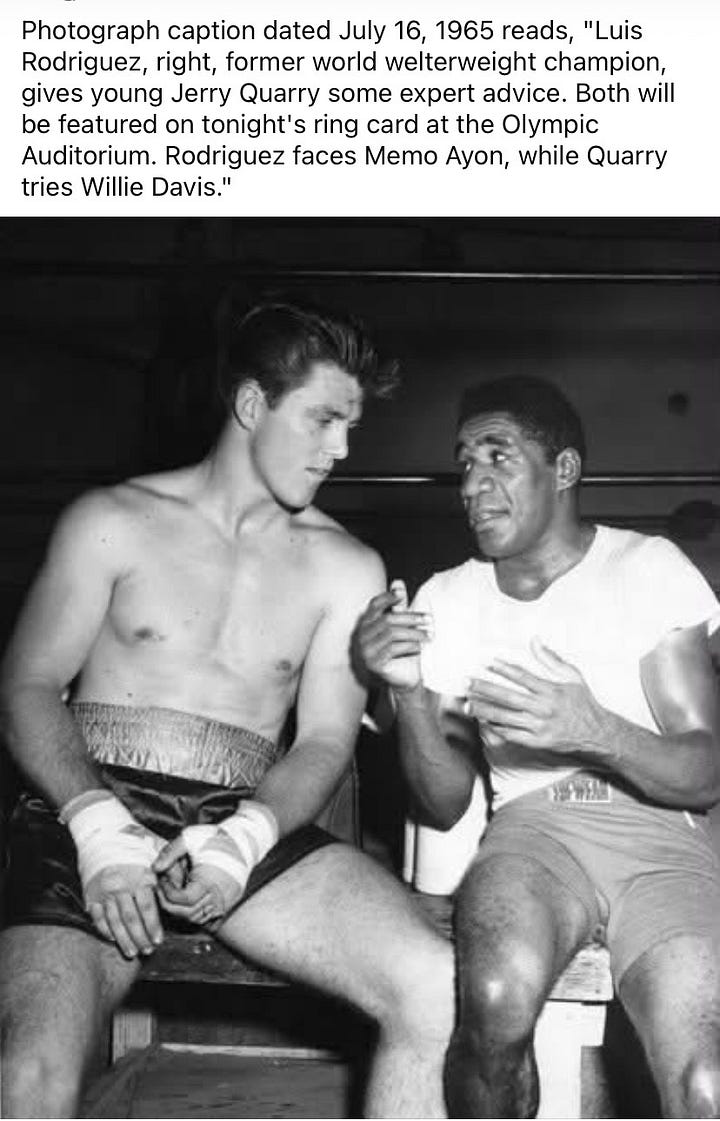
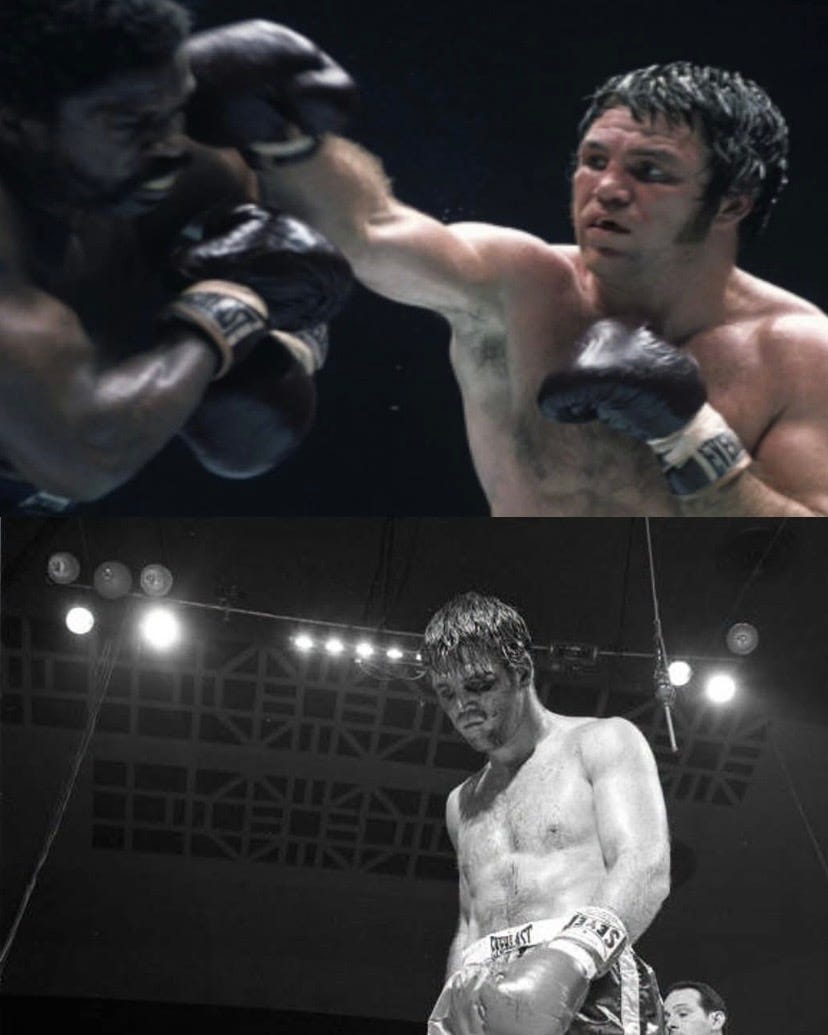
He suffered from “dementia pugilistica” and died of cardiac arrest at 53 in 1999. Watching his YouTube bout with Ken Norton yesterday, sort of his last stand, you might say, started out pretty competitively. Though you could see his once-handsome face (see the b/w photo with ex-welterweight champ Luis Rodriguez) was now puffy and battered and sure enough, he suffered a cut early in the fight.
Sensing that fate was against him one last time, he fought desperately, throwing punch after punch at the muscular, but awkward Norton, landing some, missing others, fighting for his ring life, which he really was.
He was stopped a few rounds later, his face an absolute mess and who knows what was going on under that brown mop of hair? He was “Irish Jerry Quarry” and some wise guy sportswriters had always said he fought “too Irish.” In other words, he was too willing to mix it up instead of boxing smartly and counterpunching and trying to win on points. But as that great ring philosopher Mike Tyson once said, “Everybody has a plan until they get punched in the mouth.” It’s a lot easier to win fights in front of a keyboard.
I’ve watched a lot of his fights now and there is some truth in that. But at the same time, I look at that record, all those terrific fighters that he kept stepping in the ring against, confident that he could beat them and climb up to the heavyweight title.
There were times when he was brilliant, knocking out Earnie Shavers in one round, defeating dangerous Ron Lyle by decision, beating two-time champ Floyd Patterson who was on the way out, but still, a good win. And scoring a knockout win over Thad Spencer, the No. 2-ranked heavyweight at the time and the hard-punching Mac Foster, too, also a knockout win.
But he couldn’t beat Frazier. Couldn’t beat Ali. He had two tries at both. There’s no shame in that. Neither could hardly anyone else.
Jerry Quarry’s been gone now for more than a quarter-century. He’s remembered as a pretty good, game fighter. Not for the sad way his life ended. Which is a good thing, I think.
His fights live on if you happen to wander onto YouTube like me. From time to time, maybe you, too, will find yourself talking to the screen in the dark, trying not to wake the wife.
“Duck, Jerry, duck.”
Author John Nogowski has been a fan of boxing since his teenage years. He even bought a pair of boxing gloves and for a while, sparred with his fellow Brookline boxing enthusiast Mark Fountain. Fountain had very long arms and Nogowski said he suspected his best punches landed there. But it was fun to try. As a writer, Nogowski’s favorite boxing book, which he’s written several Substacks about, is A.J. Liebling’s “The Sweet Science.” There’s a subsequent collection called “A Neutral Corner” of additional Liebling pieces, including a prophetic piece he wrote about the young Cassius Clay. Nogowski has written several books about various topics; three editions of a book on Bob Dylan: “Bob Dylan: A Descriptive, Critical Discography and Filmography,” a forthcoming book on Neil Young: “Neil Young: A Descriptive, Critical Discography and Filmography” and two books on baseball - his son is a former major-league first baseman - “Diamond Duels” about the game’s historic pitcher-hitter matchups (Hank Aaron was 1-for-23 against Don Drysdale before swatting 17 HRs off the guy) and “Last Time Out” a collection of stories about the game’s greatest players’ MLB signoffs. They are available on Amazon. He’s been writing a free Substack since 2024. He’s also been a regular contributor to the Hartford Courant and is at work on a book about Bruce Springsteen.
No posts
Comments
Nothing yet. Say the first thing.
Sign in to join the conversation.