
Someone asked me recently whether healthcare was better in the 1980s.
For reference, here’s what I looked like in 1987-
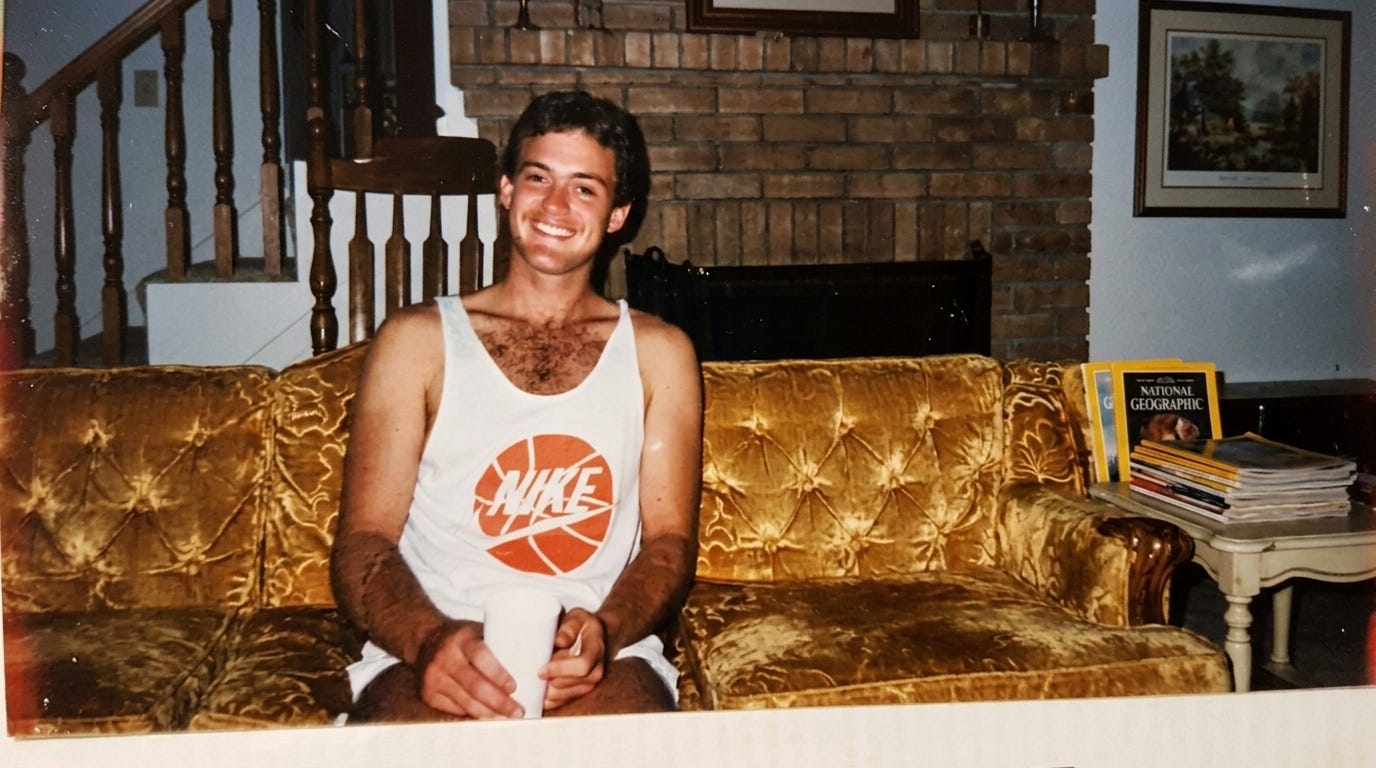
Back then, I wasn’t sure exactly where life would take me. But I knew I waned to do something that would have an impact. And so I found myself embarking on a long educational journey that took me into the world of medicine.
But back to the question. Were things better in the 80s?
The medicine? No. The pharmacology, imaging, surgical techniques - the progress is unthinkable. But I have been thinking a lot about where healthcare is going in general, and where we’ve come from.
In short: the medicine is better. The system running it? A different story.
Administrator Bloat
Between 1975 and 2010, healthcare administrators in America grew by approximately 3,200%.
Physicians over the same period? Roughly 150%.
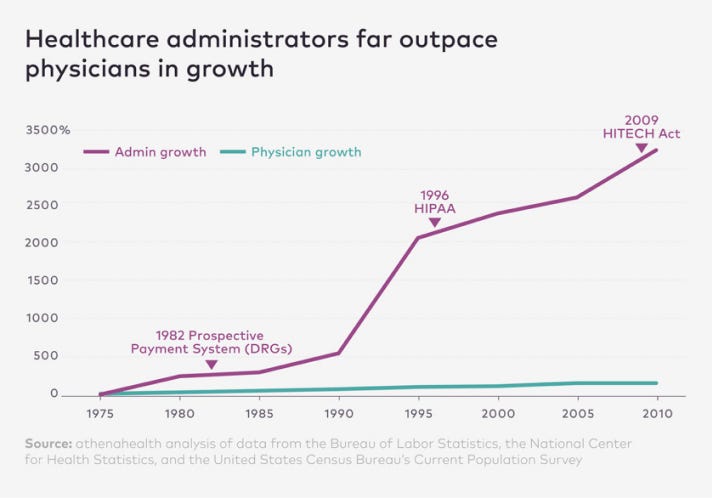
That means that for every one new physician added over those 35 years, we added more than twenty administrators.
You can trace exactly where the surges happened:
1982, when DRGs changed how hospitals got paid.
1996, when HIPAA brought privacy compliance and documentation requirements.
2009, when HITECH pushed electronic health records into every corner of the system.
Every major regulation expanded the administrative apparatus. But nobody ever asked whether the people managing the regulations should also be managing the physicians.
That’s the part that went wrong.
Administrator Rule: Caution Over Courage
Administrators aren’t bad people. They often care about outcomes as much as clinicians. But their incentive structure is almost perfectly designed to produce caution over courage.
I made the same point in my last substack:
If a bold decision works, the credit gets diffused. It is rarely directly associated with the clinicians who came up with the idea.
If it fails, the accountability lands squarely on whoever made the call. The clinicians face the blame.
I’ve said this a thousand times before: that psychology, multiplied across thousands of administrators in thousands of hospitals, is why innovation dies so slowly in healthcare.
Nobody kills it in one moment. It gets committee’d to death. Risk-assessed into the ground. Delayed until whoever proposed it gives up and moves on.
Meanwhile, the patient waiting for a new treatment protocol is still waiting.
But it also runs deeper.
Administrators are not doctors; and that means they have a limited understanding of how medicine works.
Let me explain how I think it should be:
The Best Places Do Something Different
Mayo Clinic. Cleveland Clinic. St. Jude Children’s Research Hospital. Consistently among the best institutions in the world by almost every measure.
What do they have in common? Physician leadership — not input, not an advisory committee. Structural physician leadership, embedded in how decisions get made.
I’ll bet my house on this: that’s not a coincidence.
These institutions have strong business co-leaders too. That’s the model: physician and business leader, side by side, with genuine shared accountability.
What most American health systems have is something different: the business leader in the boardroom, the physician in the clinic, decisions flowing one direction.
And that’s how things used to be - hospitals used to have clinicians in the driving seat. But increasingly, that is uncommon.
Administration Isn’t The Enemy

I’m not saying administrators are the enemy. I’ve worked with exceptional ones who made my clinical work better.
What I am saying is that a 3,200% growth in administrative headcount, outpacing physician growth by a factor of more than twenty, is a design problem.
When a physician’s ability to hire or treat requires sign-off from someone who has never treated a patient, something has gone wrong.
The most expensive healthcare system in the world delivers roughly twentieth-percentile outcomes globally.
If that were a business, we’d fire the management team and redesign the operation. No questions asked.
The medicine has never been better.
But the system has never been more in the way of it.
If you work inside a health system and you recognize what I’m describing — or think I’ve got it wrong — I’d like to hear from you.
Substack writer? Let’s collaborate!
No posts
Comments
Nothing yet. Say the first thing.
Sign in to join the conversation.