
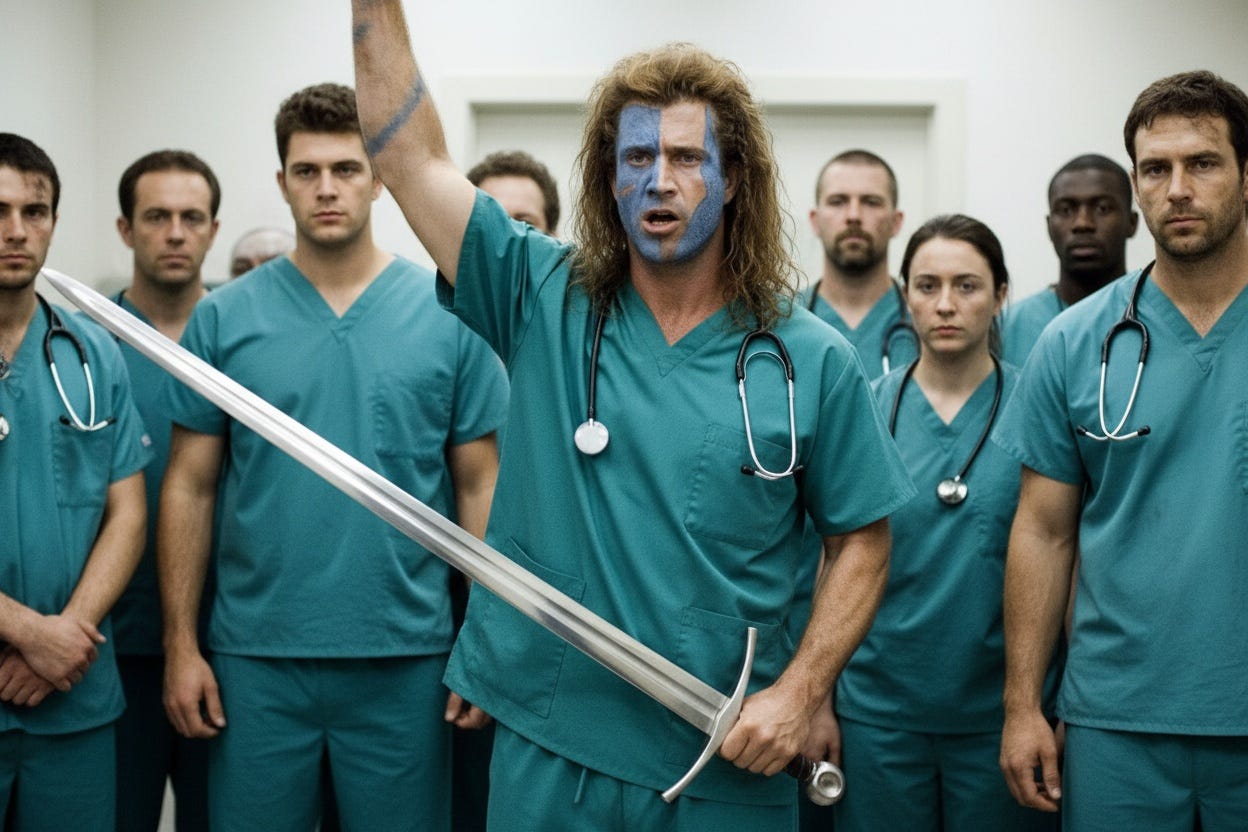
I posted on LinkedIn this week about a word that was stuck to a conference room door at the Texas Heart Institute in 2001.
The word was Brotherhood.
Physicians I encounter from across the country are telling me they felt the same thing - that something has quietly disappeared from medicine, and they couldn’t quite name it until they saw that word.
So I want to go deeper here, because this isn’t just nostalgia. There’s data behind the feeling.
What we had
When I trained at the Texas Heart Institute, I was surrounded by more than twenty of the most competitive people I’d ever met. Every case was a chance to prove yourself - or fall behind. The pressure was relentless, but honestly, felt pretty good.
But the culture that Cooley and Willerson built was something more than competition. It was a clan. When someone was drowning in a complex case, someone stepped in. When a family emergency hit, coverage appeared. When someone made a mistake, we all learned from it together.
I grew up in Appalachian clan country; Scots-Irish families who understood instinctively that individual strength has a ceiling, and collective strength doesn’t. That sign on the door wasn’t just a motivational poster. It was a reminder of something I already knew in my bones.
Fierce competitors by day. Clan by night.
What we’re losing
Fast forward to 2026, and I don’t recognise the culture I trained in.
Residents are increasingly isolated by shift structures designed for throughput, not mentorship. Attendings are buried in productivity metrics, prior authorizations, and EHR documentation - a special kind of administrative burden that steals time from patients and from each other.
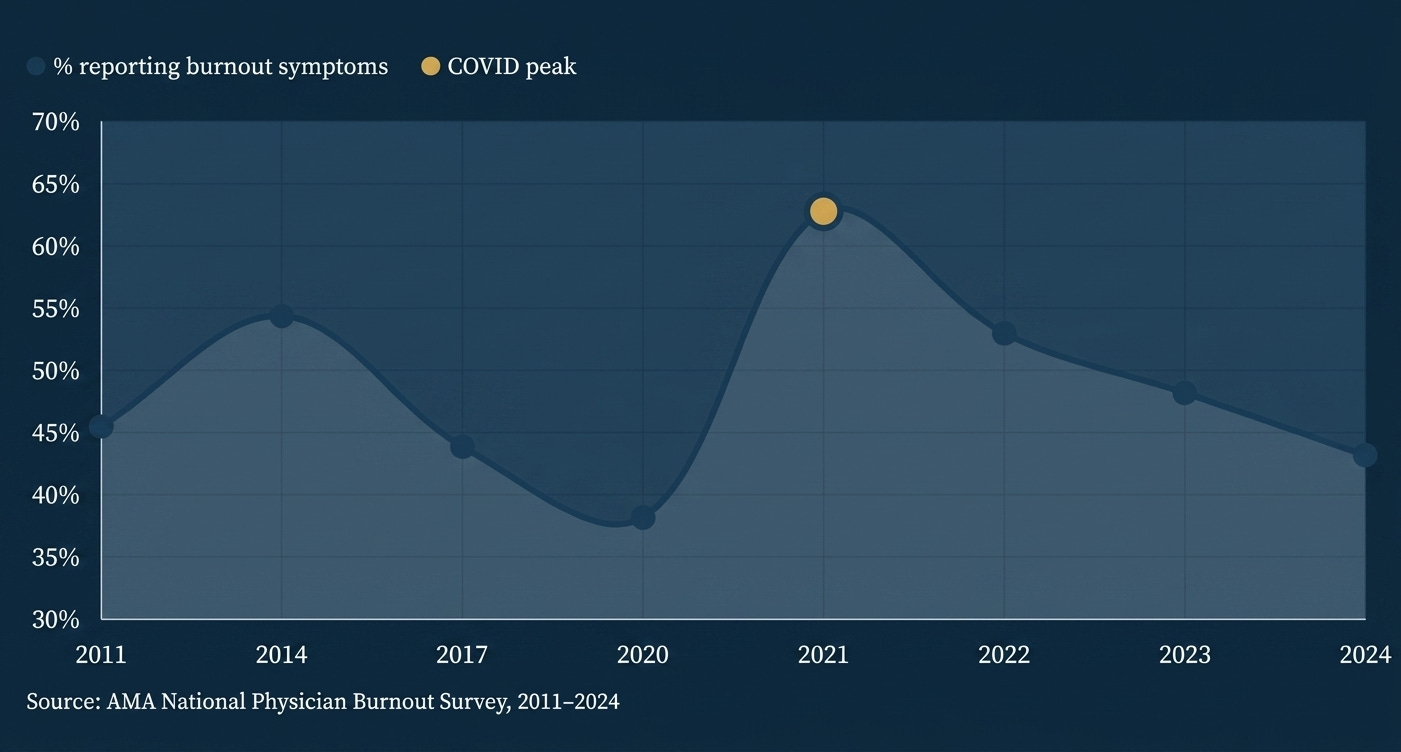
The AMA has been tracking physician burnout since 2011. At the peak of COVID, nearly 63% of physicians reported at least one symptom of burnout.
We’ve pulled back from that cliff - the latest figures put it at 43.2% - but that still means nearly one in two of your colleagues is struggling. (see chart above)
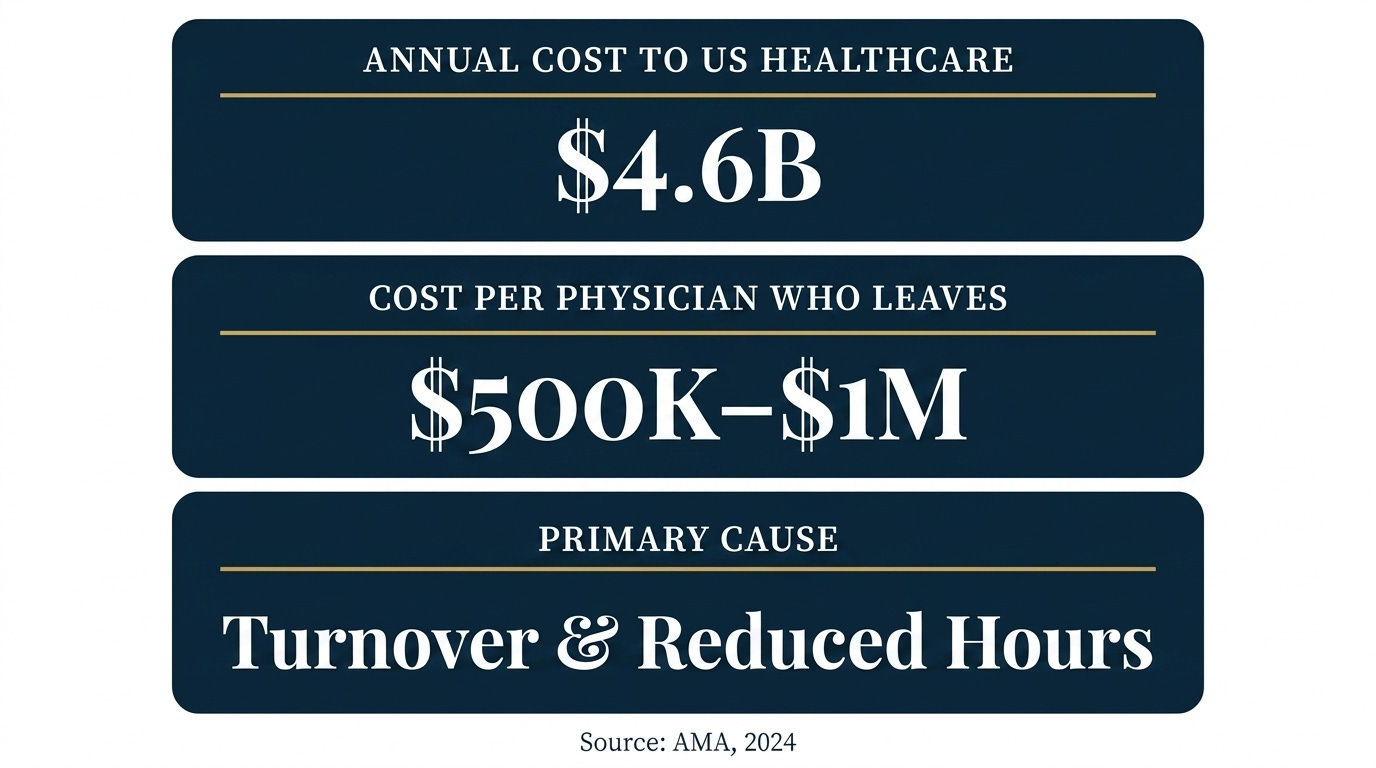
And the cost of that struggle to the healthcare system is $4.6 billion a year, mostly from turnover and reduced hours.
Those aren’t abstract numbers. That’s talent walking out of medicine. That’s the experienced physician who didn’t have someone step in when they were drowning. It’s estimated that for every physician who leaves, the cost is up to $1m.
There's another statistic that doesn't get talked about enough. A national study of hospital readmissions found that roughly one in four returns to hospital involves fragmented care -- the patient ending up at a different facility, records incomplete, no single physician holding the thread. That fragmentation was associated with up to 20% higher odds of dying in hospital. That's not a technology problem. That's a cohesion problem.
When the clan disappears, patients feel it.
What I believe
I’m not naive enough to think we can recreate the Texas Heart Institute culture in 2026. The structural pressures are real. Shift medicine isn’t going away. The EHR isn’t going anywhere.
But I do think we’ve accepted a degree of isolation that isn’t inevitable. We’ve allowed the competitive instinct - which is healthy, which makes us better clinicians - to crowd out the collective instinct entirely. And that’s a choice, even if it doesn’t feel like one.
My grandfather’s generation of coal miners in East Tennessee understood something that I think modern medicine has forgotten: the problems that are too big for one person to solve alone require a different kind of response. Not heroics. Organization. Mutual support.
Showing up for each other.
The challenges we face: burnout, access, the cost of unnecessary care, the erosion of the patient-physician relationship ...all require the kind of solidarity that used to be built into training and has since been engineered out.
Why I’m writing here
I wanted to write this Substack because I believe the conversation about fixing medicine needs to happen among clinicians first, not in boardrooms, but between people who actually take care of patients.
The clan doesn’t have to be a fellowship program or a conference room door. It can be this. A community of physicians who still believe we’re stronger together than we are alone.
If that resonates, please subscribe. Share it with a colleague who needs to hear it. And tell me in the comments - where have you still found the clan in modern medicine? I genuinely want to know.
No posts
Comments
Nothing yet. Say the first thing.
Sign in to join the conversation.