
There’s an unspoken hierarchy in medicine.
Direct patient care sits at the top. Everything else, industry, technology, administration, innovation, is somewhere further down. A step away from “real” medicine. A compromise, or worse, a retreat.
Most physicians who leave the clinic feel the weight of that hierarchy. Even when they’ve made peace with their decision, they tend to explain themselves and tend to justify the move. They want to make it clear they haven’t abandoned anything.
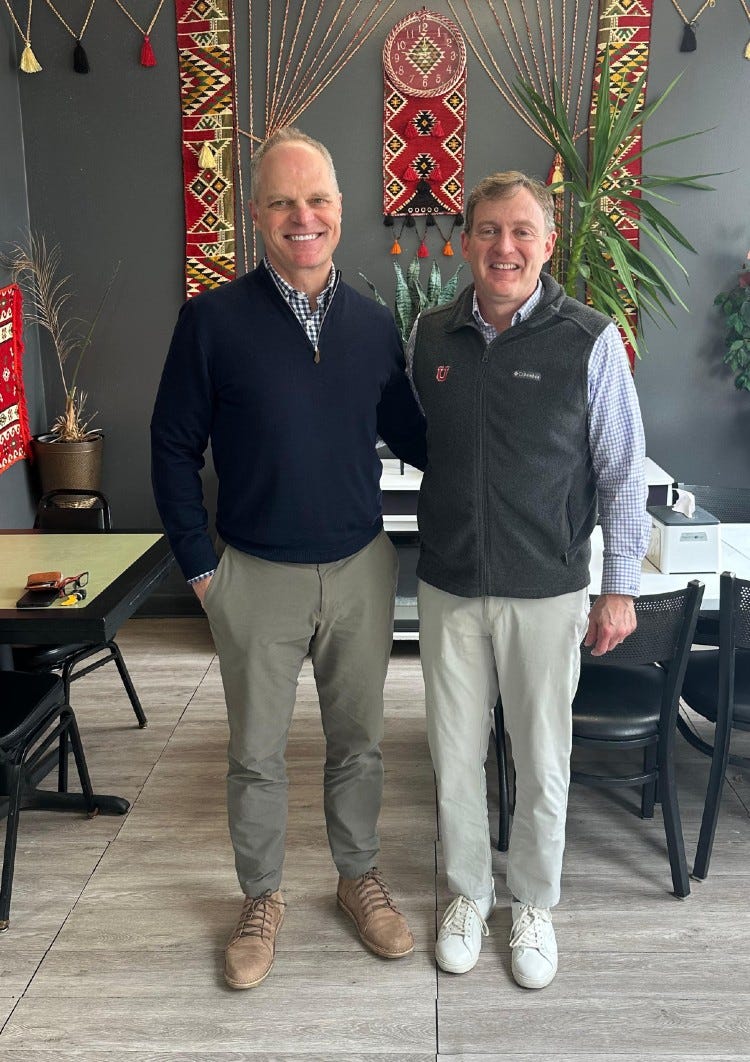
John Jefferies With Anton Decker
I understand that instinct because I’ve felt it myself.
But a conversation I’ve been having recently with a friend, Anton Decker, has sharpened something I’d known for a while without quite saying it clearly.
How we met is its own small story.
A former research director of mine left the University of Tennessee and moved to Arizona. A grant came up that brought together clinicians and researchers with backgrounds in healthcare, academia, and grant development. The research director thought of me, specifically around my work in hypertension and public health.
I was asked to join the application.
Anton was on the same call (see photo above).
He’s a gastroenterologist. I’m a cardiologist.
He led the international business at Mayo Clinic, one of the most credentialed institutions in American medicine.
When I mentioned Wharton during my introduction, there was a beat of recognition on the other end of the line.
“I’ve spent some time there too,” he said.
That was enough. We scheduled a call afterward, and we’ve been talking regularly ever since.
What I find funny is where we met: an academic grant process. The very kind of structure that, on paper, represents the institutional side of medicine we’ve both moved beyond. And yet it was that structure that introduced us. The real collaboration however - the ideas that have actually gone somewhere - has happened entirely outside of it.
Anton is a builder now.
He’s involved with a startup called VIOVOC, working on technology he believes can change how we understand the body at a population level. Without making a sales pitch about the product, it’s an ambient air sensor that can detect your fiber intake - and gives you actionable feedback for improving your diet.
He brings to that work everything Mayo gave him, the rigor, the credibility, the understanding of how large healthcare institutions actually function, and combines it with something those institutions rarely develop: the willingness to move fast, take risk, and build from scratch.
That’s what I mean when I talk about a different kind of builder.
Medicine trains you in environments where the cost of being wrong is measured in human lives.
That kind of focus doesn’t leave you.
It changes what you prioritize, what problems feel worth solving, and who you refuse to forget when you’re making decisions.
It makes you a different kind of builder: one who can optimize for outcomes, not just outputs.
I’ve been on a different version of the same path.
I spent years climbing academic medicine. And for a long time, I told myself that was the right move. Get to the table. Earn the influence, then use it.
But there was a moment that stopped me.
I was preparing a case for a clinical initiative I believed in. Good evidence with clear patient benefit. I’d done the work. And I remember sitting at my desk the night before, realizing I wasn’t thinking about the patients anymore.
I was thinking about how to frame it for the committee.
What language would land. Whose support I needed to line up in advance.
How I could make the institution comfortable with something that should have been obvious.
I caught myself and thought: when did I start doing this?
The answer, if I’m honest, was: gradually, and then all at once.
The institution had its own gravity. And without noticing, I’d started orbiting it.
When The Clinic Becomes A Ceiling
It’s not exactly that the work itself becomes limiting. Nor the patients. But it’s the structure around it, the approval layers, the political calculus, the slow grind of institutional change, that’s what closes in after a while.
And at a certain point you have to ask whether you’re still practicing medicine in service of people, or in service of a system that has long since stopped asking that question.
Talking to Anton reminded me of something I’d felt for years but rarely said plainly.
Practicing medicine is one way to help people. Sometimes it’s the best way.
But sometimes, if you have a particular combination of skills and appetite for risk and genuine frustration with how slowly systems move, it’s the most stifling way.
The question worth asking isn’t whether you stayed in medicine.
It’s where you can do the most good.
I’m writing this because I don’t think enough people in medicine are having this conversation openly.
There are physicians building companies, developing technology, advising institutions, and creating things that will reach more people than any single clinical practice ever could. Most of them feel, to some degree, like they’re operating outside the tribe.
They shouldn’t.
If you’re a physician who has moved into building, or who is thinking about it, I’d like to hear from you. What drove the decision? What did you carry with you? What surprised you?
The conversation Anton and I have been having is one I think a lot of people in medicine need access to. This is one way to start it.
No posts
Comments
Nothing yet. Say the first thing.
Sign in to join the conversation.