
Greetings readers. I wrote the essay below at another outlet’s invitation, but they ultimately declined to publish it. Such is life in front of a blinking cursor. Now it is yours to enjoy. But it does not have to be yours alone! Please feel free to share.
Local Government Capacity and the Historic Homicide Spike and Decline
Any causal explanation for the historic decline in homicide in the 2020s should have four key attributes. First, it should explain both the COVID-19 homicide spike and the 2023-2026 homicide decline. Second, the spike and decline occurred nearly simultaneously in cities, suburbs, and rural areas across the country, so any explanatory mechanism should have sufficient scope to explain a broadly experienced phenomenon. Third, the proposed cause must have materially changed during the period under observation, and the explanation should be broad enough to encompass narrower explanations for which there is broad evidence. Finally, the proposed explanation requires a causal mechanism that directly affects the outcome under study.
I propose that the best explanation for the homicide decline is the contraction and expansion of local government capacity following the shock of the COVID-19 pandemic. Local government capacity is a broad term that describes the ability of local public institutions to provide services in public safety, public health, public welfare, education, and economic development[1]. Because employment in these systems is centered on educators, social workers, police, grants administrators, and clinicians, these systems uniquely interact on a routine basis with young people at the greatest risk of violence and victimization[2]. More local capacity means more people spending more time removing obstacles and creating opportunities for those young people.
First, these two events are not separable. There is little disagreement that widespread disruptions in public and private behavior in response to the pandemic contributed substantially to the homicide spike and that the abatement of those disruptions contributed to the decline[3]. However, causal explanations require a specific mechanism related to those pandemic conditions. Criminologists have fairly cited changes in individuals’ routine activities as one mechanism[4]. Here, I am interested in systemic changes because the pandemic altered not only individual behavior, but also the capacity of institutions to provide supervision, services, protection, and support to people at greatest risk of violence and victimization, and acted exogenously on individual behavior.
Next, there is no debate that between 2019 and 2020, there was a historic spike in homicide in the United States, nor that there were historic homicide declines between 2023 and 2024, and 2024 and 2025. Both the spike and the decline were broadly experienced. The 2020 homicide spike extended across every type of community, as rates increased by 36.9% in large metropolitan counties, 32.1% in small and medium metropolitan counties, and 28.5% in nonmetropolitan counties[5]. The homicide decline of 2023 to 2024 was similarly broad, with declines of 19.1% in cities with populations of one million or more, 19.0% in cities under 10,000, 10.7% in metropolitan counties, 16.0% in nonmetropolitan counties, and 12.4% in suburban areas[6]. The only possible conclusion from these data is that the principal causes of the spike and decline were national in scope. Evidence-based local policy can amplify an improving national environment, but no single program, police chief, prosecutor, mayor, or community organization can explain why homicide fell at roughly the same time across so many places.
Third, satisfying the condition that proposed causal mechanisms must be of sufficient scale to affect a national change, and broad enough to explain widespread decline, the unprecedented homicide spike was immediately preceded by a huge loss in public sector jobs, and the violence decline was immediately preceded by large gains in local government employment. In just three months between March and May 2020, more than 1.25 million Americans lost local government jobs due to COVID-19-related reductions in local tax revenue. The American Rescue Plan Act (ARPA) was signed into law in March 2021 and ultimately reversed much of those job losses through a $350 billion investment in state and local government, unprecedented in its direct support for those public agencies. Within months, local governments began spending federal funds, and by 2022, local employment began growing. By the end of 2024, there were more local government employees than before the pandemic, and by June 2026, there were about 500,000 more local government jobs than in March of 2020.
Finally, the local government explanation satisfies the condition that the proposed mechanism must directly affect homicide. ARPA funds flowed through thousands of agencies, restoring staff, stabilizing services, and supporting many forms of prevention and intervention. More than 92% of local government spending supports staff, and although diffuse, the main categories of local government employment are in public health, public safety, public welfare, and education. Although diffuse, these positions directly support people and communities at the highest risk of violence victimization, and these roles have the practical outcome of either reducing risk conditions or improving opportunities that affect violence.
Establishing a post hoc causal relationship for national phenomena is often referred to as a cause-and-effect study[7]. This differs from our usual evaluation approaches, where we design a study and then apply it to a specific population to narrowly isolate an effect. While this is a new way of understanding crime, in other fields researchers have argued that there are limits to focusing only on the effects of prespecified causes and that acknowledging the legitimacy of broader causal questions, including reasoning backward from observed outcomes, will expand knowledge in the field[8]. Here, it is our only choice to understand the homicide spike and decline.
I have been writing a lot about causes of the crime decline, and have concluded that federal spending through the American Recovery Plan Act (ARPA) is probably the best explanation. I am not surprised that policing folks find that argument unconvincing. What surprises me is how many people assume the ARPA take is politically motivated. It took me a long time to realize this was a problem, because this argument developed organically, rather than starting with ARPA. I read everything I write. You probably do not. So, it’s worth a couple hundred words to revisit how we got here.
Finally, I am well aware that for perhaps half of Americans these days, their politics is a core part of their identity. They are not persuadable. But that leaves a lot of people who are. Perhaps you are.
The Lore
I wrote a lot about the violence spike of 2020 and 2021. In July 2021, Will Bunch of the Philadelphia Inquirer wrote a scathing op-ed blaming progressives for ignoring the spike. To support this take, Bunch quotes your friendly neighborhood blogger thusly:
John Roman, a senior fellow with the National Opinion Research Center research program of the University of Chicago who lives in the Philadelphia region, said the steep rise in gunplay is almost surely tied to the disruption of the pandemic. “You have a dense cluster of young men with nothing to do — that’s a spark for violence,” Roman said, noting that many city teens and young adults weren’t going to school or work, and lost access to everything from community centers to contact with trusted mentors. “These are places,” he added, “with deep-seated trauma, and long-standing [disputes].”
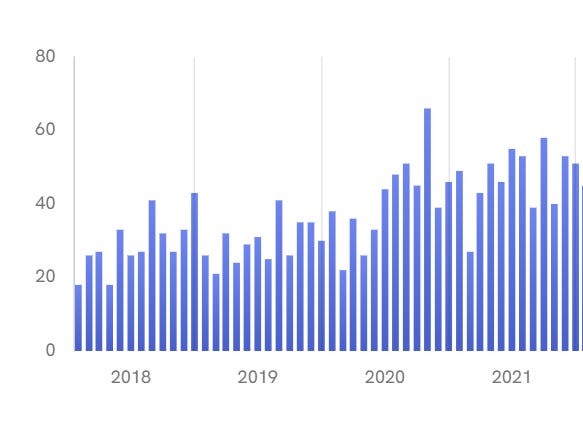
Fast forward to Thanksgiving 2023, and it was clear that the tide had turned, and violence was declining. I had been searching for months for a mechanism that would explain why crime spiked and fell beyond just the pandemic disruption to routine activities. This meant looking through every piece of macro data I could find. This is how you jumpstart causes-of-effects research, research on what caused an already observed outcome. Most academics do not like this approach because it takes the causal mechanism out of the researcher’s hands. You can’t conduct a randomized, controlled trial on something that has already happened. You can use every other quasi-experimental design, however, but that is an argument for another day.
That search for some macro correlate led me to the local government jobs data. I love FRED data, which allows you to explore just about any macro dataset you can imagine, and FRED (not Claude) was my research assistant. That led me to write this piece, Why Violence Spiked in 2020, in One Graph, which argued that there was an almost perfect negative correlation between local government job losses and the homicide trends. The only mention of ARPA in the piece comes from a commenter (yay commenters!), not me.
A month later, I wrote, Why did crime decline in 2023?, which formalized the argument. In particular, it focuses on what local government buys with its spending. Again, this piece makes no mention of ARPA. The next May (2024), I was moved to write again on the topic because by then it was obvious that violence had not simply stabilized post-pandemic, or was drifting toward pre-pandemic levels. The violence decline was accelerating. That’s my first mention of ARPA, more than three years after it was signed into law. If that is marketing a partisan idea, it was poorly executed.
One last fact. The long lens of history will hopefully point out that ARPA wasn’t partisan. Yes, the congressional vote authorizing and appropriating ARPA was absolutely partisan. But every government took the money. Zero states refused ARPA funding. As far as I can tell, the number of places that rejected ARPA funding was trivial, maybe 2%. And these were almost entirely very small towns, averaging around 500 people. The few places that did refuse the money, like Dummer, New Hampshire, and Bingham, Pennsylvania, noted either that they didn’t have the capacity to manage an ARPA grant or that they didn’t see a use for the additional money. This is far different than other federal initiatives, like Medicaid expansion, where several states refused funding on partisan grounds. By the time I started thinking about ARPA’s effect on crime, both red and blue places had already obligated almost all the money.
[1] Isaac, N., Jacobson, R., Segal, J., Wenning, J., & Wilburn, S. (2026, April 16). Annual survey of public employment & payroll summary report: 2025. U.S. Census Bureau.
[2] Ibid.
[3] In fact, that link is so clear, most authors make it indirectly, although see Love, H., & Loh, T. H. (2024, December 16). Why did U.S. homicides spike in 2020 and then decline rapidly in 2023 and 2024? Brookings Institution. The expert viewpoints on the homicide decline published by the Council Criminal Justice tend to make this point implicitly, though see Sharkey in Council on Criminal Justice. (2026, January 22). What’s driving the drop in homicide? How low might it go?
[4] Meyer, M., Hassafy, A., Lewis, G., Shrestha, P., Haviland, A. M., & Nagin, D. S. (2022). Changes in crime rates during the COVID-19 pandemic. Statistics and Public Policy, 9(1), 97–109.
[5] Kegler, S. R., Simon, T. R., Zwald, M. L., Chen, M. S., Mercy, J. A., Jones, C. M., Mercado-Crespo, M. C., Blair, J. M., Stone, D. M., Ottley, P. G., & Dills, J. (2022). Vital signs: Changes in firearm homicide and suicide rates—United States, 2019–2020. Morbidity and Mortality Weekly Report, 71(19), 656–663.
[6] Federal Bureau of Investigation. (2025, August). UCR summary of reported crimes in the nation, 2024. U.S. Department of Justice. Page 17.
[7] Dawid, A. P., & Musio, M. (2022). Effects of causes and causes of effects. Annual Review of Statistics and Its Application, 9, 261–287. Lu, Z., Geng, Z., Li, W., Zhu, S., & Jia, J. (2023). Evaluating causes of effects by posterior effects of causes. Biometrika, 110(2), 449–465.
[8] VanderWeele, T. J., Hernán, M. A., Tchetgen Tchetgen, E. J., & Robins, J. M. (2016). Re: Causality and causal inference in epidemiology: The need for a pluralistic approach. International Journal of Epidemiology, 45(6), 2199–2200.
Comments
Nothing yet. Say the first thing.
Sign in to join the conversation.