
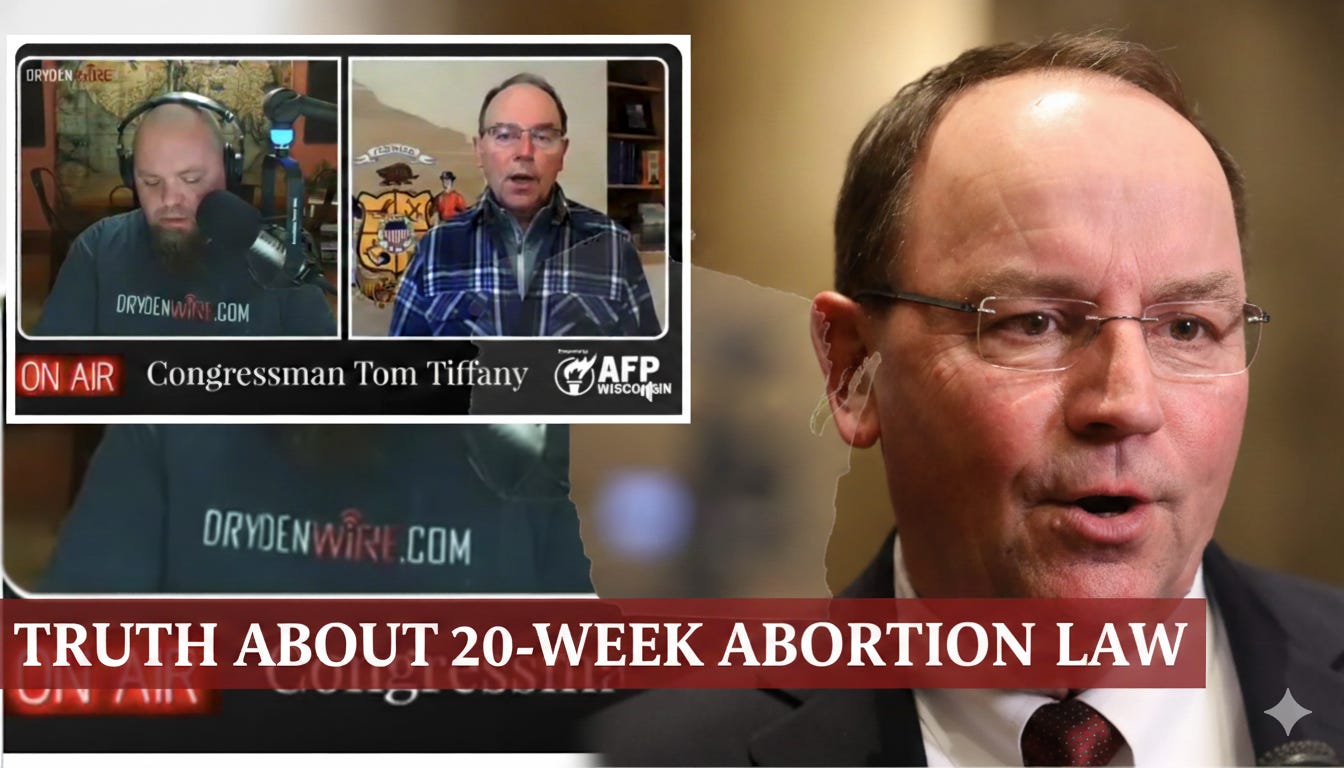
In this article, I take a look at the highly controversial topic of abortion, and the narrative that has recently been circulating about conservatives who support Wisconsin Statute § 253.107, Wisconsin’s “20-week abortion law”. For those of us who believe that life begins at conception, it is disturbing to realize that our Republican Legislature passed a law in 2015 that allows abortions up to 20 weeks after conception, when the Roe v Wade Federal ruling in effect at the time only protected abortions up to 12 weeks. That certainly does not seem to be consistent with Conservative values.
Listen to a Deep Dive on the Content of this article
0:00
-10:19
After the overturn of Roe v Wade at the Federal level, and the State Supreme Court’s ruling against the enforceability of Wisconsin’s 1849 abortion ban law following that, Wisconsin Statute § 253.107, the “20-week abortion law” became the primary governing abortion statute in the State.
Recently, our 7th District Congressman, Tom Tiffany, announced his bid for Wisconsin Governor. The Democrats wasted no time in launching attacks against him, painting him as extreme, and “toxic” to the State. To a Democrat, I suppose he is, as is anyone with a conservative viewpoint. The left leaning WisPolitics put out a hit piece targeting Tom’s significant Pro-Life stance. This is to be expected, and is the standard playbook for leftist Democrats. They did the same thing, but to a lesser extent, to Republican Gubernatorial candidate Josh Shoemann, labeling him as “extreme” and “toxic” as well.
Interestingly, while these attacks from Democrats are fully expected, there are a significant number of conservative patriots on the right attacking Tom for his stance on abortion as well, but in the opposite direction… he’s not pro-life. The assertion is that because Tom voted for a 20-week abortion bill in 2015 while he was in the State Legislature, and stands by his support for that now law to this day, he is some kind of turncoat on the abortion issue. This narrative paints him as someone who doesn’t actually support the pro-life agenda.
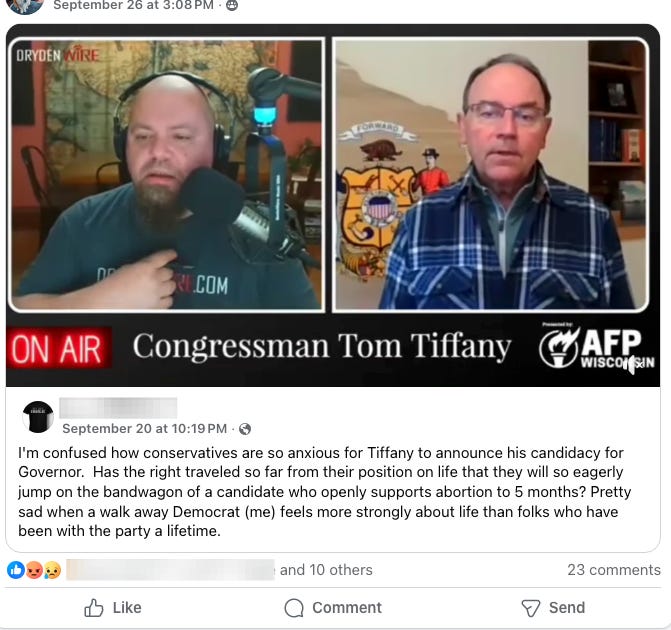
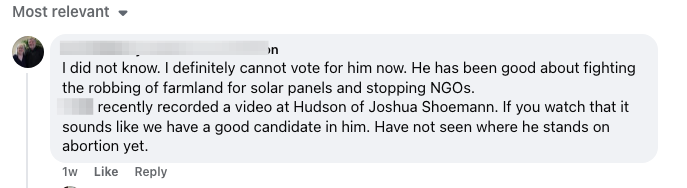
It’s shocking to conservative patriots that a supposedly pro-life conservative legislator would openly support abortion up to 20 weeks after conception. It was passed by a Republican controlled House and Senate, and Governor Scott Walker signed this bill into law in 2015. Based solely on the fact that this bill was passed along Party lines in a Republican controlled Legislature in 2015, ten years later, it certainly can seem like the Republican Legislature at the time was not pro-life.
It’s important to understand, this writing is not an endorsement for Tom Tiffany for Governor. During a Primary Election cycle, individuals should make their own choices for a preferred candidate for the highest elected office in the State. There are multiple candidates running, and likely to be more before the Primary Election next August. One cannot make an informed decision without knowing the truth. When I see good people being deceived by false narrative, I’m compelled to call it out.
“Sanctify them in the truth; your word is truth.”
- John 17:17
In this case, the truth is the complete opposite of the narrative being spread. Republicans who crafted and successfully passed the law were doing what was possible at the time to increase protections for the unborn as much as they felt was able to be passed at the time. Functionally, this bill answers the primary question a secular, Constitutional government grapples with related to unborn children: “At what point does a newly forming human receive their Constitutional protections under the law in the State of Wisconsin?”
When an objective look is taken at the history of abortion laws effective in the State over time, the truth becomes clear. Republican lawmakers were not widening restrictions on abortion, they were narrowing them.
The enactment of Wis. Stat. § 253.107 (Prohibition After 20 Weeks Post-Fertilization) in 2015 Wisconsin Act 56 1 represented a significant and deliberate legislative step toward advancing the pro-life agenda in Wisconsin at the time of its passage. Since the federal protections of Roe v. Wade were still in effect in 2015, legislators could not enact a complete prohibition, so they pursued an incremental strategy of restricting abortion access at the earliest possible point determined to be constitutionally defensible.
The Roe v. Wade ruling, which was the binding federal law when Wisconsin passed Statute § 253.107 (the 20-week ban) in 2015, established a legal framework that directly impacted the ability to get an abortion after 12 weeks of pregnancy.
Under the framework established by Roe (and later clarified by Planned Parenthood v. Casey in 1992), the regulation of abortion was tied to the stage of pregnancy, primarily distinguishing between the periods before and after viability.
Here is a detailed breakdown of how Roe v. Wade impacted abortion access after 12 weeks (the approximate end of the first trimester):
The End of the First Trimester (Around 12 Weeks)
Under the original Roe trimester framework:
Before 12 Weeks (First Trimester): The abortion decision was left solely to the woman and her physician, and the state could not regulate the procedure at all.
After 12 Weeks (Second Trimester Begins): The state’s interest in protecting the mother’s health became compelling.
Impact: The state could begin to regulate the abortion procedure, but only in ways reasonably related to maternal health. This meant states could impose requirements like licensing facilities or setting professional standards for physicians performing the procedure, but they could not outlaw the procedure itself.
The Critical Viability Standard (Post-20 Weeks)
The key factor under Roe that governed the ability to get an abortion after 12 weeks was viability, which typically occurs between 24 and 28 weeks of pregnancy.
Before Viability (13 Weeks up to ≈ 24 Weeks): The right to an abortion was constitutionally protected. A state could not impose an outright ban or place an “undue burden” (under the later Casey standard) on a woman seeking an abortion.
The Period Where Bans Were Permitted
The state’s interest in protecting potential life only became compelling at the point of viability (the third trimester under the original framework).
After Viability (≈ 24 Weeks to Term): At this point, the state could regulate and even proscribe (ban) abortion, except where necessary, in appropriate medical judgment, to preserve the life or health of the mother.
The 20-week ban passed by Wisconsin in 2015 was enacted while Roe v Wade was prevailing federal law. Because Roe prohibited bans before viability, the 20-week ban was not immediately enforceable as a criminal prohibition when it was passed. The federal right established by Roe superseded the state’s attempt to ban the procedure at 20 weeks.
Wis. Statute § 253.107 (Prohibition After 20 Weeks Post-Fertilization) advanced the pro-life agenda through three primary mechanisms: establishing an earlier, fixed gestational limit; asserting a compelling state interest in fetal life; and building a modern, restrictive legal foundation that would endure future judicial challenges.
Before the adoption of Wis. Stat. § 253.107, the most restrictive, specific gestational limit in Wisconsin was the prohibition on abortion after fetal viability (Wis. Stat. § 940.15, enacted in 1985).1 Viability is a medically fluid concept, generally occurring later in pregnancy than 20 weeks post-fertilization.
By enacting the 20-week post-fertilization ban, legislators:
Criminalized Earlier Procedures: They moved the criminal deadline for elective abortions to a fixed point in time—20 weeks post-fertilization—effectively shortening the legal window of access by several weeks.2 This explicit reduction of the access period is a core goal of the pro-life movement.
Superseded the Viability Standard: The 20-week ban became the practical, enforceable criminal ceiling for elective abortions in the state, overriding the less restrictive, time-variable viability standard for most procedures.3 This minimized the availability of late-term procedures and immediately reduced the number of abortions performed after that threshold.
Narrowed Exceptions: The law only permits procedures after 20 weeks post-fertilization in cases of documented medical emergency necessary to save the life of the woman or prevent substantial physical impairment of a major bodily function.2 This refusal to include exceptions for cases of rape or incest further reflected a firm commitment to protecting the life of the fetus above other considerations.
The passage of the 20-week ban was a public assertion of the legislature’s belief that the state has a compelling interest in protecting the life of the unborn child at this developmental stage. Although the explicit legislative findings for § 253.107 are not detailed here, such laws are typically grounded in the argument that a fetus is capable of experiencing pain at or before 20 weeks.
This legislative action built upon the existing intent found in earlier regulatory statutes (like Wis. Stat. § 253.10, enacted in 1985), which explicitly stated the intent “to further the important and compelling state interests in... Protecting the life and health of the woman subject to an elective abortion and, to the extent constitutionally permissible, the life of her unborn child“.4 The 2015 law pushed this “constitutionally permissible” limit as far as possible under the federal law of the time.
From a strategic standpoint, the legislators were ensuring that even if the historic, non-enforceable 1849 criminal ban (§ 940.04) were struck down, the state would still have a highly restrictive, modern set of prohibitions in place.
This foresight proved critical:
Survival After Dobbs and Kaul: Following the U.S. Supreme Court’s Dobbs decision in 2022, and the Wisconsin Supreme Court’s subsequent Kaul v. Urmanski ruling (2025) that impliedly repealed the 1849 ban as applied to voluntary abortions 6, the 20-week ban immediately became the de facto legal standard.7
The New Legal Ceiling: Because the Kaul decision relied on the existence of these subsequent, comprehensive regulatory acts (including the 2015 law) to justify the repeal of the older law, the 20-week limit was judicially cemented as the maximum enforceable gestational limit.3 The legislators’ action in 2015 ensured that the state’s current law permits elective abortions only up to the 20-week post-fertilization mark 2, a highly restricted position that aligns with core pro-life objectives.
If you made it this far in reading the article, it should now be abundantly clear to you that legislators who authored, supported, and passed § 253.107 in 2015 were diligently working on advancing the pro-life agenda, not loosening it. This law sought to restrict abortions to the greatest extent possible at the time, as well as set a constitutionally defensible backstop to the eventual overturning of Roe and the unenforceable nature of the 1849 law that would come back into effect when Roe was overturned.
Legislators who worked on and fought to pass this 20-week abortion ban should be commended for their diligence and foresight in advancing the pro-live agenda in Wisconsin, not vilified with myopic false narrative.
Thanks for reading this detailed analysis. If you found it interesting, please Like and Share it widely.
Regards,
John Kraft
Key Abortion Restrictions in Wisconsin, https://docs.legis.wisconsin.gov/misc/lc/issue_briefs/2024/health/ib_overview_of_abortion_laws_msk_2024_04_15
CHAPTER 253 - Wisconsin Legislative Documents, https://docs.legis.wisconsin.gov/document/statutes/253.pdf
Wisconsin - Center for Reproductive Rights, https://reproductiverights.org/maps/state/wisconsin/
2024 Wisconsin Statutes & Annotations :: Chapter 253 - Maternal and child health. :: 253.10 - Voluntary and informed consent for abortions. - Justia Law, https://law.justia.com/codes/wisconsin/chapter-253/section-253-10/
Wisconsin Statutes Health (Ch. 250 to 255) § 253.10. Voluntary and informed consent for abortions - Codes - FindLaw,
https://codes.findlaw.com/wi/health-ch-250-to-255/wi-st-253-10/Wisconsin Supreme Court Rules 176-Year-Old Law Does Not Ban Abortion, https://statecourtreport.org/our-work/analysis-opinion/wisconsin-supreme-court-rules-176-year-old-law-does-not-ban-abortion
Wisconsin Supreme Court strikes down 19th-century abortion ban - WPR, https://www.wpr.org/news/wisconsin-supreme-court-strikes-down-19th-century-abortion-ban
No posts
Comments
Nothing yet. Say the first thing.
Sign in to join the conversation.