
This week, I was asked by a colleague at the University of Exeter to take part in a panel for the annual end-of-year Grand Challenges week where students work in groups to propose solutions for some of the world’s biggest problems, from how to cope with AI or climate change to responding to populism and the Trump presidency. With colleagues from Computer Science, Political Science, Film Studies, and Theology, I was asked to answer either “What keeps me awake at night?” or “What’s on my desk?”
The fact that the two are considered to be similar questions is itself worrying. However, with my worldview not being confined to the immanent frame, but the hope of the Christian gospel, I tend to sleep better than I should. (Perhaps I shouldn’t, given the impending polycrisis, covered on Alex Evans’ Substack, due to Trump’s foolish war against Iran.) So, I focused more on the second question but it inevitably bled into the first.
The following text is a reconstruction of my talk to the students.
What’s on my desk?
On my desk sit my two recent books Indulging Kleptocracy (2025) and Security After Christendom (2024). The first explores how bad things in hard in global politics and especially Britain’s place in it. The second was written to explain that predicament theologically and give a reason for the hope that I have amidst the turmoil. I’ll focus on the first but circle back to the second.
Indulging Kleptocracy covers the story of three decades of the UK servicing kleptocratic wealth from the former Soviet Union. This includes listing companies on the London Stock Exchange as public companies which have weak corporate governance are effectively the private ventures of an oligarchic elite. It includes allowing the sale of at least £2 Billion of London real estate to elites with tainted wealth from countries such as Azerbaijan, Kazakhstan and Russia.
But it’s not just about money laundering. It’s always as much about status and influence. Perhaps the greatest asset the UK can sell to these elites is permanent residency to eventual citizenship. From 2008-2014, its tier 1 residency by investment programme granted status to thousands of millionaires mainly from Russia and China, without evidence of benefit to the UK economy. This included at least ten who were subsequently sanctioned by the UK and dozens more who were accused of corruption. The Home Office simply trusted the British law firms who submitted the documents to have done the checks and then refused to publish the report on the scandal. In 2026, the law firm Mishcon de Reya began working with the Labour-linked think tank IPPR to introduce a new invitation-only scheme.
Such schemes reflect a new kind of politics based around transnational elite networks. While in government, the Conservatives accepted political donations from Russian PEPs whose source of wealth is tied to the Kremlin including Lyubov Chernukhin and Dmitry Leus. After losing power, Tony Blair, Peter Mandelson, and other New Labour figures provided asset management and reputation management services to the kleptocratic Kazakh elite. Blair advised Nursultan Nazarbayev on how to handle the Zhanaozen crisis where his police killed and imprisoned an uncertain number of protestors. Lord David Evans, now suspended from the second chamber of parliament, directed companies used to move Kazakh elite wealth offshore after a “Bloody January” regime crisis of 2022 and launched unsuccessful but damaging defamation actions against UK journalists that reported on this asset dump from which he had personally benefited.
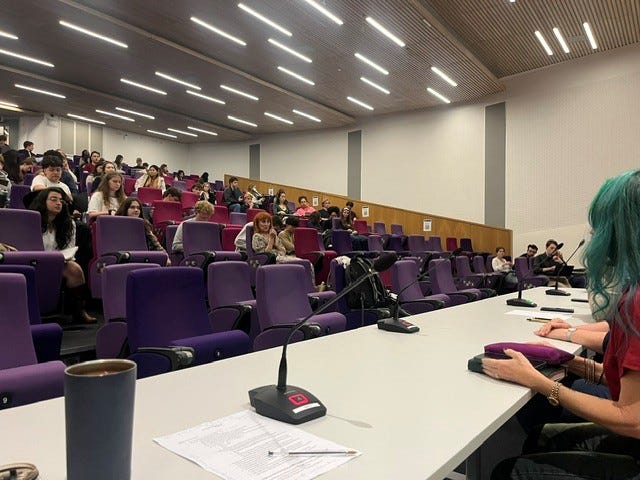
Image: Speaking to Grand Challenges, University of Exeter
How might we understand the grand challenges of global politics?
I am a Professor of International Relations. We try to write big theories of what the world is like. However, I would argue that all IR theory is normative (about an ought, not an is), including political realism. Some might see a return to geopolitics and the national interest in Trump’s actions in Venezuela, Iran, and Cuba. I see a regime determined by personal preferences, bad ideas, and business interests. But that’s partly my own radical Christian ethical preferences showing through.
The normative claims of all forms of realpolitik and statecraft include: 1) States are functionally independent of one another and autonomous of private actors; 2) States have national interests which are more than the private interests of their elite. Most classic liberals would agree with these two but add: 3) In democracies, these national interests are approximations of the public interest.
The research of Indulging Kleptocracy challenges all three of these assumptions. We find: 1) States are creatures of networks of public and private actors – out report on “the kleptocratic enterprise” arguing that transnational elite networks may operate conspiratorially and are equivalent to organised crime syndicates; 2) “National interests” disproportionately reflect the personal interests and preferences of these elites – look at family members of Trump making money of his policy choices; 3) Even in democracies – as the UK case shows – the private interests of network members often trump the public interest.
Where is this going?
It is my view that the last time the Western world was so ruptured was in 1945. The nation-state as a unit lacks the material and moral resources to put this back together again because the political conditions are not those of 1945. Our elite, any elite, lack the vision and the interests: there is no Keynes nor Beveridge on the horizon. Today, we have the abstract reasoning and cultural nostalgia of Reform’s policy chief James Orr or the libertarian impulses of crypto king Christopher Harborne.
On a global scale, territory, authority, and rights will increasingly be divided between haves and have-nots. Expect to see more special zones of exemption from tax and law onshore as well as offshore. The state will rely more on outsourcing to get things done and will be increasingly reliant on politically connected private contractors such as Palantir and other big tech firms which will increasingly control public as well as private data. Such enormous inequality will create exclusion, violence, and scarcity as the portions of the most marginalized disconnect and some take to the streets.
[My talk ended here but the conversation continued for an hour. Below is the reconstruction of some of my thoughts, reflecting on that conversation]
What can you do about this?
It doesn’t sound like there’s much hope here. But, as a Christian, I believe there is hope not despite but because of apocalyptic times. That’s why I wrote Security After Christendom which not only provided a historical and theological account of changing global politics but personal reflections on moments of hope and disappointment as a practitioner in West Africa, Central Asia, and the Global North. Often hope and disappointment are bound up together in the same episodes.
I find hope in two things. First, in truth. The character of political power is being revealed as data leaks and whistle blowers are the sources for studies like Indulging Kleptocracy. Enablers like Evans are eventually held to account via the courts. Others simply lose their status and reputation. The bible tells us that the powers turn demonic but are defeated by their exposure. Our role is not to take up arms but to stay close to the truth.
Second, I find hope in power. Contrary to prevailing opinion, power is not held only by elites and administered coercively to make people do what they would not otherwise do. Power is first and foremost, relational. In complex societies, it relies on community norms, patterns, and consent. That means it is fundamentally bottom up. We see this in all forms of progressive change which begin with civil resistance or mass movements and force the powers that be to respond.
To wrap up, here’s three things you can do to respond politically:
· Free Your Mind – Turn off your phone, stop thinking about global politics overwhelmingly in terms of states, stop thinking about domestic politics as a horserace, and cultivate your own worldview drawing on long-standing wisdom and great books. After all, it was Aristotle who introduced the concept of oligarchy.
· Build An Ark – Build your own networks of power and solidarity movements. Form local communities of radical inclusion, nonviolent protection and abundant provision, as argued in Security After Christendom.
· Stay Engaged – Listen to others whose minds haven’t been freed in the humble acknowledgement that we all remain deluded to some degree; Keep the gangway open for bringing more and different animals on to your ark.
No posts
Comments
Nothing yet. Say the first thing.
Sign in to join the conversation.