
How do we discern rightful responses to “illegal immigration”? I have been asking myself this question over the last couple of weeks after the violence which irrupted in Belfast and Southampton following brutal attacks on white men.
We have been told by politicians on both the Right and Far Right that these protests are the “direct result” of years of uncontrolled or illegal immigration. This claim has been made by Reform and Restore parties, and it has not been questioned by the mainstream parties. It is a claim which suggests that while the violence is excessive it is entirely understandable and not unwarranted.
It’s not true that the violent protests are a natural or normal response to the crime itself. In both the Southampton and Belfast cases, the families of the victims pleaded for violence not to take place. If they – who lost most – were not heading to the streets then it suggests that those that did take up arms have other motives. As in most cases of radicalization, these are probably related to their past exposure to violent and criminal groups, mob mentality and disinformation (turbocharged with social media), and the lack of family and civil society structures to prevent their criminal behaviour.
In the preceding paragraphs, I have linked the Southampton and Belfast cases. I’ve done that because the link was made by protestors and the Far Right. But the perpetrators of the two attacks are dissimilar in almost all respects. Vickrum Singh Digwa, a 23-year-old British Sikh, who killed Henry Nowak is not an immigrant. Hadi Alodid, the Sudanese man who committed the attack in Belfast, is a recent asylum seeker. What they share is the fact that they are non-white.
Race and racism are central to these protests. “Two-tier policing” was the rallying cry of the Far Right following the conclusion of the Southampton trial as the footage emerged that showed how an accusation of racism by Digwa against Nowak had led police to arrest not help the dying man.
In his first ever Substack post, Nigel Farage went further to diagnose a “two-tier state”, where, “anything which is seen to disadvantage a minority group is cracked down on. Anything which benefits a minority and damages the White British is likely to be left alone”. The evidence for these claims was cherry-picked, of course, and Farage ignored the evidence of discrimination against minorities. Prejudice determines data selection.
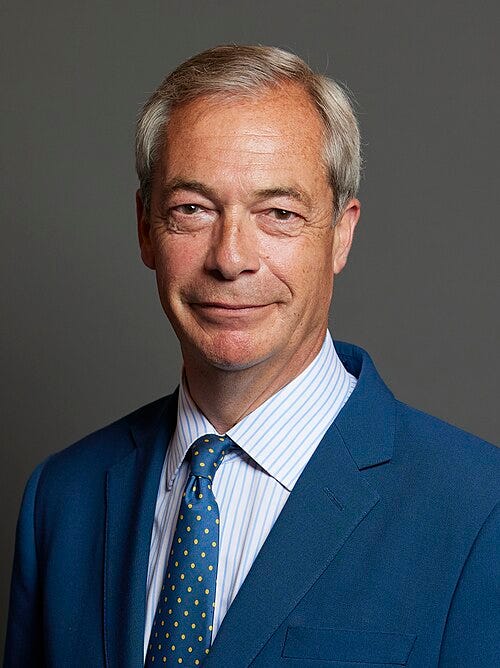
Image: Official Portrait of Nigel Farage By Laurie Noble, CC BY 3.0,
Race has been central to Reform’s message on the attacks as Robert Jenrick misleadingly quoted Kemi Badenoch to present her as supporting black over white lives. In plainer terms, Jenrick lied to play the race cared, stir up more anger, and gain electoral advantage.
For the Left, all this looks toxic. Many Christians on the Left know that such politics is not just unreasonable – it’s hateful and completely contrary to the gospel of Christ. We cannot understand how a devout believer like Danny Kruger can be in party which spreads lies and hatred. Maybe we can’t understand how some in our church support it. We may then merely want to ignore the politics and double down in our support for refugees – perhaps being less public to protect those we work with and ourselves.
I think this is understandable, but it would be a mistake. Right now, the centre ground has almost disappeared from British politics. The government tries to hold the centre, but its discourse concedes ground to the Far Right, and it languishes in the opinion polls. If a reasonable ethic of immigration is not articulated which reaches across the Left-Right divide, we face deep problems ahead. More violence. And perhaps a government including the Far Right implementing a UK version of ICE.
So, to return to our question, how do we discern reasonable concerns about “illegal immigration”? For religious people, this is determined by a vision of the common good derived from their traditions and judgments about how that good may be advanced, in different ways, by faith communities and secular governments. With respect to globalization – and today’s migration is one manifestation of globalization – the theologian Mirsolav Wolf argues that it may be rightful to the extent that it advances of human flourishing as defined by a longstanding ethical tradition.
For Christians, we must immediately distinguish between the worldwide community of peace and justice of the church with its eschatological purposes of reuniting humanity to God (Eph 2:13-18; John 11:51-52), and the secular authorities that have a limited but important role in maintaining order (Rom 13:1-7).
The bible does not, contrary to errant readings of Acts 17:26 by supporters of Apartheid among others, sanctify border controls. The nations (etnos) “appointed times in history and the boundaries of their lands” cannot possibly refer to modern nation states. But we might carefully infer that the secular authorities have rights to limit and control border crossings.
Thanks for reading Security After Christendom by John Heathershaw! This post is public so feel free to share it.
So, the vision of the church as a Pentecost community of all nations speaking all languages (Acts 2:4) is explained to the confused people in eschatological and Christo-centric terms (Acts 2: 16-22). This apocalyptically internationalised church is called to break down barriers of race (Acts 6:1-6) and was commissioned at Antioch to global mission not despite but because of this diversity (Acts 11:19-26). This was when the people were first called Christian. As Owen Hylton argues in his excellent book The Reconciled Church, the church was created by God to reconcile the nations and races.
So, the church knows no borders. The time when God’s people was ethnically distinct has long gone.
However, ecclesial internationalism is not itself a basis for Christians to support contemporary globalism. That would be to confuse the mission of the church which is eschatological with the functions of government which is temporal and passing away. The church’s mission is always and simply to welcome the stranger. The state can only ever be welcoming as an exception to its bordered reality.
What then can we do about “illegal immigration” in the context of an age in which government which has limited and, I think (according to the Christian apocalyptic vision), necessarily weakening authority? There are perhaps two things, each of which begins with accepting a kernel of apocalyptic truth in the complaints of those who oppose illegal immigration.
First, accept that illegal entry is a problem and be plain about the choice facing the UK and other recipient countries. The Far Right wants to shut the border and deport those already here. Most people just want a system of legal and fair entry. Asylum seekers enter illegally because the UK does not provide safe and legal routes for all but exceptions. Roundabout routes like that take by Alodid are taken because of the UK’s minimal participation in UN refugee relocation systems. If the UK does not want to participate in these it should start its own UK-specific general humanitarian visa system (not just ones for Ukrainians and a small number of Afghans).
Second, accept that persons from war-torn countries are somewhat more likely to commit violent crime (as British crime statistics appear to suggest) and implement better systems of reception and support. It is correct that those who are eligible for asylum are also more likely to become violent if trauma is not addressed and they become isolated where they have resettled. Holding young men together in hotels, unable to work, receiving only minimal social and health care, makes violence more likely. The current British state system makes things worse. The political discourse of the Far Right, creating fear among asylum seekers, is also likely to make things worse.
A more humane system of integration of humanitarian visa arrivals implemented by churches, civil society, and volunteers - not the state – would be far more effective and much cheaper. Community hosting and support by those who are morally committed to welcoming stranger is far better than the bureaucratic systems of exclusion we presently have. Ukrainians have been successfully integrated in their 100,000s. Such support should not only be offered to whites, women, and children. Young men with mental health problems or trauma must be identified early.
Are such changes practical? They do not necessarily mean more refugees and, in the early years, would probably mean fewer. Right now, the British state is ill-equipped to receive refugees properly. But if it introduces a proper system like the one mentioned above it would have the moral grounds, widespread public support, and perhaps legal basis to “stop the boats”. It will also undermine demand for expensive people smuggling if refugees know they can wait for a legal, safer, and cheaper route. There would be considerable transitional challenges, of course.
For churches and civil society, the transition would be easier. We’re already doing this and are ready and capable to host more.
States make refugees, but churches and civil society welcome them.
[Updated: 22 June 2026]
No posts
Comments
Nothing yet. Say the first thing.
Sign in to join the conversation.