
INTRODUCTION
This academic essay was published this week by the Faith and England’s National Identities project at the University of Southampton. It begins with a quote from the literary Gareth Southgate, surveys two distinct visions of the role of faith in England’s national identity (with discussions of leading figures such as Danny Kruger and James Orr, Tim Farron and Luke Bretherton), places these in a global context, and ends with some radical options for change.
It argues that while nostlagia will always be with us, the English nation may not. The mimetic conflict between the two visions is presently escalating to extremes. It is less important that we save England as a national community and more important that we reflect carefully on its mixed history and present-day vicissitudes to build new political communities across the hodgepodge of England, Britain, and the UK.
Note: recipients by email may find that the essay is truncated. You can find the full essay on Substack and on the University of Southampton website.
JH
By John Heathershaw
We’re – ‘stuck’. Doesn’t it feel like we’re, like, stuck? Unable to, to – move on, move forward? And, and it’s about more than just a series of – setbacks. More than tactics, talent, technique. I think – … I think we all have a problem, with what it is to be England, at the moment …
‘Gareth Southgate’ in James Graham, Dear England, Act 1, Scene 1
As is well established in the study of nationalism, national identities are not primordially given but forever in the process of change. Therefore, they are unavoidably contingent on political struggles between different movements and their visions. Without surveying the various theories of nationalism – which take different positions on the means and degree to which a nation may ever be ‘fixed’– we can at least agree that the nation is always contested (and that is especially true with respect to England, an erstwhile global power now one part of a multinational state).[2] Even conservatives who appear to be primordialist, concede this fact in practice when they lament their country ‘changing’ and talk of ‘taking it back’. Nostalgia is therefore not unproductive and entirely retrospective but may be a productive and prospective force in current political struggles. Ten years after the Brexit debate, and shortly after another near-miss in the World Cup, what Edoardo Campanella and Marta Dassù denote as ‘Anglo Nostalgia’ remains a battleground of English politics.[3]
It is the contention of this essay that the advent of the secular age with the end of Christendom in the twentieth century is one of the great global shifts which have shaped and continue to shape struggles over English identity today. By secular age, I am thinking especially of the period culminating in the twentieth century identified by the philosopher Charles Taylor not as one of the decline or privatisation of belief but of ‘new conditions of belief’ which are characterised by ‘exclusive humanism’ and participating in the world through ‘the immanent frame’.[4] By Christendom, I mean those partnerships between church and government which have shaped the nations and states of the Christian-majority world since at least Constantine.[5] These partnerships – their form and the formal and informal distance they generate between church and government – are as varied and contested as nations. ‘Christendom’ denotes a series of imagined communities that have shifted over time just as ‘Britain’ and ‘England’ have also varied.
There is value in focusing on Christendom and England not least because England has its own relationship with Christendom through the established Anglican church.[6] The relationship between England, Britain and the UK is famously complicated. This relationship has been extended to the church in Wales until 1920, while churches of Scotland and Ireland had different trajectories. Not coincidentally, political support for English-led ‘British’ nationalism (in the form of Brexit, UKIP, and the Reform UK Party) is strongest in England, and stronger in Wales than in Scotland and Northern Ireland.[7] In parallel, there are stronger separatist movements in those two nations of the UK.
The broader picture, therefore, is one of overlap and confusion. Reporting on a poll for Geography Awareness Week in 2008, the Daily Telegraph despaired that ‘three quarters of Brits [are] unable to name Great Britain’s three countries’.[8] YouGov polling in 2024 showed that just 1 in 5 Britons support church establishment and the monarch serving as defender of the faith. The same poll demonstrated considerable opposition to church leaders speaking about politics and recorded just 13% saying that the church had ‘a great deal’ or ‘fair amount’ of influence on ‘the way most people in Britain live their lives. Scots were generally more opposed to the church than the English or Welsh.[9] It is therefore not merely that religious affiliation is declining, but that there is confusion over national identities and the place of faith in those identities. As the unofficial English national prophet Gareth Southgate reminds us in the James Graham play Dear England, ‘we all have a problem with what it is it to be England at the moment’.[10]
This working paper seeks to reframe how we understand the debate on faith and English national identity as a struggle between two competing nostalgias: an illiberal neo-Christendom and a liberal post-Christendom. It takes the confusion and contention over English national identity and the Christian faith not as a problem to be solved but as an irreducible sign of our times. The case for Anglican disestablishment is compelling – for church, for state, and in public opinion – and yet it is nowhere on the horizon. My concern is not disestablishment but secularisation – a multi-century social process which is reshaping our national identity in profound ways. I argue that English national imaginaries at the end of Christendom reflect our current political divides – and these are especially pronounced in the contemporary debate over ‘Christian nationalism’. We cannot understand this phenomenon unless we consider the end of Christendom, its global context, and the alternative visions of a faithful England that are emergent.
The rivalry between neo-Christendom and post-Christendom visions of England necessarily obscures a far greater variety of inflections of faith in English national identity. However, framing things in this way is helpful in that it avoids the pejorative and potentially misleading language of ‘Far Right’ and ‘Christian Nationalism’. Moreover, it draws attention to the importance of historical imaginaries and nostalgia in mainstream and longstanding debates about faith and national identity in England. This essay contends that the current English divide is not just between Right and Left, nor simply between nationalism and multi-culturalism. It is better understood as between those who yearn for a return to an earlier Christendom and those who are nostalgic for the Christianised multifaith society which emerged in the second half of the twentieth century. It is this disagreement over how we do political community that cuts across other ideological, political, theological, and ecclesiological distinctions and is a driver of the redrawing of political divides in the last few decades. In outlining these two visions as they are articulated by evangelical Christian voices, it argues that while the former verges on idolatry and is impractical, the latter is undermined in an era of globalization and state transformation. The essay concludes by exploring the ecclesial and political practices that may sow the seeds for a new, more future-oriented, and more hopeful vision of England which is not wedded to either Christendom or liberalism.
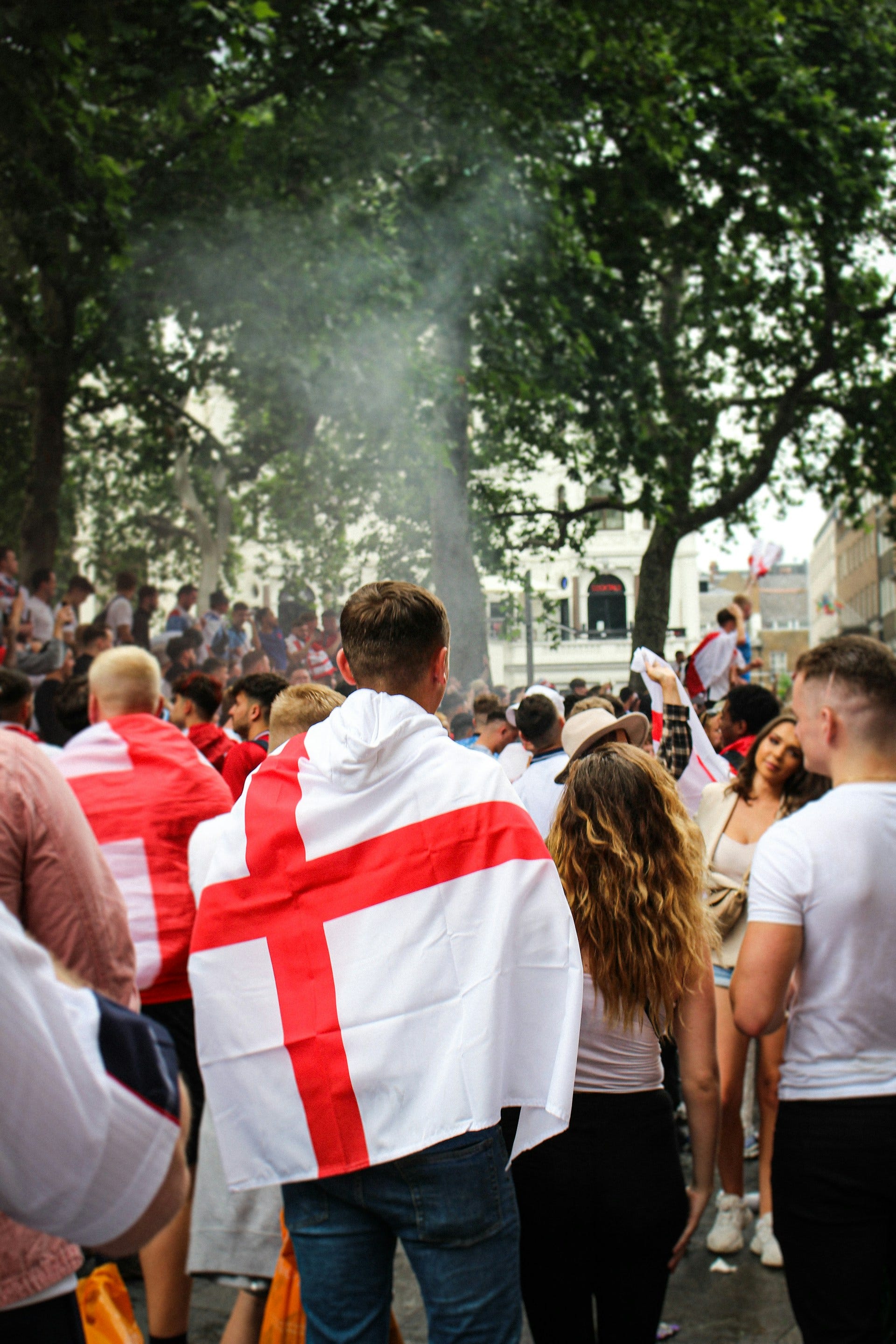
Credit: Photo by Ellen Kerbey on Unsplash
Neo-Christendom illiberalism
The Christian Right in the UK, or the ‘British Christian Right’, is a largely English phenomenon.[11] Andrea Hatcher diagnosed it as weak and leaderless in a paper published in 2023, but noted that ‘common cause with American actors and strategies is one area of success’.[12] As Francis Davis argued in 2026, the project of Christian nationalism in Britain is a campaign with transnational funding and backers which seeks the radicalization of English conservatism along the lines as has been seen in the United States and Hungary.[13] Established English Christian Right organisations like the Christian Institute (based in Newcastle upon Tyne) and Christian Concern (based in London) are now being joined by a variety of new groups and influencers, many apparently inspired or funded by Americans. These groups are illiberal, in the way Marlene Laruelle defines it, not due to their sympathy for authoritarian regimes, but due to their commitments to ideologies which stand in opposition to political and cultural liberalism.[14] Illiberalism is about the negation of liberal democracy and its neighbouring ideas (multiculturalism, multifaith society, and minority rights) as they emerged in the twentieth century.[15]
The enemies identified by the English Christian Right are overwhelmingly secularism and other faiths, especially Islam. What these groups seek to advance is commonly known as ‘Christian nationalism’, but this moniker conceals a grab-bag of traditional conservativism and instinctive patriotism, combined with anti-immigration and anti-Muslim discourse, whitewashed with some biblical proof texting. To add to this conservative and nationalist mix, many of the key figures are erstwhile neoliberals and protagonists of the New Right who promoted and benefitted from the resurgence of financial globalization and deregulation in the late-twentieth century. What appears to be ‘Christian nationalism’ is neither confessionally Christian nor doctrinally nationalist. Some of its activists may be described as ‘Far Right’ but most of its followers are better described as nostalgic. What we may call neo-Christendom illiberalism can be defined as the political discourse and movements aiming to reestablish a country shaped by putatively Christian values in opposition to cultural and political liberalism. To make some sense of this vision, we may differentiate between its funders, leaders, and intellectuals.
As with any political movement, it is worth starting with its funding. Evangelical, philanthropist, and financier Sir Paul Marshall is the most prominent donor, having bankrolled a collection of think tanks, media organizations, and church projects including Unherd, St Mellitus college, Holy Trinity Brompton (HTB), the Church Revitalisation Trust (CRT), The Spectator, GB News, and the Alliance for Responsible Citizenship (ARC). Marshall’s support for GB News is especially generous with over £100 million of debt accrued to him by the right-wing media organization.[16] What connects these diverse organizations – media and missional, conservative and libertarian, secular and religious – other than Marshall’s money? Some claim that the CRT is ideologically consistent with Marshall’s conservative media,[17] but the evidence for this is scant. Perhaps the one thing they share is a concern with renewal founded on a deep sense that this generation – of both church and state – has fallen short in comparison with the last. As Kemi Badenoch put it at ARC 2025, without such renewal, ‘our country and all of Western civilisation will be lost’.[18]
Marshall, a former Liberal Democrat who co-edited the pro-market Orange Book, appears to support both liberal and illiberal causes. It is not a contradiction to have an absolutist position on free speech and endorse social media posts which advocate for mass expulsions by the state to preserve European civilisation.[19] In his response to a March 2026 open letter from Christian leaders who questioned the £1.8 billion in investments in fossil fuels by his hedge fund and ‘attacks on climate science and action’ by GB News, Marshall claimed that it was he who was defending Britain by continuing to back fossil fuels.[20] For Marshall, immigration and net-zero are sources of civilizational decline.
Danny Kruger is perhaps the nearest thing that the English Christian Right has to a political leader. Kruger, the MP for East Wiltshire, claims that the country needs to be ‘saved’ and that it is the job of the ‘religion of the state’ to provides the values for such salvation.[21] In apportioning salvation as a political task, Kruger appears to veer to the idolatry of Nazi jurist Carl Schmitt who claimed that ‘secularised theological concepts’ sustain the state.[22] But rather than a well-established political theology, what we find in Kruger’s thought is a romantic paeon to Christendom. Take this extract from his resignation speech in an adjournment debate on ‘The Future of the Church of England’ to the empty benches of Parliament:
Uniquely among the nations of the world, this nation – England, from which the United Kingdom grew – was founded and created consciously on the basis of the Bible and the story of the Hebrew people. In that sense, England is the oldest Christian country and the prototype of nations across the west. The story of England is the story of Christianity operating on a people to make the institutions and culture that have been uniquely stable and successful.[23]
Kruger immediately caveats his ‘Christian nationalism’ with the claim that Christianity creates, ‘space for other religions under the Christian shield – a secular space’.[24] He denies that he seeks a ‘New Jerusalem’ in the state, a quest he associates with the Left,[25] and his earlier political writing in the post-Thatcher era contained a strong dose of neoliberalism. In a 2005 essay for a Tufton Street think tank he makes a case for hollowing out the state to allow for the flourishing of what he calls ‘moralisation’ and ‘localisation’.[26] A mixture of nostalgia and pragmatism appear to drive Kruger rather than a well-formed worldview. But if Kruger is not illiberal in principle, it is nevertheless hard to imagine an English government possessing the land and saving the people along the lines of the Hebrew monarchy without the use of force.
If there is an intellectual leader of the movement, it is James Orr, Cambridge philosopher, activist, Alpha course alumnus, and friend of J.D. Vance. Orr is a National Conservative, a group founded by the Edmund Burke Foundation. He advises Nigel Farage, and says that if the latter makes it to Downing Street he will have to do ‘very unpopular things’.[27] The Centre For A Better Britain – a thinktank which Orr initiated – justifies its existence in terms which imply a Christendom nostalgia: ‘Britain is simply broken’; ‘Like much of the Western world, our nation is in crisis’; ‘Reeling from the failure of liberal consensus’; by contrast, ‘Better Britain is a nation rooted in its identity, honest about its challenges, and ready to lead again’.[28] Orr’s sense of civilizational decline is reflected in his words to one journalist with regard to asylum seekers that, ‘no civilisation has invited invaders in and put them up in four-star hotels.’[29] While Orr has been presented as a Christian fundamentalist, paleo-conservative, and autocrat, he is not an aberration in conservative circles. He draws on thinkers popular among conservatives including Edmund Burke and Michael Oakeshott. What distinguishes Orr is what distinguishes Kruger and Marshall: first, their mission to arrest civilizational decline by re-Christianising power; second, their opposition to social and cultural liberalism.
Figures like Marshall, Kruger, and Orr are creating an illiberal movement which is increasingly mainstream in the elite networks of the political Right. None of them is authoritarian in a consistent and doctrinal manner but they do oppose liberal democracy in the way it has evolved in the last half century. Dramatic changes would need to take place – probably those associated with internal or external political violence – for their movement to form into a disciplined Christian nationalist party which garners popular support. Nevertheless, their illiberalism is real and arises out of their desire to impose a national singularity and uniformity on a society which is increasingly plural and diverse. Their movement has grown mimetically in competition with the post-Christendom secularism discussed below. As with most political movements it is much clearer about what it is against than what it is for. This poses challenges for those that seek to oppose it, for in doing so they may be adding more fuel to the fire.
The practical outworking of this illiberal tendency is perhaps most visible with respect to the public presence of Islam.[30] A recent example irrupted over the ‘Open Iftar’ held in Trafalgar Square at the end of Ramadan in March 2026. In a post on X, Conservative Party shadow minister Nick Timothy described the adhan (Muslim declaration of faith pronounced at iftar) as an ‘act of domination’ which is ‘not welcome in our public places and shared institutions’.[31] In effectively calling for the banning of iftar in public, Timothy claims that it is Islam which tends towards ‘domination’. His illiberal argument is acrobatically portrayed as a defence of liberalism. Similarly, Christian Concern’s Head of Public Policy, Tim Dieppe, was quick to support Timothy, noting that the public presence of Islam is, ‘a culture change that was not voted for or ever agreed to by the British people’.[32] Later in his article for Christian Today, Dieppe expands his criticism from liberalism to secularism. It is worth quoting him at length:
You can’t have a neutral public square where every worldview or religion has an equal space. This is actually an anti-Christian position which denies that the only true God is the Christian God. A secular state isn’t neutral either. It denies the truth of Christianity.
One worldview or another will have a privileged position in society. For centuries Christianity has had that position, and it has been for the benefit of all society – Christians or not. If another religion or worldview replaces Christianity in having that privileged position, then we will lose our Christian freedoms and values. This is already happening with decriminalisation of abortion up to birth, for example, and allowing men to claim they are women and violate women’s spaces for another.[33]
These are illiberal views which are neither ‘Christian Nationalist’ nor ‘Far Right’ but are widely held among many conservative Christians. So called ‘life’ issues – gender, sex, abortion – emerge from a neo-Christendom vision where the nation-state is understood to be a moral community, as opposed to merely the current basis for a limited and provisional government. The yearning for a return to Christendom is explicit in Dieppe and barely concealed in Timothy’s tweet.
The notion that ‘culture change’ is a matter to be controlled by government is both illiberal and entirely impractical without having an authoritarian state of the kind seen under fascism or communism. Government may fund and promote culture in a liberal democracy, but it is not its business to either orchestrate or prevent change and it has very few levers to do so in the era of globalization (see below). It is also arguably inconsistent with the Christian orthodoxy where government is to have the limited functions of passing judgment and approximating justice, not determining culture, constituting the nation, or saving the people.[34] Dieppe’s neo-Christendom stance against liberal secularism mirrors that of militant secularists of the French-style laicité who would agree with him that a certain governance of religion should be imposed. Dieppe’s apparent lack of confidence that Christianity shapes culture without state backing, combined with his confidence that Islam does, is odd when we consider he is an evangelical. It also appears to be in some contrast to his postgraduate work on Paul’s Areopagus address in Acts 17.[35] Where in the New Testament would Dieppe find Christ or the apostles calling on government to privilege a Christian worldview? Where does he find support for the idea of a bordered ‘Christian nation’?[36]
Post-Christendom liberalism
The preceding survey of the English Christian Right presents a movement which is not on the Far Right but close to the centre, prefers anecdotage of the nation over doctrinal nationalism, and has little or no basis in orthodox Christian theology. However, its opponents, whom Davis calls ‘mostly metropolitan Christian bien penseurs’, are arguably no less elite, nostalgic, and secularised.[37] While neo-Christendom illiberalism constitutes an English revivalist political movement, what we may call post-Christendom liberalism is less a movement than a discourse of renewal for a particular moment. This zeitgeist is that of the meeting of 500 years of established English Christendom with a radically secularised society. For a century, the church has relied on cultural esteem for the church and political inertia in government to keep these two forces in dialectical tension. Its ‘liberalism’ is narrow and limited. It is generally opposed to economic liberalism and is queasy about cultural liberalism. It’s split between theological liberals and conservatives. But its political liberalism is unwavering. Its commitment is to twentieth-century liberal democracy and its multicultural society which protected the rights of minorities, including religious minorities.
Deploying an idea from the Franco-American Christian thinker René Girard we might say that the two visions are in mimetic conflict over national identity. An ‘escalation to extremes’[38] occurs as the duel over the meaning of England goes back and forth, becoming ever more febrile. For example, Bishop Arun Arora’s rebuttal of Nick Timothy’s iftar tweet in The Guardian was in turn rebutted by Tim Dieppe. Arora argued for the multi-faith Britain that has emerged over the last half-century, quoting a speech by the late Queen Elizabeth II at Lambeth Palace in 2012, where she argued that the Church of England, has ‘a duty to protect the free practice of all faiths in this country’. Arora noted that, ‘we should draw on Christian values to reject such hate and to focus on what unites us’.[39] The C of E’s lead bishop for inter-faith engagement, Lusa Nsenga-Ngoy – in another post rebutted by Dieppe – spoke similarly on the church’s website for pluralism, for ‘the public significance of faith’, and against secularism understood as ‘the privatisation of belief’.[40] Most contemporary English Christians would no doubt agree with Arora and Nsenga-Ngoy about pluralism. However, opinion polls suggest that the wider English public are doubtful of the public significance of faith and comfortable with the privatisation of belief. It is not clear whether public statements like these shift the dial back in favour of post-Christendom or incite further mimetic rivalry with advocates for a new Christendom.
The vision articulated by the two English bishops is one of post-Christendom liberalism, which is predominant across the leadership of most of the English church, both established and non-conformist. There are many ideas and practices which are cognate with post-Christendom liberalism. They include ‘Judeo-Christian secularism’ (the idea that a secular society emerges out of late Christendom) and ‘Christian pluralism’ (academic ideas in support of liberal democracy and multiculturalism, often explicitly opposing integralism, dominionism, and other neo-Christendom ideas). ‘Christian democracy’ (more common in continental Europe but with some influence on the English political parties), ‘Christian socialism’ (instrumental in the founding of the Labour Party, but now a marginal force) and diverse trends of Christian liberalism and conservatism share the post-Christendom frame, support liberal constitutionalism, and defend the rights of religious and other minorities.
Most Christian Labour, Conservative and Liberal Democrat MPs also share this commitment to individual autonomy, as evinced by how few take an anti-abortion position and how many are openly for LGBTQ rights and expression. As such, post-Christendom liberalism may be defined as political discourse aiming to renew a country where Christian values inform government, protects minorities, and nurtures liberal democracy without seeking special privileges. The range of voices favouring this position has apparently shrunk in recent decades, but it remains a discourse of some breadth. We may explore it in terms of its organizational, political, and intellectual proponents.
While it is hard to point to a single important funder of the post-Christendom eco-system equivalent to the sizable role played by Paul Marshall, there is an extensive network of denominational bodies, representative groups (such as the Evangelical Alliance and the Joint Public Issues Team), and a panoply of Christian civil society groups. Once again, a broad range of ideological and theological positions are evident in support for post-Christendom liberalism.
Let’s take two recent examples. First, the William Temple Foundation’s (WTF) October 2025 collection of essays, Towards the Conversion of the Church of England by the Rest of England, is titled to deliberately invert the Christendom-styled title of its 1945 report and includes a range of Christian and non-Christian contributors. In a blog summarising the report, research director Chris Baker argues for ‘authentic approaches to Christian faith and English Christian traditions in ways that counter religious illiteracy about not only Anglicanism but religion and faith generally.’[41] Its recommendations include ‘Hold the Space for Dialogue and Discussion on What It Is to Be English’, and ‘Create New Coalitions across faith and secular partners’.[42] Second, the Evangelical Alliance (EA) of the UK has steered a similar post-Christendom path. For its director of public policy, Danny Webster, writing the cover article for Premier Christianity magazine in February 2026, the problem of ‘Christian nationalism’ is found not in trying to convert the nation but in the demand for political privileges in doing so.[43] These WTF and EA arguments are standard post-Christendom positions consistent with the pattern of the last half century as the church has been in retreat. They are unlikely to convince either ardent secularists or the neo-Christendom crowd.
In terms of political representation, Danny Kruger’s alter ego is perhaps Tim Farron. In their faith they may find a great deal in common, but Farron and Kruger occupy opposing positions on the question of faith in politics. It is Farron’s evangelical Christian belief that it is not the state’s business to shape public morality but that it is the state’s business to protect minorities from the impositions of the privileged majority. In his autobiography he argues that:
Christians who fear that their rights are under threat should therefore be instinctively inclined towards the liberal cause. And those who belong to other minorities should seek to defend the rights of religious minorities, especially when those minorities believe things that jar with their world view.[44]
However, Farron’s career history is one which challenges the notion that a post-Christendom liberal compromise can be maintained in the face of aggressive secularisation, religious illiteracy, and the retreat into communities of the like-minded. In 2017, he was forced to resign leadership of the Liberal Democrats after a long-running saga over his views as to whether gay sex was a sin. As Farron put it, he was ‘torn between living as a faithful Christian and serving as a political leader.’[45] His position was solidly a post-Christendom liberal one in that he maintained that faithful belief and national law must be kept apart. But what was possible in the late twentieth century was untenable in the twenty-first. He is now best known as a Christian who tested the tolerance of the Lib Dems,[46] and as a podcaster and writer on political issues for Premier Christianity. Kruger has appeared on Farron’s ‘Mucky Business’ on several occasions in conversations where mutual respect is evident.
If there is a thought leader of English post-Christendom liberalism, it is perhaps Luke Bretherton, Canon and Regius Professor of Moral and Pastoral Theology at the University of Oxford. His work provides a theological, internationalist, and pluralist account of liberal democracy, especially in his important 2019 book Christ and the Common Life. In this book he compares modern populism to ecclesial sectarianism insofar as both seek to essentialise ‘the people’ rather than accept the indeterminacy of what counts as nation or church.[47]
Bretherton is an important voice in the church and a thinker on the Left whose work stands in polar opposition to that of Orr. In a January 2026 address to the Church of England’s College of Bishops on ‘Christian nationalism’, Bretherton argued against importing the term from the United States, defended church establishment from the charge it is a form of Christian nationalism, and called for a new focus on opposing ‘anti-democratic, anti-pluralistic, and authoritarian styles of anti-politics’.[48] He is also a commissioner of the Independent Commission on Community and Cohesion which launched the National Conversation, a survey on community life, in May 2026.[49]
While Bretherton’s scholarship is highly insightful, innovative, and wide-ranging, there is a whiff of nostalgia for the second half of the twentieth century. Bretherton insists that politics ‘entails a commitment to conditions in which worlds of shared meaning and action can be created or sustained’.[50] Political violence and authoritarianism – both of which have been on the rise in the twenty-first century – are not politics as, for Bretherton, they do not generate a common life.[51] This is a normatively attractive claim which belies the many historical examples of violence and domination generating common life under conditions of authoritarianism, fascism, and communism.[52] Bretherton’s preference is for a different kind of polity which peaked in twentieth-century Europe: a social democracy characterised by ‘friendly societies, cooperatives, mutuals, credit unions, and social insurance’, which ‘enmeshes markets, economic debt, and property relations and superordinate forms of moral and political life’.[53] Unfortunately, it is precisely these forms of common life that have been deeply wounded by the turbocharging of global finance capitalism from the late twentieth century onwards.[54]
The parallels between the two opposing visions of England after Christendom suggest neither that they are equivalent nostalgias nor that the differences between them are minor but that they are generated mimetically. It is not that one is more secularised or more Christian, one more nostalgic and the other more rational, one extremist and the other mainstream. For example, there is no objective reason why English evangelicals (of which I am one) and conservatives (one of which I am not) would follow many of their American cousins and favour neo-Christendom illiberalism. Both evangelicals and conservatives may be found on both sides of the divide. The difference that matters is between the different ideas of the content and form of political community. Neo-Christendom illiberals prefer a bordered Britain and a relatively unchanging England where the Christian faith is privileged (circa 1945); post-Christendom liberals prefer a multicultural, internationalising, and progressing England where the Christian faith is in dialogue with others (circa 1989).
The two visions are not just for different times but appear to take different forms of nostalgia. Svetlana Boym distinguishes between restorative nostalgia for an imagined lost world to restore an exclusive community, and reflective nostalgia which recognises that such recovery is impossible, but which draws creatively from memory to explore hidden presents and therefore open up possibilities for alternative futures.[55] While neo-Christendom illiberalism is overwhelmingly restorative in its nostalgia, much of post-Christendom liberalism is reflective. Restorative nostalgia thrives in communities where there is what Paul Gilroy calls ‘postcolonial melancholia’. England is a global centre of such sentiment where ‘exceptionally powerful feelings of comfort and compensation are produced by the prospect of even a partial restoration of the country’s long-vanished homogeneity.’[56] Questions therefore arise as to why restorative nostalgia appears to be gaining ground over the more reflective vibe of post-Christendom England. To address these questions, we need to reflect on global processes and the dramatic changes to economy, technology and culture which have emerged in recent decades.
The Global After Christendom
One thing that most in this debate can agree on is that certain trends are placing in peril the whole idea of England or even Britain as a national political community formed in some part by faith. Thus, much bandwidth has been taken up by a debate over whether the church should accommodate or oppose these secularising trends. On the one hand, in their 2016 polemic, That Was the Church That Was, Brown and Woodhead worry that evangelicals’ fixation with Jesus is one of the reasons why the Church of England has become obsessed with internal debates and lost the country.[57] On the other hand, Francis Davis is concerned that Christian political thinking has retreated in accepting that the Christian religion is private, societal, and international while England is public, political, and national.[58] His powerful critique lands a few blows, including the failure of academic political theology to engage with the full extent of the academic study of politics,[59] and the weaknesses of Christian civil society and the churches in offering prophetic insight to a broken world.[60] He argues that academics, activists, and clerics in the post-Christendom mode tend to focus on building elite networks and coalitions rather than popular nationwide organizations and distinctly Christian platforms. This retreat from the national and political spheres by the post-Christendom crowd has opened the door for the neo-Christendom movement, he contends.
I partially concur with Davis’ diagnosis and would argue that his distinction between Left and Right reflects the late-Christendom divide outlined here. However, I disagree with respect to his assumption that politics is primarily a matter of party platforms and state policy – and thus that the failure of post-Christendom liberals to shape either is their political failure. For example, Webster, Farron, and Bretherton are all evangelicals of one kind or another,[61] and committed to pursuing the Christian gospel through various national bodies (the Evangelical Alliance, the Westminster parliament, the Anglican church, etc). They have surely learnt the hard way how difficult this is in a secularising context where faith continues but in an immanent frame. Their commitment to liberal democracy is founded in hard-fought civil society and parliamentary struggles. But advocates for a ‘Christan nation’ are no less secular as they demand the return to a form of political community which is alien to both the Bible and the medieval world. Their nostalgia for Christendom does not present an alternative to the secular but a confirmation of how far it has transformed public life. The intensified secular, its attendant economic force of capitalism, and its principal agent of the autonomous individual[62] also work against the formation of enduring collective agency: a new national ‘we’ group to replace the idea of the nation which formed under conditions of late Christendom when capitalism and individualism were much more constrained.
Here we arrive at the core issue of how to explain neo-Christendom illiberalism. American ‘Christian nationalists’ and ‘national Conservatives’, such as Stephen Wolfe and Yoram Hazony, argue that it is merely the re-emergence of a longstanding ideological tradition of conservatism dating back to figures like the sixteenth-century English Prayer Book warrior Richard Hooker and the seventeenth-century Reformer, Francis Turretin.[63] By contrast, critics point to the fact that today’s Christian Right is much closer to the libertarian and neoliberal strains of the ‘New Right’ of the late-twentieth century than we may expect. It is not that Friedrich Hayek and Ludwig von Mises were conservatives, nationalists, or populists; rather, it is that their neoliberal view of the economy remains hegemonic in the conservative tradition.[64] The elite men who once funded the New Right are now backing the neo-Christendom Right. The likes of Elon Musk and Peter Thiel appear content that their ability to accrue wealth and power on a global scale will not be threatened by the new populists’ nationalism, welfarism, or mercantilism. Even Hazony’s explicitly Judeo-Christian, scripturally covenantal, and hierarchical account of national conservative claims ‘limited executive power’ and ‘individual freedom’ as two of its five features.[65] How could this inchoate mix possibly be held together without autocracy?
The alliance of strongman rulers with the free movement of capital is a defining feature of our age from Pinochet to Trump. But it is not an easy sell to the electorate. In Brazil, partly due to its diverse evangelical base and their business interest, Bolsonaro’s ‘Christian nationalism’ was unstable and short-lived,[66] and his single term ended in criminality and incarceration. In Poland, a secularising state with a growing economy did not suffer the reactionary Law & Justice party for long and reverted to centrism under Donald Tusk. Trump narrowly avoided prison after the January 6th rebellion and faces an electoral reckoning at the midterms in November 2026. Even Orban, who has sought ‘illiberal democracy’ over his long-term rule in Hungary, has now been defeated electorally by a centre-right party.[67] Nowhere in the Western world has a decisive shift towards Christian nationalism and away from liberal democracy taken place without facing strong countervailing trends.
Where we have seen neo-Christendom successfully articulated in political movements it tends to be in the context of political violence – which has long been associated with both religious nationalism and authoritarianism. The quantitative shift – to more violence and autocracy – begets a qualitative one to virulent nationalism, civilizationism, and forms of religious fundamentalism. Russia’s war against Ukraine is legitimised through Russkiy Mir (‘Russian World’), a type of neo-Christendom civilizationism which takes a fascist form in present-day Russia. America’s support for Israel’s wars in the Middle East is formally overseen by Pete Hegseth who subscribes to Christian nationalism of, by Wolfe’s definition and acclamation, ‘a totality of national action, conducting of civil laws and social customs, conducted by a Christian nation as a Christian nation, in order to procure for itself earthly and heavenly gods in Christ.’[68] This is connotes a Christian theocracy which is quite different from the neo-Christendom vision of England surveyed above and would almost certainly need to be implemented by force. Several armed groups, such as the Lord’s Resistance Army in Uganda, have sought to impose Christian values in their areas of control by strongman rule. In England’s past, our closest experience of ‘Christian nationalism’ was around the time of the Civil War. Even in the seventeenth century it failed abysmally.
It is difficult to quantitively measure global trends of neo-Christendom; but we do have surveys of autocracy and of armed conflict. These are not encouraging. According to the leading political science dataset V-Dem, the world had 92 autocracies and 87 democracies at the end of 2025.[69] We might add that many of the democracies – including those where religious nationalism has gained ground, such as Modi’s India, Trump’s United States, and Putin’s Russia – have seen strong autocratizing trends in recent years. This reflects the overall drift since 2000 back towards the historical norm of authoritarian or strongman governance. It has been called the ‘great reversal’ and the ‘third wave of autocratization’.[70] With respect to armed conflict, similarly regressive trends are observable. A significant reduction in the number of conflicts and volume of fatalities in the second half of the twentieth century has been reversed over the last 20 years with ‘less restraint and increasing violence targeting civilians’.[71] The Gaza and Ukraine wars, which are respectively endorsed in Zionist and neo-Christendom visions, are the two most devastating armed conflicts of the last four years.
The presence of clear blue water between neo-Christendom illiberalism and its extreme form in violent and authoritarian Christian nationalism should not cause us to be wholly dismissive of their overlaps and connectors. Supporters of the revival of Christendom in England may find this associating of them with violence and autocracy to be overwrought. The difference between weak English neo-Christendom illiberalism and the more militant varieties found in violent and authoritarian places is both quantitative (differences of degree) and qualitative (differences of kind). However, authoritarianism which is nurtured in illiberal political practice and armed conflict often begins with intermittent street violence such as Far-Right terrorism and violent protests against migrants. Both are increasing in today’s England. The country has also seen a decline in its democracy score[72] and big increase in the perception of corruption.[73] Nevertheless, England remains far from the societal conditions that have fomented ‘Christian Nationalism’ in authoritarian Russia or the turbulent United States.
Conclusions: Nostalgia Will Not Save England
In commenting upon England’s national identity crisis and its flirtation with ‘Christian nationalism’ there is a danger of falling into a lazy binary. As Luke Larner puts it in response to the violence following the June 2026 release of the video showing policing failure in the awful murder of Southampton teenager Henry Novak,
Many of the well-meaning Christian commentators on current events seem to envision racist white populists on one side and some kind of generally liberal cosmopolitan middle-class identity politics on the other.[74]
What this essay has suggested is twofold: first, that the divide is only meaningful in the form of nostalgic political visions (not coherent political movements); and second, it is produced in the mimetic rivalry between elites (not just driven by objective processes of cultural, technological, and economic change). What these visions are mainly against is each other. Both are elite projects and, naturally, both rarely mention class politics.[75] They are both undermined by trends of globalization, the neoliberal gutting of the state, the dissociative and individualist tendencies turbocharged by technological change, and the increase of non-national political identities. Neither successfully articulates a viable vision of political economy where the basic human needs of both the white English poor and the UK’s recent immigrants are found to be in common.[76] Race and class must be foregrounded for England’s divides to be confronted. The reflective nostalgia of post-Christendom liberalism fails when it does not confront the racism and implicit class divides of neo-Christendom’s illiberal restoration project.
In conclusion, I wish to argue that better responses to this predicament will be properly apocalyptic not performatively catastrophising. The foreseeable future promises to be febrile, driven by mimetic rivalry over national identity within the Far Right as well as between Right and Left. Rupert Lowe, leader of Restore Britain, a new party with representation in parliament and which promises to return Britain to Christian values, said in response to the Belfast attack on a White British man by a Sudanese immigrant: that his party would ‘put murderous third-world savages to death.’[77] Thankfully, public support for such fascism is lacking, and the Right is riven by factionalism.
The nation-state also lacks, and has always lacked, the capacity and legitimacy to determine national virtues. In Christian apocalyptic terms this is good because the Kingdom of Christ is not bound by national identity or earthly borders.[78] Christians across the political spectrum are making new transnational post-Christendom political communities in England just as English neo-Christendom is being fomented by the borderless capital and ideas of the global Right. Ours is a time of accelerated precarity and change not a ‘crossroads’ where we can choose to return to a form of political community which is no longer viable.
What may come from post-Christendom? Is there a new grand bargain which may emerge? At this point I must recognise that this paper is as much a work of self-criticism as criticism. As a Christian intellectual and internationalist my work has not been ‘organic’ to my English working-class roots and has failed to exceed the post-Christendom frame and middle-class Christian sensibilities that I have critiqued above. My academic work provides little more than a diagnosis of part of the problem.[79] For visions of the future, I would look elsewhere. Alternative Christian visions perhaps take three broad forms. Each of them is emergent from the post-Christendom milieu but each extends beyond the mimetically driven debate presented above.
First, there is an internal and minority Anglican argument against the national church and for church disestablishment which has most recently been convincingly restated by Jonathan Chaplin.[80] There can be no such thing as a ‘national church’, for, in Nicholas Woltersdorff’s words, ‘[w]henever the church enters society, it destroys any religio-ethical unity that society may have possessed’.[81] Or in Christ’s words: ‘Do you think I came to bring peace on earth? No, I tell you, but division’ (Luke 12:51, NIV). Formal disestablishment is tempting to the Left – and part of the platform of the surging Green Party. It is also very un-English, difficult to implement, and as Chaplin admits, the ‘practical benefits for both church and state’ would be ‘modest’.[82] It seems unlikely that disestablishment can ignite a new debate about faith and national identity.
Second, there is the agonistic patriotism of Dietrich Bonhoeffer, who recognised the sin – in his case plots to assassinate Hitler – entailed in saving the nation and whose final parting words before his court martial in 1945 were, Keith Clements reminds us, ‘to an Englishman’.[83] For Bonhoeffer, the national is relative, provisional, and a ‘holding operation’ for salvation in Christ.[84] When a national government loses sight of that task it must be opposed. If a government with a neo-Christendom vision comes to power, faithful English Christians may be inspired by Bonhoeffer. This vein of thought is that which is most clearly emergent from the reflective nostalgia of post-Christendom liberalism which laments the loss of unifying forces of politics, culture and economy while recognising that a return to these conditions is impossible. It is an agonistic patriotism which characterises Bretherton’s address to the College of Bishops and the first paper of the Anglican General Synod’s Bishops’ Working Group on ‘Promoting Unity in Our Nation (England United)’ of June 2026, which includes Bretherton’s address as an appendix.[85] And yet the paper advocates more foodbanks and election hustings in churches and falls disappointingly short of recommending innovative new ecclesial practices.
Third, there is a basket of postcolonial and decolonial visions of England such as those of Oxford theologian Anthony Reddie and historians such as Paul Gilroy, John Darwin, Stuart Ward, and Nadine El-Enany.[86] As Ward puts it, ‘there is a link between the historical burden of imperial decline and the slow depletion of shared British sentiment.’[87] For Reddie, what we have identified as neo-Christendom illiberalism, is characterised by racism and xenophobia which were ‘lain dormant for a period of time’ but reignited by Brexit.[88] From this perspective, our institutions are fatally compromised by capitalism and empire; a progressive English futures can only be reconstructed after and through a full acknowledgement of imperial oppression and its contemporary afterlives. Al Barrett, in his response to ‘Promoting Unity in Our Nation (England United)’, takes issue with Bretherton’s narrow definition of politics which risks occluding differences between oppressors and the oppressed. Barrett suggests that ‘a more radical vision of “common ground” requires a move against the interests of the landed and propertied, to literally reclaim our land as common – for the rooting and tending and benefitting of all (whether of deeply-rooted English ancestry or more newly arrived).’[89]
All three of these discourses have been apparent in the English church for several decades. Arguably, all have shaped post-Christendom liberalism in its current form. What separates these three alternatives from the two nostalgic and dominant visions of England is that they are each, in some way, ‘apocalyptic’: they unveil the current crisis, anticipate change, and look to the future. They each recognise empirically that in the ebb and flow of church history England finds itself in a place where church and government are become more distant from one another. They also proclaim normatively that such distancing is good thing, which provides opportunity for the church to take its rightful position of witnessing to the nation, not becoming the nation. And yet none of them are yet to sketch out an innovative pathway to the future which offers a compelling vision in both theological and secular contexts.
As Clements, quoting Bonhoeffer, and lamenting the nostalgia of both Left and Right in the 1980s, put it with respect to British patriotism:
The British story is a complex and many textured drama and we have yet to decide which themes are the most significant for today and tomorrow. It is ‘how the coming generation will live’ that must determine how we draw upon, select, and put to use the items from our tradition. And put them to use is what we must do if Britain is not to become an island museum.[90]
It appears that future perspectives are still in short supply in England forty years later. It would be a mistake to think that any of these three visions has yet given birth to a movement which is transforming the debate of the last half century. Most likely, the struggle between neo-Christendom and post-Christendom visons of England will go on for some time yet. But let us not forget that these competing national nostalgias constitute one another in their rivalry and thereby risk an escalation to extremes. Every bishop defending iftar, every church leader appearing on stage with Stephen Yaxley-Lennon, is inciting their opponent as much as exciting their backers. As a matter of political strategy, careful liberals would be wise to pick their battles for the sake of not losing the war. There may not always be an England. If it’s lost, it will not be to a foreign invader but because of a long-term process of the reconfiguration of political identities in which we have all participated.
Thanks for reading Security After Christendom by John Heathershaw! This post is public so feel free to share it.
John Heathershaw is Professor of International Relations at the University of Exeter and research associate at the Centre for the Study of Bible and Violence. His research addresses conflict, security, and development in the Eurasian region and theological questions of global politics. John is co-author of Dictators Without Borders (Yale, 2017), The UK’s Kleptocracy Problem (Chatham House, 2021), Indulging Kleptocracy (Oxford, 2025) and principal investigator of several research projects about armed conflict and illicit finance. He holds a PhD from the London School of Economics (2007) and was awarded a senior fellowship of the British Academy in 2021/22. John regularly advises parliament and government. He is a founding member of the Academic Freedom and Internationalisation Working Group of the UK, which campaigns for transparency and accountability in universities’ international relations, and a member of the British government’s Anti-Corruption Strategy External Engagement Group. He is also an advisor to Dnipro Hope Mission, a Christian charity responding to the war in Ukraine, and Outreach Southwest, which works with asylum seekers and refugees in southwest England. John considers himself a perpetual student and is presently undertaking a second doctorate in Divinity via Bristol Baptist College and the University of Aberdeen. The prologue to that project is the book Security after Christendom: global politics and political theology for apocalyptic times (Wipf & Stock, 2024).
NOTES
[1] Thanks to those that provided comments on drafts of the paper including Al Barrett, Luke Bretherton, Jonathan Chaplin, Francis Davis, Steve Finamore, Nick Megoran, Helen Paynter, Carolyn Whitnall, and an anonymous peer reviewer. Its considerable limitations are entirely the responsibility of the author.
[2] For a summary of the debate in this context see Greg Smith, ‘Will there always be an England?’, Faith and England’s National Identities, 26 January 2026,
[3] Edoardo Campanella and Marta Dassù, Anglo Nostalgia: The Politics of Emotion in a Fractured West, Oxford: Oxford University Press, 2019.
[4] Taylor, The Secular Age, Cambridge, Mass & London: The Belknap Press of Harvard University Press, 2007, pp.20-21.
[5] This definition is unpacked and explored in John Heathershaw, Security After Christendom: global politics and political theology for apocalyptic times, Eugene: Wipf & Stock, 2024.
[6] For a discussion see Jenny Leith, ‘The Church and English Identity’, Faith and England’s National Identities,19 January 2026,
[7] YouGov, UK polling voting intention tracker, accessed 2 April 2026, https://yougov.com/en-gb/trackers/voting-intention
[8] Daily Telegraph, ‘Three quarters of Brits unable to name Great Britain’s three countries’, 19 November 2008, https://www.telegraph.co.uk/news/newstopics/howaboutthat/3486403/Three-quarters-of-Brits-unable-to-name-Great-Britains-three-countries.html
[9] YouGov Survey Results, 7 November 2024, https://ygo-assets-websites-editorial-emea.yougov.net/documents/Internal_ChurchofEngland_241107_publish.pdf
[10] James Graham, Dear England, Act 1, Scene 1.
[11] See: Andrea Hatcher, ‘The Christian Right in the UK’, in Gionathan Lo Mascolo (ed.) The Christian Right in Europe: Movements, Networks, and Denominations, Verlag Transcript, 2023; Francis Davis, ‘The Architecture of the British Christian Right: A Case Study in Political Capture’, Faith and England’s National Identities, 15 January 2026,
[12] Hatcher, p.372.
[13] Davis, op.cit.
[14] Marlene Laruelle, ‘Illiberalism: A conceptual introduction’, East European Politics 38, no. 2 (2022): 303-327.
[15] Fareed Zakaria, The future of freedom: Illiberal democracy at home and abroad, NYC: W. W. Norton & Co, 2007.
[16] Peter Geoghegan, ‘We need to talk about Paul (Marshall)’, Democracy for Sale, 8 March 2025.
[17] ‘The Billionaire, the Bible, and the Battle for Britain: Sir Paul Marshall and the Rise of Elite Evangelical Nationalism’, Byline Times, 29 March 2026.
[18] Geoghegan, ‘We need to talk about Paul”
[19] Ibid.
[20] Paul Marshall, ‘Focus on net zero policy is harming Britain’, Guardian letters, 30 March 2026
lhttps://www.theguardian.com/media/2026/mar/30/focus-on-net-zero-policy-is-harming-britain
[21] Danny Kruger, ‘Reforming Britain?’, https://www.premier.plus/a-mucky-business-with-tim-farron/podcasts/episodes/danny-kruger-reforming-britain
[22] Schmitt, Carl, Political Theology: Four Chapters on the Concept of Sovereignty, Chicago: University of Chicago Press, 1985, p.36.
[23] Hansard, ‘Future of the Church of England’, 17 July 2025,
[24] Ibid.
[25] ‘Danny Kruger: Reforming Britain?’, Premier Christianity, 9 December 2025, https://www.premier.plus/a-mucky-business-with-tim-farron/podcasts/episodes/danny-kruger-reforming-britain
[26] Kruger, ‘Love, money and time: how to grow civil society’, in John Tate (ed), What’s Right Now? Conservative essays on the role of civil society, markets and the state, London: Social Market Foundation, 2005, p.150.
[27] Iain Overton, ‘Shock and Orr: Meet the Farage-Supporting “Philosopher King” of British Authoritarianism’, Byline Times, 26 August 2025, https://bylinetimes.com/2025/08/26/james-orr-british-authoritarianism/
[28] Centre for A Better Britain, ‘How Will We Work?’, accessed: 2 April 2026, https://www.cfabb.uk/how-we-work
[29] Ibid.
[30] As Tim Winters has pointed out, while England does not have quite the bloody history of confrontation with Islam of some European secular states, this has not prevented its public articulation from causing controversy. Tim Winter, ‘Some thoughts on the Islam-and-England synergy’, Faith and England’s National Identities, 19 January 2026,

Nick Timothy MP@NJ_Timothy
Too many are too polite to say this. But mass ritual prayer in public places is an act of domination. The adhan - which declares there is no god but allah and Muhammad is his messenger - is, when called in a public place, a declaration of domination. Perform these rituals in
10:30 AM · Mar 17, 2026 · 7.27M Views
5.76K Replies · 10.7K Reposts · 49.2K Likes
[32] Tim Dieppe, ‘On the Iftar in Trafalgar Square’, Christian Today, 26 March 2026,
https://www.christiantoday.com/news/on-the-iftar-in-trafalgar-square
[33] Ibid.
[34] Oliver O’Donovan argues that salvation of persons and possession of the land are not tasks of Christian politics. The latter is defined by the exercise of judgment, primarily in warfare and in the economy. See: Oliver O’Donovan, The Desire of the Nations: Rediscovering the roots of political theology, Cambridge: Cambridge University Press, 1996.
[35] Tim Dieppe, Paul vs .the Pagans: The Apologetic Approach of the Areopagus Address, Dissertation submitted for the degree of Master of Arts in the University of Chester in part fulfilment of the Modular Programme in Kingdom Theology, June 2016, https://www.academia.edu/30291935/Paul_vs_the_Pagans_The_Apologetic_Approach_of_the_Areopagus_Address
[36] In a recent debate with post-Christendom liberal Christian leader Krish Kandiah, Dieppe proof couches his opposition to immigration by taking Acts 17:26 (‘And he made from one man every nation of mankind to live on all the face of the earth, having determined allotted periods and the boundaries of their dwelling place’) out of context to justify modern nation-state borders which would not have been imagined by Paul in his speech. This is an act of scriptural proof texting also deployed by segregationists in the United States and apartheid theologians in South Africa. See Krish Kandiah and Tim Dieppe, ‘Immigration & integration: A debate on how can we consider it wisely’, Evangelicals Now, 14 November 2025, https://www.e-n.org.uk/features/2025-11-immigration-integration-a-debate-on-how-can-we-consider-it-wisely/
[37] Davis, op.cit.
[38] Girard deployed this idea in his final and most apocalyptic book Battling to the End, East
Lansing: Michigan State University Press, 2010.
[39] Arun Arora, ‘There’s nothing sinister about Muslim prayers in Trafalgar Square. As a bishop, I reject the right’s attacks on worship’, The Guardian, 20 March 2026,
https://www.theguardian.com/commentisfree/2026/mar/20/muslim-prayers-trafalgar-square-nick-timothy
[40] Church of England, ‘Trafalgar Square iftar: Comment from the Lead Bishop for interfaith engagement’, 20 March 2026,
[41] Chris Baker, Towards the Conversion of the Church of England by the Rest of England, 8 October 2025, https://williamtemplefoundation.org.uk/towards-the-conversion-of-the-church-of-england-by-the-rest-of-england/
[42] Towards the Conversion of the Church of England by the Rest of England: A William Temple Roundtable, Temple Books, 2025, pp.78. 81.
[43] Danny Webster, ‘What’s wrong with Christian nationalism?’, Premier Christianity, 29 January 2026, https://www.premierchristianity.com/features/whats-wrong-with-christian-nationalism/20890.article
[44] Tim Farron, Better Ambition: confessions of a faithful liberal, London: SPCK, 2019, p.101.
[45] Sky News, ‘Tim Farron quits as Liberal Democrat leader over Christian faith’, 15 June 2017
https://news.sky.com/story/tim-farron-resigns-as-leader-of-liberal-democrats-10915873
[46] See also the case of David Campanale. https://www.churchtimes.co.uk/articles/2026/1-may/news/uk/lib-dems-admit-to-unlawful-religious-discrimination-against-david-campanale
[47] Luke Bretherton, Christ and the Common Life, Grand Rapids: Eerdmans, 2019, ch.13.
[48] Luke Bretherton, ‘What kind of thing is a nation? And what story should we tell about this nation?’, Address to the College of Bishops, 23 January 2025, High Leigh Conference Centre.
[49] See:
https://www.thenationalconversation.org.uk/
The co-chair of the Commission, Sajid Javid, when asked about what constitutes national identity on Radio 4’s Today programme, pointed to moments of togetherness and his childhood memory being dressed in red, white, and blue for the Queen’s Silver Jubilee in 1977: Today, BBC Radio 4, 18 May 2026, 0742, https://www.bbc.co.uk/sounds/play/m002whzf
[50] Bretherton, Christ and the Common Life, p.37
[51] He notes, ‘Politics is the name for generating this common life and the stark alternative to three other options. When I meet someone that I disagree with, dislike, find strange, or threatening, I can do one of four things. I can kill them. I can create a structure of domination so I can control them. I can make life so difficult that they run away. Or I can do politics.’ Luke Bretherton, A Primer on Christian Ethics: Christ and the Struggle to Live Well, Cambridge: Cambridge University Press: 2023, p.317.
[52] For example, the violent and totalitarian Soviet Union’s surprising capacity to form new and enduring nations is well documented and debated in the literature. See: Francine Hirsch, Empire of nations: Ethnographic knowledge and the making of the Soviet Union, Ithaca NY: Cornell University Press, 2005; Terry Martin, The affirmative action empire: Nations and nationalism in the Soviet Union, 1923–1939, Ithaca NY: Cornell University Press, 2018; Olivier Roy, The new Central Asia: the creation of nations, NY: NYU Press, 2005.
[53] Bretherton, Christ and the Common Life, p.356, emphasis in the original.
[54] For a discussion of the corrupting effects of the offshore financial system and deregulation in the city of London see John Heathershaw, Tena Prelec & Tom Mayne, Indulging Kleptocracy: British service providers, Eurasian elites and the enabling of kleptocracy, Oxford: Oxford University Press, 2025, ch.2.
[55] See, Svetlana Boym, The Future of Nostalgia, NYC: Basic Books, 2001. Thank you to Luke Bretherton for drawing my attention to this helpful distinction.
[56] Paul Gilroy, After Empire: Multiculture or Postcolonial Melancholia, London & NY: Routledge, 2004, p.93.
[57] Andrew Brown and Linda Woodhead, That Was the Church That Was: How the Church of England Lost the English People, London: Bloomsbury, 2016.
[58] Davis, ‘The Architecture of the British Christian Right’.
[59] Francis Davis, ‘The crisis in British Christian social thought: evidencing the need for a new “empirical political theology”’, Theology 2022, Vol. 125 (5), pp. 335–344.
[60] Davis, ‘The Architecture of the British Christian Right’.
[61] Bretherton describes himself as ‘Anglicostal’.
[62] This understanding of the secular is derived from Charles Taylor, A Secular Age.
[63] Yoram Hazony, Conservatism: A Rediscovery, Washington DC: Regnery Gateway, 2022, p.7; Stephen Wolfe, The Case for Christian Nationalism, Moscow, ID: Canon Press, 2022.
[64] Slobodian’s work should be understood in this way rather than in terms of his attention-grabbing title. Quinn Slobodian, Hayek’s Bastards: the neoliberal roots of the populist right, London: Allen Lane, 2025.
[65] Hazony, Conservatism, pp.30-1
[66] Amy Erica Smith, ‘Religion is shaping Brazil’s presidential election – but its evangelicals aren’t the same as America’s’, 26 September, 2022, https://theconversation.com/religion-is-shaping-brazils-presidential-election-but-its-evangelicals-arent-the-same-as-americas-190509
[67] Anita Komuves, ‘Once inspired by Orban, Hungary’s Peter Magyar now leads the charge to unseat him’, Reuters, 25 March 2026, https://www.reuters.com/world/once-inspired-by-orban-hungarys-peter-magyar-now-leads-charge-unseat-him-2026-03-25/
[68] Wolfe, The Case for Christian Nationalism, p.9.
[69] V-Dem Institute, DEMOCRACY REPORT 2026, ‘Unraveling The Democratic Era?’ https://www.v-dem.net/documents/75/V-Dem_Institute_Democracy_Report_2026_lowres.pdf
[70] Ibid.
[71] ACLED, ‘What’s driving conflict today? A review of global trends’, 11 December 2025
https://acleddata.com/report/whats-driving-conflict-today-review-global-trends
[72] V-Dem Institute, p.17.
[73] Transparency International, Corruption Perceptions Index 2025, https://www.transparency.org/en/cpi/2025/index/gbr
[74] Luke Larner, ‘Which side are you on? Reflections on the tragic death of Henry Nowak, state violence and the populist backlash’, 4 June 2026, https://roadsidemusing.wordpress.com/2026/06/04/which-side-are-you-on-reflections-on-the-tragic-death-of-henry-nowak-state-violence-and-the-populist-backlash/
[75] A notable exception is the work of Luke Bretherton, which has argued for the recovery of class analysis against a Left increasingly organised around a narrow and managerial politics of identity. See Bretherton, Christ and the Common Life, ch.7
[76] For an excellent recent attempt to link new economic ideas on the Left to Pauline political theology in the UK context see, Carolyn Whitnall, ‘From Garys Economics to Paul’s Apocalyptics: Thinking Theologically About Wealth Inequality’, 9 June 2026,
. On race and the church, see Owen Hylton, The Reconciled Church: rethinking race, reconciliation, the bible, and the church, TRC Publishing, 2025.
[77] See The Economist, ‘British politicians are racing to the hard right’, 10 June 2026, https://www.economist.com/britain/2026/06/10/british-politicians-are-racing-to-the-hard-right
[78] This is an important theme reasserted by the Churches Together in England resource, Kingdom over Nation, https://cte.org.uk/working-together/kingdom-over-nation/
[79] Heathershaw, Security After Christendom.
[80] Jonathan Chaplin, Beyond Establishment: resetting church-state relations in England, London: SCM, 2022.
[81] Quoted in Ibid., p.60
[82] Ibid., p.3
[83] Keith W. Clements, A Patriotism for Today: Love of country in dialogue with the witness of Dietrich Bonhoeffer, London; Collins, 1986, second ed, p.17.
[84] Ibid., p.49
[85] General Synod, GS2449, https://www.churchofengland.org/sites/default/files/2026-06/gs-2449-promoting-unity-in-our-nation.pdf.
[86] Anthony Reddie, Theologising Brexit: A Liberationist and Postcolonial Critique, London & NY: Routledge, 2019; John Darwin, Unfinished empire: the global expansion of Britain, London: Allen Lane, 2012; Stuart Ward, Untied Kingdom: A Global History of the End of Britain, Cambridge: Cambridge University Press, 2023; Nadine El-Enany, Bordering Britain: law, race and empire, Manchester: Manchester University Press, 2020.
[87] Ward, Untied Kingdom, p.3.
[88] Reddie, Theologising Brexit, p.30.
[89] Al Barrett, ‘Promoting Unity in our Nation’: a response (2)’, This Estate We’re In, Substack, 6 July 2026,
[90] Clements, A Patriotism for Today, pp.170-1.
No posts
Comments
Nothing yet. Say the first thing.
Sign in to join the conversation.