
His intent was that now, through the church, the manifold wisdom of God should be made known to the rulers and authorities in the heavenly realms.
Ephesians 3:10
When Pontius Pilate asked Jesus, “are you the king of the Jews?” he did not reply with a counteroffer that he would be happy to be archbishop if Pilate would be defender of the faith. There’s also no evidence that he slipped that suggestion to Peter when he said, “on this rock I will build my church” (Matthew 16:18, NIV).
Christ answered Pilate ambiguously. “Is that your own idea?” he asked. The Lord went on: “My kingdom is not of this world. If it were, my servants would fight to prevent my arrest by the Jewish leaders. But now my kingdom is from another place.” (John 18:33-36, emphasis added).
This is well-known scripture, but it seems we have not understood its full, hopeful, and deeply political meaning.
The title of “defender of the faith” dates from the sixteenth century and relates to the monarch’s role as the supreme governor of the Church of England. It is a historical artefact not a biblical warrant.
In the Sovereign Grant report 2025-26, Buckingham Palace released new language to accompany the title, reflecting King Charles III’s desire to defend “faith within the multi-faith nation”. The language of “defender of the faith” has fallen out of favour but the supreme governor’s role is retained.
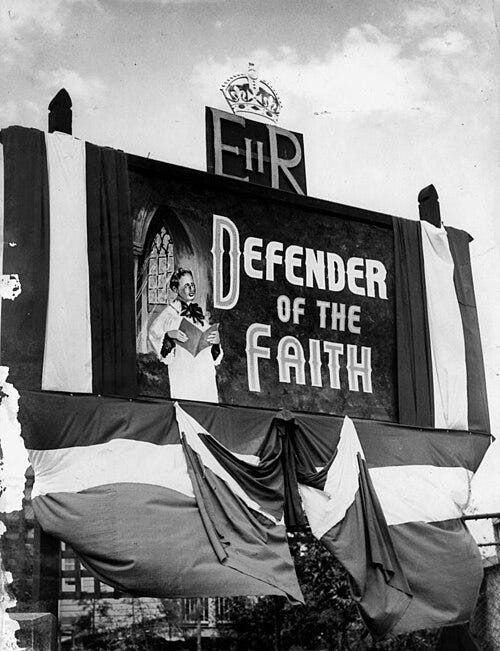
Church decorations in Vulture Street, South Brisbane for the royal visit in 1954. Contributor(s): Queensland Newspapers Pty Ltd, Public domain, via Wikimedia Commons
It is not my purpose to question the constitutional place of the Church of England here as this is a different and complicated matter. I’m more concerned with how evangelical Christians (like me!) understand defending the faith.
In an article for Evangelical Times, Carl Trueman laments the change of words as what he sees as a “decline in public Christianity”. It’s worth quoting him at length.
This shift in language is not a minor drafting choice. It points to a deeper problem at the heart of English culture. Not only does the new formula repudiate the idea that any form of robust Christianity played a positive role in English history; it also reveals that English culture now lacks the tools to negotiate the country’s current religious spectrum except through relativistic pieties of multiculturalism – pieties that the other religions of significance, most notably Islam, reject.
I’m sure that many evangelicals would agree with Trueman’s sentiment. The self-described “vexed vicar” Chris Wickland and other conservative Christians have expressed similar laments.
Thanks for reading Security After Christendom by John Heathershaw! This post is public so feel free to share it.
I would agree that there is a “deeper problem” here and have recently written about that problem at length. I do not agree with Trueman that the new language is a repudiation of Christianity’s role in English history. This is certainly not what Buckingham Palace says nor what was said in the coronation ceremony of 2023.
But my main issue is with the idea that public Christianity ought to rest on the state being more Christian and explicitly defending the state. I contend that this is his “own idea” (John 18:33), not a biblical or faithful idea.
As evangelicals we take biblical revelation as the primary source for a better story about the world. The idea of a monarch defending the faith is difficult to substantiate biblically beyond the Hebrew bible – the Old Testament scriptures which detail the life of the people of God before the cross and resurrection.
Arguably, desiring that the state defend the church is akin to negating the power of the Christ event. Jesus proclaimed the Kingdom of God but many political theologians write as if this proclamation has no political value.
On the one hand, Christ behaved in the opposite fashion to a King in emptying himself out (kenosis) on the cross just hours after he said those words to Pilate. On the other hand, he is a King but the one whose “kingdom is from another place”.
I’ve been thinking of this other place over this year as we’ve seen many Christians claim that Christ must be King in the UK and that Christians must be treated preferentially. It seems to follow for these people that if Christ is king of the whole world he must in some sense be king of England.
For me, this a fundamental error of a political theology which denies that Christ reinvented politics and political participation for his people, instead seeking a model of politics grounded in Genesis or the idea of a particular Christian nation state.
In some of the most political sections of the New Testament, a different kind of politics is sketched.
I’ve been reading Ephesians recently. Ephesians 6:10-20 famously speaks of Christians wearing the armour of God to struggle “against the rulers, against the authorities, against the powers of this dark world and against the spiritual forces of evil in the heavenly realms” (v.12).
This is the language of defence but it is not martial. The helmet is salvation and the breastplate is righteousness. The shield is faith and the sword is the spirit. The letter to the Ephesians is not calling for more spirit for us to kill more with the sword. It is calling for a different kind of battle and a different kind of kingdom.
This language is quite different to that of defending the state, but it is decidedly political. Some Christians take the references to spirit to understand the struggle as otherworldly and note verse 18’s command to “pray in the Spirit on all occasions”. But this comes at the end of a letter which is very practical and political.
Bearing this armour, for which community do we fight? Earlier chapters describe something like a “Christian nation” as a universal and political community (Eph 1:9-10, 19-22, 2:19-20; 3:10) which is formed not of a composite of Christian countries, but out of all nations (see also Psalm 47:8, Matthew 28:19).
These Christian people are contrasted to the folly of the “kingdom of the air” (2:1-2) and “fruitless deeds of darkness” (5:13) which may refer to work of nationalism and militarism - and perhaps also some foundationless progressivisms of the Left.
We may infer that expecting the state to defend the faith is fruitlessness of the highest order. States defend themselves and their earthly powers. That’s always been true, even when they declared a “crusade” against Muslims or when the king was happy to defend the one true faith, often at the expense of Christian dissenters.
The true Christian nation demands long-standing practices of costly discipleship (Ephesians 4:22-24, 31-32; 5:4, 6-7) and the transformation via over-acceptance of institutions such as patriarchy and slavery (Ephesians 5:22-24; 6:5-8). By loving our neighbour and our enemy we redefine human communities.
The deep hope that comes from this message is that demanding a state defender is a counter-productive and unbiblical basis for defending the faith. Public Christianity is expressed and defended by millions of acts loving others – whether they are Christian nationalists or Muslims – by UK Christians. That sounds like a robust way to negotiate the UK’s religious spectrum to me.
So, if we don’t want the state to defend the faith what do we want it to do?
The orthodox free church position is twofold. We would like the state to give us the freedom to be church. And we’d like it to act with justice towards the weakest and most vulnerable in society. In the modern era that may involve running schools, hospitals, and housing programmes. But it certainly doesn’t involve sanctioning a particular form of the Christian faith.
The Rev Dr Steve Finamore put it like this in a recent sermon on Ephesians 3: 10.
Our national structures may be useful
And our denominational institutions have their purposes
But the Church is far bigger than that – we easily forget that
It is the bearer of a gospel of universal reconciliation
This “universal reconciliation” happens despite - and sometimes against - not because of state attempts to define and defend a faith. The demise of the language of official protection is to be welcomed not lamented. The faith is not to be defended by the state, it is to be proclaimed by the church to the state as a completely different way of doing politics.
This short essay is cross-posted to the Substack of Better Story.
No posts
Comments
Nothing yet. Say the first thing.
Sign in to join the conversation.