
Dr. Drew Altman recently announced his upcoming retirement as President and CEO of the kff.org (formerly the Kaiser Family Foundation) at the end of this year. His tenure has been a long and distinguished ride. He is taking advantage of his final months to look back at some of the major KFF initiatives in which he was involved. Last week, he reflected on the organization’s decades long efforts to improve medical care and population health for all South Africans. It’s an untold story well worth understanding.
KFF first got involved well before the end of Apartheid in the mid-1990s. “We decided to get directly and heavily involved instead, helping South Africa prepare for and then build a democracy and a health system for the whole population. We trained leaders, built institutions, and supported a free press,” notes Altman.
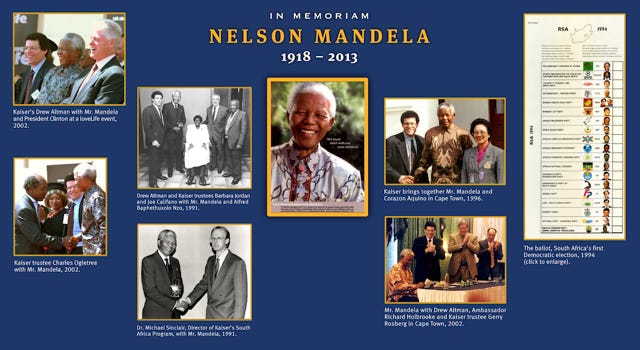
(KFF photo memoriam to Nelson Mandela)
One noteworthy moment involved a meeting with KFF Program Director Michael Sinclair and two KFF board members, former Congresswoman Barbara Jordan (D-TX) and former HHS Secretary Joe Califano, who “were asked to meet with a top general in the South African armed forces. The meeting took place in a hotel. After explaining their position on their nuclear weapons they had developed and eventually destroyed so as to not incinerate their country along with the ANC and its allies, and covering other territory distasteful to the general, he abruptly said, ‘Look, I want you to know that I don’t like what you people are doing in my country, and I am prepared to give my life to stop the blacks from taking over our country.’ Barbara, the great orator, sitting in her wheelchair, had not said a word in the meeting. She answered, ‘Well sir, we may just need to take you up on that kind offer,’ and wheeled from the room, ending the meeting.”
KFF played an essential role helping to facilitate the transition to black majority rule, training countless new officials for their government roles, working in tandem with newly elected leader Nelson Mandela who served as President between 1994-1999.
When Mandela’s successor as Prime Minister, Thabo Mbeki, refused to address the severity of the intense AIDS crisis in South Africa, KFF launched the loveLife program in September 1999. They worked with leading South African organizations and community organizations, media groups, including the South Africa Broadcasting Corporation (SABC), and foundations. “loveLife combined a highly visible and sustained national multi-media HIV education and awareness campaign with countrywide adolescent-friendly service development in government clinics, and a national network of outreach and support programs for youth. We set it up as an independent non-profit organization governed by its own board so it could eventually be folded into the operations of a friendlier government,” noted Altman.
Early in the South African government’s existence, the new government stated their goal to achieve universal health insurance for all, and including that commitment in their new Constitution. Despite repeated efforts over more than 30 years, including Mandela’s passing in 2013, that commitment remains unfulfilled. KFF’s involvement in South Africa was a difficult journey and well worth taking. I appreciate Drew Altman’s recollecting that engagement for all of us.
Comments
Nothing yet. Say the first thing.
Sign in to join the conversation.