
The 4th of July has never been among my favorite holidays. Too much unfiltered and unbalanced jingoism for my taste. Today’s New York Times article by Jason Farago tosses all those reservations behind in a spectacular online merging of uplifting text and mesmerizing photos: “The Most Iconic American Artwork Is the Hardest to See,” posted on July 2nd, has to be viewed online for best effect:
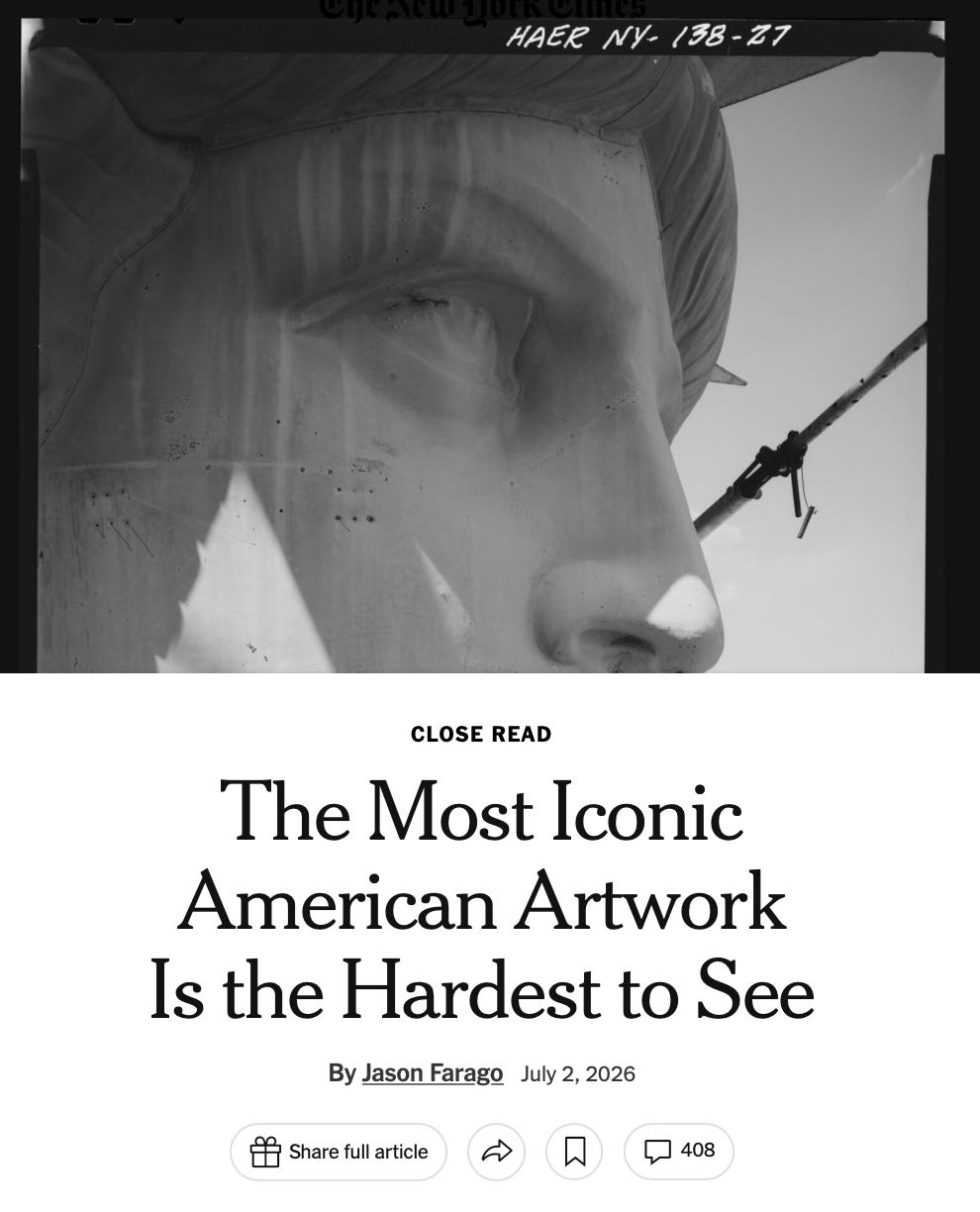
“…the most iconic work of American Art? A French sculpture, of course, assembled in Paris, and then again in New York harbor,” in 1886 at 151 feet tall. It is an Americanized image of the term “Liberté” and “(i)n French, the noun is feminine.” The conceptualizer, the designer, and the implementer was Frédéric-Auguste Bartholdi. The official name of the Statute of Liberty is “Liberty Enlightening the World.” Starting his thought process in 1865, Bartholdi and his French liberty compatriots “envisioned a gift, a really big gift for America’s centennial, one that will also rally their cause at home.”
Bartholdi first pitched his idea to Americans during his initial trip to the U.S. in 1871. In 1979, he received a US design patent for the statue. On July 4th, 1880, the statue was officially delivered to America’s ambassador to France. On October 28 1886, the Statue was formally presented as a joint gift by French and American people, installed on Bedloe’s Island in New York Harbor. So it was on that day that Lady Liberty became a naturalized US citizen!
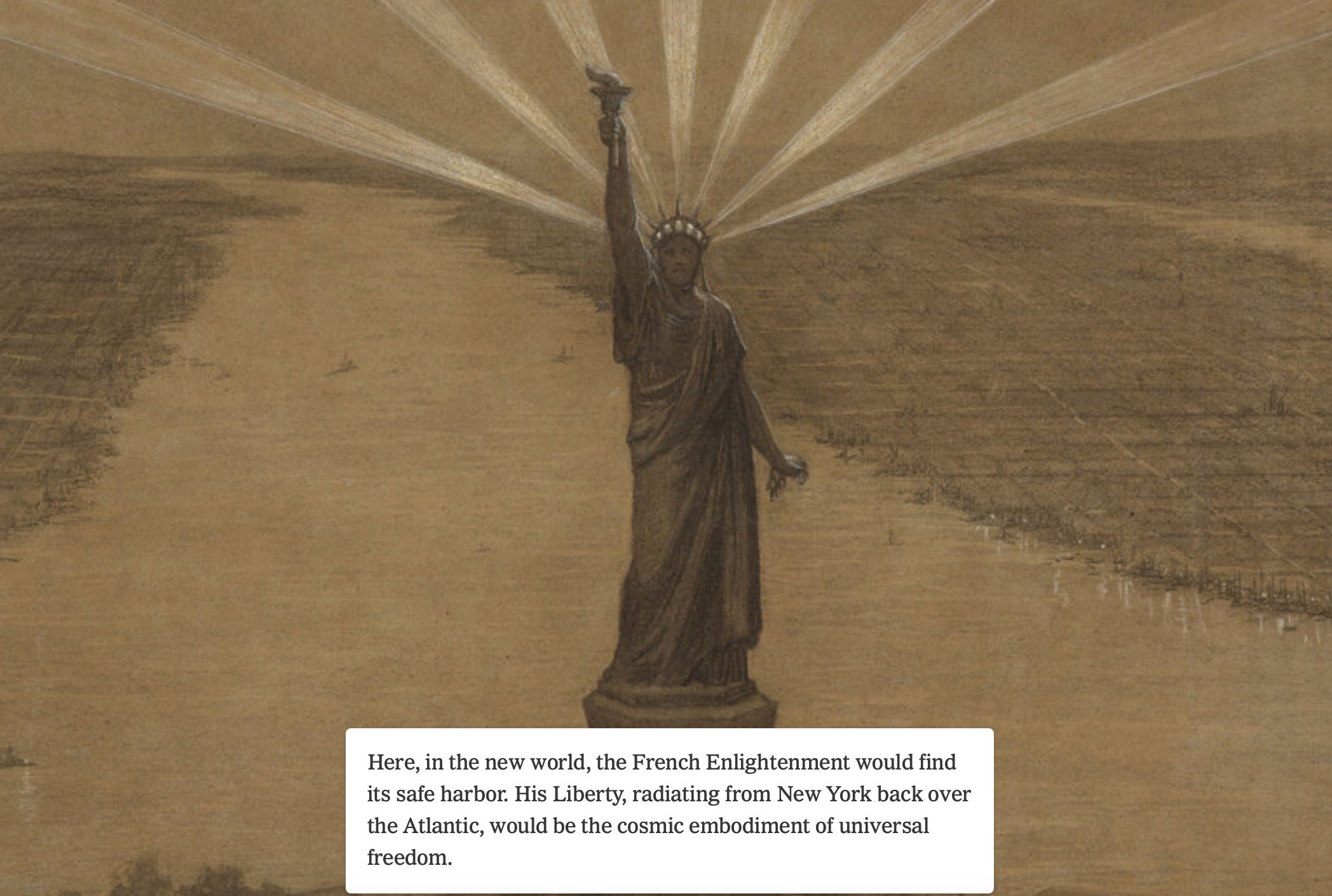
Bartholdi’s inspirations came from many quarters beyond France, including Egypt, Turkey, and other sources. Farago writes that “She was a metallic incarnation of France’s own republican rebirth” and “one of the greatest engineering feats of the 19th century.” Perhaps its only rival in that era was the Eiffel Tower in Paris which was completed shortly after using the same engineering strategies. “The Statue of Liberty is, as literally as I can say, an American Eiffel Tower.” In other words, the Statue of Liberty is the Eiffel Tower in a dress, built like an erector set with no weight carried by the statue’s feet.
In the wake of the US Civil War, Americans inaugurated the statue as a monument to freedom, “years before the US set up a depot for other immigrants on nearby Ellis Island … These arrivals … recast Liberty as an allegory of world wide welcome.” Emma Lazurus wrote her historic poem “The New Colossus” in 1883 to help raise funds to construct the statue’s enormous pedestal:
Not like the brazen giant of Greek fame,
With conquering limbs astride from land to land;
Here at our sea-washed, sunset gates shall stand
A mighty woman with a torch, whose flame
Is the imprisoned lightning, and her name
Mother of Exiles. From her beacon-hand
Glows world-wide welcome; her mild eyes command
The air-bridged harbor that twin cities frame.
“Keep, ancient lands, your storied pomp!” cries she
With silent lips. “Give me your tired, your poor,
Your huddled masses yearning to breathe free,
The wretched refuse of your teeming shore.
Send these, the homeless, tempest-tost to me,
I lift my lamp beside the golden door!”
At the end of Farango’s unforgettable piece, like Emma Lazarus, he reaches for the stars:
Life, liberty, the pursuit of happiness: the formula for democracy is a thing of multiple parts. At its core is nothing solid, just a framework, on which pieces brought across oceans would be conjoined. From many, one. …It is all matter of creative engineering. Of real and ideal. Of coming up with something meaningful, and then figuring out how to make it stand.
Happy July 4th, 250, everyone. This one I’ll remember.
Comments
Nothing yet. Say the first thing.
Sign in to join the conversation.