
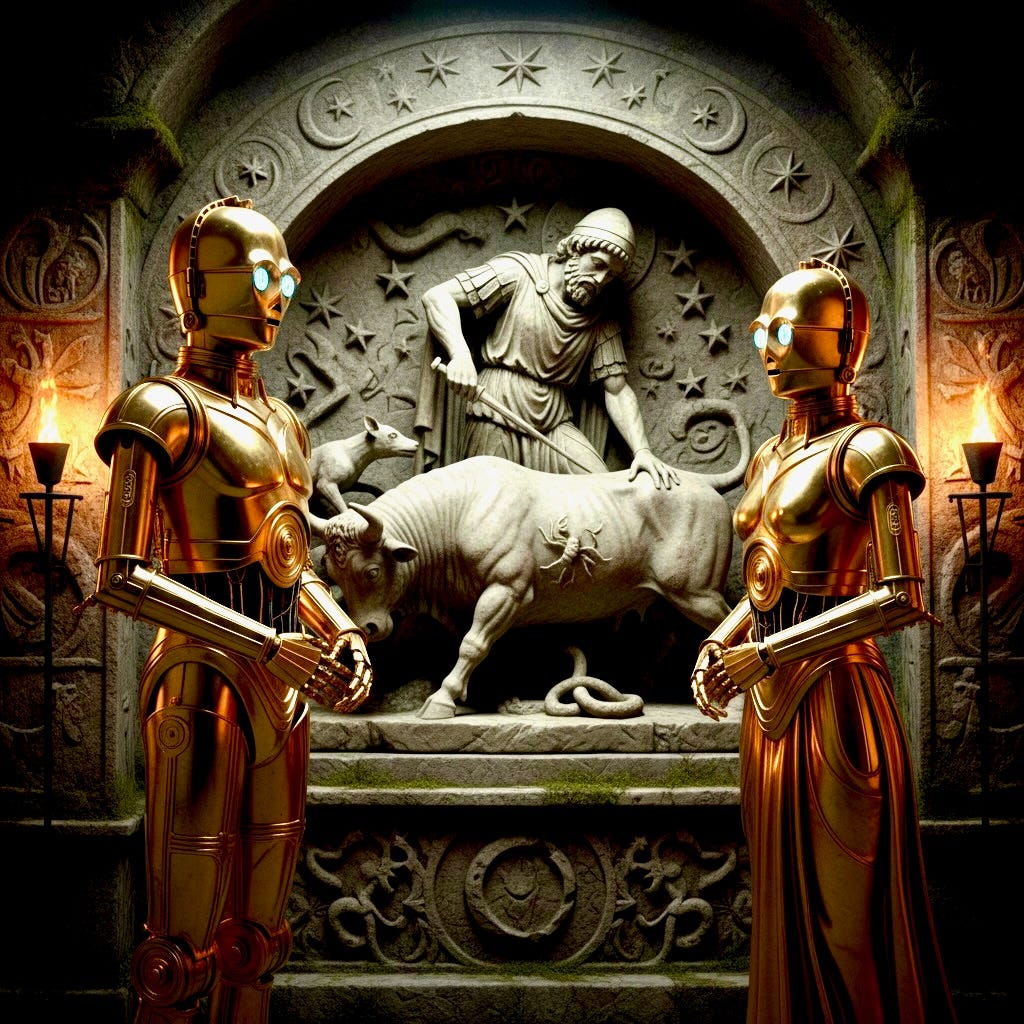
There is a weird form of vertigo you feel when standing seven metres below the pavements of the City of London. Not the vertigo of height, which I have suffered all my life, but its inverse: the ground opening downward through time, floor after floor, each one representing a century or two, until you find yourself in the third century AD while the twenty-first roars overhead, not just muffled but unheard.
Last week I went looking for precisely that experience, taking Gaia with me—our eldest daughter, who carries the name of the living Earth, and who walked with me through the streets of London and thence down through the dead layers of our home city.
As we progressed, a Paul Simon song sounded in my brain, exactly forty years old. Graceland. In it, “the Mississippi Delta was shining like a national guitar.” The song explained: “I’m going to Graceland, Graceland/Memphis, Tennessee.” And then: “My traveling companion is nine years old/He is the child of my first marriage/But I’ve reason to believe/We both will be received/In Graceland.”
Simon spoke of pilgrims with their families—and now here we were, pilgrims through time, peeling back layers of Earth, looking for evidence of where our world came from. Searching for a long-lost deity, just as Simon was in pursuit of an early god of rock’n’roll, Elvis Presley.
We were looking for Mithras. And just as Elvis had his roots, so did Mithras, based on the Persian deity Mithra, god of the sun, justice, contract and war. Now, descending in pursuit of an all-male cult that attracted Roman soldiers, government officials, merchants and freed slaves, the long-ago city planner in me reflected that all great settlements rise like this, layer upon layer, each age building on the flattened remains of the last.
As they rise, they unthinkingly bury the evidence of our part—all that labour, love, waste, and violence stomped down into the foundations of the next generation of buildings, roads and open spaces. London has done it as energetically as any city on Earth, which is why it is such a good place to look for what time has buried. I recalled the bomb found just feet from our London kitchen, dating back to the Blitz, the WWII one.
Entering the London Mithraeum, or rediscovered temple of Mithras, we probed the foundations of the local HQ of a company whose whole business revolves around the market—where the Bull is celebrated, the Bear feared. And the Beaver, of which more later, is generally ignored.
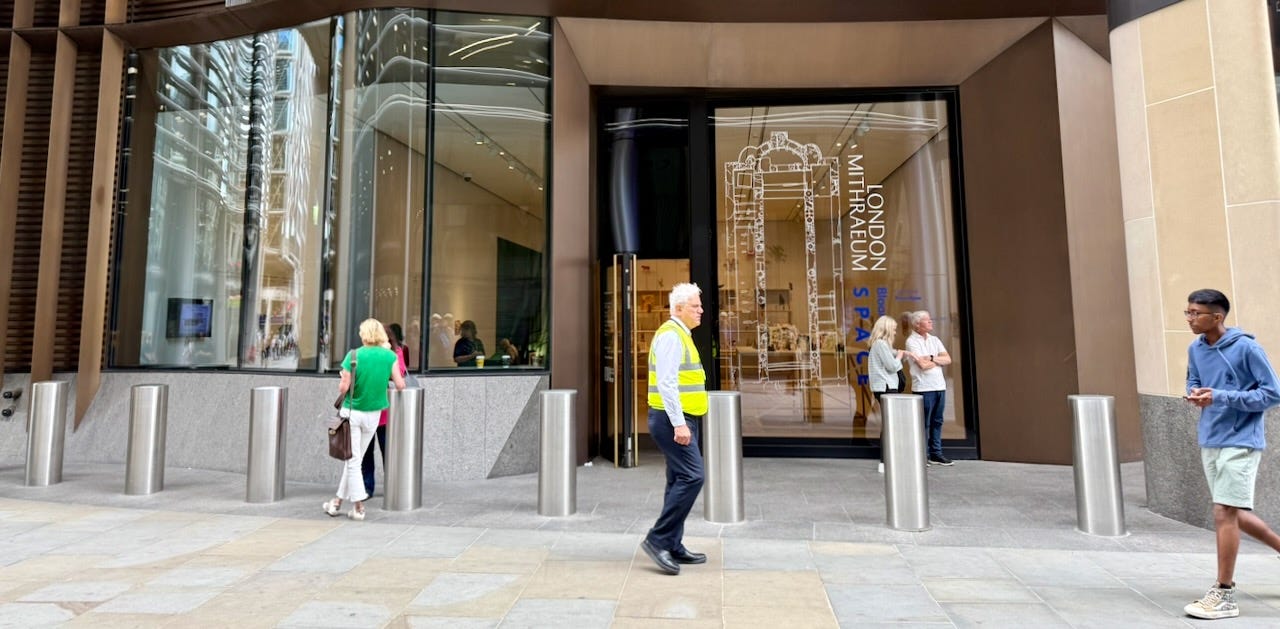
Seven metres beneath the building’s foundations, restored to roughly where it stood around AD 240, lies this local Roman temple to Mithras, the bull-slaying god. The cult’s defining image, carved on every altar, shows Mithras driving a knife into a sacred bull—which would then, it was said, turn into the Moon.
So, you muse, the bull is worshipped above—and slaughtered below. And a financial nervous system that moves prices around the planet at the speed of light thrums directly over a windowless cave where soldiers and merchants once made their way through seven secret grades of initiation, sharing their ritual meals in the dark.
The temple first emerged into our world in 1954, when archaeologist W.F. Grimes was picking through a WWII bomb site on the buried course of the Walbrook, another lost river that still runs somewhere beneath the pavements. On the dig’s last day, a marble head of the god surfaced, and the story, you might say, detonated.
Tens of thousands of Londoners soon queued in the rubble to see it—a pilgrimage to a religion unpractised for sixteen hundred years. Then, in an act that now looks like vandalism, the ruins were lifted, trucked a hundred meters away, and reassembled in 1962 on a concrete podium—imagine flat-pack furniture built without the instructions.
This is the other half of the pattern: if cities bury the past, it is often new buildings that keep dragging it back up. When Bloomberg bought the site in 2010, as a condition for the new building, they had to put the temple right. It has now been returned close to where it began, seven metres down, and staged as an “experience”—low haze, chanted voices, cones of light rising and falling to sketch walls no longer there.
Beautifully done, but unmistakably a staging, the original smells edited out. The reality the Romans knew was the dank odor of damp, bodies, smoke and blood, plus the reek of a sacrificed bull. What we got was a stage-managed atmosphere, curated for tourists and Londoners between meetings.
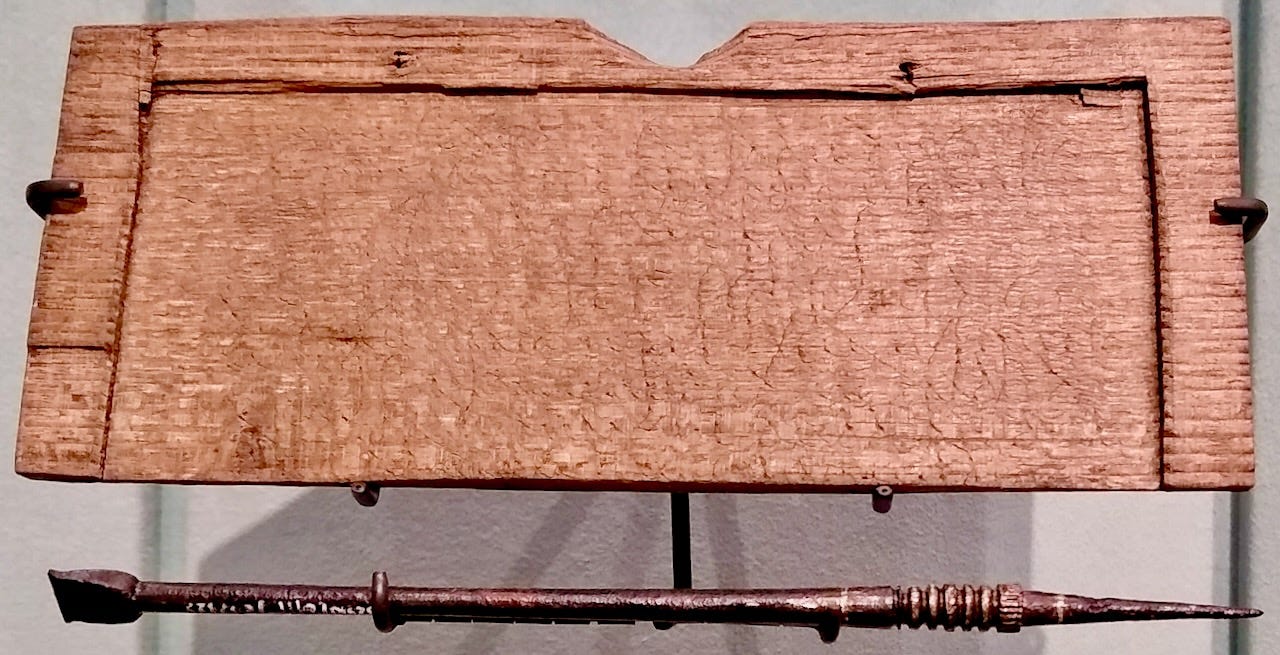
And here’s a detail that snagged my memory. When they dug into the site, the archaeologists also pulled more than four hundred Roman writing tablets from the wet mud of the Walbrook—the oldest handwritten documents ever found in Britain.
Among them is the earliest dated financial document in the country: a note from 8 January, AD 57, one Roman promising to repay another a sum of money—an IOU.
The oldest written reference to London by name—Londinio—was also found in that same hoard.
So directly beneath the headquarters of a company that sells the world its financial data, someone had buried, and the mud had preserved, the first surviving London debt.
When Benjamin Franklin observed that the constants of life were death and taxes, he should perhaps have added credit and debt to his list.
Next, on a whim, we walked north to the Guildhall. For the best part of a millennium, this has been a seat of civic authority. The medieval great hall, still standing after the Great Fire gutted it in 1666 and the Blitz burned it again in 1940, is the ceremonial heart of the City of London Corporation, a curious self-governing enclave whose autonomy, wealth and unbroken traditions predate Parliament itself.
This has always been the place where the City weighs its trade. As far back as 1640, the rules of the London hat trade required that any faulty or deceptive beaver hats be seized and carried directly to the Guildhall, to be judged by a jury. And directly beneath this monument to commerce and power we plumbed the depths again, this time into the ruins of London’s Roman amphitheatre.
It was built around AD 70, not long after Boudica had burned the young town flat. Some seven thousand people (at a time when the city’s entire population was between 20,000 and 30,000) could pack the banks around the amphitheater’s oval shape to watch gladiators, wild animals, and alleged criminals killed for sport.
The structure was lost so completely that historians spent a century arguing about whether London ever had an amphitheater, until it turned up by accident in 1988—when they were digging the foundations for a new gallery.
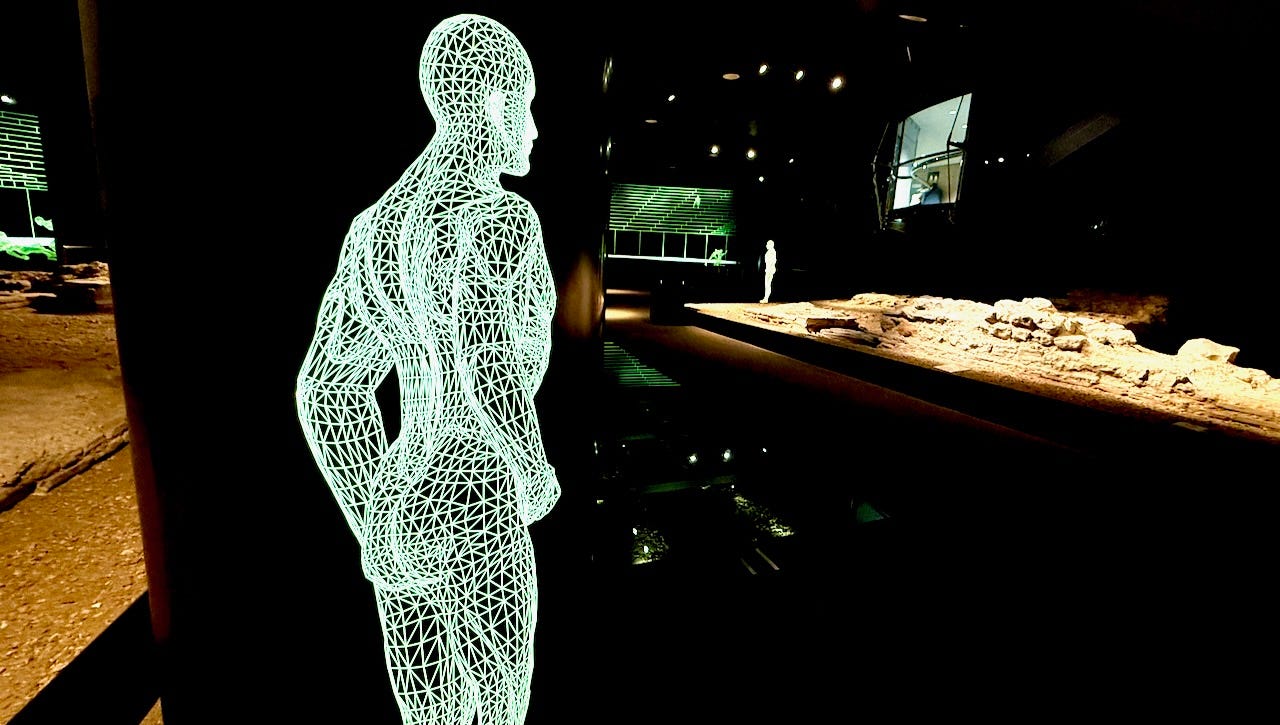
When you descend into the dim, cool room and turn onto a walkway above the actual stone thresholds and timber drains, worn black with age, green fibre-optic light throws the silhouettes of a phantom crowd onto the walls around you. The space marks a lost reality rather than reconjuring it.
Up in Guildhall Yard, back in the daylight, a curved line of dark stone is set into the paving to trace the original arena wall—drawn deliberately on the surface, so that the thousands crossing the square each day walk the rim of a killing ground, most of them completely unaware.
Still, I love it that our home city has reached this accommodation with deep time—with shining glass and steel towers soaring directly over the ruinous echoes of other ages, neither quite cancelling the other. Our nano-pilgrimage—down through the levels and the epochs and then back up into the daylight—felt like something that should be part of any modern education, for each and every age group.
Which is why I keep coming back to the framing of rewilding markets—and to the market role of the beaver. Both as a symbol and an environmental engineer. If the bull and the bear are the big beasts symbolizing the market’s rise and fall, the beaver should be our emblem of a third possibility: the regenerative economy. The keystone animal that does not merely take from a system but rebuilds it, bringing whole landscapes back into life.
The beaver, whose pelt those Guildhall juries once weighed, was hunted out of Britain’s rivers. And the global trade in its fur pushed the species to the edge of extinction across two continents—a buried cost if ever there was one. Now it is being let back, dam by dam, in probably the most powerful act of rewilding we know.
As you walk today’s city, you see occasional evidence that London’s wealth was built partly on two trades in the bodies of the living. From 1672 the Royal African Company, chartered and directed from within the City, shipped hundreds of thousands of enslaved Africans across the Atlantic—some branded with its initials—making London England’s first great slaving port, before Bristol and Liverpool.
The beaver trade ran on the same logic, with the Hudson’s Bay Company draining North America of its beavers for Europe’s hats. Yet only one is openly monumentalized: a golden beaver still turns as a weathervane above the company’s old Beaver House in Bishopsgate.
Our markets, too, involve magnificent surface architecture built on buried costs—the carbon, the extraction, the human grief paved over so the experience up top stays cool and frictionless. But buried things, as the Mithraeum and the amphitheater remind us, do not go away. They wait in the wet ground until the diggers come.
Tomorrow’s rewilded markets must be honest enough to keep all relevant costs in full view, both visible and priced. Like the beaver, they must give more than they take. Standing in the dark with Gaia, feeling the weight of all that accumulated time, I was reminded yet again about the historic debts—calculated in currencies like slaves, beaver, trees, whale oil, carbon and forever chemicals—that we remain sublimely unaware of. All the IOUs we chose not to read, understand and honor.
At least to date.
No posts
Comments
Nothing yet. Say the first thing.
Sign in to join the conversation.