
This is a largely spoiler-free review but depending on your sensitivity to such things, some of what I discuss here might be considered SPOILER-ISH.
What are the minimum requirements for a story?
(Not to give the game away, but it’s never a good sign when you start a review asking that sort of question)
The most basic element is incident: something happened and you’re hearing about it. In real life, that’s all you need — you ask your friend what they did over the weekend, they tell you. But in fiction you need a little more to leave an audience feeling satisfied. You need emotion, character, passion, irony, theme: all of the things that turn a story from a skeleton of a plot into something dynamic and meaningful. If I relay the plot beats of, say, George Lucas’ 1977 film Star Wars to you, you might acknowledge that it sounds like a good outline for a story. But watch the film itself, see how the characters change and grow, experience the emotion and texture of the story, and suddenly it becomes something much more than a chain of events. It’s a real story, a great story.
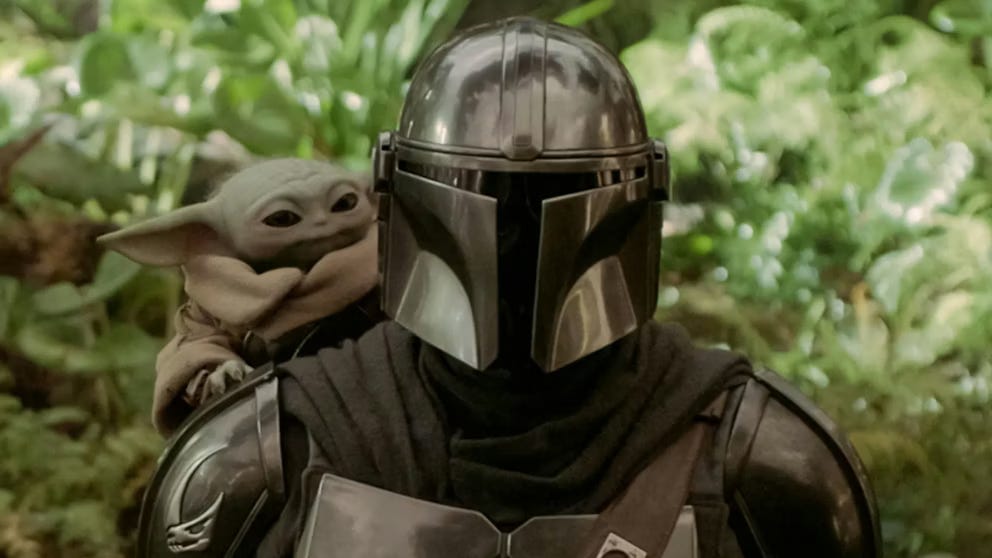
The Mandalorian and Grogu, the first Star Wars film in seven years, is rarely more than a chain of events, a relentless series of “and then…”s in which the characters hardly grow, change, or even express much emotional investment in what’s happening. The film is based, of course, on the Disney+ show The Mandalorian, and it’s already becoming a cliche to say that it feels like several episodes of that show smushed together to reach feature length. But the problem with The Mandalorian and Grogu isn’t that it’s just a long TV episode: it’s that it’s a mid-season filler episode, where little is gained, nothing is lost, and the characters remain in largely the same place (emotionally/character arc wise) between the opening and closing credits.
If this were episode 7 of a 13 episode run, it would be perfectly acceptable, even enjoyable. In a two-plus hour movie, it’s unforgiveable.
Before I get into my issues with The Mandalorian and Grogu (and, to be fair, the things I liked!), let’s do a quick rundown of those incidents: Din Djarin, the titular Mandalorian (Pedro Pascal), is a planet hopping bounty hunter, a steely professional who doesn’t waste words where a curt nod will do. Grogu is an adorable puppet who everyone still calls Baby Yoda even though Disney keeps sobbing and stamping their feet and saying “He’s GROGU! His name is GROGU!” They have a Lone Wolf and Cub situation, with Mando (as most people call Djarin) serving as a surrogate father. They travel around the galaxy, capturing (or killing) criminals for money.
In the film, which takes place about eight years after Return of the Jedi (1983),1 the pair are working for the New Republic — at this point still basically a provisional government following the fall of the Galactic Empire. The Empire, as we see, hasn’t fallen so much as shattered, with regional governors and warlords carving up territory to create their own private fiefdoms. Mando is hunting these guys in particular, at the behest of Colonel Ward (Sigourney Weaver). Early in the film, visiting her at the New Republic airbase on Planet Monterey Beach,2 he receives his next assignment: track down Rotta the Hutt (Jeremy Allen White), son of the late and unlamented Jabba, and return him to his aunt and uncle, crime bosses called the Twins, in exchange for the location of an ex-Imperial officer. Naturally, complications ensue. Rotta has no interest in returning home: the hunky Hutt is making a name for himself in brutal gladiatorial matches, and wants to chart his own course, out of his father’s shadow.3 He offers to help Mando capture the aforementioned ex-Imperial in exchange for his freedom.
“Ah, okay,” you’re saying, “so the movie is about Mando, Grogu, and Rotta teaming up to take down this semi-mysterious villain while also finding a way to help Rotta maintain his freedom.” Well, no, that’s just the first half. In the second half, the Mandalorian is captured by the vengeful Twins and poisoned. It falls to Grogu to save him.
As I said earlier, just summarizing the events of a story doesn’t give you a fair sense of the story itself. Certainly there’s more to it when you’re experiencing, feeling, this story alongside the characters and watching them grow and change, right?
Unfortunately, no. The Mandalorian and Grogu wisely doesn’t require you to be too steeped in Star Wars lore to follow the story (not a Darksaber or mythosaur in sight), but it also does nothing that would disrupt the status quo of the series. I don’t necessarily fault them for that: developing the plot in any major way in a standalone movie could potentially alienate both casual and devoted viewers. And one of The Mandalorians’ chief pleasures, especially in its first season, was its ability to tell exciting, self-contained stories in the Star Wars sandbox. On paper, this approach makes sense.
But if you’re going to tell a story at feature length, you need more of a reason than “longer action scenes.” Just because the plot can’t grow doesn’t mean the characters can’t. The Mandalorian and Grogu nods at this, vaguely, with a quasi-theme of Mando worrying about what will happen to Grogu (whose species is, naturally much longer-lived than humans) when he’s no longer around to protect him. Except you never actually see him worrying about it: a couple of other characters comment on it, and you’re left to infer it’s something he’s been thinking about. You get the sense that there used to be more of that in an earlier draft of the film, perhaps providing an actual emotional spine to the narrative (and echoing Rotta’s own father/son angst). As is, it’s a few lines here and there, and the idea is much more told than felt.
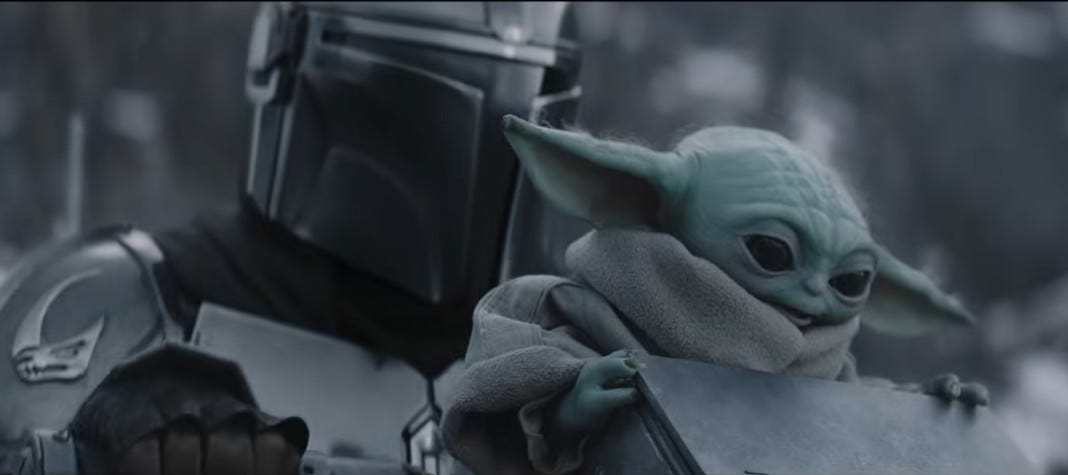
The one exception is also the film’s best section: when Mando is out of commission and Grogu has to fend for himself. We see him use his burgeoning Force powers and ingenuity to protect Mando from roving hunters and the elements, make a connection with a gator-man played by Stephen McKinley Henderson,4 and eventually save the day. It’s pretty fun! It includes the best joke in the movie, and was definitely the section that my kids (who, overall, enjoyed this much more than I did) found most engaging.
This is good story. We’re seeing a character we know and care about face a new sort of challenge. That creates drama, and the way he goes about addressing it shows how he’s grown, what he’s taken from his various teachers (specifically Mando). At the end of the film, the Mandalorian seems more willing to accept Grogu as an emerging partner and not just a child who needs his protection. If this were a single episode, it would be pretty good! But at this runtime, and with so much lifeless CGI nonsense around it, the emotion gets diluted.
I’m also not claiming, as some have, that Star Wars needs to be epic in scale. Not every movie has to be about saving the galaxy. But the stakes of each movie should feel that big to the characters. Until things take a more perilous turn in the third act, The Mandalorian and Grogu is very much just another job for these guys, which made it hard for me to care about any of it. You know that they’re not going to kill off either of our leads (unless you’re one of those extremely credulous people who thought that, like, Spider-Man was actually dead forever after Infinity War) so there needs to be something else they stand to lose if the film wants us to feel any sense of drama at all. Also, self-contained doesn’t have to mean small. Look at the Indiana Jones movies! He’s out there running into Hitler and seeing (well, not seeing) the spirit of God’s Vengeance, but you can watch the original three movies in any order and be totally fine. They’re good stories, and that counts for a lot!5
I have more to complain about: the dialogue is dreadful,6 the characters are flat (as so often happens in these tentpoles, everyone is just sort of snarky and that stands in for personality), the action scenes are confusing and listless, and the performances are phoned in (even Pascal doesn’t give you much, blurring the line between “stoic badass” and “guy who’s extremely disengaged”). There’s also stuff I liked: any and all puppet shenanigans (including the Anzellans and the Phil Tippett guard droids), the look of Space Chicago (Shakari). Ludwig Göransson’s score is fantastic, lending scenes far more drama and power than they would otherwise earn. Scorsese gives a more committed performance than half of the main cast in a cameo role as an Ardennian food truck operator. I went into a little more detail about all of that over on my Letterboxd.
I’m not trying to nitpick. I love Star Wars and believe it’s worth taking seriously as a story. My brilliant friend Eric A. Clayton wrote a whole book about how Star Wars can deepen your spirituality and, as I’ve possibly mentioned before, I have a book coming out about how watching movies in general can bring you closer to God. I believe movies, and stories in general, matter — even corporate megaliths like Star Wars. And part of taking a story seriously is being able to engage seriously with it as a piece of art, which means being able to identify where it falls short.7
And let’s be honest: Star Wars hasn’t always been well-written. Star Wars hasn’t always been well-performed, well-shot, or made perfect narrative sense. But, for me, it usually overcome those weaknesses through the power of good story. When the story is good, when I believe in the characters and the emotions and the stakes of the story, then I don’t care that people’s accents keep changing or that no one can pronounce “Han” the same way or that the special effects look fake. Those flaws can even be charming.
But increasingly, it feels like Star Wars has lost the ability to do even that. So much of the franchise’s recent output have been exercises in nostalgia bait and Easter Egg spotting. The main thrill they can deliver is the thrill of recognition. Even the positive reviews I’ve heard of The Mandalorian and Grogu are backwards-looking: “It’s like Season 1 of The Mandalorian!” The snake is eating its own tail, here. This is what makes Andor work so well: the creative team is invested in making it a great story, first and foremost, not just IP management.
I think, buried deep inside The Mandalorian and Grogu, there is a desire to tell a story: one about parenthood, fathers and sons, growing up and letting go. But something (I’m going to guess a corporate mandate to make it more blandly accessible) doused whatever genuine narrative spark this might have once possessed. So instead we get the grown-up version of a character from a cartoon movie,8 a choppy fight scene based on something you’ll recognize from A New Hope, and a lot of callbacks to ships and gear you know from The Mandalorian itself.
If that’s the future, it’s a grim one: a Star Wars that can only remind you of good stories, not tell them.
That’s 12-13 ABY, for the real freaks.
The Mandalorian and Grogu is the first Star Wars film to be shot entirely in California and it shows.
He’s also aware that his aunt and uncle obviously plan on killing him because of his claim to the throne. Why they would bother is a little mystifying, since they already seem to be comfortably occupying “the throne” and there doesn’t seem to be anyone agitating for a trueborn son of Jabba to relieve them of the regency; we’re also talking about a Mafia don role, not a hereditary monarchy, but anyway.
Completely off-topic, but I’ve been listening to Merrily We Roll Along a lot recently — my 10-year-old is really into it, we’re very normal at my house — and I’m realizing I never got how funny it is that a high school is doing it in Lady Bird. “They didn’t get it.”
Except Temple of Doom, which is a mess, no matter what the contrarians want to tell you.
More than just being cliche-ridden, it often fails at the sentence level. At one point Mando growls “I won’t repeat myself again.” My other favorite example is Rotta’s repeated determination to “be [his] own man.” He’s not a man, he’s a jacked alien slug! Would “be my own person” really have sounded that much clunkier? Maybe you didn’t find this silly and distracting, but based on reviews I’ve read I’m not the only one who did!
I should also note that I never feel the need to clarify this except with Star Wars, which doesn’t speak well of us Star Wars fans.
Star Wars: The Clone Wars, which was literally three episodes of TV smushed together to create a movie.
No posts
Comments
Nothing yet. Say the first thing.
Sign in to join the conversation.