
Last time, in “Writing Across Difference Is Just Writing Well,” I made the case that writing across difference isn’t some special, risky category of fiction. It’s just fiction, done well—and done well is the hard part, no matter who your character is. Worth a look if you missed it, for the fuller picture, though this post stands fine on its own.
When writers on panels get asked how to build a character different from themselves, especially one from a traditionally marginalized community, I often hear the same advice: do the research. Talk to someone who’s lived it. Read books by writers from inside that community. Learn the history. It’s good advice. It’s just not where you should start.
The first thing you need to research is yourself.
Author Alexander Chee makes this point in a piece he wrote for Vulture about unlearning the habits that shape how we write the “other,” and he describes the first step in self-research with clarity:
We write what we believe a story is, and so our sense of story is formed by the stories we’ve read. But for most of us, the stories we hear are the first stories that teach us. Stories from family. Stories in the news. Stories we’re taught at school. Gossip, trash talk, and jokes, which are the shortest, complete form of narrative. How you grew up, who you grew up with, how you know them. All of this affects what you think is real, and whom you think counts as human—which, in turn, affects how you write stories.
That’s really the whole argument. Before you write a character from a community you don’t belong to, you need to know what your own community already told you about that community, and just as important, what it never told you at all.
I’ll give you a personal example, the kind of thing I ask my students to dig up about themselves. One of my middle names is Kipling, after Rudyard Kipling, who wrote The Jungle Book and also “The White Man’s Burden,” a poem urging the U.S. toward the same colonial project in the Philippines that Britain had been running elsewhere for decades. My mother loved Kipling’s stories. She actually wanted Kipling as my first name—I could have been Kip Copenhaver, but my father said no. (If I’d been Kip, I’m sure I’d have had a killer forehand, looked sharp in tennis whites, and grown a luscious mane of hair, but I doubt I would’ve written a word.) When she named me, she wasn’t thinking about the violence behind those stories. She’d been protected from ever having to think about it. That’s the inherited blindness Chee is describing, handed down without anyone meaning to hand it down.
My schooling didn’t do much to correct it, either. At my prep school in the early 1990s, I read two books by Black authors and four by women across four years of English class, and every one of those authors was dead except Alice Walker, Tom Stoppard, and Edward Albee. Nobody mentioned that Albee, Walker, and Tennessee Williams were gay. A trans author, a book that dealt seriously with disability—neither was on the syllabus, nor on anyone’s radar that I remember. My imagination formed almost entirely around books written by and about dead straight white men. So it’s no surprise that my MFA thesis—a novel that will stay on the shelf forever, thank God—had no LGBTQ+ characters, at least none who were queer on the surface, and nobody who wasn’t white. I didn’t notice the absence until I went looking for it.
That kind of noticing doesn’t stop once you’re out of school. For several years, I chaired a high school English department outside Washington, DC, and before I could lead that department toward decentering whiteness and straightness in our curriculum, I had to do the same work on myself again, this time as an adult with some actual power to change what students were assigned to read. I had to take a hard look at what my own family and community had reinforced in me. Research starts with you, and apparently it doesn’t stop after one round.
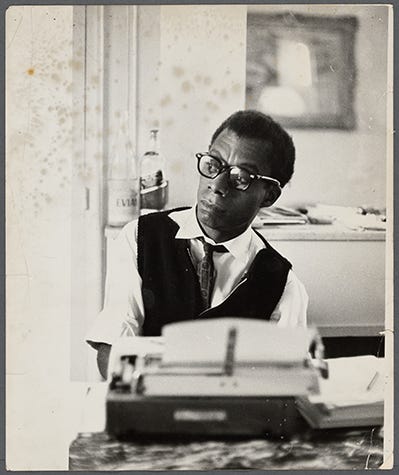
James Baldwin describes the same blindness in The Fire Next Time, in the letter he wrote to his fourteen-year-old nephew:
[White people] have had to believe for many years, and for innumerable reasons, that black men are inferior to white men. Many of them, indeed, know better, but, as you will discover, people find it very difficult to act on what they know. To act is to be committed, and to be committed is to be in danger. In this case, the danger, in the minds of most white Americans, is the loss of their identity. Try to imagine how you would feel if you woke up one morning to find the sun shining and all the stars aflame. You would be frightened because it is out of the order of nature. Any upheaval in the universe is terrifying because it so profoundly attacks one’s sense of one’s own reality.
Baldwin’s writing about race, about people who refuse to know certain things to hold onto their identity. Sometimes that refusal is willful. More often, it’s passive. My mother didn’t know what she was handing me when she named me after Kipling. The English syllabi that shaped me worked the same way. Nobody at my prep school decided to leave out queer writers and living writers of color. The absence didn’t register as a decision. It just looked like literature to them—what they’d always been told were the classics, as if the canon were fixed. Which meant I sat inside that partial picture of myself for years, mistaking what I’d been shown for the whole of it.
That’s what gets me about Baldwin’s image of the stars. There’s a dry joke buried in it: the stars are burning all the time, day and night, whether we’re looking or not. The only thing “out of order” is what people are willing to see. A syllabus works the same way—what’s missing from it doesn’t advertise itself as missing. Those texts are out there, stars burning in daylight. Nobody’s taught to look.
This kind of research is hardest for people whose upbringing gave them a strong sense of security and belonging. If the world you grew up in made you feel safe and certain of your place in it, then tugging at the edges of that worldview risks real disillusionment, and it will feel like loss before anything else. I can tell you that mine eventually felt less like loss and more like a chance to clean house, to rearrange the furniture and make room for ideas that hadn’t been let in the door before. But you go through the loss first. You can’t write honestly about a community you haven’t first examined your own relationship to.
So before the reading list, before the interviews, before you book a sensitivity reader, sit with a few questions. What stories did you grow up with? Who did they put at the center, and who did they leave out? What did you absorb so early in life that it still feels like a fact rather than an inheritance?
That’s where the research has to start.
Thanks for reading THE TWISTED PLOT: Notes from a Mystery Author! This post is public, so feel free to share it.
Comments
Nothing yet. Say the first thing.
Sign in to join the conversation.